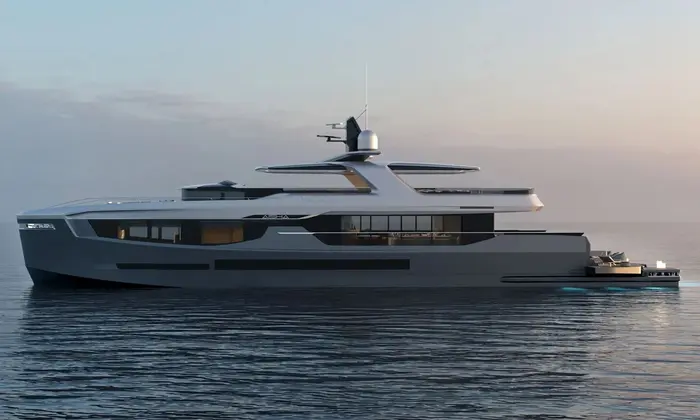
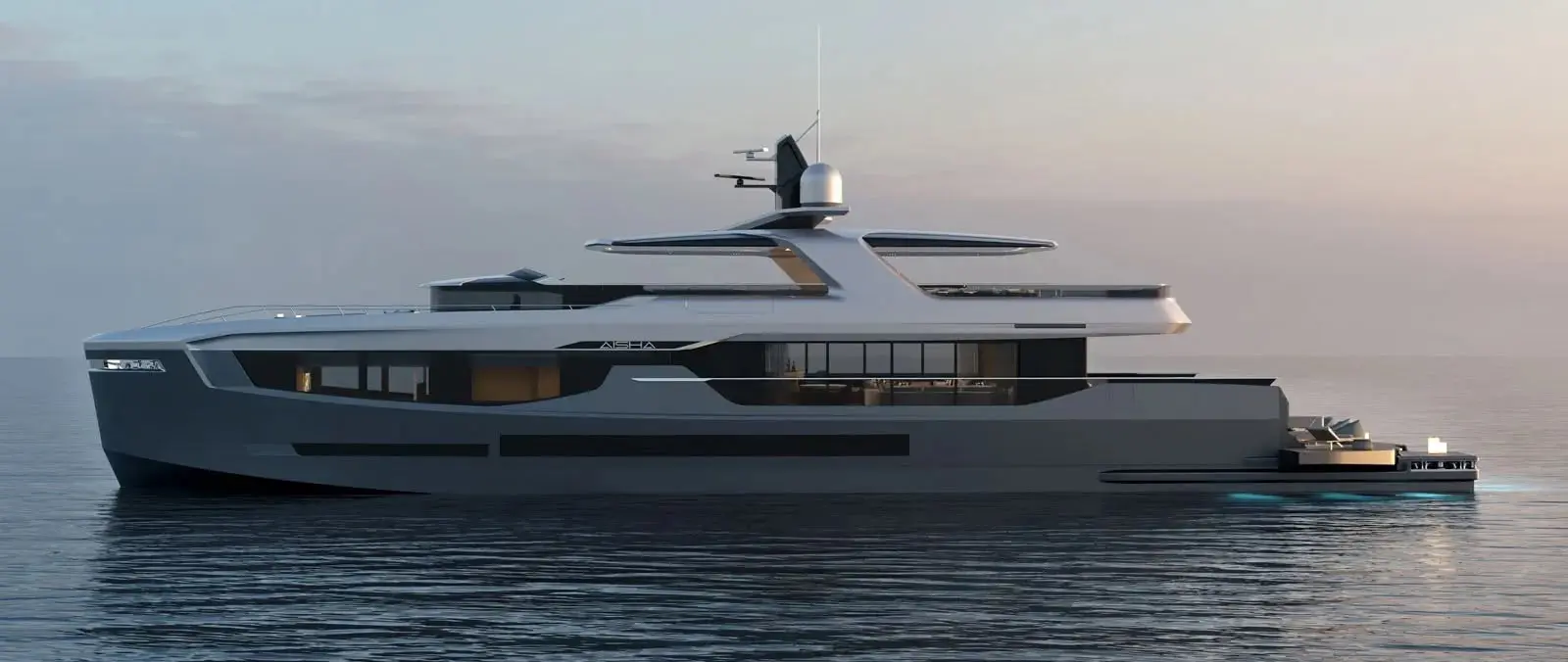
The delivery of the 40.8-metre Aisha is more than the completion of another custom yacht in Turkey’s increasingly productive superyacht sector.
For Anadolu Shipyard, the project represents a move from a background dominated by commercial vessels, military ships and complex naval programmes into a market where engineering capability must be combined with luxury, personalisation and the expectations of a private owner.
Aisha was delivered following her launch in March 2026. Built entirely in aluminium, the raised-pilothouse yacht was designed around generous family accommodation, large exterior spaces and comparatively strong performance for a yacht of her volume.
The result is not a naval vessel softened into a yacht. Aisha is recognisably a contemporary private superyacht, with exterior and interior design by Red Yacht Design, naval architecture developed with Notilus Engineering and project management by Eureka Yachts. Yet beneath that owner-focused design is a shipyard accustomed to delivering vessels in which systems integration, structural discipline and reliability are fundamental rather than optional.
Anadolu Shipyard traces its origins to the 1950s, when it was established as a family-owned commercial shipyard. Over time, the yard moved increasingly towards naval platforms and became a builder of sophisticated amphibious, auxiliary and combat-support vessels.
Its completed projects include the Turkish Navy’s TCG Bayraktar and TCG Sancaktar, which Anadolu describes as among the navy’s largest and most advanced amphibious command ships. The yard says that, since 2008, it has delivered 20 naval platforms to the Turkish Navy and six to the Qatar Emiri Naval Forces, all reportedly completed on schedule.
That background matters because large custom yachts are becoming increasingly complex ships.
They require detailed weight management, electrical and mechanical integration, noise and vibration control, regulatory compliance, redundancy and coordination between hundreds of suppliers and subcontractors. The finishes may be different from those found aboard a naval vessel, but the underlying project-management challenge remains recognisably maritime.
The delivery of Aisha therefore demonstrates how a yard with experience in commercial and naval construction can redirect part of that capability towards a private yacht without attempting to imitate the production model of a traditional luxury-yacht builder.
Aisha was developed for a private owner through a design process lasting approximately nine months. Red Yacht Design worked closely with the owner and the shipyard to create a yacht that could combine extensive interior volume with the performance and seakeeping expected from an aluminium hull.
The decision to use aluminium throughout the hull and superstructure was central to that compromise. A heavier structure could have provided volume more easily, but aluminium allowed the project team to retain a relatively light and responsive yacht while accommodating the broad beam and substantial living spaces required by the owner.
Red Yacht Design adopted a raised-pilothouse layout, giving Aisha a long, clean profile while freeing more of the main deck for owner and guest use. Her beam of approximately 9.1 metres is unusually generous for a yacht in this size range and contributes directly to the volume of the saloon, master suite and guest accommodation.
The main saloon covers approximately 60 square metres and includes a large seating area, a breakfast or games table and a bar. A tilting window maintains a visual connection with the galley, reflecting an owner who intends to use the yacht as a family environment rather than treating the galley and service areas as completely separate from guest life.
The full-beam owner’s suite is positioned on the main deck and includes office space and separate bathroom areas. Guest accommodation on the lower deck consists of two double cabins and two convertible twin cabins with additional Pullman berths, allowing the yacht to accommodate as many as ten guests. Crew accommodation is arranged for up to eight.
Military shipbuilding does not automatically make a yard capable of producing a successful superyacht. Owners judge a yacht by silence, comfort, finish quality, spatial planning and emotional appeal, qualities that are rarely the primary focus of a naval contract.
However, naval and commercial work can provide a strong technical foundation.
A shipyard used to military programmes must manage strict specifications, extensive documentation, system redundancy, quality assurance and complex commissioning. It must also coordinate equipment from numerous specialist suppliers while maintaining control over weight, access, maintenance and future serviceability.
Those disciplines are increasingly relevant as superyachts incorporate more hotel systems, communications equipment, automation, stabilisation, environmental technology and specialised owner equipment.
In Aisha’s case, the luxury and lifestyle elements were led by Red Yacht Design, while Notilus Engineering contributed to naval architecture and Eureka Yachts represented the project-management structure. This division allowed Anadolu to concentrate on construction and integration while specialist yacht teams protected the owner’s design and operational requirements.
The important point is not that a naval shipyard can simply replace a conventional yacht builder. It is that a suitably assembled design and management team can allow heavy maritime expertise to support, rather than dominate, a bespoke yacht project.
Aisha’s all-aluminium construction was intended to maintain performance despite her broad beam and substantial accommodation.
Red Yacht Design lists a maximum speed of 19 knots, powered by two MAN engines rated at approximately 1,450 hp each. The designer also reports a range of around 1,500 nautical miles.
These figures position Aisha as a fast-displacement family yacht rather than a long-range explorer. Her role is not to cross oceans at highly economical speeds, but to combine generous living spaces with the ability to move efficiently between Mediterranean destinations.
That operating profile is reflected in the yacht’s layout. The emphasis is on social spaces, flexible cabins and prolonged family use rather than oversized tender garages, expedition equipment or overtly commercial styling.
The yacht’s proportions also demonstrate how custom projects around 40 metres are being asked to provide amenities and interior volumes previously associated with much larger vessels. The engineering challenge is to create that space without producing excessive displacement, compromised appearance or disappointing performance.
Anadolu’s entry into custom yachting follows a pattern already visible elsewhere in Turkey.
The country’s shipbuilding sector includes yards with backgrounds in commercial vessels, offshore construction, naval craft and industrial engineering. Some are now applying that capacity to one-off yachts, explorer vessels and larger private projects.
This route differs from the traditional European model in which a specialist yacht builder gradually increases the size and complexity of its products. A commercial or naval yard begins with heavy engineering, construction space and systems capability, then adds yacht design, interiors and owner representation through external specialists.
The advantage can be access to substantial infrastructure and an experienced shipbuilding workforce. The challenge is developing the culture of detail, responsiveness and finish expected by private owners.
Aisha suggests that Anadolu approached that challenge by assembling an experienced yacht-specific team around the project rather than attempting to perform every discipline internally.
Red Yacht Design shaped the yacht’s exterior, interior and owner experience. Notilus Engineering supported the naval architecture, while Eureka Yachts managed the project on the owner’s behalf. Anadolu supplied the construction environment and maritime engineering discipline.
One delivery does not by itself establish Anadolu as a major custom-yacht builder.
The real measure will be whether Aisha performs reliably in service, whether her interior and technical systems meet the owner’s expectations and whether the yard uses the experience to secure further private commissions.
Nevertheless, the project gives Anadolu a completed reference yacht in a highly competitive size segment. It also shows prospective owners that the yard can work with established designers, naval architects and project managers while adapting its construction processes to a fully bespoke private yacht.
For Turkey’s wider yacht-building industry, Aisha reinforces the value of its broader maritime base. The country’s ability to produce commercial and naval ships provides engineering capacity that can be redirected towards increasingly ambitious superyachts when the right design, management and quality-control structure is in place.
Aisha may therefore be remembered not only as a 40.8-metre custom yacht delivered in 2026, but as evidence that the division between specialist yacht yards and larger industrial shipbuilders is becoming less rigid.
Anadolu Shipyard has not abandoned its naval identity. Instead, it has demonstrated that the engineering disciplines developed for demanding commercial and military projects can become part of a very different product: a quiet, personal and family-focused superyacht.
Explore
Go deeper into the yachts, companies, events and destinations directly connected to this article.
Continue reading
The 54m Mangusta GranSport 54 BETSY has been delivered following a three-year construction project represented by MarineMax. The fifth hull in the series was …
Orion Yachts has delivered the 44-metre Orion One, marking the first completed superyacht from the shipyard. The project combines exterior and interior design by …
Numarine has delivered the 30th and final 26XP explorer yacht, closing a production run that became central to the Turkish builder's compact explorer range. …
Turkish builder Dearsan has delivered the 50.2-metre Queen Yaz, completing its new flagship superyacht with design by Red Yacht Design and naval architecture by …
Superyacht Guide
Continue into the wider Superyacht Guide.