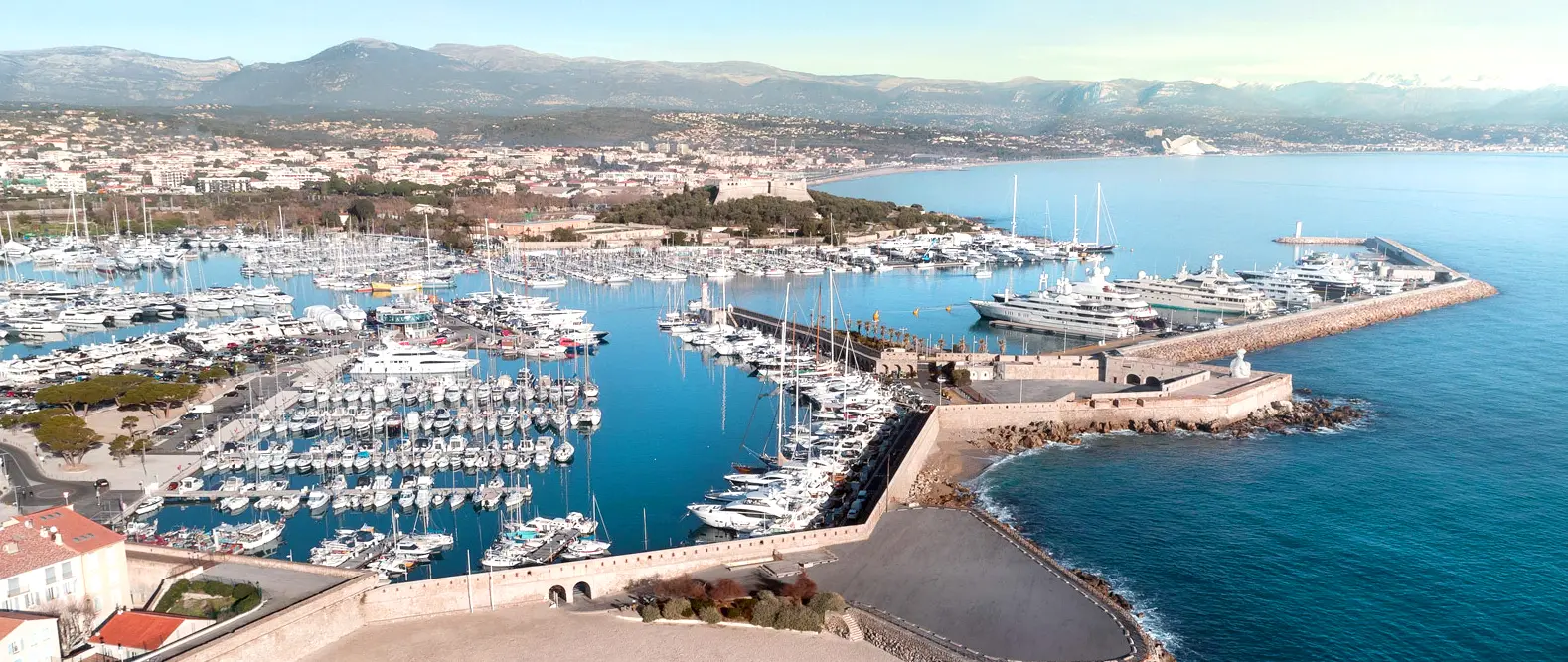
Antibes remains one of the Mediterranean's most practical superyacht bases, led by Port Vauban and the IYCA's capacity for yachts up to 160 metres. This 2026 guide compares Port Vauban with Port Gallice and nearby Port Canto for owners, captains and crew planning a Riviera berth.
Antibes has been one of the defining addresses of Mediterranean yachting for decades, combining a large professional marina, a dense yacht-service economy and immediate access to the French Riviera cruising grounds. Port Vauban is the centre of that ecosystem, but berth planning changes considerably with yacht size, making Port Gallice in Juan-les-Pins and nearby Port Canto in Cannes useful alternatives for some superyachts.
Port Vauban combines the scale of a major Mediterranean marina with a position directly beside the historic centre of Antibes. The current port operator lists 1,500 berths across the marina, while its dedicated International Yacht Club d'Antibes area provides the large-yacht infrastructure that has made Antibes particularly important to the superyacht fleet.
The marina's history is part of its identity, but the modern Port Vauban is not simply an old harbour filled with large yachts. A long-term transformation programme has been modernising infrastructure and services, while preserving the relationship between the port, the Antibes ramparts, Fort Carré and the old town that makes the location distinctive on the Riviera.
The International Yacht Club d'Antibes occupies the large-yacht area associated with the Quai Camille Rayon, historically known as the Billionaires' Quay. Port Vauban's current information describes 18 IYCA berths for superyachts up to 160 metres, giving Antibes capacity at a scale that few nearby marinas can match.
The value of the IYCA is not only berth length. The modernised area includes controlled private access, concierge support, VIP pontoons and technical spaces, while the dedicated Crew Center provides a lounge, fitness facilities, a gym and changing areas for yacht crews spending extended periods in port.
A marina becomes a useful home port only when the shore-side infrastructure works as well as the berth itself. Antibes has developed around yachting for decades, so captains can draw on engineering, maintenance, provisioning, crew, agency and professional services without treating every technical requirement as a special project.
Port Vauban also sits in a strategically useful part of the Côte d'Azur. The port operator positions Antibes between Monaco and Saint-Tropez, while Nice Côte d'Azur Airport provides the principal international air gateway for owners, guests and crew joining yachts based in the area.
Across the Cap d'Antibes area, Port Gallice provides a very different marina environment at the entrance to Juan-les-Pins. Its current operator states that the port accommodates yachts up to 43 metres, placing it firmly within the range of smaller superyachts while making it unsuitable for the larger 50m, 70m and 100m-plus vessels that Port Vauban can receive.
For a yacht in the 24m to low-40m range, that difference can be an advantage rather than a limitation. Port Gallice gives owners and guests a position close to Cap d'Antibes and Juan-les-Pins, while the yacht remains within the same wider Antibes service and cruising area.
When an Antibes berth is unavailable or the yacht's programme is centred farther west, Port Pierre Canto in Cannes becomes an important nearby alternative. The City of Cannes currently lists 553 berths at Port Canto with capacity for vessels up to 90 metres and a published draught range extending to seven metres.
That gives Port Canto a useful position between the smaller-yacht scale of Port Gallice and the very-large-yacht capacity of the IYCA. The port operates with 24-hour reception and sits on the Croisette facing the Lérins Islands, making it particularly relevant for yachts whose owners or guests are spending time in Cannes.
Length is only the first filter because beam, draught, power requirements, berth geometry and actual availability must all be confirmed with the harbour master. Even so, the published size limits provide a practical first-pass guide when a captain or management team is comparing the Antibes and Cannes area.
Those figures should never be treated as an automatic berth entitlement. A yacht close to a marina's maximum length can still be unsuitable because of draught, beam, power demand or berth configuration, and temporary availability can be more restrictive than the theoretical maximum size.
The French Riviera concentrates owners, charter yachts, brokerage activity and major events into a relatively short summer season. A yacht that needs a particular berth size in Antibes or Cannes should therefore treat reservation planning as part of the cruising programme rather than waiting until the vessel reaches the coast.
Port Vauban operates on VHF channel 9 and provides dedicated commercial contacts for berth enquiries, while Port Gallice and Port Canto also provide direct reservation channels. For larger yachts, the sensible approach is to confirm length, beam, draught, shore-power requirements, arrival window and expected length of stay in one request so the marina can assess the berth properly.
Antibes is especially valuable because it functions as a working yacht base outside the peak guest season. Crew facilities, technical support and a large resident yachting community make the port relevant for winter periods, maintenance preparation and crew continuity as well as high-season owner cruising.
The IYCA's crew facilities reinforce that year-round role, while Port Vauban's continuing modernisation is intended to support both ordinary yachting and international superyachting. For a captain choosing between a short glamorous stop and a practical operational base, that distinction is important.
Antibes should not be viewed in isolation from the rest of the Côte d'Azur. Port Vauban, Port Gallice and Port Canto serve different parts of the fleet, and their proximity means a yacht can base in one marina while owners, guests or operational activity are focused elsewhere along the coast.
For the largest superyachts, Port Vauban's IYCA capacity remains the defining advantage. For smaller vessels, the choice broadens considerably, and the best berth may depend as much on the owner's itinerary, crew requirements and shore-side programme as on the marina's maximum published length.
For a yacht management team, the practical decision starts with dimensions and operational requirements rather than reputation alone. Port Vauban offers the broadest range and the strongest very-large-yacht capability, Port Gallice gives smaller superyachts a Cap d'Antibes and Juan-les-Pins option, and Port Canto extends the available large-yacht network toward Cannes.
The published limits are useful for planning, but the final decision belongs with the current berth offer from the marina. Captains should confirm availability and technical compatibility directly before committing the yacht's itinerary, particularly for large vessels travelling during the busiest Riviera weeks.
Explore
Go deeper into the yachts, companies, events and destinations directly connected to this article.
Continue reading

An IYC and SuperYacht Times panel at Monaco Yacht Show 2026 examined how crew rest, staffing, mental wellbeing and working culture affect the guest …
Yacht Chef Salary 2026: Pay, Tips and Charter Earnings Yacht-chef pay depends on yacht size, private or charter use, professional background, qualifications, rotation and …
Superyacht Crew Tips: How Much Can Crew Earn on Charter? Charter-yacht crew often receive discretionary guest tips, but tips are not guaranteed salary and …
During a charter, the captain has to balance guest expectations with crew capability, rest requirements and a weather picture that can change by the …
Superyacht Guide
Continue into the wider Superyacht Guide.
Business opportunities · Superyacht Guide
Companies serving the superyacht market can discuss clearly identified advertising, sponsorship and business-profile opportunities. Commercial activity remains separate from independent editorial coverage.