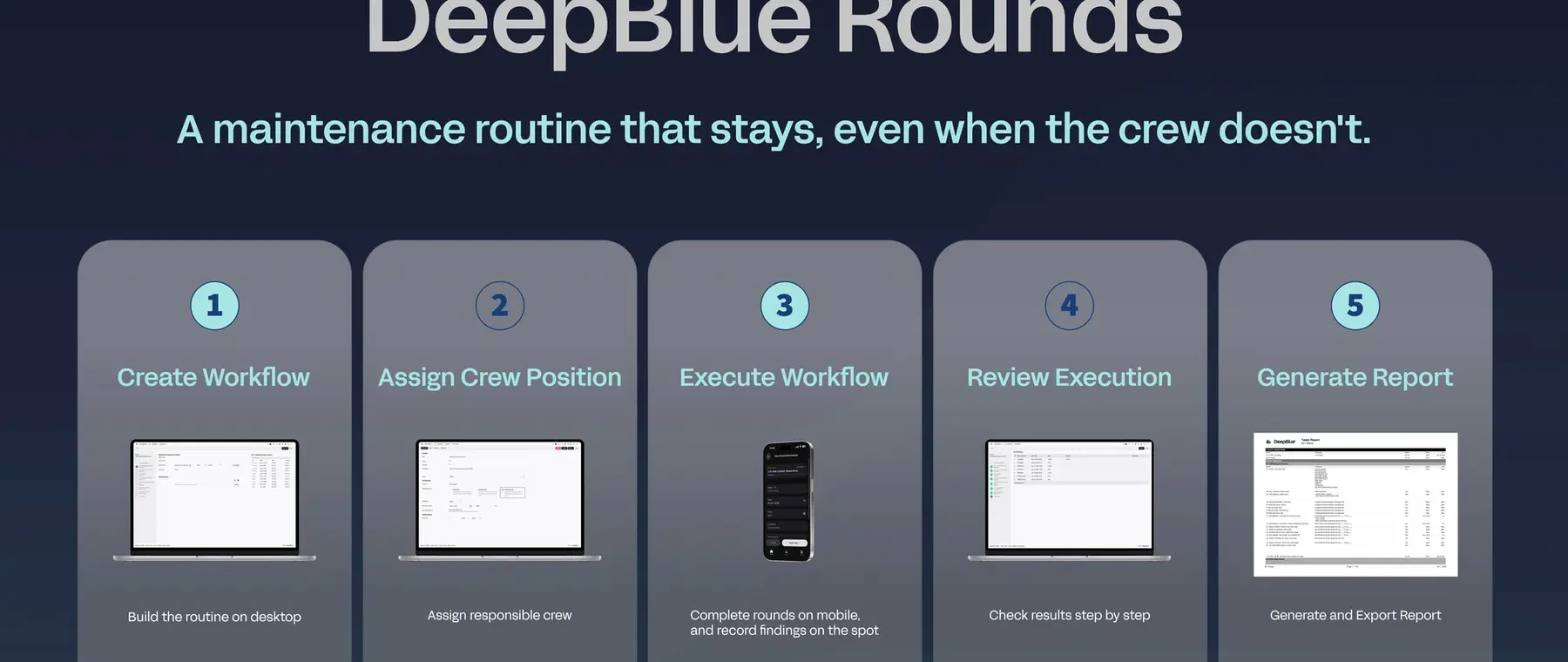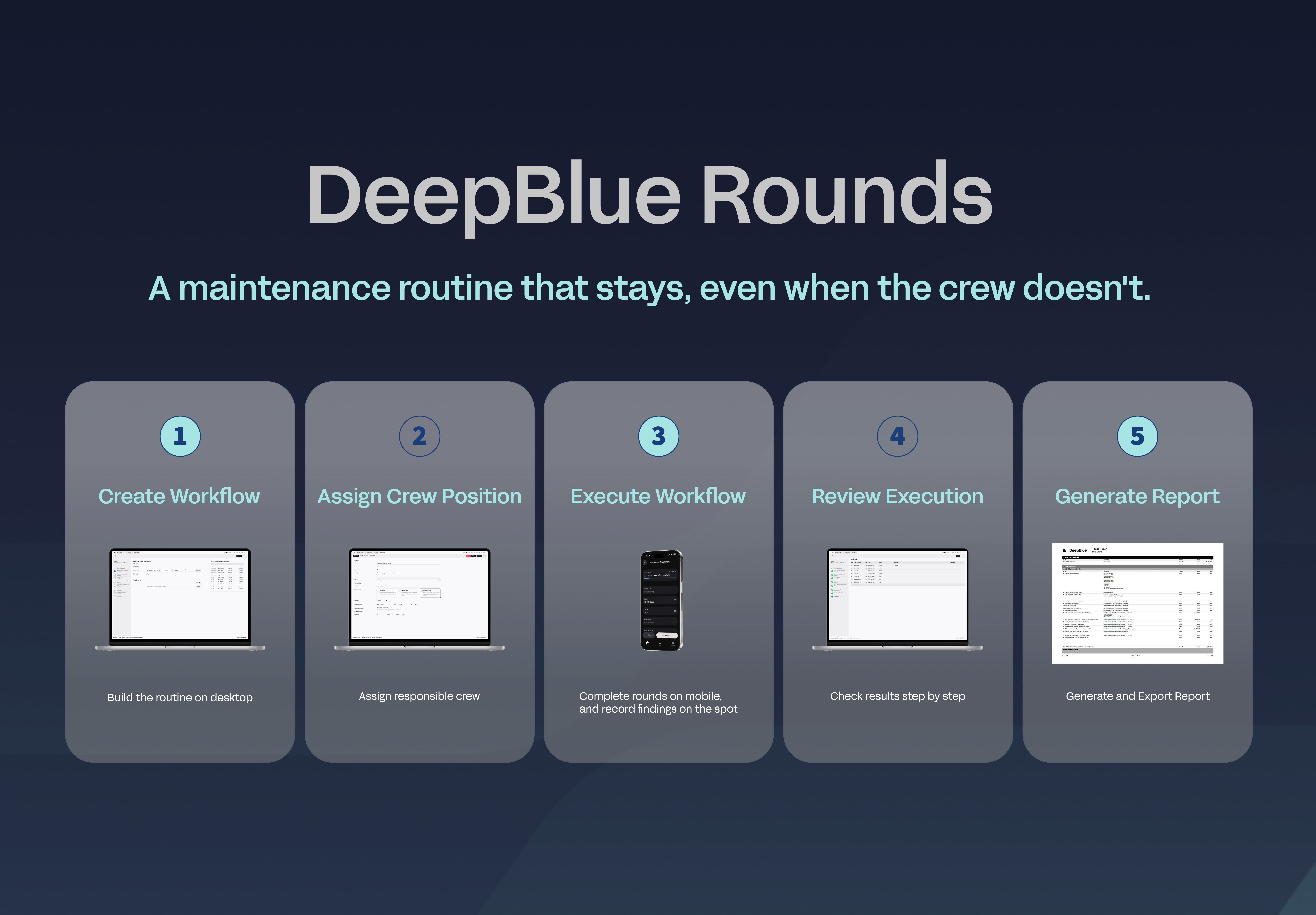
DeepBlue Rounds mobile maintenance workflow, official product interface rendering

News

DeepBlue Adds Mobile Maintenance Rounds to Superyacht Equipment Histories Ahead of METSTRADE

Nov. 13, 2026 Technology

DeepBlue Rounds mobile maintenance workflow, official product interface rendering

DeepBlue introduces Rounds, a mobile inspection workflow linking equipment readings, maintenance checks and follow-up jobs to yacht equipment records.

A new module for a familiar daily operation DeepBlue has introduced Rounds, a mobile workflow for inspections and routine technical checks aboard yachts. The Monaco-based yacht-management software company announced the feature in November 2026 and says it will demonstrate the complete process at METSTRADE in Amsterdam from 17 to 19 November. The premise is straightforward: crew already inspect machinery, deck equipment and safety systems, but the readings and observations they collect may be separated from the planned-maintenance records used to make decisions. Rounds is designed to connect those activities. This is software for yacht operations rather than a change to classification rules or an endorsement by a particular flag state. Its effectiveness will depend on setup, training and how accurately crew use it.

From a list of equipment to an ordered route The workflow begins on desktop, where an authorised user selects equipment from the yacht's existing register and puts the inspection steps into a chosen order. Each step may require a reading, a check or completion of a planned maintenance job. That relationship with named equipment is important. A generic checklist can state that a reading was entered, but a reading attached to an identified pump, main engine or other asset can become part of the history that engineers consult later. DeepBlue says its approach avoids the separate data-entry stage in which handwritten notes or spreadsheets must be transcribed after a round. That can reduce duplication of effort, although it does not eliminate the possibility of an incorrect reading being entered.

Crew carry out the round at the machine Once the route has been created, crew use DeepBlue Mobile on a phone or tablet to follow the scheduled sequence. At a particular item of equipment they can see the reading instruction, the relevant unit and the previous recorded values. DeepBlue says the last ten readings appear beside a new entry. This gives an engineer context while standing in front of the machinery, rather than requiring a return to an office computer before any unusual trend is noticed. Photographs and comments can be attached to the individual step. Good practice still requires the person taking the reading to understand the machinery and the operational limits; software cannot establish whether a gauge is accurate or the equipment is safe to approach.

A built-in check catches one class of data error DeepBlue reports that the mobile interface rejects an engine-running-hours entry lower than the preceding recorded figure. That is a specific data-validation measure, not a promise that every anomalous reading will be detected automatically. It can help avoid a simple transcription mistake in records that should normally rise as equipment runs. Other values may fluctuate legitimately and need engineering interpretation. If two related machines show different temperatures, for example, an engineer must consider load, ambient conditions, instruments and maintenance history before identifying a fault. The benefit of digital rounds is that historical values are more readily available, supporting better questions and faster follow-up rather than replacing professional judgement.

Unplanned work can become a maintenance job immediately The feature allows a crew member who encounters a problem to raise a one-off job against the appropriate equipment while still carrying out the inspection. Alternatively, a planned job can form a step within the round and be marked complete with details such as parts used. This creates a connection between observation and maintenance action, an area where information can otherwise become fragmented. A note scribbled on a sheet and forgotten may never reach the chief engineer's planning queue. A job raised in the equipment register has a clearer place in the maintenance system. The workflow nevertheless needs defined priorities and approval processes so urgent defects are not treated like routine requests.

Scheduling can reflect different operating rhythms According to the company, a round can be carried out on demand, on a rolling interval or against a fixed calendar schedule. Those choices suit different tasks. Some checks may be needed before machinery is operated or after a long passage, while others are due at regular intervals independent of voyage timing. Assignments can be associated with crew positions, and reminders are available. A thoughtful maintenance system should account for changes in a yacht's programme, workload and crewing, particularly where charter turnarounds compress the time available for routine tasks. A digital schedule supports discipline only when responsibilities remain clear and a missed or overdue round prompts an appropriate response.

Revisions provide a record of what was actually required A notable feature is version control. DeepBlue says that once a round is published it becomes locked, with any subsequent change creating a new revision. The completed record therefore identifies the procedure that was in place when crew carried out the inspection. This matters after refits or equipment changes, when the list of machinery and approved operating routines may no longer match the original build specification. A historical record is much harder to interpret if a checklist can be silently rewritten after it was completed. The version approach creates an audit trail, though operators still need a controlled process for reviewing changes and ensuring outdated procedures are no longer used.

Deck and safety teams can use the same structure The company presents Rounds as useful beyond the engine room. Deck departments and safety personnel can organise sequential inspections of the equipment under their responsibility, applying the same principle of recording information against named assets. The requirements differ considerably between a technical plant, a davit or an item of emergency equipment. A sensible implementation therefore begins with appropriate departmental input rather than applying one identical checklist to every asset. For some checks, regulatory and manufacturer's instructions determine the procedure. Software should make those instructions available and help record compliance, but it cannot itself authorise a deviation from applicable technical or safety requirements.

Management receives an exportable record After a round is completed, DeepBlue describes a review process and a step-by-step report showing readings, work, timestamps and supporting comments. The report can be exported as a PDF. Captains and shore-side managers can see whether routines are current or overdue and which crew position carried out the work. Such visibility may help when a yacht changes crew or a management company must review maintenance remotely. However, the possession of a PDF is not the same as a successful survey or proof of mechanical condition. An inspector may also require supporting service documentation, calibration evidence and independent examination. The value of the report is in the quality of the information it records.

Why equipment identity matters during a refit Major refits can change the machinery register substantially. A generator may be replaced, a tender system upgraded or new safety equipment introduced. If routine checks are maintained separately from the asset register, obsolete items can persist in the schedule while new equipment is omitted. DeepBlue's design is intended to make the round draw from the same equipment records used for planned maintenance. That could reduce inconsistencies during technical change, provided the register is updated correctly and the revision process is understood. Owners considering the software should ask how historical records are preserved when equipment is renamed, replaced or removed and who controls changes to the asset register.

An operational tool, not an automatic survey approval Digital evidence can help a yacht demonstrate that checks were planned and performed, but software providers should not be treated as issuing statutory certificates. Class societies and flag administrations may have requirements about maintenance records, machinery surveys and planned-maintenance systems. The relevant standards vary according to the vessel and its regulatory position. DeepBlue has described its wider planned-maintenance platform as class-approved, but buyers should establish precisely which functions and approvals apply to their own yacht. A newly introduced mobile routine does not by itself make a yacht compliant. Operators remain responsible for carrying out work safely and maintaining the records required by their class, flag and company procedures.

What managers should ask in a live demonstration The launch provides practical questions for a chief engineer or fleet manager visiting METSTRADE. Can existing asset data be imported without losing history? How are crew permissions defined? What happens when connectivity is unavailable? Can a supervisor require review of exceptional readings before closing a round? How are photographs stored, exported and protected? Which steps can be amended after a round begins, and what happens if a piece of equipment is temporarily inaccessible? The announcement does not answer every integration or offline-operation question, and answers should not be presumed. A useful demo will show a complete workflow from setting up a routine to finding an earlier reading and generating a maintenance follow-up.

The wider move towards structured onboard data The new module reflects a broader trend in superyacht management: systems that were once separate, such as equipment logs, service schedules and shore-side reports, are being brought together. Integration can reduce manual duplication and allow different departments to work from the same underlying records. Yet a more connected system also places greater importance on cybersecurity, account management and data retention. Operational software may contain information about equipment, crew duties and yacht movements that needs careful protection. The current announcement is about maintenance workflows and does not prove that every data-security question has been resolved. Buyers should examine access controls and contractual data arrangements as part of technical procurement.

The launch before the Amsterdam exhibition DeepBlue plans to demonstrate Rounds at Stand 08.371 during METSTRADE 2026, which runs from 17 to 19 November. The company says the mobile component is included in every licence, while configuration and management remain on desktop. Prospective customers should confirm which packages, support arrangements and setup work their particular fleet requires. For superyacht operators, the news is not a dramatic new piece of machinery but an attempt to make routine engineering work more traceable. If implemented thoughtfully, that may allow engineers to identify issues closer to where they arise and give captains more reliable evidence of the checks being carried out aboard.

**Primary source:** DeepBlue official product announcement, November 2026, and company-authored 3 November release. Official DeepBlue Rounds product imagery; commercial claims attributed to the supplier, not independently tested.

Primary source: DeepBlue official announcement.

Image: DeepBlue official Rounds product-media screenshot; a software interface illustration, not a yacht photograph. Official source image.

Photo licence and source

Image: DeepBlue official Rounds product-media screenshot; a software interface illustration, not a yacht photograph.

Continue reading

All news

Superyacht Guide

Explore the superyacht world

Continue into the wider Superyacht Guide.

Business opportunities · Superyacht Guide

Reach the superyacht industry audience

Companies serving the superyacht market can discuss clearly identified advertising, sponsorship and business-profile opportunities. Commercial activity remains separate from independent editorial coverage.