
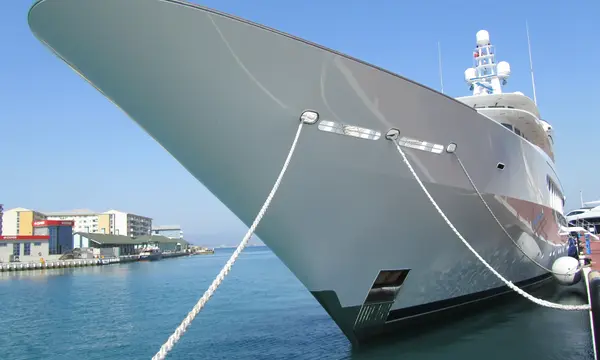
Beijing Convention on judicial sales of ships, official International Maritime Organization photograph

News

EU's Beijing Convention Date Approaches as Superyacht Judicial-Sale Buyers Revisit Title Risks

Nov. 13, 2026 Legal

Beijing Convention on judicial sales of ships, official International Maritime Organization photograph

The Beijing Convention on judicial sales of ships takes effect for the European Union on 15 December 2026, adding a treaty framework for cross-border title recognition.

A December date owners and advisers should understand The United Nations Convention on the International Effects of Judicial Sales of Ships, widely known as the Beijing Convention, will enter into force for the European Union on 15 December 2026. The date follows the European Union's approval of the treaty on 18 June 2026, confirmed by the United Nations Commission on International Trade Law. As that deadline approaches, the convention deserves attention from superyacht buyers, lenders and legal advisers dealing with judicial or administrative sales. It is intended to reduce uncertainty about whether a court-supervised sale recognised in one participating jurisdiction will be accepted elsewhere. The framework does not replace ordinary due diligence or establish that every yacht sale anywhere in the world will automatically convey clean title.

The convention is already in force internationally The Beijing Convention entered into force internationally on 17 February 2026 after the necessary ratifications. The European Union's own application date is later, on 15 December, following its approval and the applicable treaty timetable. It is important not to confuse these dates or suggest that the entire international convention is only beginning in December. Panama's entry into force followed in September 2026, demonstrating that different participants may acquire treaty obligations on different dates. The authoritative treaty-status table maintained by UNCITRAL distinguishes signatures from ratifications or approvals, and sets out when entry into force applies to each participant. A state signing a convention is not necessarily equivalent to its being bound by every substantive provision.

Why a judicial sale is different from a normal brokerage sale Most yacht transactions involve an owner voluntarily selling a vessel under negotiated contractual terms. A judicial sale, by contrast, takes place under the authority of a court or comparable legal process, often in connection with debts or enforcement. A buyer may be concerned that creditors, mortgage holders or other claimants could subsequently seek to assert rights over the ship in another country. The Beijing Convention seeks to address that cross-border uncertainty for qualifying sales. It is not a consumer protection law for all second-hand boats, a universal refund scheme or a regulation dictating how brokers should advertise yachts. The nature of the sale and the legal authority conducting it are fundamental to determining whether the treaty is relevant.

The concept of a clean title The International Maritime Organization describes the treaty as creating a mechanism for recognising qualifying judicial sales across participating jurisdictions, so a purchaser can obtain title free from previous claims and interests in the vessel. In practice, this can be valuable where a superyacht has a complicated financial history. A purchaser who has paid a substantial sum at a court-supervised sale needs confidence that a claim arising from an earlier owner will not simply follow the yacht into another jurisdiction. Yet the words clean title should not be treated as a blanket warranty against every risk. Buyers must establish that the sale qualifies under the treaty, the appropriate documentation is issued and any exceptions or other legal considerations are addressed.

The legal conditions are important The convention applies to judicial sales conducted in a participating state when the vessel is physically within that state's territory at the time of sale, subject to the treaty's definitions and requirements. It also addresses circumstances in which interested parties must receive notice before the sale. Those details are not bureaucratic formalities: they help explain why the framework is designed to provide international recognition without undermining basic procedural safeguards. A sale arranged privately, or a transaction conducted in a jurisdiction outside the relevant treaty relationships, may require a different legal assessment. Buyers should never assume that the presence of a court order alone guarantees the treaty's consequences in every port they intend to visit.

Notices and certificates form the documentary backbone The treaty envisages official notices of judicial sale and certificates issued under the prescribed process. The International Maritime Organization has a role in making those documents available through its Global Integrated Shipping Information System, or GISIS, for users who need to assess the status of a transaction. The idea is to reduce the risk that potential buyers and interested parties must reconstruct a judicial history from fragmented local records. The documentary system does not abolish the need for lawyers, surveyors or registration checks. It provides a more standardised way of evidencing that a qualifying sale has taken place and that the buyer should receive the convention's protections across participating jurisdictions.

A European Union approval is not the same as every national law changing overnight The European Union participated in the convention as a regional economic integration organisation and submitted a declaration identifying the areas in which competence has been transferred by member states. The legal effect of that participation must be understood within the relevant division of powers and national legal procedures. It would be misleading to claim that all European registration, mortgage and enforcement systems become identical on 15 December. Owners may still face different procedural requirements when dealing with local courts, registries or maritime authorities. Advice needs to account for the particular member state, flag, location of the sale and legal structure under which ownership is held.

Why superyachts can present unusually complicated cases Large yachts may have substantial secured lending, complex corporate ownership, multiple service claims and operating histories spanning several countries. A vessel may be flagged in one jurisdiction, physically located in a second and financed or managed by entities established elsewhere. Those connections can make a forced sale legally demanding. The Beijing Convention addresses one particular source of uncertainty: the international effects of a qualifying judicial sale. It does not resolve every dispute about corporate ownership, beneficial interests, tax liabilities or alleged wrongdoing. Buyers and financiers should distinguish what a sale certificate can establish from other matters that require independent investigation before committing funds.

The impact on bidding and valuations is not yet established Greater legal certainty can make a judicial sale more attractive to potential buyers, but the treaty does not guarantee higher hammer prices. Yacht valuations depend on condition, specification, market conditions, maintenance history, access for inspection and the circumstances of sale. Distressed vessels may require costly work, while a time-limited sale can reduce the number of bidders prepared to participate. Industry commentators have noted significant discounts in several high-profile government or court-related yacht disposals, but those outcomes cannot be attributed to a single legal factor. A responsible report should avoid predicting that the European entry-into-force date will cause yacht prices to rise by a particular percentage. No such reliable market estimate is provided by UNCITRAL.

Purchasers still need technical due diligence A treaty concerning title cannot confirm that a yacht is seaworthy, that machinery is in good condition or that all service records are complete. Surveying a complex superyacht may involve class status, flag requirements, engines, safety systems, hull condition and specialist equipment such as helicopter facilities or submersibles. Access and inspection rights can be limited during some judicial processes. A buyer needs to understand those constraints and plan accordingly. The presence of a potentially clearer legal transfer mechanism may reduce one category of risk while leaving technical and operational liabilities untouched. Sound decisions require legal and engineering expertise working together, not one specialist attempting to address every issue.

Lenders and insurers will examine recognition across borders Banks financing yacht purchases may have an interest in the enforceability of security interests and the circumstances in which a previous mortgage or lien is extinguished. Insurers and other market participants may similarly consider the documentation available after a judicial sale. The convention's purpose is to create more predictable cross-border effects, but individual contractual and underwriting requirements remain. It would be premature to promise a reduction in insurance premiums or financing costs from the December date alone. Stakeholders should review the treaty's provisions with their advisers and the relevant institutions. The critical question is how recognition works in the particular jurisdictions involved in an actual transaction.

Registration and flag questions remain practical issues A vessel bought through a judicial sale may need to change ownership records, flag or registration details before continuing normal operations. The convention contains provisions relevant to recognition and registration, but local registry procedures and documentation checks may still apply. Buyers should identify these requirements early, particularly if a yacht needs to leave a port quickly after sale. Questions about crew contracts, operating permissions or customs status may also arise separately. An owner should not assume that a judicial-sale certificate solves unrelated operational matters. A careful closing plan includes a timetable for documents, surveys, insurance and any immediate technical work required before the yacht moves.

How Malta fits into the international picture Malta appears among the jurisdictions that signed the convention in June 2024. The UNCITRAL status page should be checked for the latest ratification or approval details rather than treating signature as proof that Malta has independently become a contracting state. The EU's participation creates an additional legal dimension, with specific competence declarations attached to its approval. This is especially relevant to advisers working with Malta-flagged or Malta-managed superyachts, but the legal outcome in an individual case will depend on more than a flag name. Clients should seek advice qualified in the applicable national, European and maritime legal frameworks before making any assumption about title or enforcement.

A framework that aims to improve confidence without eliminating risk The approaching 15 December date is an important stage in the convention's adoption, not a revolutionary change to every yacht transaction. A qualifying sale may benefit from more predictable cross-border recognition, potentially making an otherwise uncertain purchase easier to assess. The actual benefit will depend on how courts, registries, creditors and purchasers use the system. For Superyacht Guide readers, the practical message is to begin reviewing procedures and documentation before a forced-sale opportunity arises. An owner looking at a yacht offered through judicial proceedings should ask a maritime lawyer whether the convention applies and what evidence will be needed for subsequent registration and operation.

**Primary sources:** UNCITRAL, European Union approval notice (22 June 2026), and the treaty-status table; IMO commentary on international entry into force (17 February 2026). Image: official IMO photograph accompanying its February 2026 Beijing Convention coverage; not an image from a December event. This article is general reporting, not legal advice.

Primary source: United Nations UNCITRAL official convention notice.

Photo: International Maritime Organization official Beijing Convention coverage, February 2026; not a December event photo. Official source image.

Photo licence and source

Photo: International Maritime Organization official Beijing Convention coverage, February 2026; not a December event photo.

Continue reading

All news

Superyacht Guide

Explore the superyacht world

Continue into the wider Superyacht Guide.

Business opportunities · Superyacht Guide

Reach the superyacht industry audience

Companies serving the superyacht market can discuss clearly identified advertising, sponsorship and business-profile opportunities. Commercial activity remains separate from independent editorial coverage.