53.5m Admiral Silvia Delivered After Custom Hybrid Build
The Italian Sea Group's 53.5-metre Admiral Silvia has reportedly been delivered, bringing a heavily customised Panorama-series yacht with an aluminium hull and hybrid hotel …
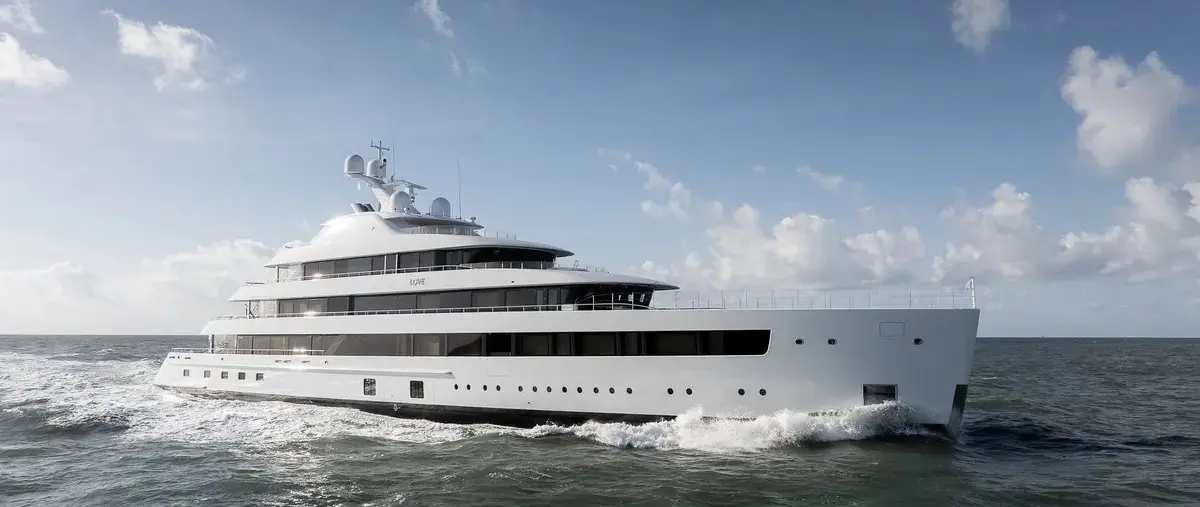
© Feadship. Original builder fleet photograph of motor yacht LOVE, delivered 2026.
Feadship confirms the delivery of 79.75-metre motor yacht LOVE, hull 716, listing her Studio De Voogt exterior, Sinot interiors and integrated diesel-electric FAED propulsion.
Feadship has listed the 79.75-metre motor yacht LOVE as a delivered vessel in its official fleet, confirming that hull 716 joined the Dutch custom builder's completed yachts in 2026. The update places a finished, nearly 80-metre project into the public record with its final name, principal dimensions, design credits and unusually detailed propulsion information. For the superyacht industry, the distinction between a photographed launch, sea trials and a confirmed delivery is important: the builder's fleet entry now identifies LOVE as delivered.
Independent industry reporting dated 25 November 2026 states that the yacht left IJmuiden in the Netherlands on 22 November and reached Portsmouth in the United Kingdom the following day. Feadship's own public record confirms the 2026 delivery but does not publish that precise voyage timetable. This report therefore treats the delivery status and model specifications as manufacturer-confirmed facts, while keeping the timing of the reported movement attributed separately. It does not infer a buyer's identity, ownership structure or intended cruising itinerary.
Feadship identifies the vessel as hull number 716, with an overall length of 79.75 metres, or 261 feet 7 inches. The final name LOVE is now shown alongside a set of current yacht photographs. That is a more definitive identification than the temporary project numbers commonly used before a custom yacht enters service. It also allows readers to distinguish this yacht from other vessels whose names include the word “love” or that belong to earlier Feadship construction programmes.
The builder's current presentation focuses on the yacht's exterior profile and electrical architecture, rather than circulating unconfirmed deck plans or stories about the owner. The photographs show a clean white profile, a broad superstructure and an emphatic forward bridge section. What is publicly known is enough to examine the vessel as a piece of contemporary custom shipbuilding, without pretending that a complete interior inventory or a private owner's specification is in the public domain.
Feadship credits Studio De Voogt with LOVE's exterior design. The builder describes forward-leaning curved bridge windows, an elegantly formed sun deck funnel and long, uninterrupted exterior lines. The visual effect is restrained rather than dominated by overtly theatrical features. The profile is meant to emphasise the yacht's length and preserve the sense of one coherent object, despite the practical demands of several substantial decks.
That appearance must also serve real functions. Window geometry influences views from the bridge, while the shapes surrounding decks and equipment affect how a yacht appears both underway and at anchor. Exterior design on this scale is not independent of structure or service access. Feadship's announcement provides design attribution and an architectural description; it does not provide wind-tunnel data, exact glazing performance or detailed engineering drawings. Those should not be invented to make the design seem more technically complete.
Feadship De Voogt Naval Architects is named as LOVE's naval architect. This role is separate from the exterior's styling and from the interior design. Naval architects must coordinate the vessel's hull form, hydrostatics, stability, structural demands and the integration of a propulsion solution that fits the yacht's intended service. The public specification does not publish all of the calculations or class documents, but it confirms the organisation entrusted with that central engineering responsibility.
On a vessel of almost 80 metres, the relationship between exterior ambitions and naval architecture becomes particularly complex. Large windows, long deck spans, a multi-level layout and a specialised drive train all need to coexist with the requirements of safety and operation. A custom project depends on these decisions being resolved as an integrated design. This is context for how such yachts are developed, not an assertion that LOVE has achieved a particular efficiency or stability result in independent tests.
For the interior, Feadship names Sinot Yacht Architecture & Design. That brings a separate creative practice into the same project while preserving a clear division of responsibilities: Studio De Voogt for the exterior, Feadship De Voogt Naval Architects for naval architecture and Sinot for the interior. Public disclosure of a design team is relevant because bespoke superyachts are often built through long-standing collaborations between yards, architects, interior designers, suppliers and owner representatives.
Feadship's fleet entry does not publish a complete room-by-room interior tour. It would therefore be misleading to describe a specific cinema, private spa, beach-club treatment room or collection of artworks as confirmed features of LOVE. The involvement of Sinot tells readers who developed the interior architecture and atmosphere, but not the final identity of every private space. A later authorised interior release, if one occurs, would be the appropriate basis for a more detailed account.
The manufacturer gives LOVE a beam of 13.50 metres and a draught of 3.55 metres. The beam is an important part of understanding how much space a 79.75-metre yacht can distribute across its decks. At the same time, draught and the overall length are directly relevant to the practical choices available to the captain when considering ports, anchorages and approaches.
Those figures do not establish that a particular marina berth or anchorage can accommodate her without further checks. Safe entry depends on actual depths, tidal conditions, local restrictions, manoeuvring room and the yacht's condition at the time. Owners and captains of large vessels must make those assessments using official navigational information and the vessel's operational documents. The technical specifications provide a useful starting point, not a substitute for route planning.
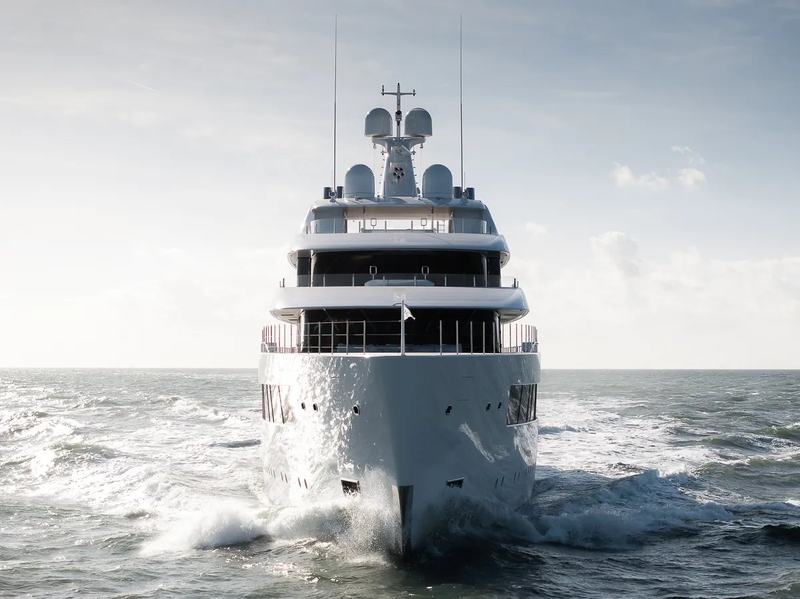
Second original manufacturer image of the delivered 79.75m LOVE, hull 716. © Feadship. It illustrates the completed yacht rather than an independently observed sea-trial result.
One of the strongest features in Feadship's description is the use of Feadship Advanced Electrical Drive, or FAED. The builder characterises this as an integrated diesel-electric propulsion architecture intended to support quieter operation, improved efficiency and onboard comfort. Rather than describing a conventional direct mechanical path from a diesel engine to a propeller, the published configuration identifies a generation and drive system managed as an electrical installation.
It is important to be precise about what that means. “Diesel-electric” does not mean that the yacht is powered solely by batteries or produces no exhaust emissions while operating. Diesel generators still provide energy when required, and the energy source, operating profile and management strategy determine actual fuel use and emissions. Feadship describes benefits of FAED for this vessel; the public entry does not publish a verified life-cycle emissions analysis or comparable fuel-consumption trial against a specific conventional yacht.
The official specification names two VETH CR-1550i units, each associated with an output figure of 1,855 kilowatts at 750 revolutions per minute. Veth equipment is central to the yacht's propulsive arrangement, and the precise integration of electrical power and underwater propulsion is a meaningful part of this project. The builder lists those units under its propulsion information, rather than providing a simple pair of traditional diesel engine models with directly coupled shafts.
The nominal power ratings should be read as equipment specifications, not a guaranteed achieved speed. LOVE's fleet page does not give a top-speed claim, detailed range at a particular cruising speed or an independently verified consumption chart. Any article reporting a precise maximum speed without a traceable source would be inventing an operational result. A proper assessment of performance would require the completed yacht's sea-trial documentation and the relevant operating conditions.
Feadship lists four Caterpillar C32 units with seawater-aftercooled, variable-speed arrangements, rated in its public material at 1,134 electrical kilowatts each. The generator set reflects a basic challenge aboard a large diesel-electric yacht: power must be supplied both to propulsion and to substantial hotel loads. Lighting, air handling, refrigeration, navigation, communications and other systems all demand energy even when the vessel is stationary.
It would be simplistic to add the published ratings together and describe the result as a continuously available propulsion output. Electrical distribution, redundancy, power-management limits and the demand from other ship systems will influence the operating configuration. The presence of several generators can offer flexibility, but the details of how LOVE allocates power in each mode are not publicly documented in full. The important confirmed fact is the manufacturer-identified installation, not a speculative efficiency number.
The builder specifically cites quieter operation and enhanced onboard comfort as intended benefits of FAED. For a large yacht, acoustic performance can influence the perceived quality of private cabins, lounges and outdoor areas. Sound and vibration can travel through structure, machinery spaces and ventilation paths; reducing them requires coordinated design rather than simply selecting a different propeller or generator.
Feadship's public statement is an engineering proposition, not an independent acoustic measurement. The published fleet page contains no comparative decibel readings or results from guest-cabin testing. Accordingly, LOVE can reasonably be described as equipped with a system designed for quieter operation, but cannot be ranked as quieter than another named yacht without reliable test evidence. That is an important distinction for buyers who assess comfort through technical surveys rather than promotional adjectives.
The official specifications list 195,000 litres of fuel, equivalent to approximately 51,513 US gallons. That substantial capacity is consistent with the scale of the vessel and the demands of a large electrical and propulsion installation. However, fuel tank size is not the same as an advertised cruising range. A vessel's endurance depends on consumption at specific loads, passage speeds, auxiliary systems, reserves and numerous operational factors.
A serious range assessment begins with a power profile and verified fuel-consumption measurements. It must also consider time spent at anchor, use of generators for hotel services and the availability of safe refuelling facilities. For a captain organising a transoceanic passage, such considerations become more important than the headline size of the tanks. LOVE's published specifications can inform the starting calculation; they do not justify reporting an unannounced range in nautical miles.
Feadship reports a freshwater capacity of 40,000 litres, approximately 10,566 US gallons. The figure helps convey the logistical scale of a yacht designed to carry guests and crew in considerable comfort. Freshwater supplies are influenced by shower use, laundry, food preparation, housekeeping and other hotel functions, as well as by any onboard production or treatment equipment installed.
The fleet listing does not specify every aspect of the yacht's freshwater-management system. It would be inappropriate to invent the capacity of a desalination plant or the number of days of independence achievable with a particular guest complement. In practice, vessel managers balance storage, production, demand and maintenance. The confirmed tank figure is meaningful in its own right and should be distinguished from operating assumptions that require additional data.
FAED is particularly interesting because it makes the propulsion architecture part of the overall design, rather than a system selected at the end of the process. A large custom yacht must coordinate machinery dimensions, cooling, exhaust management, electrical distribution, ventilation and service access with spaces intended for guests and crew. Changes in one system can affect several others, often in areas that will never be visible in the finished photographs.
These relationships help explain why the design credits and mechanical specifications belong in the same story. The exterior may draw a buyer's attention, while the machinery will influence the way the yacht is operated for many years. Neither dimension can be assessed independently when serviceability, comfort and engineering reliability are considered. Feadship's public material identifies the key arrangement but does not disclose its proprietary engineering or certification records.
Contemporary reports describe LOVE as appearing to have four external deck levels, with a substantial upper area and a long white superstructure. The photographs on Feadship's own fleet page are the proper basis for identifying visible features of her completed appearance. These images are a stronger source for the yacht's current silhouette than earlier concept illustrations, particularly now that the builder lists the vessel under her final name.
Even a good set of exterior images cannot establish how each deck is used privately. An open-looking aft space could be configured differently from the impression offered by its outline, and windows cannot reveal the function of the room beyond them. The newsroom has not inspected LOVE's interior or deck arrangements. The most accurate account therefore discusses the visible profile, stated designers and known dimensions without inventing a guest count or entertainment layout.
Industry coverage places LOVE's launch in August 2026 and sea trials in October, ahead of the late-November delivery report. These are different construction milestones. Launch brings the hull into the water; sea trials provide a period of testing and commissioning; delivery marks a formal change in the vessel's commercial status. Feadship's completed fleet entry verifies that she has reached the final stage of that sequence in 2026.
The distinction also matters when comparing a builder's annual record. A yacht photographed outside a shipyard is not necessarily available to its owner, while a delivery may take place some time after extensive trials. Headline reports sometimes compress these events into a single moment. Here, the combination of Feadship's updated fleet record and independent late-November reporting supports a more precise account. The dates of movement at sea remain attributed to reporting rather than described as a Feadship-published itinerary.
The trade publication YachtBuyer reported on 25 November that LOVE had departed IJmuiden on the morning of 22 November and reached Portsmouth on 23 November, drawing on vessel-tracking information. This is useful context for how the yacht moved after her Dutch trials, but it should not be presented as an official statement of her future cruising programme. The presence of a vessel in a particular port says little about the owner's personal plans.
Likewise, the reported movement should not be confused with a public invitation to visit the yacht. LOVE is a privately built superyacht, and a port call does not create a right of public access. The builder has released a fleet description and photographs, not a tour schedule. Owners and enthusiasts can appreciate the design and engineering while respecting the privacy associated with a custom commission of this scale.
The completion of a nearly 80-metre custom yacht is a substantial engineering and coordination milestone. It brings together the work of the naval architecture, design, outfitting, electrical, mechanical and commissioning teams, with the builder retaining responsibility for presenting a finished vessel that meets the agreed requirements. LOVE joins the brand's delivered-fleet record as a concrete example of this highly integrated process.
This report does not assign a sales value, construction budget or delivery penalty without a first-party disclosure. Nor does it assume that the yacht's completion establishes a new record for the yard; Feadship has delivered larger vessels. The significance is the arrival of a distinctive individual project with a named integrated power architecture, not an unsupported claim of being the largest or most expensive build of the year.
The public entry provides length, beam, draught, design responsibilities, key propulsion equipment and tank capacities. It leaves many of the details relevant to technical due diligence unpublished: operational modes, class notation, trial outcomes, actual consumption curves and the service arrangements associated with different systems. Those may remain private. A knowledgeable reader should value the confirmed details without expecting every custom owner's confidential documents to become public.
For an owner contemplating a new build with diesel-electric propulsion, LOVE can serve as a reference point for questions to raise with technical advisers. Which hotel loads will the design support quietly? How will the plant be maintained? What redundancy is planned? How do system choices affect weight and available volume? The answers must come from the design brief and engineering team of the next project, not by assuming the specifications of LOVE apply to an unrelated yacht.
LOVE's arrival in Feadship's delivered fleet provides an authoritative close to a public construction story that has unfolded through temporary project numbers, photographs and trial reports. The vessel now has a settled name, final publicly stated dimensions and a manufacturer-authored description of her appearance and propulsion philosophy. These are the parts of the story readers can verify today.
For the superyacht industry, the yacht illustrates how a custom builder can combine understated exterior design with a complex electrical propulsion programme. Feadship identifies the designers and equipment, and independent late-November reporting helps locate the completion in time. Future owner-authorised releases may show more of the private interior or provide additional technical results. Until then, the responsible record is the confirmed 2026 delivery of the 79.75-metre LOVE, hull 716, and the specific design and engineering information supplied by her builder.
Principal first-party source: Feadship fleet entry for LOVE, hull 716, identifying the delivered year, 79.75-metre length, 13.50-metre beam, 3.55-metre draught, Studio De Voogt exterior, Feadship De Voogt naval architecture, Sinot interiors, FAED propulsion, Veth units, Caterpillar generator sets, fuel and freshwater storage. Context for the reported late-November movement comes from the 25 November 2026 YachtBuyer delivery report; its third-party photography has not been used.
Lead and supporting photographs are genuine, first-party yacht photographs served directly from Feadship's official LOVE fleet page and its image-delivery domain, © Feadship. The photographs are used only as credited editorial illustration of this specific completed yacht. They are not images sourced from competing news publications, altered composites or AI illustrations, and they are not represented as independently photographed by Superyacht Guide.
Continue reading
The Italian Sea Group's 53.5-metre Admiral Silvia has reportedly been delivered, bringing a heavily customised Panorama-series yacht with an aluminium hull and hybrid hotel …
In December 2020 Heesen announced the sale of steel-hulled Project Oslo24, a 50-metre hybrid yacht later known as Cinderella Noel IV.
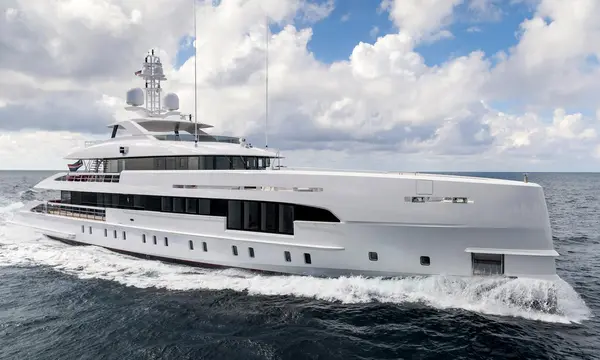
Heesen is delighted to announce the sale of YN 19150 Project Electra, the second hybrid yacht in the 5000 aluminium class.
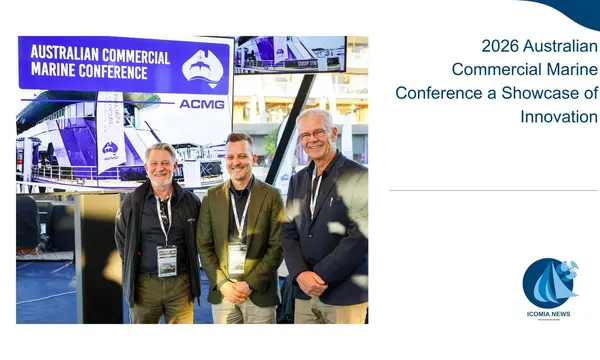
ICOMIA reports the Australian Commercial Marine Conference 2026, with technical presentations on electric propulsion, ventilation, trim systems and marine services.
Superyacht Guide
Continue into the wider Superyacht Guide.
Business opportunities · Superyacht Guide
Companies serving the superyacht market can discuss clearly identified advertising, sponsorship and business-profile opportunities. Commercial activity remains separate from independent editorial coverage.