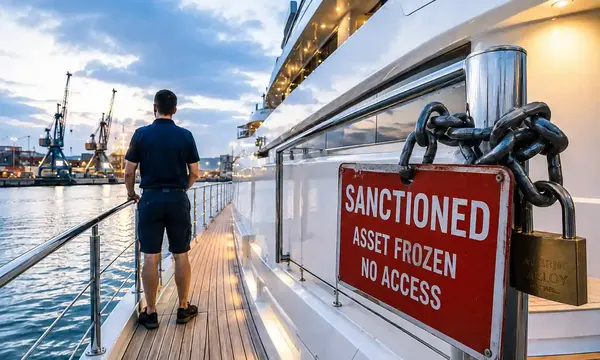
When Crew Are Caught in Sanctions: Life Aboard a Frozen Yacht
A sanctions freeze can immobilise a superyacht without making its crew sanctioned, leaving wages, contracts and daily operations caught between employment law and financial …
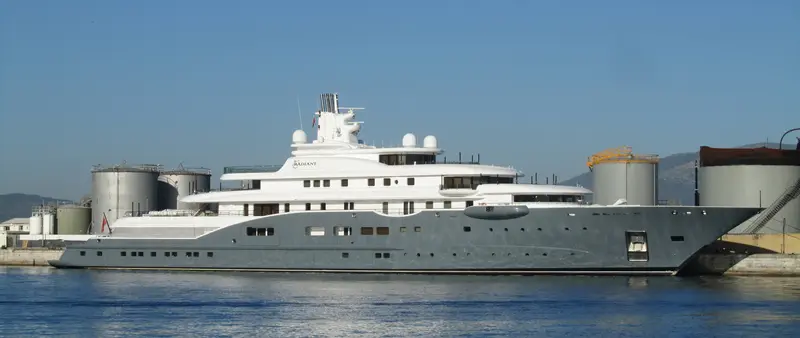
Gibraltar remains a strategic superyacht stop for bunkering, crew changes and transit, but its new 2026 customs and border regime requires more careful planning.
For a superyacht approaching the Strait of Gibraltar, the Rock is more than one of the Mediterranean's great geographical landmarks. It marks a decision point. Continue east towards the Balearics, the Côte d'Azur and Italy, turn south towards Morocco, or stop long enough to bunker, change crew, collect spares and prepare the yacht for the next stage of its programme. For decades Gibraltar has built an unusually strong maritime business around that decision, benefiting from its position beside one of the world's busiest shipping routes and from a port economy designed around vessels that often need services rather than a destination holiday.
That distinction explains Gibraltar's importance to superyachts. It is not Monaco, Palma or Porto Cervo, and attempting to judge it by the same criteria misses much of its value. Gibraltar is at its strongest when a captain needs something practical: fuel without a significant diversion from the passage, an agent who understands international shipping, a crew movement, a spare part, customs clearance or a secure berth before the yacht continues into or out of the Mediterranean. Gibraltar Port Authority describes the territory as the Mediterranean's largest bunkering port and says fuel is normally delivered by barge while ships are anchored in Gibraltar Bay, although bunkering alongside is also available.
What has changed in 2026 is the tax and border framework surrounding those operations. The UK-EU treaty concerning Gibraltar began provisional application on 15 July, introducing a new customs union with the European Union, a new transaction tax system and new immigration arrangements. The practical consequence is that some of the old shorthand about Gibraltar being simply “tax free” is now too crude. Yet the changes have deliberately protected important maritime activities, particularly bunkering and ship supplies. For yacht owners, captains and managers, Gibraltar therefore remains compelling—but understanding why now requires more precision than it did a few years ago.
Gibraltar's bunkering industry exists because the geography is almost perfect. A vessel moving between the Atlantic and Mediterranean is already passing close to the territory, so a bunker stop can be incorporated into a passage without the kind of diversion required by many alternative ports. High turnover creates competition between suppliers, while an established bunker fleet and mature port procedures mean the operation is not an occasional sideline to recreational yachting but part of a large commercial marine industry.
The Gibraltar Port Authority says bunkering remains the port's principal activity and describes Gibraltar as the largest bunkering port in the Mediterranean. Multiple grades of marine fuel are available, supplies are subject to quality-control procedures, and GPA bunkering superintendents monitor operations. Delivery at anchor is particularly significant for large yachts because the vessel can often bunker without needing a marina berth or turning a fuel stop into a prolonged port stay.
The port's tariff structure reinforces that transit model. Its published tariffs provide a 75% reduction in standard tonnage dues for vessels whose main purpose is bunkering, provided the vessel leaves no later than six hours after completion of bunkers. The Port Authority also publishes a dedicated superyacht tariff of £6.50 per metre per day for berthing, including at anchor, with increasing discounts for longer stays. These are port charges rather than the price of the fuel itself, but they reveal the commercial logic: Gibraltar actively accommodates vessels that want to arrive, take what they need and continue their passage efficiently.
For a captain, however, cheap or convenient fuel should never mean treating bunkering as a purely financial transaction. Quantity, specification, sampling, delivery documentation and contamination risk remain important regardless of where fuel is purchased. Gibraltar's mature bunker market reduces some operational friction but does not remove the yacht's responsibility to confirm exactly what is being taken aboard. The engineering team still needs the correct product specification, properly witnessed samples where appropriate, accurate tank planning and enough time after delivery to deal with any discrepancy before departure.
The strongest financial point in 2026 is more specific than Gibraltar simply having low taxes. Under the new treaty framework, Gibraltar has introduced transaction tax to replace its former import-duty system, with the standard rate beginning at 15%. Transaction tax is not VAT, and Gibraltar has not become part of the EU VAT territory. More importantly for shipping, official Gibraltar guidance states that bunkering fuel benefits from an outright exemption from transaction tax. The treaty framework also provides that no excise duty will be applied to fuel during the first three years of its application.
That protects the economic model on which Gibraltar's bunker sector depends. Owners should nevertheless distinguish between exempt bunkering supplied to a vessel and ordinary goods being placed on the Gibraltar domestic market. The new 15% transaction tax applies to many goods entering the local market, so describing Gibraltar generically as VAT-free or tax-free can obscure a much more nuanced position. For a superyacht taking bunkers and qualifying ship supplies, the maritime exemptions are the important part.
The 2026 treaty represents one of the biggest changes to Gibraltar's commercial framework in decades. Gibraltar has created a customs union with the EU while explicitly remaining outside the EU Customs Territory. Goods moving between Gibraltar and the EU now operate under a new set of customs and transit procedures, while transaction tax has replaced the old import-duty regime for goods placed on the Gibraltar market. The standard transaction-tax rate is 15% in the first year and is expected under the agreed formula to rise subsequently, although the final rate is governed by the treaty mechanism rather than being permanently fixed today.
For yachts, the crucial distinction is between goods being imported for sale in Gibraltar and goods moving through recognised maritime procedures. Government guidance specifically protects ship supplies and bunkering fuel, and the customs framework allows ship supplies to leave Gibraltar by sea without first being routed through a designated EU customs point. The same guidance expressly identifies bunkering fuel as a ship supply and provides special treatment for fuel arriving into Gibraltar for bunkering purposes.
This makes Gibraltar particularly useful for a yacht in transit because the territory's new relationship with the EU has not erased the commercial structures that made its maritime sector valuable in the first place. If a yacht needs fuel, bonded stores or certain ship supplies before proceeding offshore, the transaction is not automatically equivalent to an owner walking into a Gibraltar shop and buying ordinary domestic goods.
That does not mean every yacht transaction is tax-free. The Port Authority's clearance guidance says goods intended for non-Gibraltar-registered vessels need to be imported through a customs clearing agent or ship's chandlers to qualify for duty-free treatment. Goods intended for Gibraltar-registered vessels below 500 tonnes can be treated differently. Cargo or other items intended for Gibraltar must also be declared on arrival. The practical lesson is that the yacht should use its agent and chandlers correctly rather than assume the vessel's status automatically exempts every purchase made while alongside.
This is especially relevant during refit or technical work. A spare component being supplied to a foreign yacht, equipment imported temporarily for installation, and an item being purchased for ordinary local consumption can sit in different customs positions. The distinction matters more now because Gibraltar's post-treaty arrangements are new and considerably more structured than the old perception of a low-tax free port. A good yacht agent is therefore not simply a concierge service; it becomes part of the compliance chain.
For an owner comparing Gibraltar with nearby Spain, the question should no longer be reduced to a headline VAT percentage. The more useful analysis is what the yacht is doing, how the goods are being supplied, whether they qualify as ship supplies or under another customs procedure, what the vessel's registration and commercial status are, and what happens to those goods after Gibraltar. A tax advantage that depends on a legitimate maritime exemption is very different from assuming there is no tax system at all.
The Rock sits at the narrow gateway between two cruising worlds. Eastbound yachts may be coming from the Caribbean, Canary Islands, Portugal or Northern Europe and preparing for a Mediterranean season. Westbound yachts may be leaving the Mediterranean for an Atlantic crossing or repositioning towards the Caribbean. Others are moving between Mediterranean shipyards and Atlantic yards. In each case, Gibraltar falls naturally onto the route rather than requiring the itinerary to be constructed around it.
This gives the port a commercial advantage that no marina development could manufacture. Gibraltar Port Authority emphasises its proximity to the main shipping lanes and says vessels can reach port facilities within roughly an hour of leaving the principal Strait routes. The territory also has only about a one-metre tidal range, while commercial berths on the Western Arm can accommodate large vessels and the Mid-Harbour Marina provides around 500 metres of outer berthing dedicated to superyachts, with a minimum charted depth of six metres and greater depth in much of the area.
For a yacht that does not require a full berth, anchoring and taking bunkers by barge can keep the call efficient. For one that needs shore access, Gibraltar's marina and port facilities allow a wider package of work: provisions, spare parts, medical services, agency support, crew movements and repairs. The Port Authority describes a shipping-service sector that supports around 9,000 vessel calls annually across bunkering, provisioning, repair and crew-change activity, which helps explain why superyachts benefit from infrastructure developed for much larger commercial traffic.
The airport is another unusually practical advantage. Gibraltar International Airport is only minutes from the port, with UK connections that make owner, crew and specialist movements relatively straightforward. Spain's Málaga airport adds another major international gateway on the other side of the border. With the treaty's provisional application from 15 July 2026, routine checks at the Gibraltar-Spain land frontier were removed and the Government described the new arrangement as the beginning of free flow across the frontier. That can make the wider Campo de Gibraltar and Costa del Sol more useful to a yacht than a map of Gibraltar's tiny land area might suggest.
There is an important qualification. Free flow does not mean that immigration requirements have disappeared. Gibraltar's new arrangements are connected to Schengen rules, and the Government has specifically warned that the system cannot be used to circumvent Schengen entry requirements. For visa-requiring third-country nationals, the rules changed on 15 July 2026 and Schengen short-stay visa procedures now apply in the circumstances set out by the treaty.
This is particularly relevant to multinational superyacht crews. The Government's July guidance confirms an exemption from visa requirements for civilian sea crew landing to join a vessel or going ashore in transit to another country when they hold qualifying seafarer's identity documentation under the recognised ILO or IMO conventions. That exemption is operationally valuable, but captains and pursers should not turn it into an assumption that every crew member in every circumstance can cross the border without considering nationality, documentation and the purpose of the movement.
Gibraltar's strengths become clearest when compared with what it is not. An owner looking for a week of secluded anchorages, resort restaurants and beach-club culture is likely to keep moving towards the Balearics or the Riviera. Gibraltar's land area is small, its harbour is intensely commercial and the visual environment mixes yachts with bunkering activity, cargo operations, cruise ships and naval history.
Yet this industrial character is precisely what can make the territory reassuring to a captain. Gibraltar is accustomed to ships. Agents understand port clearances, crew changes, bunker documentation and spare-parts logistics. The Port Authority operates Vessel Traffic Services around the clock, and its maritime directory encompasses ship agents, chandlers, management companies, repair services and other businesses servicing international vessels.
There is also genuine superyacht berthing rather than merely a commercial anchorage. The Port Authority identifies three commercial marinas in Gibraltar together with its Mid-Harbour superyacht facility. Ocean Village and Marina Bay place yachts close to the airport and town, while the wider local network includes chandlery, hospitality and professional services. Superyacht Guide's own Gibraltar destination coverage therefore describes the territory principally as a strategic gateway and operational stop rather than a long-stay resort, which remains the most useful way to understand it.
Its compact size can also be an advantage. The airport, port, marinas, town centre, agents and many professional services are compressed into an area where transfers are measured in minutes rather than hours. A visiting engineer can arrive by air and reach the yacht quickly. Crew can move ashore without a long transfer. Parts arriving through an agent do not have to make their way through an enormous metropolitan port before reaching the vessel.
For very large yachts, however, advance planning still matters. A superyacht should not approach Gibraltar on the assumption that the presence of a large commercial port guarantees an appropriate recreational berth on demand. Mid-Harbour bookings are handled through nominated agents, and the most suitable arrangement may be commercial berthing or anchorage rather than one of the private marinas. Length, draught, shore-power requirements, security, planned work and the purpose of the call should be established before arrival.
Clearance is similarly formal. The Port Authority states that yachts coming alongside require clearance from the Port Authority, Customs and Immigration, normally through an agent; yachts entering the marinas without their own agent can have clearance handled through the marina operator. Gibraltar HM Customs uses its ASYCUDA system for declarations, and cargo or goods intended for Gibraltar must be declared. The process is routine, but it is not optional simply because the call is brief.
The most interesting question in 2026 is whether Gibraltar's new treaty arrangements weaken the old case for stopping there. On the evidence available so far, the answer for superyachts is largely no—but the reasons need to be described more accurately.
Gibraltar can no longer be understood through the lazy phrase “tax-free port” without qualification. A 15% transaction tax now exists for many goods placed on the domestic market, and the customs relationship with the European Union is considerably more sophisticated. At the same time, the treaty was constructed with explicit protections for bunkering fuel, ship supplies and other maritime activity. Bunkering fuel remains exempt from transaction tax, fuel excise is not applied during the first three treaty years, and maritime supply procedures continue to recognise the economic importance of Gibraltar's port.
The border has also become easier in one sense and more European in another. Physical movement into neighbouring Spain is more fluid following the removal of routine frontier checks, making the enormous service and transport infrastructure of Andalusia more accessible. Yet visa and immigration status must now be considered within the new treaty framework, particularly for non-European crew members. This is not a reason to avoid Gibraltar; it is a reason for the purser and agent to prepare properly.
For the owner, much of Gibraltar may remain invisible. The yacht arrives, takes a large quantity of fuel, perhaps receives provisions and a technical specialist, rotates several crew members and leaves the following day. There may be no beach club, no celebrated summer restaurant reservation and no week-long anchorage programme. Financially and operationally, however, that short call may be one of the most useful stops of the season.
That is ultimately Gibraltar's strength. Its value does not depend on persuading yachts to divert from their route. The route already comes to Gibraltar.
For a captain managing fuel margin before an Atlantic passage, an engineer needing spares before entering the Mediterranean, a purser organising crew travel or an owner looking at the practical tax treatment of a major bunker lift, the Rock remains where geography, shipping infrastructure and fiscal policy meet.
Gibraltar is not the glamorous centre of the Western Mediterranean superyacht season. It is something arguably harder to replace: a place where a large yacht can solve problems efficiently before continuing to somewhere else.
Gibraltar Port Authority — Bunkering
Gibraltar Port Authority — Port Tariffs
Gibraltar Port Authority — Yachting Clearance Formalities
Gibraltar Port Authority — Berthing
Gibraltar Port Authority — Mid-Harbour Marina
HM Government of Gibraltar — Basic Features of the Customs Union Between Gibraltar and the EU
HM Government of Gibraltar — Checks Removed from the Frontier
Continue reading
A sanctions freeze can immobilise a superyacht without making its crew sanctioned, leaving wages, contracts and daily operations caught between employment law and financial …

Gard’s 2026 Crew Claims Report draws on about 3,000 P&I crew claims and finds elevated injury risk early in a crew member’s time on …
Yacht Chef Salary 2026: Pay, Tips and Charter Earnings Yacht-chef pay depends on yacht size, private or charter use, professional background, qualifications, rotation and …
Superyacht Customs and Immigration: How Border Clearance Works International yacht clearance normally combines vessel declarations, crew and passenger information, customs formalities, immigration and health …
Superyacht Guide
Continue into the wider Superyacht Guide.