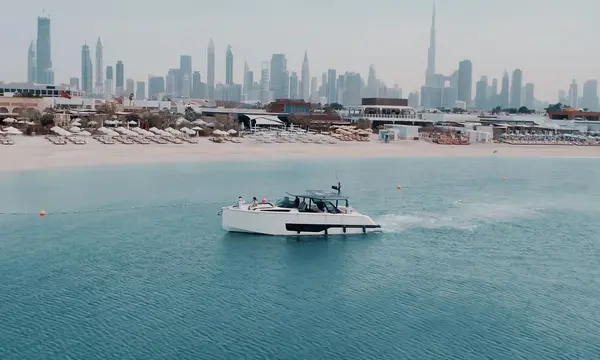
D-Marin Details Dubai J1 Beach Anchorage and Tender Service
D-Marin's October guidance explains how visiting yachts use a permitted offshore anchorage and dedicated tender service to reach Dubai's J1 Beach restaurants.
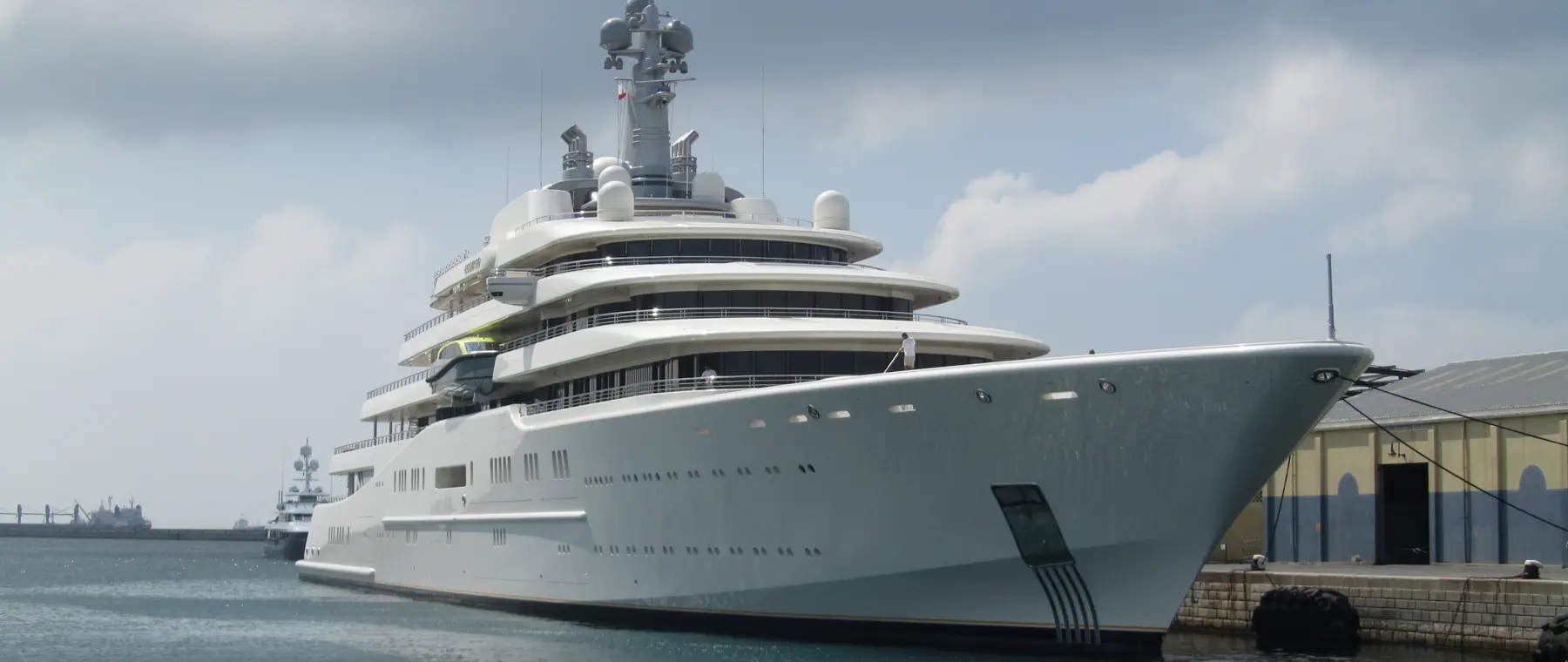
Most displacement superyachts cruise at roughly 10–15 knots, while performance yachts can exceed 30 knots. The real trade-off is fuel: speed rises quickly in cost because resistance and required engine power do not increase in a straight line.
Ask how fast a superyacht goes and the answer can range from little more than 12 knots to well above 40. The difference is not simply engine size: hull form, displacement, length, propulsion system and the yacht’s intended mission determine whether a vessel is designed to cross oceans efficiently or cover short distances at sports-yacht speeds.
For most conventional displacement superyachts, a practical cruising speed is around 10–15 knots and maximum speed often sits somewhere around 14–20 knots. Semi-displacement and fast-displacement yachts can push into the high teens or 20s, while genuine performance yachts may cruise above 30 knots and exceed 40 knots at the top end. The important point for owners is that maximum speed is usually the least efficient way to travel, and even a modest increase above an economical passage speed can have a large effect on fuel use and range.
A yacht’s advertised top speed is the maximum performance figure achieved or expected under defined conditions, not the speed at which the captain will normally operate for hours at a time. Cruising speed is a more sustainable operating point chosen for machinery loading, comfort and passage time, while economical or range speed is slower again and is selected to maximise the distance covered for each unit of fuel.
The distinction is visible in current builder data. GX Superyachts publishes a 12-knot cruising speed and 16-knot top speed for its 42.1-metre GX42, while the current Pershing 140 specification gives a 36-knot maximum and a 10-knot economic cruising speed; a specific fourth Pershing 140 was reported by the builder with a 30-knot cruising speed and 36-knot maximum. These yachts are similar enough in length to make the contrast useful, yet their operating philosophies are completely different.
Displacement yachts are designed primarily to move efficiently through the water rather than climb onto the surface and plane. A 26-metre Steeler Ocean Explorer 85, for example, is quoted by the builder at about 8 knots cruising and 12 knots maximum with approximately 4,000 nautical miles of range, while the 76.5-metre Feadship Boardwalk V is listed at 15 knots cruising and 18.4 knots maximum. In both cases, endurance, comfort and volume matter more than headline speed.
Performance yachts sit at the other end of the spectrum. Pershing’s 43.3-metre 140 uses four 2,600hp MTU engines and waterjet propulsion, while ISA Yachts’ current Sportivo 100 is a 30.5-metre planing GRP-and-carbon design quoted at 34 knots cruising and 44 knots maximum. ISA’s earlier 30-metre Aldabra demonstrated how extreme this niche can become when the builder recorded 55 knots during sea trials.
| Example | Length | Hull / mission | Cruising or economic speed | Maximum speed |
|---|---|---|---|---|
| Steeler Ocean Explorer 85 | 26.0m | Long-range displacement explorer | Approx. 8 knots | 12 knots |
| GX42 | 42.1m | Hybrid efficiency-focused yacht | 12 knots | 16 knots |
| Boardwalk V | 76.5m | Large displacement superyacht | 15 knots | 18.4 knots |
| Pershing 140 | 43.3m | High-performance aluminium yacht | 30 knots on fourth hull | 36 knots |
| ISA Sportivo 100 | 30.5m | Planing performance yacht | 34 knots | 44 knots |
The table should not be read as a simple size-to-speed ladder. A 30-metre performance yacht can be more than twice as fast as a 70-metre displacement yacht because the faster vessel is lighter, shaped for planing or semi-planing operation and equipped with a very different power-to-weight ratio. Conversely, the larger displacement yacht may be able to travel thousands of miles between fuel stops at a speed that would feel slow beside a sports yacht.
Water resistance does not increase in a neat one-for-one relationship with speed, and the power needed to overcome that resistance can rise sharply as a yacht is driven faster. Superyacht Guide’s naval-architecture guide explains the same principle from the hull side: effective power is resistance multiplied by speed, so a relatively small increase in speed can require a much larger increase in propulsion power and fuel flow.
GX Superyachts’ published performance curve makes the effect unusually easy to see. For the GX42 platform, the builder gives approximately 54 litres per hour at 10 knots, 83.66 litres per hour at 12 knots, 159.8 litres per hour at 14 knots and 306.93 litres per hour at 16 knots. That means the published fuel use per nautical mile rises from about 5.4 litres at 10 knots to roughly 19.2 litres at 16 knots, even before considering hotel loads or real-world weather.
Sea-trial data from Amer Yachts points in the same direction on a different platform. The 41.45-metre Even Further was reported at about 60 litres per hour at 9.5 knots in Eco Mode and around 150 litres per hour at 12.5 knots, with the builder describing the change in active engines and load as speed demand increases. Those figures are specific to that yacht and propulsion system, but they illustrate why captains think in terms of a fuel curve rather than one universal “litres per hour” number.
Running close to maximum speed may be useful when schedules are tight, weather windows are closing or a performance yacht is being used exactly as its designer intended, but it is rarely the optimum setting for long passages. Higher fuel burn shortens range, increases machinery load and can make ride comfort more sensitive to sea state, so captains often reduce speed materially when endurance matters.
This is why published range figures are normally attached to a specific speed rather than to the yacht’s headline cruising or maximum figure. Pershing’s current 140 specification, for example, lists an economic cruising speed of 10 knots and a range of about 1,400 nautical miles at that speed despite the model’s 36-knot maximum, while ISA quotes 550 nautical miles at 12 knots for the 30.5-metre Sportivo 100 even though its normal performance figures are much higher. Range, speed and fuel therefore have to be read as one system rather than three independent specifications.
There is no single correct cruising speed because the answer changes with hull form, machinery, sea state, schedule and the owner’s priorities. A displacement yacht crossing the Atlantic may spend days around 10–13 knots to protect range and reserves, while a fast Mediterranean yacht may legitimately cruise in the 20s or 30s when moving between nearby destinations and fuel endurance is less important.
The captain will also consider more than propulsion consumption. Generators may be supporting air-conditioning, stabilisers, refrigeration, watermakers, galley equipment, communications and guest services at the same time, so the yacht’s total fuel burn can remain materially higher than the main-engine figure alone. Superyacht Guide’s Atlantic-crossing analysis makes the same distinction: tank capacity is not usable range, and prudent passage planning must include hotel load, weather, diversion options and a reserve rather than calculating the route from brochure figures alone.
For an owner comparing yachts, the most useful questions are therefore not simply “How fast does it go?” but “What is the normal cruise speed, what is the most economical passage speed, how much fuel does it burn at each, and what range remains with a sensible reserve?” A yacht that reaches 35 knots may be perfect for short Mediterranean hops, while another that cruises at 12 knots may be the better machine for repeated ocean passages.
As a broad rule, most large displacement superyachts live in the 10–15-knot cruising band and reach the mid-to-high teens at maximum speed, while performance-led yachts can cruise above 20 or 30 knots and exceed 40 knots. The faster number is easy to advertise, but the fuel curve is what determines how that speed feels in the operating budget, how far the yacht can travel and how often the captain has to think about the next bunker stop.
Continue reading
D-Marin's October guidance explains how visiting yachts use a permitted offshore anchorage and dedicated tender service to reach Dubai's J1 Beach restaurants.

Marina Bahía Golfito highlights prospective customs, port services, road access and research facilities in Costa Rica before FLIBS 2026.
IGY explains how its Trident programme supports eligible superyacht captains seeking short-notice berths during busy events and sudden itinerary changes.
Five Guangdong yachts made the inaugural southbound visit to Hong Kong on 16 October, launching two-way cross-border arrangements and new marina ambitions.
Superyacht Guide
Continue into the wider Superyacht Guide.
Business opportunities · Superyacht Guide
Companies serving the superyacht market can discuss clearly identified advertising, sponsorship and business-profile opportunities. Commercial activity remains separate from independent editorial coverage.