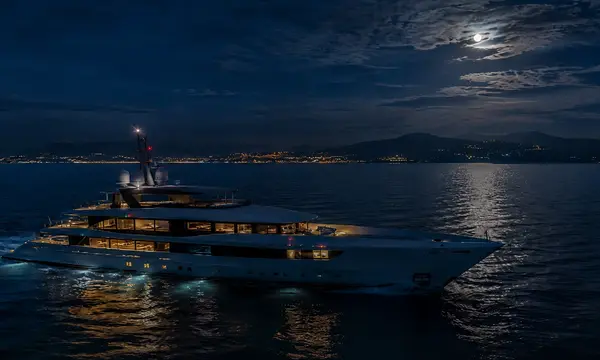
Night Passages on Superyachts: What Guests Never See
While guests sleep through an overnight passage, bridge and engineering teams remain fully engaged. Watchkeeping, machinery monitoring, fatigue control and arrival planning make the …
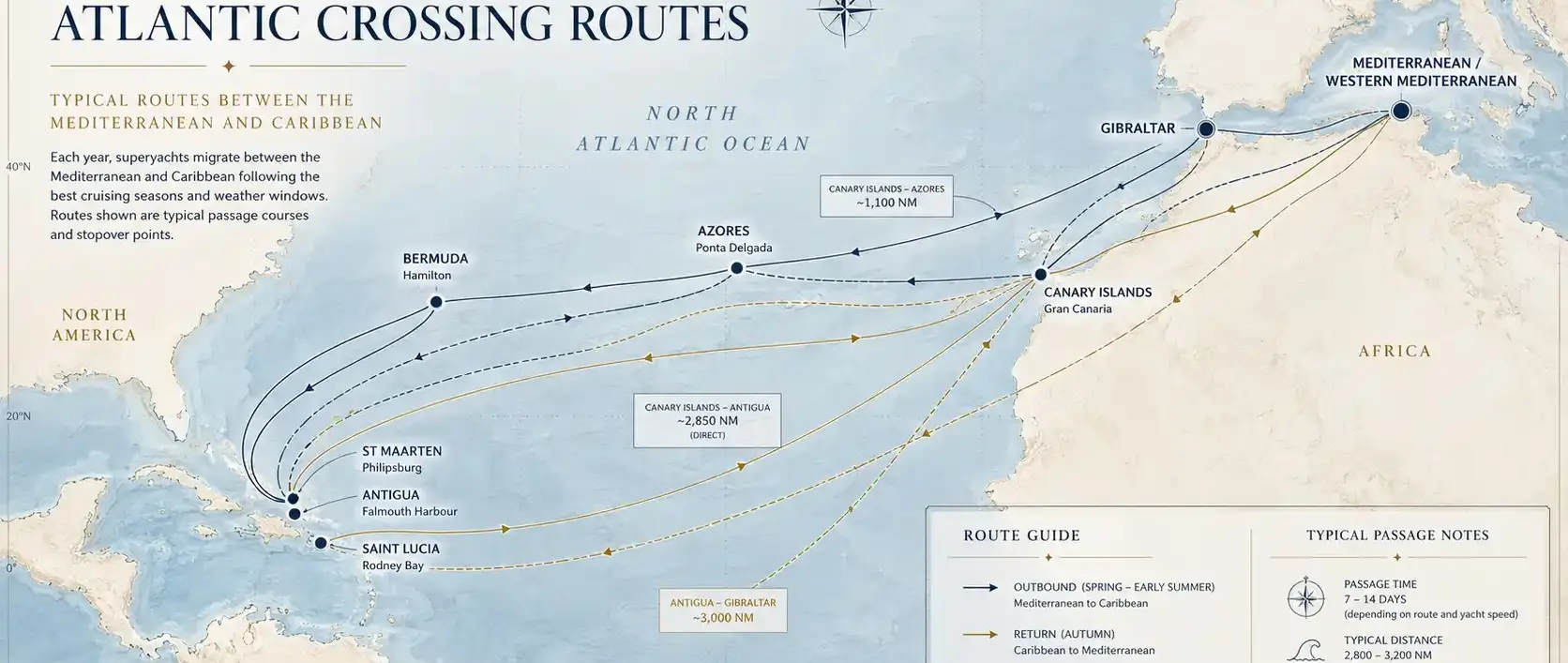
Many superyachts can cross the Atlantic, but safe passage depends on real-world range, fuel margin, machinery reliability, crew watchkeeping and the weather window.
Yes, many superyachts can cross the Atlantic under their own power, and ocean passages are a routine part of the operating life of numerous long-range yachts. But being large, expensive or described as ocean-going does not by itself prove that a particular yacht has the endurance, machinery condition, crew structure or weather margin required for a safe crossing.
The real question is whether the yacht can complete its planned longest leg while retaining sensible reserves and alternatives when conditions change. Range, fuel consumption, machinery reliability, watchkeeping, stores, communications and weather routing all have to work together before a captain can treat an Atlantic passage as operationally sound.
The classic westbound Atlantic Rally for Cruisers route runs from Las Palmas de Gran Canaria to Rodney Bay in Saint Lucia, and the World Cruising Club describes the crossing as approximately 2,700 nautical miles. That provides a useful scale for the ocean leg even though a motor yacht may choose different departure points, landfalls or routing.
At a theoretical average of 12 knots, 2,700 nautical miles represents about 225 hours of travel, or just over nine days, while at 10 knots the same distance is about 270 hours, or more than eleven days. Those figures are only simple distance-and-speed calculations because an actual passage may be longer after weather avoidance, current, speed changes and routing decisions.
A yacht with a published range of 2,700 nautical miles should therefore not be assumed to have a comfortable 2,700-nautical-mile ocean capability. The International Maritime Organization’s Guidelines for Voyage Planning require the vessel’s condition and limitations, competent and well-rested crew, weather information and other relevant factors to be considered for the complete voyage, which is why a brochure range figure is only one part of the decision.
Size alone is a poor guide to transatlantic capability because hull form, displacement, propulsion, cruising speed, fuel capacity and the yacht’s intended mission can produce very different endurance figures. A smaller displacement explorer may consequently offer a larger safe operating radius than a bigger yacht designed around speed or shorter regional cruising.
Yacht Length Published range Published fuel capacity MAT 44.5m More than 5,000nm at 10 knots 65,000 litres Orion 49.8m 3,750nm at 12 knots 47,000 litres
Cantiere delle Marche publishes more than 5,000 nautical miles at 10 knots for the 44.5-metre explorer MAT, supported by 65,000 litres of fuel. Heesen publishes 3,750 nautical miles at 12 knots for the 49.8-metre Orion, showing that yachts of similar broad size can have materially different endurance characteristics.
These examples also explain why the word “superyacht” cannot answer the Atlantic question by itself. The useful figures are the yacht’s own verified range curve, tank arrangement, actual consumption records and the margin remaining after the planned route is completed.
A yacht may carry tens of thousands of litres of fuel, but tank capacity alone does not reveal how far it can safely travel because consumption varies with speed, loading, hull condition, wind, waves, current and machinery configuration. The amount of fuel physically aboard also should not be confused with a captain’s prudent passage-planning allowance.
Speed can make a particularly large difference because many displacement and fast-displacement yachts achieve their best range at moderate passage speeds rather than near maximum speed. Heesen states that Orion consumes 98 litres per hour at 12 knots excluding hotel load and 45 litres per hour at 10 knots in hybrid mode, demonstrating how dramatically operating mode can alter the propulsion calculation.
The phrase “excluding hotel load” matters because generators may be supporting air conditioning, refrigeration, watermakers, pumps, bridge electronics, communications, galley equipment and other systems continuously for more than a week. A realistic fuel plan therefore needs the yacht’s total operational consumption rather than a propulsion figure considered in isolation.
An Atlantic crossing rarely unfolds as one perfectly straight line at one perfectly constant speed, so the passage plan needs room for changing conditions and operational decisions. The yacht may have to slow down in head seas, alter course around a weather system, change its landfall or spend additional hours operating machinery before reaching a suitable berth.
The IMO’s GreenVoyage2050 weather-routing guidance notes that wind, waves and ocean currents affect the power required to maintain speed over the ground and that route selection can reduce fuel consumption and exposure to damaging conditions. That relationship between weather and fuel is one reason a captain is unlikely to regard the yacht’s published maximum range as a target to be exhausted almost completely.
The larger the remaining endurance margin, the more freedom the bridge team retains to make a conservative decision when circumstances change. As that margin disappears, a weather deviation or unexpected machinery problem can become a fuel problem as well.
An Atlantic-capable yacht also needs a crew structure capable of continuous operation for days because navigation, engineering, communications and safety functions do not stop at night. The passage has to be organised around qualified watchkeepers and realistic rest rather than around the staffing pattern that happens to work during a week of short coastal cruising.
For UK-flagged commercial yachts over 24 metres, the Maritime and Coastguard Agency’s Safe Manning Document guidance describes the approved minimum manning framework and the need for appropriately qualified personnel. Minimum manning is nevertheless a regulatory baseline rather than a guarantee that the same number of people is ideal for every long ocean passage.
The MCA’s MLC hours-of-work and rest guidance sets the normal minimum-rest framework at at least ten hours in any 24-hour period and 77 hours in any seven-day period. A transatlantic watch system therefore has to provide continuous coverage without quietly creating fatigue faster than the voyage creates miles.
Weather is not a final box to tick after the range calculation because it can change the route, departure time, speed, fuel burn and acceptable level of motion aboard. A yacht can have ample theoretical range and perfect machinery yet still remain in port because the available weather window is wrong for that vessel and route.
The U.S. National Hurricane Center defines the official Atlantic hurricane season as 1 June to 30 November and notes that tropical activity is historically concentrated within that period, although storms can occur outside it. Current forecasts, sea state and route-specific professional judgement therefore matter more than relying on a calendar date alone.
For broader North Atlantic conditions, NOAA’s Ocean Prediction Center Atlantic products provide high-seas forecasts, surface analysis and wind and wave information. Westbound routing commonly uses the Canary Islands as a staging area before the trade-wind crossing toward destinations such as Saint Lucia, while eastbound passages may use more northerly sequences involving Bermuda and the Azores.
Range matters only if the machinery can reliably deliver it, so the engineering department has to examine propulsion engines, generators, fuel transfer, cooling, steering, pumps, stabilisers, watermakers, refrigeration and other critical systems before departure. Spares and consumables also need to reflect the failures the crew could reasonably be expected to diagnose and manage when the nearest marina is several days away.
The MCA’s MGN 709 guidance for short-range yachts making passages more than 90 miles from a safe haven emphasises issues including vessel condition, watertight integrity and appropriate manning. The exact statutory regime depends on the yacht’s flag, certification and operating status, but the operational principle is broader: offshore self-sufficiency must be planned rather than assumed.
Tenders, personal watercraft, loose furniture and deck equipment also need ocean-passage stowage rather than the arrangements tolerated during benign coastal cruising. Water production, food, medical supplies, communications and essential consumables must similarly allow for the planned passage plus a realistic contingency if arrival is delayed.
Potentially, but this is where the answer becomes especially yacht- and route-specific because a published range only modestly greater than the nominal ocean leg leaves less room for adverse conditions. A 3,400-nautical-mile brochure figure may look comfortably larger than a 2,700-nautical-mile route, yet that difference has to absorb real loading, generator consumption, current, weather deviation, speed changes and the captain’s required reserve.
Slowing to a more efficient passage speed can sometimes increase endurance when the yacht’s verified performance data support that decision, while route design may reduce the longest uninterrupted leg by using an intermediate stop such as Cape Verde. Neither approach should be improvised after departure because the fuel availability, weather, port access and resulting passage geometry have to be assessed in advance.
If the margin remains unattractive, commercial yacht transport is another operational option and can reduce machinery hours or reposition a yacht whose design is better suited to regional cruising. Choosing transport does not mean the yacht is incapable in a general sense; it can simply be the more rational way to move a particular asset between cruising regions.
Owners and guests can remain aboard when the yacht’s certification, operating plan and master permit it, but many Atlantic repositioning passages are primarily crew operations. The vessel is moving between seasonal programmes, so bridge watches, engineering reliability and safe arrival take priority over a guest itinerary built around anchorages and shore visits.
Conditions can also differ sharply from normal luxury cruising because even a large stabilised yacht may spend days in persistent ocean swell. For owners who specifically want the experience, a transatlantic passage can be one of the reasons to own an ocean-capable yacht, while others prefer to fly ahead and rejoin after the crew has completed the repositioning.
A direct 2,700-nautical-mile westbound passage at an average 12 knots works out at roughly nine and a half days of continuous travel, while 10 knots produces a little over eleven days. A slower average speed, longer route or weather diversion can extend the voyage substantially, so these figures are scale estimates rather than schedules.
Eastbound passages are often planned differently from westbound routes and may be divided into several ocean legs, depending on range, weather and available safe havens. The master ultimately selects the route from current information and the yacht’s actual condition rather than from a generic Atlantic-crossing timetable.
If a yacht has genuine safe endurance beyond its planned longest leg, reliable machinery, sufficient stores, appropriately qualified and rested crew, suitable certification and a workable weather window, an Atlantic crossing can be a normal part of its operating life. Many displacement and explorer yachts are specifically designed around that kind of autonomy, while other superyachts require tighter planning or another method of repositioning.
There is no minimum length at which a yacht suddenly becomes transatlantic and no brochure range that guarantees a safe passage. The Atlantic tests the difference between luxury and capability because the yacht must not merely have enough fuel to reach another continent; it must retain enough resilience to absorb the changes that occur before it gets there.
Superyacht Guide has separately examined why charter yachts migrate between the Mediterranean and Caribbean, including the seasonal business logic behind those movements. This article addresses the different question of whether a particular yacht has the technical and operational capability to make the crossing safely.
Continue reading
While guests sleep through an overnight passage, bridge and engineering teams remain fully engaged. Watchkeeping, machinery monitoring, fatigue control and arrival planning make the …
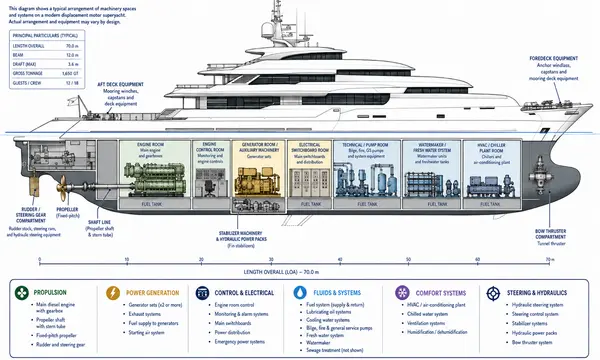
Behind every quiet cabin, working shower and seamless passage is an engineering team responsible for keeping a highly complex vessel operating safely, reliably and …
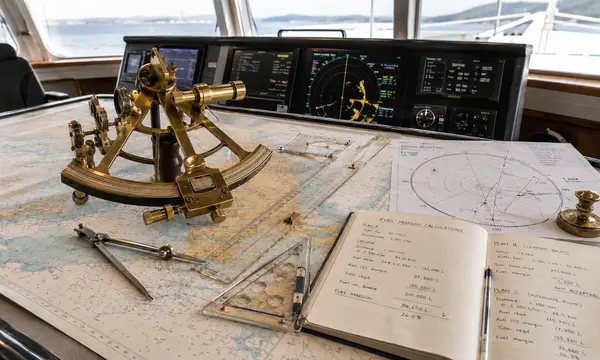
Good passage planning is not just a route on a chart. It is a moving judgement about weather, fuel, safe havens, crew endurance and …
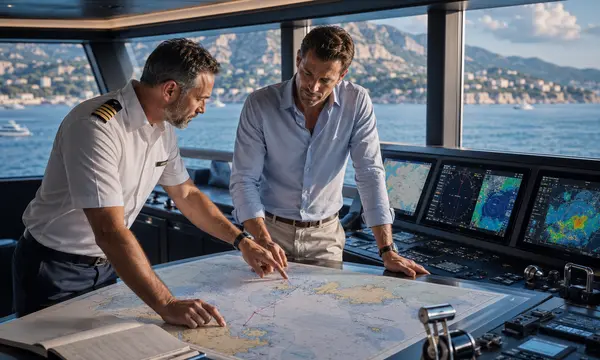
Passage planning turns an owner’s preferred itinerary into a safe, legal and realistic superyacht voyage, balancing comfort, weather, fuel, crew and risk.
Superyacht Guide
Continue into the wider Superyacht Guide.
Business opportunities · Superyacht Guide
Companies serving the superyacht market can discuss clearly identified advertising, sponsorship and business-profile opportunities. Commercial activity remains separate from independent editorial coverage.