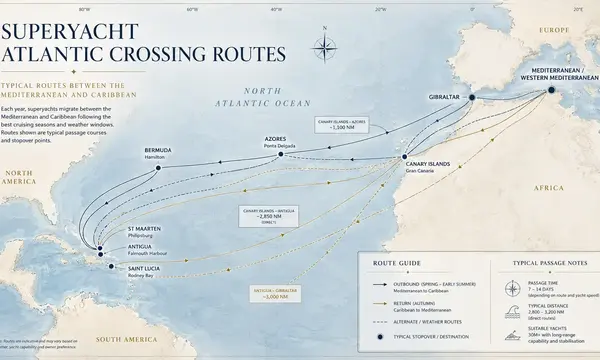
Can a Superyacht Cross the Atlantic? Range, Fuel, Crew and Weather
Many superyachts can cross the Atlantic, but safe passage depends on real-world range, fuel margin, machinery reliability, crew watchkeeping and the weather window.
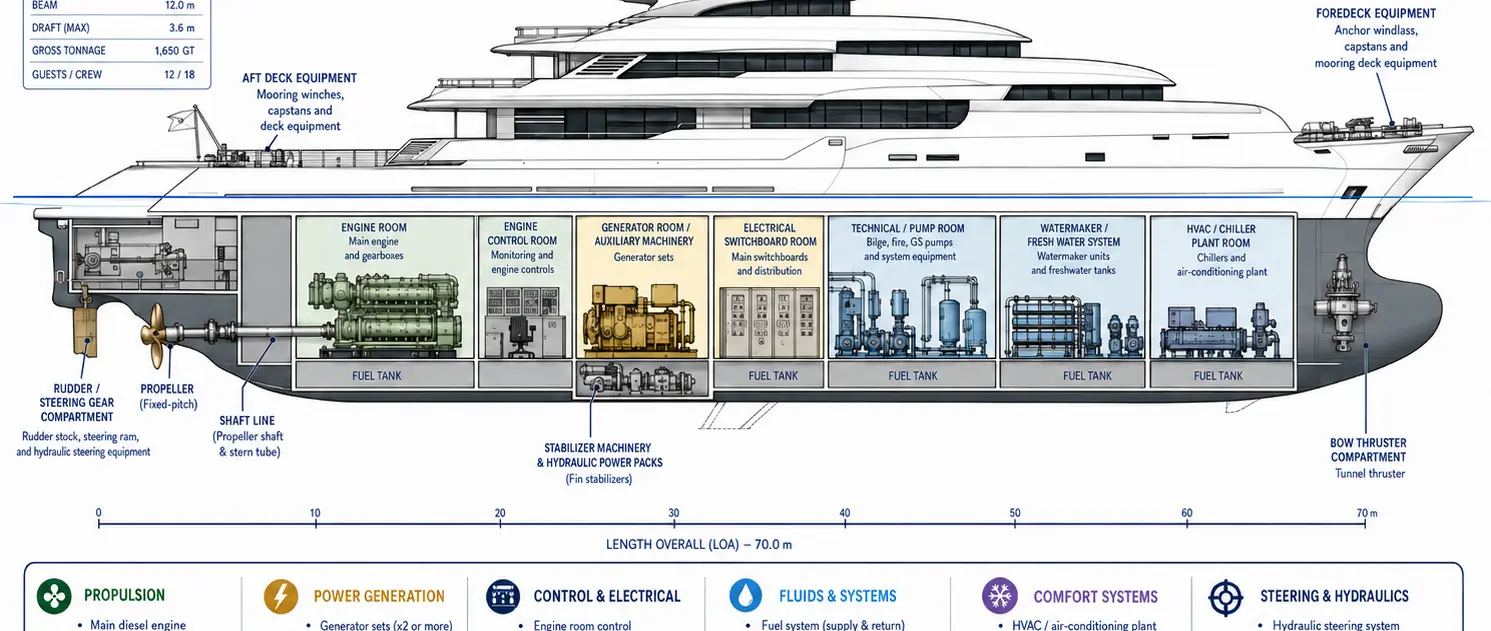
Behind every quiet cabin, working shower and seamless passage is an engineering team responsible for keeping a highly complex vessel operating safely, reliably and almost invisibly.
This article is a composite portrait of chief engineers, second engineers, junior engineering officers and sole engineers. It does not represent one identifiable person or yacht.
The luxury of a superyacht is experienced through its guest spaces: cool cabins, generous showers, carefully lit interiors, silent nights at anchor and the ability to move from one destination to another without apparent effort. Yet almost everything that creates that experience depends on machinery hidden behind panels, beneath decks and inside technical compartments that most guests will never enter. Power must be generated and distributed, fresh water produced and pressurised, waste treated, fuel transferred, cabins cooled, tenders maintained and propulsion systems kept ready for immediate use.
The engineer’s working life takes place inside this less visible yacht. It is a world of pumps, generators, switchboards, compressors, pipes, batteries, filters, hydraulic systems and monitoring screens, all of which must continue operating while the vessel functions as both a ship and a private hotel. The work can be highly technical, physically demanding and mentally exhausting, but it is also deeply practical. Problems cannot be discussed indefinitely or postponed simply because they are inconvenient. They must be understood, controlled and resolved while the rest of the yacht continues with its programme.
This is not the story of one particular engineer or one particular vessel. It is a composite portrait of the chief engineers, second engineers, junior engineering officers and sole engineers whose responsibilities differ according to the yacht’s size and operation. Their routines are not identical, but they share the same central purpose: to make a complicated vessel feel dependable to everyone else on board.
A modern superyacht contains a second vessel beneath the one seen by guests. Its machinery spaces support propulsion, electrical generation, stabilisation, refrigeration, air conditioning, fresh-water production, sewage treatment, fuel management, fire protection and many of the systems associated with tenders, pools, beach clubs and hydraulic platforms. Larger yachts may also include battery banks, hybrid equipment, high-voltage installations, exhaust treatment and extensive automation linking machinery from different manufacturers.
The engineer must understand how these systems interact rather than treating each item of equipment as an isolated machine. A problem with a seawater pump may affect the air-conditioning plant. A generator fault may reduce the electrical capacity available to the galley, laundry or guest areas. A leaking pipe may damage an interior several decks above the point where the failure began. The engineer therefore develops a working picture of the yacht as one connected system, where a minor change in temperature, pressure, vibration or electrical load may be the first indication of a larger problem.
Much of the work is preventive. Machinery is serviced according to running hours, calendar intervals, condition reports, manufacturer instructions and classification requirements. Filters are replaced before flow is restricted, pumps are rebuilt before seals fail, oil samples are analysed for signs of wear and electrical connections are inspected before heat or corrosion creates a more serious risk. Maintenance records must show what was done, when it was done and what was found, because the history of a machine often matters as much as its current reading.
This demands patience and attention rather than constant emergency repair. Experienced engineers become familiar with the normal sounds, temperatures and behaviour of the machinery under different operating conditions. They notice when a pump begins to sound rougher, when a generator carries load differently or when a system cycles more frequently than it did the previous week. These changes may appear insignificant to anyone else, but acting on them early can prevent a failure during manoeuvring, a guest trip or a passage far from technical support.
The engineering day often begins before the main guest operation. Rounds are completed, tank levels checked, alarms reviewed and overnight machinery behaviour assessed. Planned maintenance may then begin, but the schedule remains vulnerable to interruption because the engineer is responsible for any technical problem affecting the yacht.
A job that appears simple on paper can occupy several hours once access, isolation and testing are considered. A pump may be difficult to reach, a replacement part may require modification or the equipment may be connected to systems that cannot be shut down while guests are on board. Engineers frequently have to plan work around the yacht’s routine, carrying out noisy or disruptive tasks while guests are ashore and coordinating electrical or water interruptions with the galley, interior and deck departments.
Guest use greatly increases technical demand. Showers, laundry machines, galley equipment, refrigeration, air conditioning, entertainment systems, lighting, pools and water toys may all be operating at the same time. Tenders require fuel and maintenance, hydraulic platforms are moved repeatedly and doors between cooled interiors and hot exterior decks remain open. The engineering team has to support this level of activity without allowing the guest experience to become dominated by technical explanations.
This requires communication as well as mechanical ability. The engineer must be able to tell the captain whether a fault is minor, whether it can be managed temporarily and whether the yacht can continue safely. Other departments need practical information: whether cabin temperatures will remain stable, when water will be restored, whether a tender can be used and how long a repair is likely to affect operations. The best engineers communicate in terms people can use, without concealing risk and without overwhelming the rest of the crew with unnecessary technical detail.
The work is often unnoticed when it is successful. Guests do not usually ask how the fresh water was produced, why the cabins remain cool or what ensured the generators shared the electrical load correctly. They simply experience a yacht in which everything works. That apparent effortlessness is not the absence of engineering work; it is the result of problems being anticipated and managed before they become visible.
On a large yacht, the chief engineer carries overall technical responsibility. This includes maintenance planning, budgeting, contractor management, spare parts, surveys, bunkering, dry-docking, statutory compliance and communication with the captain, yacht manager and owner’s representatives. The chief engineer may still take part in practical repairs, but the position increasingly involves making decisions about risk, priorities and the long-term condition of the vessel.
One of the most difficult parts of the role is deciding when the yacht should not sail. A machine may still operate while no longer being reliable enough to trust. A temporary repair may have reached the limit of what can reasonably be accepted, or the failure of one remaining system may leave no safe redundancy. The chief engineer must translate this technical position into a clear recommendation for the captain, even when the yacht appears ready, guests are arriving or the planned itinerary is commercially important.
The second engineer usually carries much of the department’s daily operational workload. They may organise maintenance, supervise junior engineers, manage records, trace faults and take responsibility for important machinery systems while continuing to develop towards chief-engineer command. On a well-run yacht, this position provides structured experience in both technical work and decision-making. The second engineer is allowed to lead repairs, participate in survey planning and understand the reasons behind budget and operational decisions.
Junior engineering officers learn through rounds, maintenance tasks and watches, gradually developing the ability to recognise abnormal conditions and work safely without constant supervision. Their progress depends heavily on the culture of the department. Good senior engineers explain why a task is being done, insist on correct isolation and testing procedures and allow junior crew to build confidence without placing the yacht at unnecessary risk.
On smaller yachts, one person may carry nearly all these responsibilities. The sole engineer can be responsible for propulsion, generators, plumbing, air conditioning, electrical systems, tenders, refrigeration and hotel equipment, while also assisting with deck operations or general maintenance. This creates a close understanding of the yacht, but it also means there may be no other engineer available to take over when a fault occurs at night or a difficult repair extends into the following day.
The sole engineer’s greatest challenge is often not technical capability but continuous availability. When every machinery problem belongs to one person, proper rest becomes difficult to protect. A night alarm does not remove the maintenance planned for the morning, and guest operations may continue regardless of how much sleep the engineer has had. Responsible captains recognise that fatigue in a technically essential crew member is a safety issue, not simply a personal inconvenience.
Machinery failures rarely occur at a convenient time. A generator may trip during dinner service, a hydraulic system may fail while preparing to berth or a tender may refuse to start when guests are waiting to go ashore. In these situations, the engineer must balance urgency with discipline.
The first priority is to establish whether there is an immediate danger involving fire, flooding, electrical shock, pollution, propulsion or steering. Once the yacht is safe, the engineer begins diagnosing the fault. Alarms are useful, but they often identify a symptom rather than the actual cause. A low-pressure warning may result from a failed pump, blocked filter, closed valve, damaged sensor, electrical fault or lack of fluid. Replacing the first component suggested by the alarm can waste time and create additional problems.
Experienced engineers work through possibilities systematically, even when several departments are waiting for an answer. They examine what changed, what happened immediately before the alarm and which other systems may be affected. They compare readings, inspect equipment and test assumptions rather than allowing pressure to become guesswork. This methodical approach may look slower in the first few minutes, but it is often the quickest route to a reliable repair.
The human pressure can be as difficult as the technical problem. The captain needs to know whether the itinerary is affected, the interior team may be dealing with uncomfortable guests and the deck department may be unable to use essential equipment. The engineer may be working in a hot, confined space while also being asked repeatedly for a completion time that cannot yet be known.
Good communication becomes essential. An engineer does not need to provide false certainty, but should explain what has been established, what is being checked and what alternative arrangements may be necessary. The ability to remain calm does not mean the engineer feels no pressure. It means the pressure is being contained rather than transferred to the rest of the yacht.
Night alarms are particularly demanding because the engineer must move quickly from sleep into technical decision-making. A bilge alarm, loss of cooling or electrical fault may be minor, but it must be treated seriously until the cause is confirmed. Even when the incident is resolved before the guests wake, the engineer carries the knowledge of what could have happened if the alarm had failed, the leak had reached electrical equipment or the yacht had been farther from assistance.
Some of the engineer’s most important work takes place during operations that appear routine. Bunkering is one example. From the quay, it may look like a straightforward fuel delivery, but the engineering team must confirm the quantity and grade, plan the distribution between tanks, monitor stability and prevent overfilling. Valves, connections, vents, communications, emergency stops, fire precautions and spill-response equipment must all be checked before transfer begins.
Fuel quality matters because contamination may not become apparent until long after the supplier has left. Water, dirt, microbial growth or an incorrect specification can damage engines and generators, particularly during a passage or manoeuvring operation when reliable fuel supply is critical. Samples and accurate records may therefore become important evidence if a dispute develops.
The same principle applies throughout the engineering department: routine work is safe only because it is treated seriously. Electrical isolations, confined-space entry, hot work, machinery testing and fuel transfers all require planning and clear responsibility. Familiarity can create complacency, particularly on a yacht where the same tasks are repeated for years, but the consequences of a mistake remain significant.
Engineers are also responsible for maintaining equipment linked directly to emergency response. Fire pumps, emergency generators, bilge systems, alarms and shutdown arrangements may remain unused for long periods, yet they must work immediately when required. Testing them can feel less urgent than repairing equipment used every day, but their reliability may determine whether a developing incident is controlled or becomes a major casualty.
A refit reveals how much of a yacht’s true condition remains hidden during normal operation. Panels are removed, tanks opened, machinery dismantled and systems exposed that may not have been fully inspected for years. The engineering team often arrives with a work list developed over several seasons, including recurring faults, temporary repairs, equipment approaching the end of its service life and systems that no longer meet the yacht’s operational needs.
Drawings may not accurately reflect previous alterations. Pipes may have been rerouted, cables added and machinery replaced without every document being updated. Equipment that appeared accessible during construction may be extremely difficult to remove once the yacht is complete. The engineer becomes an important source of institutional knowledge, explaining how the yacht actually operates rather than how the original plans suggest it should operate.
Refit work also demonstrates how interconnected technical decisions can be. Replacing a chiller may require changes to pipework, electrical supply, controls, ventilation and access. Installing batteries or hybrid equipment affects cooling, fire protection, weight distribution and emergency procedures. A project that begins as a single replacement can expand once machinery is opened and hidden corrosion, wear or incompatible modifications are discovered.
From an owner’s perspective, a technical refit can be frustrating because large sums may be spent without creating obvious visual change. The yacht may leave the yard looking almost identical, even though unreliable systems have been replaced, major surveys completed and serious future failures prevented. The engineering department understands the value of this work because it experiences the difference in reliability during the seasons that follow.
Refit periods can also be among the most exhausting stages of an engineer’s career. Contractors must be supervised, work checked, systems tested and records updated while deadlines approach and the yacht prepares to return to service. Once the yard work is complete, the engineering team must ensure that the vessel has not simply been repaired, but has been returned to a safe, documented and operable condition.
Superyacht engineering can offer strong salaries, travel and rotational leave, but the lifestyle places pressure on relationships and ordinary routines ashore. Engineers may spend weeks or months away, then return home expected to move immediately back into family life. Itineraries change, yard periods overrun and leave can be interrupted because the yacht needs someone who understands a particular system.
Rotational schedules can improve the balance, especially on larger yachts with structured engineering teams, but they do not remove the mental responsibility completely. An engineer may leave detailed handover notes and still receive questions from the yacht about a recurring fault, the location of a spare or the history of a repair. Years of technical knowledge cannot always be transferred in one handover meeting.
Career progression also requires investment beyond daily work. Engineers build sea time, complete specialist courses and prepare for written and oral examinations in order to qualify for higher levels of responsibility. Leave periods that appear generous from outside may partly be used for study, certification and medical requirements.
Some engineers remain at sea for decades, progressing from junior positions to chief engineer and taking responsibility for increasingly large and complex yachts. Others eventually move ashore into yacht management, surveying, refit supervision, technical consultancy or shipyard work. The technical skills transfer well, but the decision to leave is often influenced as much by lifestyle as by career opportunity.
Despite the pressure, many engineers find genuine satisfaction in the work. There is pride in completing a major overhaul, identifying a fault that has resisted previous attempts or preparing a yacht for a long passage that is completed without serious technical difficulty. There is also satisfaction in building a reliable department, teaching junior engineers and knowing that the captain trusts the technical advice being given.
The real life of a superyacht engineer is not defined only by emergency alarms or dramatic failures. Most of it consists of careful, repetitive and highly skilled work carried out before anybody else becomes aware that a problem is developing. It is checking machinery, studying trends, maintaining records, sourcing parts, supervising contractors and making decisions about what can safely wait and what must be addressed immediately.
The chief engineer carries overall technical authority and must often defend difficult recommendations. The second engineer keeps the department’s daily work moving while developing towards command. Junior engineers build competence through practical experience, while sole engineers carry the particular burden of being the only technical person available. The structure changes from yacht to yacht, but the responsibility remains the same.
They keep the vessel powered, cooled, supplied with water, capable of manoeuvring and ready for the next stage of its programme. They support every other department while working largely outside the guest’s view. When the machinery behaves normally, the yacht appears calm. When something fails, they are expected to restore that calm as quickly and safely as possible.
Effortless luxury is therefore not effortless at all. It is the visible result of technical preparation, disciplined maintenance and people who understand how quickly comfort can disappear when one hidden system stops working.
Continue reading
Many superyachts can cross the Atlantic, but safe passage depends on real-world range, fuel margin, machinery reliability, crew watchkeeping and the weather window.
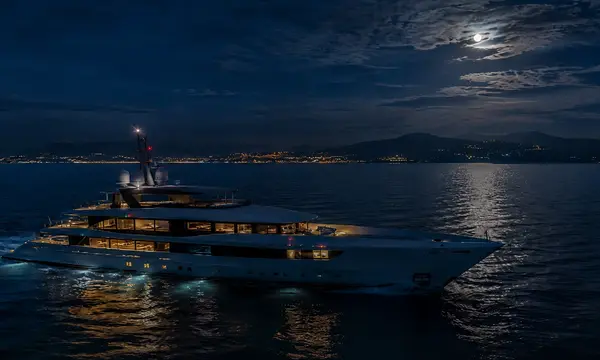
While guests sleep through an overnight passage, bridge and engineering teams remain fully engaged. Watchkeeping, machinery monitoring, fatigue control and arrival planning make the …
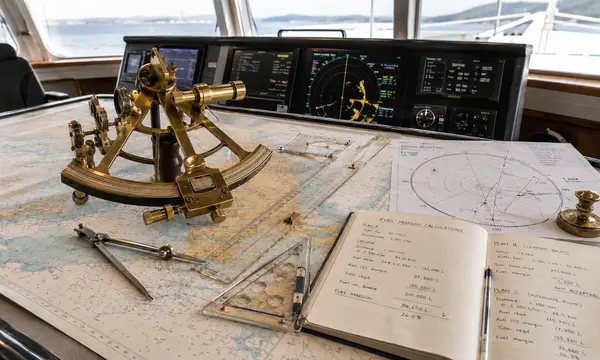
Good passage planning is not just a route on a chart. It is a moving judgement about weather, fuel, safe havens, crew endurance and …
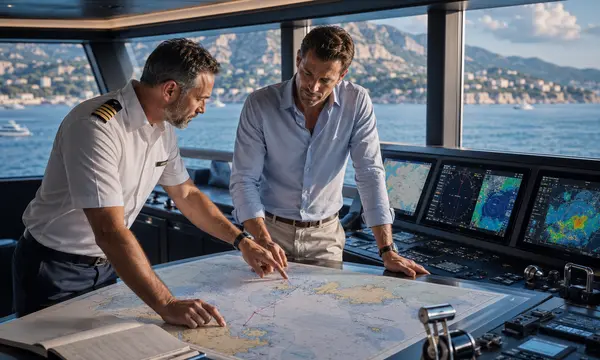
Passage planning turns an owner’s preferred itinerary into a safe, legal and realistic superyacht voyage, balancing comfort, weather, fuel, crew and risk.
Superyacht Guide
Continue into the wider Superyacht Guide.