Company
International Maritime Organization
Explore the company profile and related Superyacht Guide coverage.
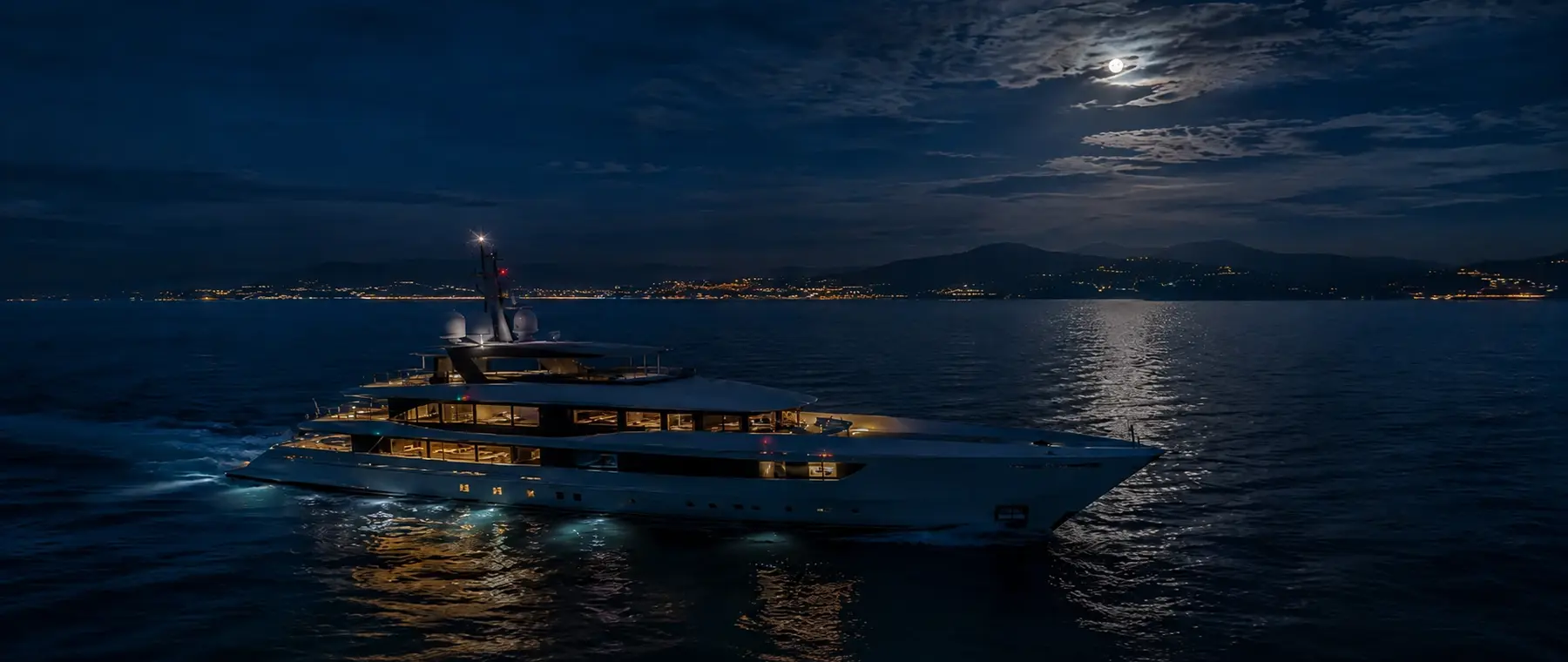
While guests sleep through an overnight passage, bridge and engineering teams remain fully engaged. Watchkeeping, machinery monitoring, fatigue control and arrival planning make the apparently effortless change of destination possible.
At midnight, a superyacht can feel almost impossibly quiet. Dinner has finished, exterior lighting has been reduced, cabin doors are closed and the activity that filled the decks during the day has largely disappeared. A guest waking briefly might notice only the faint movement of the yacht, the low sound of machinery or a changing line of lights beyond the window before turning over and going back to sleep.
Behind that apparent stillness, however, the yacht has entered one of the most disciplined phases of its operation. The bridge remains active, engineering systems continue to be monitored, watchkeepers rotate through their duties and the yacht's progress is reassessed as weather, traffic and sea conditions change. What appears to the guest as an effortless transition from one destination to another is actually the result of an overnight operation involving navigation, machinery, fatigue management, communications and careful preparation for the arrival ahead.
That contrast is one of the least visible aspects of superyachting. Guests experience dinner in one anchorage, sleep through the passage and wake somewhere new, while much of the crew's most concentrated work has taken place during the hours in between.
During the day, the bridge can feel connected to the guest experience. Owners or guests may be invited in to look at the chart, discuss the next destination or watch the yacht approach a harbour, and natural light makes the room feel open to the rest of the vessel. At night, the same space becomes a more controlled working environment in which lighting is reduced, unnecessary conversation disappears and attention shifts towards the route, surrounding traffic, weather and the yacht's behaviour at sea.
A navigational watch is not simply a matter of leaving someone beside a bank of instruments until morning. International collision regulations require a proper lookout to be maintained using sight, hearing and all appropriate available means, while the risk of collision, safe speed and the movement of surrounding vessels have to be continually assessed. Radar, AIS, electronic charts and other bridge systems provide enormous assistance, but they do not remove the need for human judgement or the responsibility of the watchkeeper to understand what is developing around the yacht.
The workload can vary dramatically from one night to another. A long offshore leg in settled weather may offer extended periods of relatively uncomplicated navigation, whereas a passage through a busy traffic separation scheme, a fishing area or the approaches to a major port can demand continuous assessment. Reduced visibility, uncertain vessel movements, changing weather or dense commercial traffic can require additional lookout arrangements or the captain's presence on the bridge even when another officer formally has the watch.
Much of this activity remains invisible to everyone sleeping below. A yacht may alter course slightly during the night because another vessel is expected to pass too close, reduce speed because traffic is converging ahead or modify the route to avoid weather that has developed since departure. When those decisions are made early and professionally, the guest is unlikely to know they happened at all, which is precisely the point.
Modern superyacht bridges contain an extraordinary amount of information. Electronic charts display the planned route and navigational hazards, radar reveals traffic that may be difficult to see visually, AIS provides information about many surrounding vessels, satellite systems deliver updated weather data and integrated monitoring displays can show propulsion, stabilisation and machinery information alongside navigation data.
The challenge is no longer simply obtaining information but interpreting it correctly. A radar contact may be obvious electronically while almost invisible outside, an AIS target may not behave as expected, rain can affect radar presentation and shore lighting can make small craft difficult to identify visually. The watchkeeper therefore has to compare what the instruments are reporting with what can actually be seen and heard, while remaining conscious of the limitations of every system being used.
Night makes that judgement particularly important because the visual world becomes less intuitive. A cluster of lights can belong to a fishing vessel, a ferry, a ship at anchor or infrastructure on the coastline, and the relative movement of another vessel may not be immediately apparent simply by looking through the bridge windows. Radar plotting and electronic information help establish the developing picture, but the officer still has to decide whether the situation is safe and when action should be taken.
The busiest night passages are not necessarily those involving poor weather. Areas such as the approaches to Gibraltar, the English Channel, the Strait of Messina and major Mediterranean ports can remain heavily trafficked throughout the night, while fishing activity can turn apparently open water into a complex navigational environment. The bridge can therefore be one of the most intensely alert places aboard at exactly the moment when the guest decks feel at their quietest.
Navigation is only one part of the overnight operation. While the bridge manages the yacht's position and movement through the water, the engineering department is responsible for the machinery and systems that keep both the vessel and the guest environment functioning.
A superyacht underway is consuming and managing far more than propulsion power. Generators continue supplying electricity, air-conditioning remains active throughout the accommodation, refrigeration protects provisions, pumps move water and fluids, stabilisation systems may be operating and navigation, communications, sewage treatment and freshwater systems all depend on machinery continuing to perform correctly.
Engineering watch arrangements differ according to the yacht, its machinery installation, certification and operating procedures. Some machinery spaces may be attended under particular circumstances, while other yachts operate approved unattended machinery arrangements supported by alarm systems and call-out procedures. In either case, the absence of an engineer physically standing beside the engines does not mean the machinery has been left unattended in an operational sense.
Temperatures, pressures, tank levels, generator loads and propulsion behaviour provide an evolving picture of machinery health. The engineering objective is to identify a developing problem while it is still manageable, because a minor fault at sea can carry very different consequences from the same problem alongside. A pump failure, unusual temperature rise or generator alarm that could wait for daylight in port may require immediate investigation if it affects an essential system during a passage.
Guests normally experience only the successful outcome of this work. The cabin remains at the chosen temperature, the lights work, water continues to run and the yacht arrives with all the domestic systems ready for the next day's programme. The engineering achievement lies partly in making an enormous amount of machinery operation effectively disappear from the guest's awareness.
Night passages are also exercises in managing human performance. International watchkeeping standards recognise fatigue as a genuine safety issue and require watch systems to be arranged so that personnel responsible for safety-critical duties are sufficiently rested to perform effectively.
That principle sounds straightforward until it is applied to a superyacht, where the same vessel is simultaneously a ship and a hospitality operation. A deck crew member may have spent the afternoon launching tenders and toys before later being required for passage-related duties, while interior crew may finish a late dinner service after the bridge has already settled into its overnight watch routine. Engineers can be called from rest by machinery alarms, and the captain may have to return to the bridge for weather, traffic or an approaching harbour even when another qualified officer has the watch.
Hours-of-rest regulations provide a formal framework on commercially operated yachts subject to the relevant conventions and flag-state requirements, but legal compliance alone does not guarantee that someone is genuinely refreshed. Interrupted sleep, repeated call-outs and badly timed duties can erode alertness even when the paperwork appears acceptable, which is why experienced operators look beyond the minimum numerical requirements when planning a demanding passage.
The problem becomes particularly acute towards the end of the night. A yacht may arrive at an unfamiliar harbour shortly after sunrise, meaning that the most demanding navigation, deck preparation and manoeuvring of the entire passage occurs at the point when the human body naturally expects to be asleep. Good passage planning therefore considers not only the route and weather but also which people will need to be sharp for the arrival and how their rest can be protected beforehand.
A professionally managed yacht does not rely on adrenaline to compensate for poor scheduling. The captain and senior crew have to balance guest activity, maintenance, navigation and rest so that the people needed for safety-critical work are capable of performing it when conditions become complicated.
The guest accommodation does not become irrelevant simply because most people are asleep. Someone may wake feeling unwell, a child may need assistance, a guest may want water or decide to sit outside and watch the stars, while movement at sea can expose a loose object, an unfamiliar noise or a cabin issue that was not apparent alongside.
The overnight service arrangement therefore has to provide appropriate support without unnecessarily keeping an entire interior team awake. The exact system varies between yachts and guest programmes, but the underlying challenge is the same: preserve the level of service expected aboard while protecting the rest of crew who will be required for the following day.
Comfort can influence the passage itself as well. A yacht capable of maintaining a particular cruising speed may slow because the reduced speed produces a better motion, while a modest alteration of course can sometimes make the difference between an uncomfortable night and several hours of reasonable sleep. Stabilisation systems help enormously, but they cannot eliminate every effect of wind and sea state, so speed and routing remain operational tools for managing comfort.
Those decisions are rarely announced to guests unless they materially affect the itinerary. There is little value in waking someone to explain that the captain has reduced speed by a knot because the yacht is riding more comfortably, or that the route has been adjusted slightly to improve the angle to the sea. Successful operation often consists of making small changes early enough that the guest experience remains uninterrupted.
This is one of the ways night service differs from daytime hospitality. During the day, luxury is frequently demonstrated through visible attention, but during an overnight passage the highest level of service may be expressed by how little the guest has to notice.
The romantic version of a night passage ends with the first light appearing over a beautiful coastline and the yacht gliding towards an anchorage. From an operational perspective, those final hours can be the most demanding period of the voyage because several parts of the yacht begin moving from night mode into arrival mode at the same time.
Navigation becomes more confined as the vessel approaches land, traffic may increase and the captain may return to the bridge if not already there. The deck department begins preparing lines, fenders or anchoring equipment, while engineering ensures propulsion and manoeuvring systems are ready for whatever the arrival requires. Communications with harbour authorities, agents, pilots or marinas may begin at the same time that the interior department starts preparing for the guests' morning routine.
Arrival timing is therefore more than an itinerary decision. Daylight can provide valuable visual information when entering an unfamiliar harbour or anchorage, but the yacht may also have to account for traffic, weather, pilot availability, berth arrangements and local restrictions. The most visually attractive arrival time is not always the safest or most practical one.
A well-run yacht manages this transition without making it feel like a major event. A guest may walk onto the aft deck at seven in the morning and find coffee ready, land ahead and the yacht already slowing towards its destination, with little indication that the bridge team has been monitoring the approach for hours and the deck crew are already preparing for the final manoeuvre.
At that moment, two different working days can overlap. One group of crew may be completing a night watch and preparing to rest, while another begins the service, deck and housekeeping programme that will carry the yacht through the day. Managing that overlap without exhausting the people involved is part of the invisible organisation behind a successful passage.
Night passages illustrate an important truth about superyachting: much of the real luxury aboard is created by processes that owners and guests rarely need to witness. They do not need to follow every radar contact, understand watch schedules, monitor generator loading or know that the yacht altered course during the night because another vessel was expected to pass too close.
What they experience instead is continuity. Dinner is served in one place, the yacht moves through the night and breakfast begins somewhere new, while the complicated work required to connect those two moments remains largely behind the scenes.
That apparent simplicity depends on competent watchkeeping, machinery monitoring, proper handovers, realistic passage planning and disciplined management of fatigue. It also depends on departments that are often thought of separately — bridge, engineering, deck and interior — operating as parts of the same system throughout the night.
When everything works as intended, there is little drama to recount the following morning. The yacht has moved safely, the guests have slept, the machinery has performed, the crew required for arrival are ready and the next destination is waiting outside.
That is what a successful night passage looks like from the guest deck: almost nothing happened. Below and above them, however, the yacht never stopped working.
Explore
Go deeper into the yachts, companies, events and destinations directly connected to this article.
Company
Explore the company profile and related Superyacht Guide coverage.
Continue reading
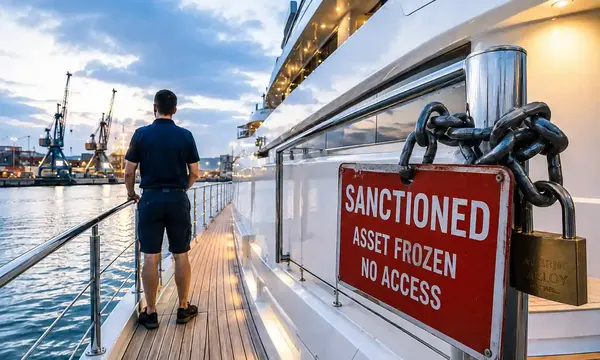
A sanctions freeze can immobilise a superyacht without making its crew sanctioned, leaving wages, contracts and daily operations caught between employment law and financial …
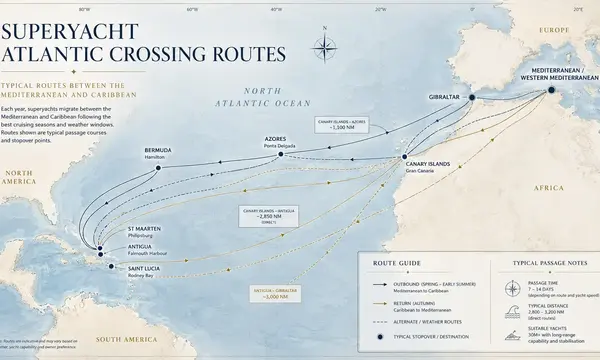
Many superyachts can cross the Atlantic, but safe passage depends on real-world range, fuel margin, machinery reliability, crew watchkeeping and the weather window.
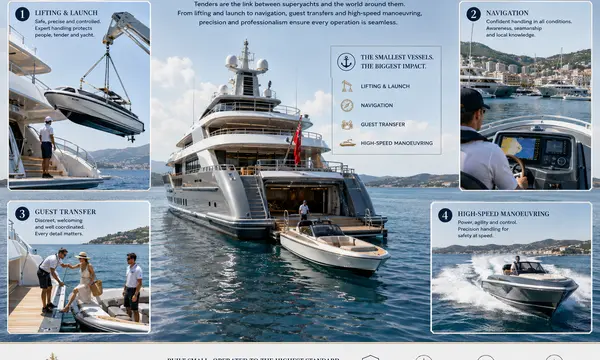
A tender may be one of the smallest vessels in a superyacht operation, but it combines lifting, navigation, passenger transfer and high-speed manoeuvring in …
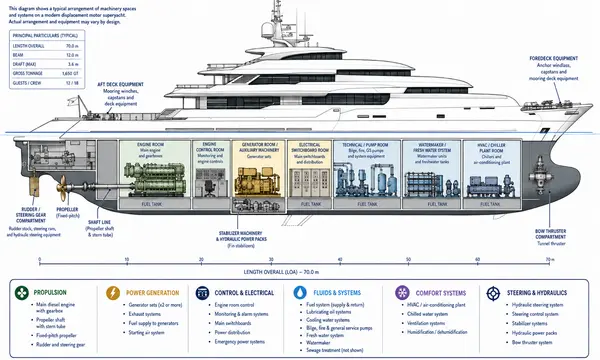
Behind every quiet cabin, working shower and seamless passage is an engineering team responsible for keeping a highly complex vessel operating safely, reliably and …
Superyacht Guide
Continue into the wider Superyacht Guide.
Business opportunities · Superyacht Guide
Companies serving the superyacht market can discuss clearly identified advertising, sponsorship and business-profile opportunities. Commercial activity remains separate from independent editorial coverage.