Company
International Maritime Organization
Explore the company profile and related Superyacht Guide coverage.
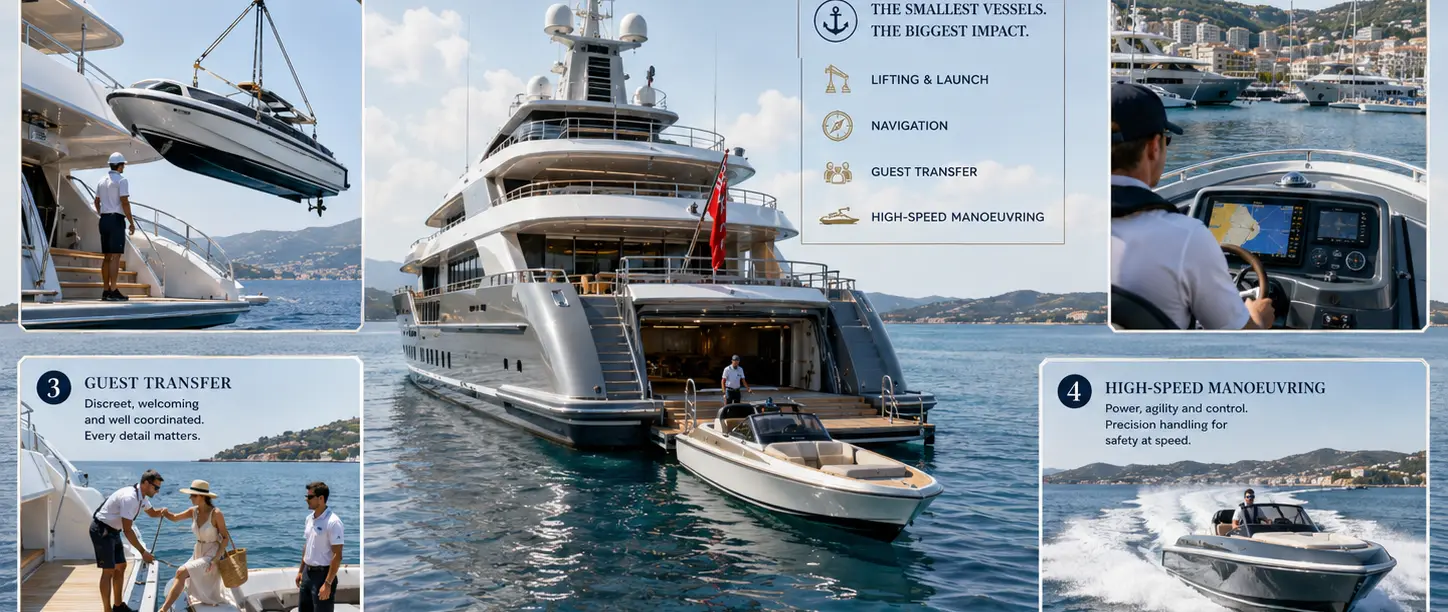
A tender may be one of the smallest vessels in a superyacht operation, but it combines lifting, navigation, passenger transfer and high-speed manoeuvring in an environment where routine can quickly become risk.
A superyacht tender can make one of the most complicated operations aboard look effortless. It appears at the swim platform when guests want to go ashore, carries them to a restaurant or beach, returns later that evening and disappears into the garage before most people aboard have given the exercise much thought. On a busy charter yacht this can happen repeatedly throughout the day, creating the impression that tender movements are simply another element of guest service rather than a sequence of maritime operations requiring their own planning, equipment and judgement.
That apparent simplicity is deceptive. During a single journey the deck team may have to launch several tonnes of tender from a moving yacht, transfer passengers between two independently moving platforms, navigate through an unfamiliar anchorage, enter a crowded harbour, manage a landing and repeat the entire process after dark. Weather may change between the outward and return journeys, the person driving may already have worked a long day, and the passengers may have little understanding of how quickly conditions aboard a small craft can change.
Unlike the mothership, the tender has little mass with which to absorb poor conditions. A wake that barely registers aboard a 70-metre yacht can throw a tender hard against a boarding platform, while a modest increase in wind can make recovery beneath a crane substantially more difficult. Shore lights can obscure small boats at night, and a powerful tender capable of more than 30 knots can consume the available distance between recognising a hazard and colliding with it remarkably quickly.
That combination makes tender operation one of the least appreciated concentrations of risk within the superyacht programme. It is also a risk that can increase with familiarity, because the more often the same transfer is completed without incident, the easier it becomes for a genuine navigation, lifting and passenger-transfer operation to feel like nothing more than another trip ashore.
The first mistake is to think of the tender principally as an accessory. Large yachts increasingly carry sophisticated custom tenders with their own navigation systems, powerful propulsion, communications equipment and considerable passenger capacity. Some are limousine tenders intended for sheltered transfers, while others are high-speed RIBs, landing craft, dive tenders or multipurpose boats expected to work well beyond the protected water in which they may have been commissioned.
Whatever its type, once a tender leaves the yacht it becomes a vessel operating independently in the marine environment. The fundamental requirements of navigation do not disappear because the boat is eight metres long instead of 80. The International Regulations for Preventing Collisions at Sea centre on principles including proper lookout, safe speed, assessment of collision risk and appropriate action to avoid collision, and those obligations remain highly relevant when a tender is travelling quickly through an anchorage, harbour approach or coastal route.
In some respects, applying those principles can be harder aboard a small high-performance craft. The helm may be closer to spray and glare, passengers may be talking immediately behind the operator, the boat can accelerate very rapidly and the person driving may have much less time than a superyacht bridge team to interpret a developing situation. A modern tender may also be travelling considerably faster than the mothership routinely does in confined water, so a seemingly small lapse in concentration can have disproportionately large consequences.
Short routes encourage another form of complacency. When the crew have driven between the same anchorage and harbour twenty times during the week, local knowledge can begin to replace conscious passage planning, yet the environment is never completely static. Yachts swing, fishing boats appear, paddleboards cross established routes, temporary moorings are laid and harbour traffic increases around restaurants and beach clubs at precisely the times when superyacht guests are often travelling.
The Marine Accident Investigation Branch investigation into the fatal collision involving the tender of motor yacht Isabell Princess of the Sea in Göcek, Turkey, provides a particularly serious illustration. The 7.35-metre tender was travelling at about 28 knots at night when it collided with the 5.6-metre RIB Vega, killing the sole person aboard the smaller craft. MAIB found shortcomings involving passage planning, speed, lookout and use of the available navigation equipment. The accident should not define tender operations generally, but it demonstrates how quickly a journey that feels routine can acquire the same collision risks as any other passage.
For a superyacht, the operational implication is clear: the safety culture of the bridge should not stop at the swim platform. The tender may be smaller, but it is still carrying the yacht’s guests, crew and operational responsibility every time it leaves the mothership.
Many tender journeys begin with something potentially more hazardous than navigation: lifting. A tender stored on deck, in an open well or behind shell doors may have to be attached to lifting points, moved with a crane or davit and lowered into water that is moving independently beneath it. The operation can involve several tonnes of suspended weight, crew positioned close to pinch points and a yacht whose own motion changes the geometry of the lift from one second to the next.
The UK Maritime and Coastguard Agency treats lifting operations aboard vessels, including relevant yacht operations, within a formal safety framework. That reflects an obvious reality which can nevertheless become obscured by routine: a tender crane is not simply a convenience system used to put a boat in the water. It is lifting equipment handling a significant load in an environment where wind, swell, vessel motion and human positioning all affect the outcome.
Conditions that remain comfortable aboard the mothership may already be problematic at tender level. A 60-metre yacht can sit relatively calmly while the tender beneath the crane is moving through a much greater arc, and windage can drive a suspended boat sideways towards topsides or deck structure. Tag lines can load suddenly, the yacht can roll unexpectedly and a crew member who instinctively reaches out to control the tender may put hands, feet or body weight into a dangerous position.
There is also an important distinction between lifting the tender and lifting people inside it. The Red Ensign Group Yacht Code addresses the concept of “man-riding” where people remain inside a tender, rescue boat or similar craft during launch or recovery, and equipment approved for such use is treated differently from equipment that is not. The exact requirements depend on flag, vessel status and equipment certification, but the underlying operational principle is clear: a crane being capable of lifting a tender does not automatically establish that passengers or crew should remain aboard while it is suspended.
Good tender procedures remove uncertainty before the operation begins. The crew should know who controls the crane, who controls the tender, who gives the final command, where personnel may stand and who has authority to stop the operation if conditions deteriorate. Recovery requires the same discipline because the circumstances may be very different several hours later; the tender may return wet, carrying additional equipment or fuel, while wind and sea conditions have changed since launch.
This is one area where refusing or delaying an operation can be evidence of professionalism rather than overcaution. A yacht may be perfectly safe and comfortable at anchor while tender recovery has become unnecessarily hazardous, and the deck team should not feel pressured to continue simply because guests are waiting or the operation succeeded earlier in the day.
Owners and guests usually experience tender operation as part of the service provided by the yacht. They want the tender ready when required, clean and dry, with a smooth ride and a convenient landing. The deck team sees a different problem: two or more moving platforms, changing sea conditions and passengers whose priorities and physical abilities may differ substantially from those of trained crew.
Alongside the mothership, the tender can rise and fall, surge ahead or drop astern while fenders compress and release. The height of the boarding step changes continuously, and a passing wake can turn an apparently easy transfer into an awkward gap within seconds. At the shore end the variables change again, because a floating pontoon behaves differently from a fixed stone quay, while a beach, exposed jetty or improvised landing can present conditions that were not present when the guests originally went ashore.
The passengers themselves add another layer. Guests may be wearing footwear selected for dinner rather than boarding a boat, carrying telephones or bags, helping children or dealing with restricted mobility. Alcohol may become relevant on the return journey even when it played no part in the outward trip. A competent deckhand therefore has to watch the tender’s movement, the guest’s balance, the distance to the landing, other crew members, neighbouring boats and the actions of the helm while still making the entire transfer appear calm and effortless.
That is why a professional tender operation cannot assume guests understand boats. It has to be designed around the possibility that they do not. Instructions about where to sit, when to move, what to hold and when to remain seated should be clear without becoming theatrical, while the crew need sufficient authority to halt a transfer if the timing or conditions are wrong.
Propulsion makes the final approach particularly important. Propellers and waterjets create obvious hazards around anyone entering the water unexpectedly, while appendages on the mothership can affect where the tender can safely remain. A convenient boarding point is therefore not automatically a safe one, and the crew may occasionally need to use the opposite side of the yacht, change the landing place ashore or abandon a beach transfer altogether.
From the guest’s perspective, those decisions may appear inconvenient. From the tender helm, they may represent the difference between continuing a routine operation and allowing service expectations to override basic seamanship.
Tender use after dark deserves particular attention because almost every familiar element of the daytime journey changes. The restaurant may still be in the same harbour and the yacht anchored in the same bay, but visual information has deteriorated considerably. Shore lighting can make the situation worse rather than better, because navigation lights and small craft may disappear against illuminated waterfronts while glare from the yacht or tender reduces the operator’s ability to adapt to darkness.
Speed becomes especially important in this environment. A tender capable of 35 or 40 knots has no obligation to use that performance simply because the route is familiar, and safe speed should reflect what the operator can actually see and the distance available to respond. Fishing boats, RIBs, paddle craft, swimmers, floating debris and poorly lit moorings can all be far more difficult to identify at night, particularly when combined with spray, windscreen reflections or bright cockpit displays.
The COLREG requirements governing lookout, safe speed and navigation lights remain relevant regardless of whether the passage is two miles or two hundred. The Göcek casualty illustrates how several relatively ordinary weaknesses can combine: MAIB identified problems involving passage planning, lookout and speed, and also examined the human factors surrounding the tender operation. The investigation noted issues relating to authority and alcohol, while the yacht manager subsequently introduced additional safety-management provisions concerning tender use at night.
The wider lesson is not that night transfers should be avoided, but that they cannot simply be treated as the daytime operation with the sun removed. Routes that are completely familiar still deserve consideration, local speed limits need to be understood and navigation equipment should be used rather than disregarded because the person at the helm already knows the harbour.
Crew fatigue adds another dimension. A deckhand may begin work early preparing exterior areas and toys, spend much of the afternoon running watersports and then undertake repeated tender transfers after midnight. The boat itself remains mechanically capable of completing another trip, but the operator’s judgement, concentration and reaction time may no longer be at the same level as they were earlier in the day.
This is where tender safety becomes a management issue rather than merely a deck-department issue. The captain needs enough suitably competent people to prevent every late-night movement falling to one exhausted crew member, while owners and guests need realistic expectations about when transfers can be made. Fitness for duty should be treated with the same seriousness as it would be on the bridge of the yacht, because recreational use does not reduce the consequences of impairment once a tender is moving at speed.
The most important element of a safe tender programme is therefore not the engine, electronics or even the boat itself. It is operating discipline. A well-run yacht establishes who is authorised to drive each tender, where they may operate, what communications are required and under what conditions a particular boat should remain aboard.
The details will differ between yachts, but the questions are remarkably consistent. The helm should be competent with the actual tender rather than simply holding a general qualification; unfamiliar routes should be considered before departure; local restrictions and speed limits should be understood; and the bridge should know where the tender is going and who is aboard. Weather should be considered for the expected return as well as the outward journey, and the operator must remain fit for duty throughout.
Emergency planning is equally important because the assumption that every problem can be solved by calling the mothership is not enough. A tender can lose propulsion several miles from the yacht, foul a rope, suffer an electrical failure, become involved in a collision or find that deteriorating weather has made the intended return route or landing unsuitable. Communications can themselves fail, while a guest injury ashore can turn what began as a restaurant transfer into a medical and logistical problem.
The equipment carried should therefore match the actual operation. Fuel reserves, navigation equipment, communications and lifesaving gear should reflect how far and in what conditions the tender is expected to travel. A boat routinely carrying guests several miles from the yacht is operationally different from one used only to cross a protected marina, even if both happen to be described simply as “the tender”.
The bridge also needs to maintain awareness of the yacht’s smaller craft. Large yachts may simultaneously operate guest tenders, chase boats, rescue craft, PWCs and watersports equipment, effectively creating a small fleet around the mothership. Knowing which craft are away, who is operating them, who they are carrying and when they should return is not unnecessary bureaucracy; it is basic operational control.
Maintenance belongs within the same culture. Steering, throttle controls, navigation lights, radios, bilge systems, lifting points and propulsion equipment are safety-critical regardless of the tender’s size. A defect that would be considered unacceptable on the yacht should not become normal merely because the equipment is fitted to a smaller boat.
The irony of tender operations is that success makes them look trivial. Hundreds of transfers can take place without incident, the crew become extremely efficient at launching and recovering the boats, and guests become accustomed to stepping aboard without thinking about what is involved. The familiar route from the yacht to the marina can eventually become so routine that conscious navigation feels unnecessary.
That is precisely when risk can become invisible. A superyacht bridge team recognises a night harbour approach, deteriorating weather or a close-quarters situation as circumstances requiring increased attention, yet an eight-metre tender can encounter all three during a twenty-minute guest transfer. Its smaller size does not reduce the responsibility carried by the person at the helm; in some respects it concentrates it into a faster, more exposed environment with fewer people available to identify mistakes.
For owners, this means understanding that a slower journey, altered landing point or decision not to launch can be evidence of good seamanship rather than poor service. For captains, it means ensuring that the yacht’s safety-management culture continues beyond the stern platform and into every craft carrying guests away from the mothership. For the crew member driving the tender, it means resisting the dangerous moment when familiarity transforms a genuine voyage into something that no longer feels worthy of preparation.
The best tender operation is therefore not defined by horsepower, elaborate electronics or the price of the boat. It is defined by a crew who can make a complicated sequence of lifting, navigation, transfer and recovery appear effortless to the guests without ever allowing that appearance of effortlessness to influence the seriousness with which they conduct it.
That is why tender operations deserve more attention within the superyacht world. The tender may be one of the smallest vessels in the programme, but every time it leaves the yacht it carries people, responsibility and risk far beyond its physical size.
Explore
Go deeper into the yachts, companies, events and destinations directly connected to this article.
Company
Explore the company profile and related Superyacht Guide coverage.
Continue reading
While guests sleep through an overnight passage, bridge and engineering teams remain fully engaged. Watchkeeping, machinery monitoring, fatigue control and arrival planning make the …
Can a Superyacht Transit the Suez Canal? Fees, Security and Planning Yes. Tourist yachts can transit the Suez Canal, with current Suez Canal Authority …
Can a Superyacht Transit the Panama Canal? Cost, Size and Booking Yes. Superyachts transit the Panama Canal, but tolls, booking options, pilotage and scheduling …
Can a Superyacht Cross the Pacific? Range, Fuel and Route Planning Yes. Properly designed ocean-going superyachts cross the Pacific, but the route is far …
Superyacht Guide
Continue into the wider Superyacht Guide.