Where Is the Best Place to Buy a Superyacht?
Where Is the Best Place to Buy a Superyacht? There is no single best country or boat show for every buyer: the strongest market …
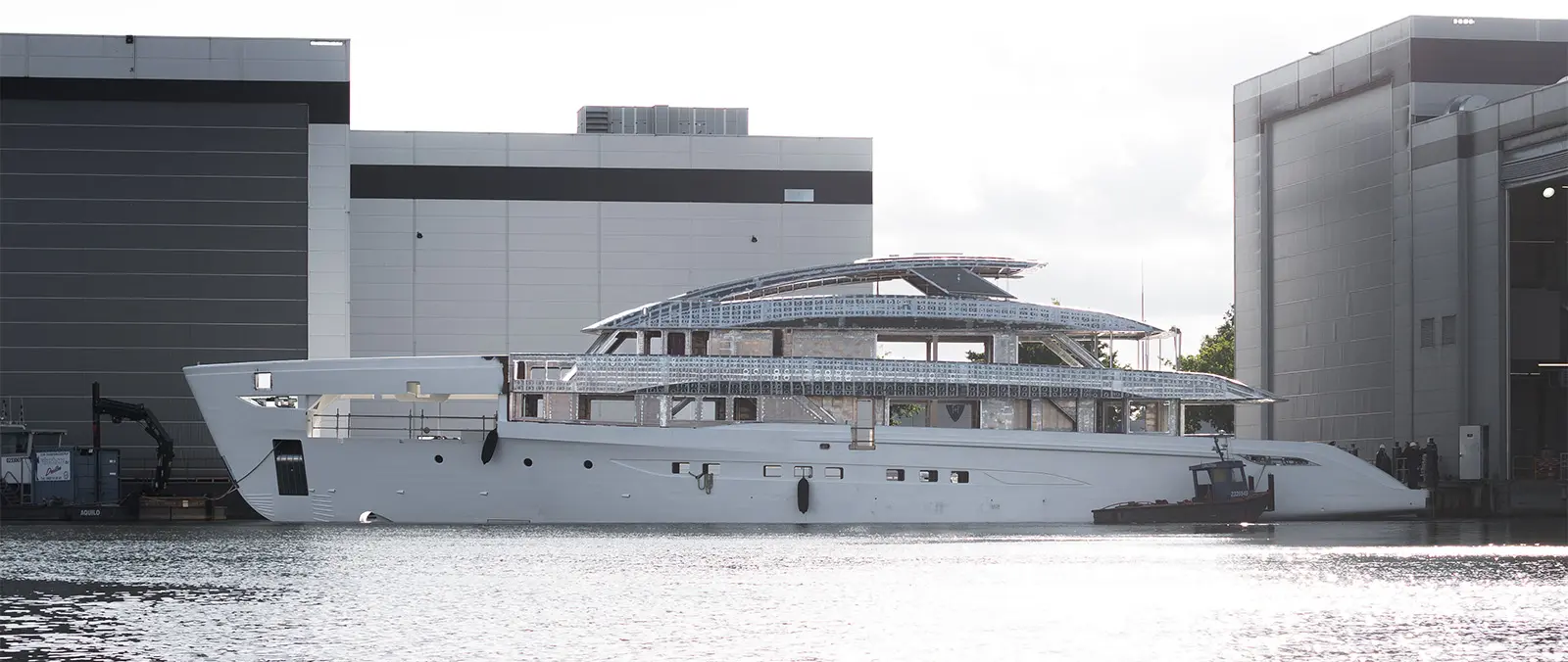
Image: Heesen Yachts
A superyacht can take anywhere from around two years to more than five years to build. Superyacht Guide examines realistic 40m to 100m timelines, why custom yachts take longer and how buying a yacht already in build changes the wait.
A useful answer to how long a superyacht takes to build is about two to five years, but length alone does not determine the schedule. A 50-metre yacht based on an established technical platform and already under construction can reach its owner far sooner than a smaller clean-sheet custom yacht, while an 80- or 100-metre project can absorb several years of design, engineering, fabrication, outfitting, commissioning and trials.
There is another complication: people often start the clock at different points. An owner may regard the project as beginning when the design brief is signed, a shipyard may measure physical construction from first steel or keel laying, and a buyer purchasing a speculative yacht halfway through construction may count only the months between signing and delivery, so three different answers can describe exactly the same yacht.
The ranges below are Superyacht Guide planning ranges rather than claimed statistical industry averages. They synthesise recent official shipyard programmes and disclosed construction milestones and assume a professionally managed project without a major redesign during construction.
These ranges primarily describe serious production engineering and physical construction through delivery. A completely new yacht can require another six to eighteen months or more before first steel while the owner, designers, naval architects, class society, flag advisers and shipyard turn the original concept into an approved vessel that can actually be manufactured.
Around 40 to 60 metres, the greatest scheduling difference is often not length but whether the engineering already exists. Heesen Yachts explicitly distinguishes its Smart Custom approach from Full Custom construction, using proven hull engineering to reduce engineering time while still allowing extensive personalisation.
Project Grace illustrates the other end of the 50-metre spectrum because it is the first yacht in Heesen's new 50m Steel class. The keel-laying milestone took place in December 2024 and delivery is scheduled for the first quarter of 2028, putting the programme at a little over three years from keel milestone to planned delivery.
The buyer's personal waiting time can nevertheless be dramatically shorter when construction begins before the final owner enters the project. Heesen sold the 50-metre Project Jade in February 2024 with delivery scheduled for the second quarter of the same year because the yacht was already approaching launch rather than starting fabrication when the purchase agreement was signed.
Once yachts move through the 60- to 80-metre range, the programme becomes increasingly dominated by engineering integration. Electrical generation, HVAC, hotel loads, stabilisation, hydraulics, navigation systems, AV and IT, tenders, pools, lifting equipment and increasingly sophisticated propulsion systems all have to function as one coordinated technical architecture.
Heesen's 72.3-metre Project Ananda provides a current planning benchmark. Keel laying is scheduled for November 2026 and delivery for the first quarter of 2030, implying approximately 38 to 40 months between those milestones even though the yacht is conceived as a Smart Custom platform rather than an unrestricted blank-sheet design.
The first Amels 80 provides an unusually useful real-world comparison because Damen Yachting has published both ends of the physical construction programme. Steel cutting took place on 17 May 2022 after two years of detailed design and engineering, while the completed first yacht, PANGEA, was delivered on 28 October 2025.
That means the visible physical construction programme occupied about 41 months, while the complete design-and-build effort was substantially longer. It is a useful reminder that an 80-metre Limited Editions yacht may reuse proven thinking but still remains a major shipbuilding project involving thousands of engineering, production and outfitting decisions.
The distinction between construction time and owner waiting time is particularly clear on yachts built on speculation or as part of an established platform programme. The shipyard carries the early construction period before the final owner arrives, allowing the buyer to enter after structural and engineering milestones have already been completed.
The 60-metre MEMORIES demonstrates how far this can go. Damen Yachting states that her owner entered the project only about six months before delivery while still being able to make a number of customisations, showing that a short buyer timeline does not mean the yacht itself was constructed in six months.
For buyers comparing new-build opportunities, the practical question is therefore not simply how long a model takes to build. It is what work has already been completed on the specific hull, what decisions remain open and whether major equipment, engineering approvals and production slots are already secured.
The upper end of the market is where four- and five-year planning horizons become increasingly realistic. At approximately 100 metres, the owner may be commissioning a unique hull form, propulsion architecture, structural glazing, pools, aircraft facilities, large tenders, energy-storage systems and hotel services whose engineering complexity is closer to a specialised ship than a conventional leisure craft.
Superyacht Guide previously documented the physical construction of NIXIE in Inside the 44-Month Build of 102m Lürssen NIXIE. The 102.4-metre Lürssen yacht progressed from first steel in November 2022 to delivery on 26 June 2026, providing a physical-build benchmark of approximately 44 months before allowing for the design and engineering work that preceded fabrication.
Feadship's 100-metre Project 824 provides another useful scale reference because the builder describes it as a pure-custom creation with diesel-electric propulsion and ABB pod drives. At the still larger and more technologically experimental end of the spectrum, Feadship described its 118.8-metre hydrogen fuel-cell Project 821 as five years in the making.
The programme begins with design and specification. The owner, exterior and interior designers, naval architect, project team and shipyard establish dimensions, general arrangement, performance, equipment, materials and regulatory requirements before production engineering converts those decisions into calculations and thousands of drawings.
Physical construction then moves from steel or aluminium cutting into block fabrication, hull assembly and superstructure joining. Machinery, piping, cabling and technical equipment are progressively installed, often before large sections are closed because later access would be difficult or impossible.
Outfitting consumes a major portion of the calendar because the yacht must transition from a structure into a finished operational vessel. HVAC, electrical systems, propulsion equipment, insulation, joinery, stone, glass, lighting, furniture, navigation and entertainment systems have to be installed in a sequence that prevents one trade from blocking another.
Launch is not delivery. Commissioning, harbour acceptance tests and sea trials follow, allowing propulsion, steering, navigation, stabilisation, generators, safety systems and hotel services to be tested together before faults are corrected and the yacht is formally accepted.
The greatest schedule advantage comes from reusing proven engineering. A hull, machinery arrangement and structural design that have already been built successfully reduce the quantity of new calculations, approval work and integration risk compared with an entirely new technical platform.
Starting a yacht on speculation can shorten the eventual owner's wait even further because the yard finances and completes early milestones before the buyer signs. Early owner decisions also protect the critical path, since changing loose furniture late is very different from moving a staircase, enlarging a pool or changing propulsion architecture after production drawings and structural work are complete.
Full-custom design adds time because major solutions have to be developed rather than selected from an existing technical platform. New propulsion technology, unusual materials, extreme glazing, underwater spaces, large pools, helicopter facilities and demanding tender-handling arrangements can each generate yacht-specific engineering and approval work.
Supply chains and owner changes can extend the schedule as well. Main engines, generators, switchboards, stabilisers, custom glazing and specialist equipment may have long lead times, while a late design change can trigger revised drawings, class review, new purchasing, fabrication, installation and retesting.
Superyacht Guide examines those schedule risks separately in Why Delivery Dates Slip: The Owner's Guide to Build and Refit Timelines. The distinction matters because the present article establishes a realistic starting build horizon, while the delivery-date guide explains why an otherwise credible programme can subsequently move.
For a 40- to 50-metre yacht on a proven platform, an owner seeking a genuinely new build should generally think at least two to three years ahead unless an appropriate yacht is already in construction. For a 60- to 80-metre project, a three- to four-year planning horizon becomes more realistic as engineering complexity and customisation increase.
At around 90 to 100 metres, owners should normally think in terms of roughly four to five years for a substantial custom design-and-build programme, with additional time before construction where the yacht begins as a clean-sheet concept. The more novel the technical specification, the less useful length alone becomes as a predictor of delivery.
The most important lesson is that length is only the first variable. Platform maturity, gross tonnage, material, build stage at purchase, owner changes, technical novelty, yard capacity, approvals and supply-chain timing can move the completion date by many months.
Before signing, an owner should therefore ask for more than one promised delivery date. The useful documents are the engineering status, first-steel or keel milestone, major-equipment order status, hull and superstructure programme, outfitting sequence, launch window, commissioning period, sea-trial programme and contractual contingency, because together they reveal whether the proposed delivery date is supported by an actual construction plan.
Continue reading
Where Is the Best Place to Buy a Superyacht? There is no single best country or boat show for every buyer: the strongest market …
What Paperwork Do You Need When Buying a Superyacht? A superyacht acquisition requires far more than a bill of sale: buyers normally need a …
What Is a Superyacht Sea Trial? A superyacht sea trial is the buyer’s opportunity to observe the yacht operating underway before contractual acceptance, testing …
Can You Finance a Superyacht? Yacht Loans and Marine Finance Explained Yes. Private banks and specialist lenders offer yacht mortgage loans, pre-delivery finance and …
Superyacht Guide
Continue into the wider Superyacht Guide.
Business opportunities · Superyacht Guide
Companies serving the superyacht market can discuss clearly identified advertising, sponsorship and business-profile opportunities. Commercial activity remains separate from independent editorial coverage.