
A superyacht delivery date can move because of design changes, engineering, procurement, class approval, hidden refit work and commissioning. For owners, the best defence is disciplined decision-making, realistic contingency and professional control of the critical path.
A superyacht delivery date has a seductive certainty about it. It appears in a contract, a project programme or a progress report as a single day when years of design, engineering, fabrication and expenditure are supposed to resolve into something wonderfully simple: the owner walks aboard and the yacht is ready to leave.
The reality is more complicated. A delivery date sits at the end of hundreds of interdependent decisions and activities. Drawings must be approved before components can be fabricated. Components must arrive before systems can be installed. Systems must be installed before spaces can be closed. Machinery must run before it can be tested. Testing must be completed before faults can be corrected. Class, flag and other regulatory requirements must be satisfied before the yacht can be accepted for operation.
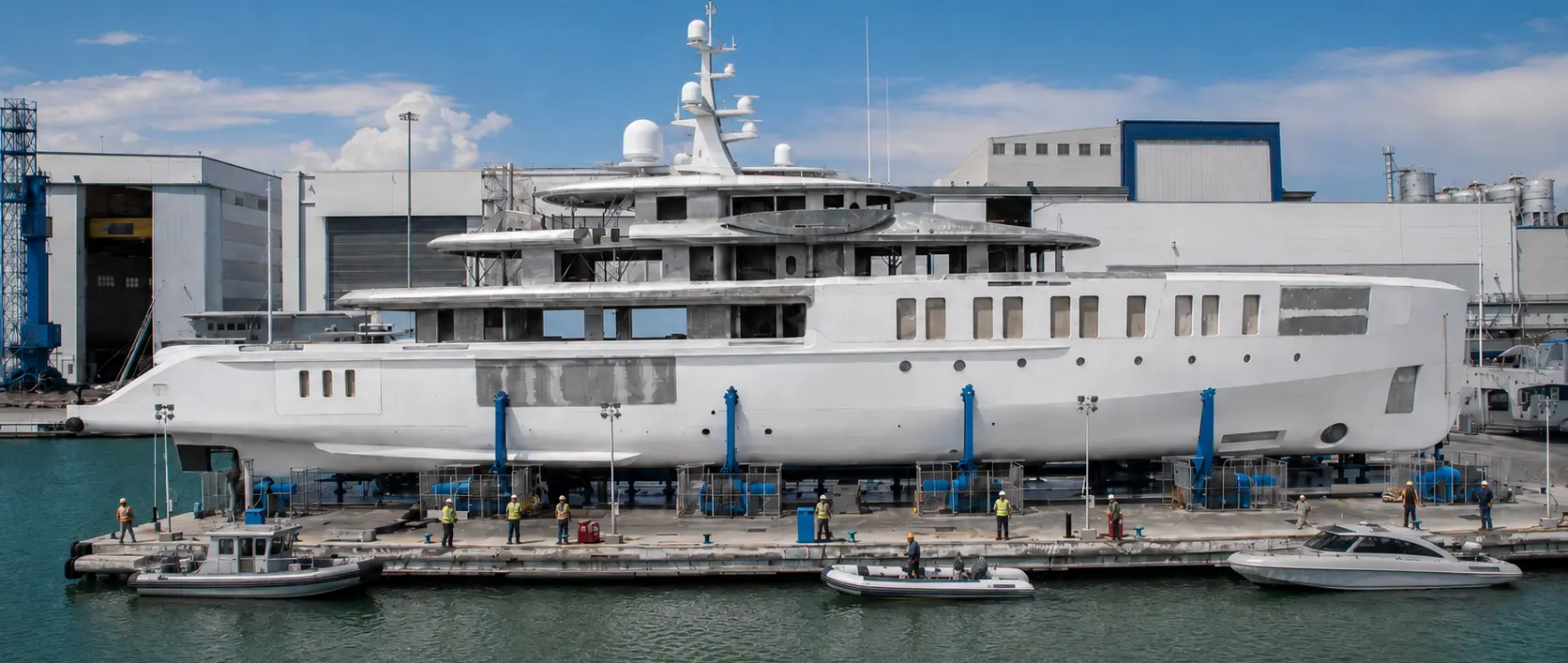
Lürssen describes custom yacht construction as a sequence of milestones extending from design approval through steel cutting, keel laying, block construction, launch, final outfitting and sea trials. Its description also makes an important point for owners: launch is not delivery. After the yacht enters the water, interiors and final work can continue while acceptance testing examines propulsion, navigation, dynamic positioning, noise, vibration, stabilisers, anchoring and other systems before final approval. Lürssen’s official construction overview demonstrates how much work can remain after a yacht first touches the water.
That is why a yacht can look virtually complete and still be weeks or months away from being genuinely ready. Delivery is not simply the day construction stops. It is the point at which a complex prototype has become an operational vessel that the owner can reasonably accept.
The most important misunderstanding about yacht schedules is that delay is often cumulative. A project may not suddenly lose three months. Instead, it loses three days here, five days there and two weeks somewhere else until the margin that once existed inside the programme has disappeared.
Project managers commonly think in terms of a critical path: the chain of activities that directly determines the earliest possible completion date. Some jobs have flexibility around them. Others do not. If a non-critical decorative item arrives late, another task may continue. If a critical switchboard, propulsion component, engineering approval or structural modification is delayed, several later activities may be unable to start.
Owner changes can have precisely this effect. Moving a wall, changing a staircase, selecting different lighting or replacing a piece of equipment may sound like an isolated alteration, but the physical change can require revised drawings, engineering calculations, new cable or pipe routes, purchasing, class review, fabrication, installation and retesting. A decision that takes five minutes in a meeting can therefore affect work that involves several companies and multiple decks.
Lürssen notes that design remains capable of revision during the development process and that a large custom build involves hundreds of specialised technicians and engineers across structural work, electrical engineering, joinery, painting and numerous other disciplines. The closer a significant change is made to physical construction, the fewer opportunities there are to absorb its consequences invisibly.
Decision-making speed matters for the same reason. An owner does not need to personally answer every technical question, but the project team needs a clear authority structure. When a designer, owner’s representative, captain, family office and owner all believe somebody else has final approval, apparently minor decisions can remain unresolved while work waits.
This is one reason an experienced owner’s representative is much more than a person who visits the yard and sends photographs. DNV’s discussion of yacht new-build management describes the owner’s representative and technical team reviewing structural, outfitting and systems drawings, working with class and flag, introducing specialist consultants and participating in harbour and sea acceptance trials. That structure exists because decisions made during construction have consequences for the yacht long after delivery. DNV’s new-build guidance provides the class perspective on this process.
Supply is another source of schedule vulnerability. A modern superyacht incorporates machinery, generators, switchboards, navigation systems, glazing, specialist doors, HVAC equipment, AV/IT, stabilisers, tenders, interior materials and countless bespoke components. The yard may control its own labour very well while still depending on manufacturers and subcontractors whose work sits directly on the project’s critical path.
Ordering late can therefore be just as damaging as building slowly. A replacement component may have a production lead time, engineering interface and commissioning requirement that cannot simply be overcome by putting more people onto the yacht.
A new build begins largely with drawings and new materials. A refit begins with an existing yacht, and that makes the schedule inherently less certain.
Some work can be inspected and priced in advance. Other problems become visible only after panels, insulation, machinery, tanks, pipework, cabling or coatings are opened up. Corrosion may extend farther than expected. Old electrical installations may not match drawings. A machinery overhaul may reveal additional wear. Removing an interior may expose work that no longer meets the standard required for the intended modification.
This is why experienced refit teams distinguish between known scope and discovery work. The owner may arrive expecting to replace generators, repaint the hull and renew guest spaces, only to discover that completing those jobs properly requires additional steel, pipework, insulation or electrical work.
ICOMIA’s Client’s Guide to Good Refit Governance places considerable emphasis on preparation. It recommends defining the work list in detail, assigning priorities and responsibilities, preparing specifications for larger refits, considering class and flag implications early and obtaining yard availability well in advance. Its guidance suggests approaching yards around six months ahead for more general refit work and considerably earlier for larger projects such as major structural alterations, long-period surveys or extensive painting.
That advance planning is not bureaucracy. It gives the yard time to reserve dock space, labour and subcontractors and gives the yacht time to order materials before the clock starts running against the desired departure date. ICOMIA also notes that shipyards may not place subcontract orders or purchase materials until the contractual down payment has been received, another reminder that commercial decisions and project scheduling cannot always be separated.
The danger for an owner is allowing the refit period to become an opportunity to do everything anyone has ever wanted to change about the yacht. Once the vessel is open and surrounded by trades, additional work can look temptingly efficient. The captain finds three more engineering jobs. The interior team proposes another upgrade. The owner decides that this is the moment to alter a cabin. The AV contractor recommends replacing a wider system rather than one component.
Each suggestion may be sensible. Collectively, they can destroy the original programme. A disciplined refit therefore needs a scope threshold. Safety, regulatory requirements and genuinely necessary discoveries must be dealt with. Desirable additions should be assessed against their effect on cost and the departure date rather than automatically added because the yacht happens to be in a shipyard.
Owners naturally become frustrated when a yacht appears physically finished but remains undelivered. From the quayside, the final phase can look disproportionately slow because much of the remaining work is no longer visually dramatic.
Yet commissioning is where individual systems become a functioning yacht. Pumps that worked in isolation must operate as part of complete systems. Alarms must behave correctly. Generators must share loads. Navigation equipment must communicate. Stabilisation must perform under real conditions. Hotel services must work while machinery is operating. Doors, tenders, cranes, anchoring equipment and safety systems all have to do what the specification says they will do.
Class and flag add another independent layer of assurance. DNV describes class and flag involvement throughout construction, including drawing review, feasibility work, hazard studies and on-site survey. Lürssen describes classification-society officials and owner representatives participating in sea trials before final approval.
Testing also creates findings. That is its purpose. A sea trial that exposes excessive vibration, an overheating component, a software problem or inadequate performance is not evidence that the trial failed as a process. It means the process found something that should ideally be corrected before the owner takes possession. The alternative—meeting a ceremonial delivery date by deferring important defects—can transform a schedule problem into an operational problem.
This creates one of the hardest decisions in a yacht project. There is a point at which delaying delivery to achieve perfection becomes inefficient because non-critical defects can reasonably be completed during a warranty period. But there is also a point at which accepting too much unfinished work merely transfers project pressure from the shipyard to the yacht’s crew.
The owner’s team therefore needs agreed acceptance criteria well before the final weeks. Items affecting safety, class, statutory certification, seaworthiness or essential operation belong in a very different category from minor cosmetic defects. A properly managed delivery is not a yacht with no outstanding item whatsoever; it is a yacht whose outstanding items are understood, documented, prioritised and contractually controlled.
The most effective owners are not necessarily those who demand the fastest answer to everything. They are the ones whose projects make decisions cleanly.
A realistic programme should distinguish between the contractual delivery date, the project team’s working completion target and the date on which the owner actually needs the yacht operational. Those dates should not automatically be identical. An owner planning a first family cruise, charter commitment or major event immediately after contractual delivery creates a second layer of risk because any movement in the build schedule immediately becomes a personal or commercial crisis.
For a major new build, senior crew should also join early enough to understand the vessel rather than meeting it at handover. DNV specifically points to senior crew involvement during the build and participation in harbour and sea acceptance trials as part of the transition from construction into operation.
For a refit, ICOMIA’s client guidance is similarly practical about owner-side participation. It stresses communication, written requests, prompt decisions, coordination with class and flag and realistic planning for the desired departure date. Its governance guidance explicitly warns that the yacht side also has responsibilities if a hard completion deadline is to be achieved.
The owner’s project controls should therefore answer a small number of questions consistently: What is currently on the critical path? Which decisions are overdue? Which owner changes have affected completion? Which long-lead items remain exposed? What has class or flag not yet approved? What testing remains? Which defects genuinely prevent delivery? And how much schedule contingency remains?
A glossy progress percentage is less useful than those answers. A project can be described as 95 per cent complete for a surprisingly long time if the remaining five per cent contains the work that determines whether the yacht can actually leave.
Changes should also carry a schedule consequence as well as a price. Owners are accustomed to seeing the cost of a variation order; they should be equally interested in its effect on delivery. A change that costs €100,000 and consumes no critical-path time is fundamentally different from one that costs the same amount but delays closing a deck for three weeks.
Good contracts provide a framework for dealing with these issues rather than eliminating them. ICOMIA’s Refit Contract Guide identifies scope, performance, oversight, redelivery, price and payment, insurance, warranty, disputes and force majeure among the areas owners and yards need to understand. The precise contractual consequence of delay will depend on the agreement and governing law, which is why significant build and refit contracts should be reviewed by experienced marine legal advisers.
There is one final timetable that owners frequently underestimate: the period after formal delivery. A brand-new or extensively refitted yacht may be legally and technically ready while the crew are still learning how she behaves. Stores must be organised. Spare parts must be catalogued. AV systems need familiarisation. The engineering team learns machinery quirks. The bridge team builds confidence in handling. Interior crew discover how guest routines interact with new equipment and layouts.
The first weeks of operation are therefore better treated as a controlled transition than as proof that the project is entirely finished. For an owner, this means the most valuable date may not be contractual delivery at all. It may be the date at which the yacht is sufficiently commissioned, crewed, provisioned and proven to undertake the intended programme confidently.
That distinction matters. A yacht delivered on 1 June and struggling through warranty defects during an important July cruise has not necessarily served the owner better than a yacht delivered on 15 June after a more complete testing programme.
The objective should not be delay for delay’s sake. Shipyards must still be held to their obligations, owner teams must challenge weak scheduling and unjustified slippage should not be normalised. But the measure of a successful project is not whether everybody managed to preserve a date printed years earlier at any cost.
It is whether the owner receives the yacht that was promised, with the systems working, the documentation in order, the crew prepared and the remaining defects properly controlled.
A delivery date matters because owners plan their lives around it. The best way to protect that date is to understand what it actually represents: not one deadline, but the final point on a chain of thousands of decisions. When scope is controlled, decisions are timely, suppliers are engaged early, class and flag are involved properly, testing is allowed to do its job and the programme contains genuine contingency, delivery becomes considerably more predictable. When the date does move, the owner should be able to understand precisely why.
Explore
Go deeper into the yachts, companies, events and destinations directly connected to this article.
Continue reading
How Much Does a Superyacht Crew Cost Per Year? Crew payroll can range from a few hundred thousand euros on a 24–30m yacht to …

A superyacht can function as a full-time home, but continuous living changes crew, maintenance, berthing and operating requirements. We examine the practical and financial …
Running a 40m superyacht requires a substantial annual budget for crew, maintenance, fuel, berthing and other operating costs. Superyacht Guide's 2026 model of 322 …

Why do some extraordinary superyachts spend weeks sitting quietly in marinas? The answer lies in owner availability, crew, maintenance, cost, geography and the hidden …
Superyacht Guide
Continue into the wider Superyacht Guide.