
IYC Reports Firm Winter Charter Bookings After Positive Summer
IYC reports summer yacht charter bookings 2% ahead of 2025 and early 2026–27 winter reservations up 11%, amid increasing global fleet competition, with.
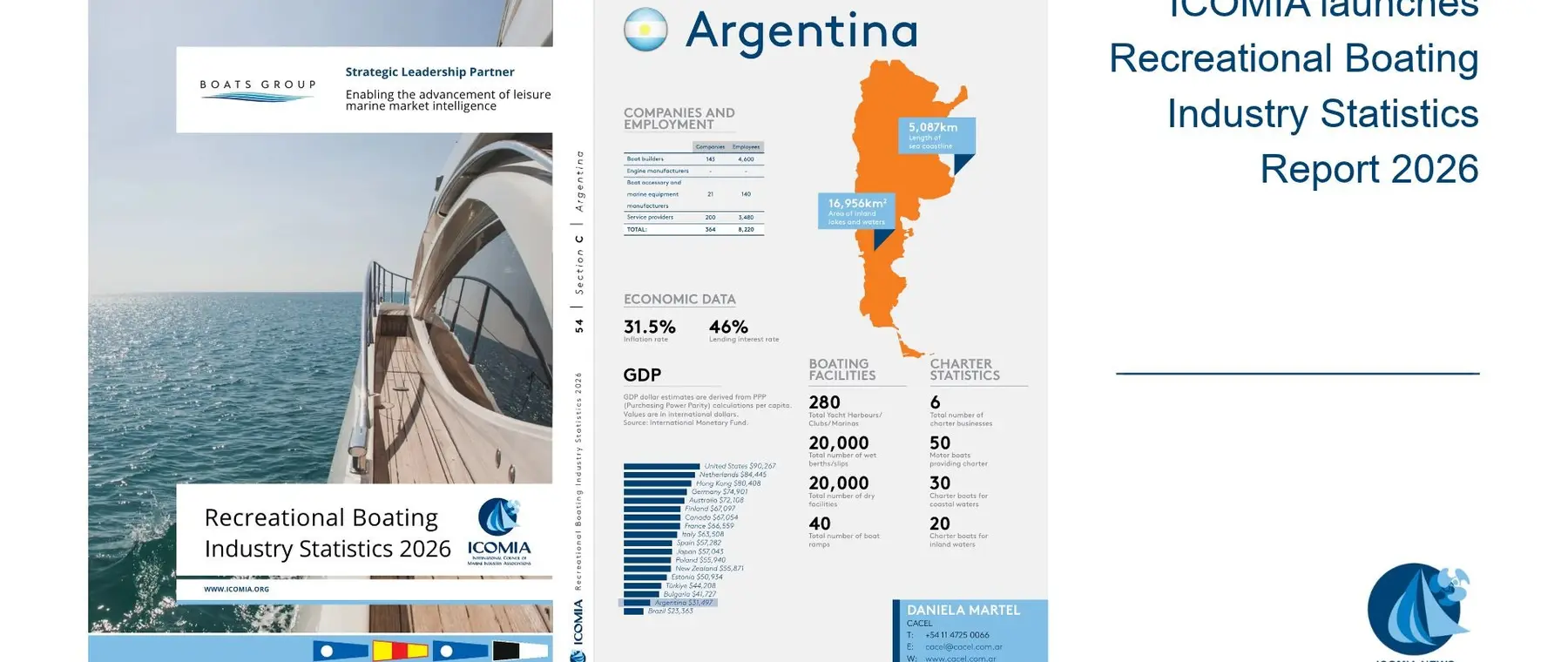
© ICOMIA. Official publisher's image accompanying the 2026 recreational boating statistics release, not a chart of unverified data.
ICOMIA's Recreational Boating Industry Statistics Report 2026 assembles association data on production, imports, exports, engines and equipment for marine market analysis.
The International Council of Marine Industry Associations announced the publication of its 2026 Recreational Boating Industry Statistics Report on 13 November. The organisation describes it as an annual reference drawing on national marine industry associations and reporting information on boat production, trade, engines, equipment and the wider recreational marine sector. For yacht builders, suppliers, refit businesses and investors, the release matters because decision-making often relies on national statistics that are difficult to compare. A common international reference can help place a particular market within a wider picture. It is important, however, to distinguish the availability of a new report from specific figures that have not been publicly verified. This article examines what the publication offers and why its methodological boundaries matter rather than inventing production totals or investment forecasts.
Recreational marine activity spans everything from small outboard-powered craft to highly complex superyachts. Manufacturers and policymakers may all refer to the boating industry while looking at very different segments of the market. A national association might track registrations, another may emphasise boat production, while a third reports export values or engines sold. Each measure captures only part of the sector. International comparisons become unreliable if those differences are ignored. ICOMIA's annual statistical work attempts to make a broad range of information available through a recognisable framework. The usefulness of a particular statistic still depends on its definition, the reporting period, and the quality and completeness of the source data. An apparently precise number may be far less informative if its scope is not understood.
ICOMIA says the publication was prepared with help and input from its global member associations. This approach is significant because national organisations may have access to local manufacturers, official statistics and regional market knowledge that would be difficult for an individual international researcher to assemble. It also introduces a responsibility to document variations. A national association's estimate of market size may not be directly comparable with a government registration count from another jurisdiction. Readers should therefore look for methodological notes, footnotes and definitions before using a country table in a commercial presentation. International aggregation is valuable, but it does not automatically erase the ways in which individual countries gather information.
The association lists production, imports, exports, boat types, engines and equipment among the subjects addressed. These categories connect different parts of the supply chain. A boatbuilder may use production data to understand capacity and market direction. An equipment maker may be interested in engine categories or the kinds of craft being bought. A marina operator may study fleet trends to anticipate changes in demand, while an analyst may want to understand trade flows. The official launch description identifies these categories but does not publish every table in the report. This account does not claim to have extracted figures from a paid or restricted document. It is concerned with the release itself and with how decision-makers should use a statistical reference responsibly.
A common error in industry reporting is to treat production, retail deliveries, orders and registrations as if they measured one event. They do not. A boat can be completed in one year and sold or registered in another. A yacht ordered several years earlier may enter construction or delivery at a later point, and a builder's order book may include projects at different stages of commitment. International statistics can help describe broad trends, but the measure must match the question. If the subject is manufacturing capacity, production data may be more relevant than new registrations. If the subject is consumer demand, the timing of actual deliveries and sales becomes important. The new report can contribute to such analysis only if the relevant series are interpreted correctly.
Imports and exports are important for an industry whose suppliers and customers operate across borders. Yet trade values can be affected by exchange rates, classification of products, re-exports and the location at which goods pass through customs. A large yacht constructed in one country, equipped in another and registered elsewhere can create a complex commercial story that is not captured by a single headline trade number. Researchers should distinguish the value of complete boats from engines, spare parts and other equipment. A change in export value may reflect a different mix of products rather than a proportional increase in vessel numbers. The new ICOMIA publication offers a reason to revisit these distinctions, especially when discussing the commercial position of national yacht industries.
Marine equipment is a substantial business in its own right. Propulsion systems, electrical installations, navigation devices, refrigeration and many smaller components are purchased not only for new vessels but also for maintenance and upgrades. Statistics about equipment and engines may therefore reveal activity that would not be obvious from newboat production alone. At the same time, not every sale of a component indicates a new vessel entering service. Replacement demand, inventory decisions and refit activity can be important. For suppliers operating across several categories, the distinction can change the interpretation of market growth. A responsible industry analysis should state which products are counted, which geography is covered and whether the figures represent shipments, sales or installed units.
The global recreational boating sector is broader than the superyacht market. A large motor yacht built to an individual owner's specification has a different production cycle, customer base and service profile from a small recreational boat. Using one market's statistics to describe the other can produce misleading conclusions. The ICOMIA report is relevant to superyacht businesses because many supply chains overlap, but it is not necessarily a dedicated census of every large yacht under construction. Readers should identify the segment covered by any table before projecting it onto the superyacht industry. The strongest use of a broad report may be to understand the surrounding economic environment while drawing on specialist fleet and order-book information for large yacht-specific questions.
ICOMIA says member associations have also supplied extended national reporting, allowing readers to look beyond a single comparative table. Such detail can help explain whether a country's figures are influenced by manufacturing, domestic use, tourism or a particular export sector. The official launch cites research connected with the Korean marine economy as an example of additional national insight. A country chapter may be particularly useful when making decisions about distribution, after-sales support or entry into a new market. Its conclusions should still be assessed against the underlying evidence and the date of the research. A national report can highlight opportunities, but it should not be treated as a guarantee that a new dealer or service base will achieve a particular level of demand.
A builder considering new production capacity needs to distinguish long-term demand from short-lived changes in orders. Comparative data can help identify whether certain market segments or countries appear to be expanding, stable or contracting. However, a strategic investment should not rest on one annual report. Manufacturers need current order enquiries, cost forecasts, labour availability, finance and supply-chain information. The ICOMIA statistics can provide an external reference against which internal assumptions are tested. This is particularly useful when a business is tempted to generalise from a busy show, a small collection of recent contracts or anecdotal sales activity. Market intelligence becomes stronger when several sources are compared and their limitations are made explicit.
An equipment maker may care less about the number of expensive yachts sold and more about the quantity and distribution of systems likely to be fitted to boats in a particular size range. The relevant information might include propulsion choices, vessel types or regional production patterns. A supplier preparing to enter a new market can use statistical reports to guide initial research, but still needs direct knowledge of local regulations and channels. The 2026 ICOMIA release describes a reference designed for that wider professional audience. Its value should not be overstated as a self-executing business plan. A credible export strategy combines research with customer interviews, technical qualification, distribution arrangements and an assessment of the total cost of supporting products after delivery.
Marinas and refit yards are affected by the existing fleet, vessel sizes, cruising patterns and the regional availability of services. Newboat production is one input, but fleet age and maintenance demand can be equally important. An international statistical reference may help operators understand the industries from which visiting boats originate and the types of craft common in different markets. It should not be used as a direct berth-demand forecast without additional information about location, accessibility and actual movement of vessels. A national total does not tell an individual harbour how many owners will request a berth in a particular week. The right relationship is between broad market context and detailed local planning.
Industry marketing often includes impressive figures that lack a precise date or definition. A publication backed by national association input creates an opportunity to ask more disciplined questions: what is being counted, which period is represented, and how does the figure compare with the previous year? Those questions are essential when discussing employment, economic impact or the performance of particular boat categories. They also help separate public advocacy from investment analysis. The existence of a recognised annual reference does not make every statistic equally reliable, and a careful reader should be willing to note gaps or differences in national reporting. The value of good data is not that it supports every optimistic narrative, but that it makes unsupported claims easier to challenge.
The marine industry is under pressure to understand environmental impacts across manufacturing, operation and eventual disposal. Market statistics alone do not establish those impacts, yet they can provide context for estimating the scale and distribution of activity. ICOMIA has separate programmes concerning life-cycle assessment and sustainable boating. The 2026 statistical report should not be presented as a completed environmental inventory unless its contents establish that. A broader set of industry references may support future work by clarifying how many and what kinds of products are entering different markets. Environmental estimates need their own methods, assumptions and evidence. Keeping those categories distinct is part of responsible analysis.
Anyone using the report in an investor briefing, a shipyard strategy or public marketing should preserve the edition year, table title, geographic scope and definitions. If a number is later revised, that context makes the comparison intelligible. Researchers should also distinguish raw statistical series from their own calculations and forecasts. The 2026 announcement does not license an author to invent current production totals simply because the publication has appeared. A well-grounded summary can explain the report's purpose without reproducing tables that have not been obtained or verified. For the superyacht industry, this discipline matters because a single large order or a shift in product mix can substantially affect annual comparisons.
ICOMIA's official 13 November announcement confirms that the Recreational Boating Industry Statistics Report 2026 is available and covers production, trade, vessel types, engines and equipment using material contributed by its worldwide member associations. The accompanying official image identifies the publication and should not be mistaken for a chart from an unseen table. This article makes no claim to reproduce subscriber-only data or to calculate an independent global market size from the release. The practical significance is that manufacturers, suppliers, policymakers and yacht-sector analysts have a newly issued common reference for structured discussion. Its greatest value will come when its figures are cited accurately and combined with the specialised information needed for individual business decisions.
Continue reading
IYC reports summer yacht charter bookings 2% ahead of 2025 and early 2026–27 winter reservations up 11%, amid increasing global fleet competition, with.

Denison Yachting announces a €300,000 price reduction on a 65m superyacht berth at Porto Mirabello, with a €1.375m asking price and lease through 2067.

Benetti reports 15 yachts from 34 to 72 metres in construction for Middle East owners and 11 recent deliveries as the 2026 Dubai boat …

Northrop & Johnson's October market update finds charter activity rising much faster than participating fleet size, while early 2027 reservations are fewer but longer.
Superyacht Guide
Continue into the wider Superyacht Guide.
Business opportunities · Superyacht Guide
Companies serving the superyacht market can discuss clearly identified advertising, sponsorship and business-profile opportunities. Commercial activity remains separate from independent editorial coverage.