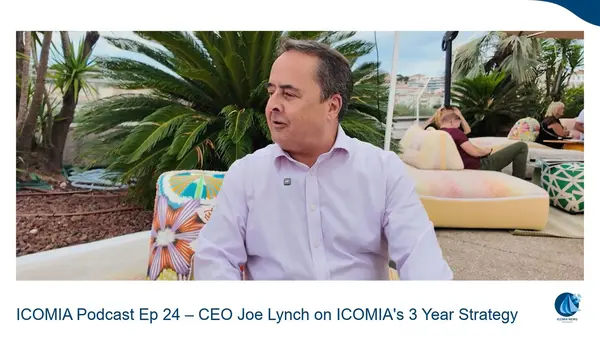
ICOMIA Chief Executive Sets Three-Year Strategy for Global Marine Industry
ICOMIA chief executive Joe Lynch outlines a three-year strategy centred on international collaboration, industry market data and technical standards.
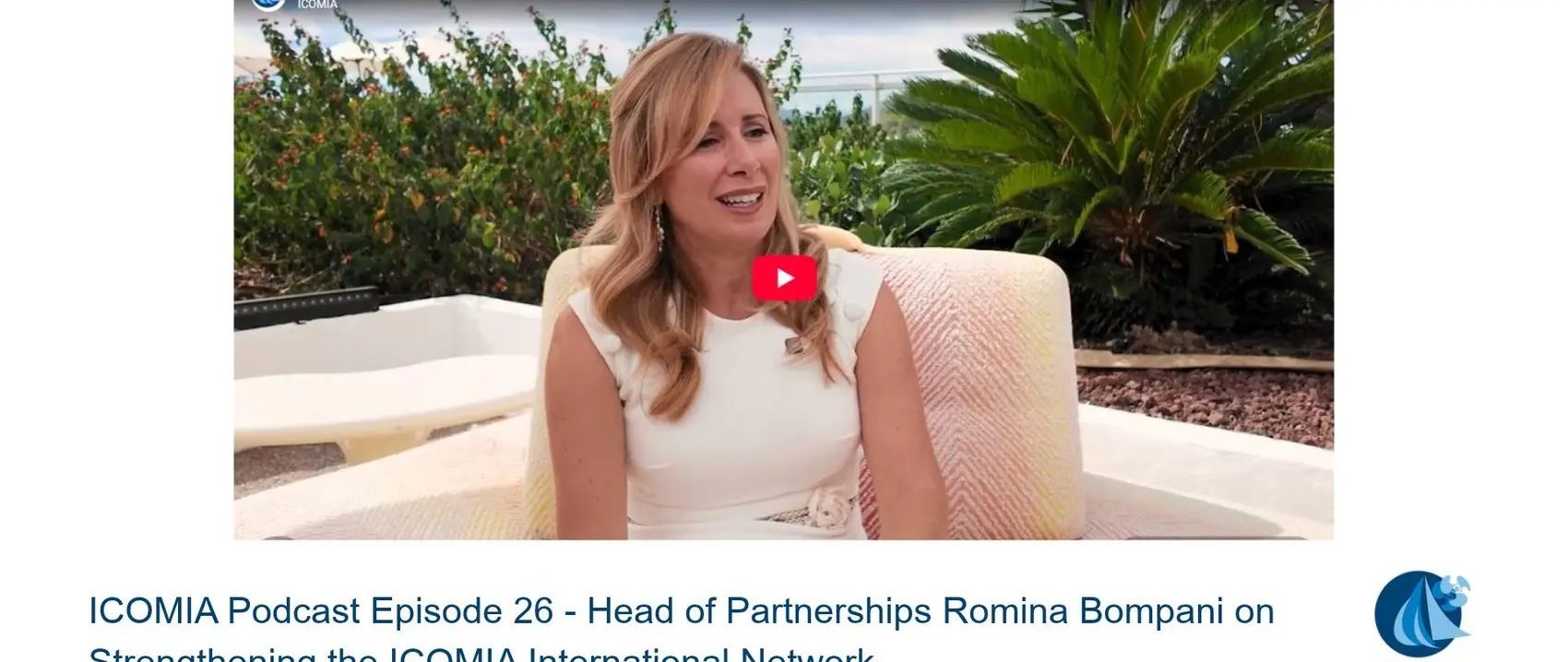
© ICOMIA. Official first-party podcast artwork published with Romina Bompani’s interview.
ICOMIA head of partnerships Romina Bompani discusses international marine business links, member value and the Asia-Pacific marina sector.
The International Council of Marine Industry Associations has published a conversation with its head of partnerships, Romina Bompani, explaining how the organisation intends to build stronger connections across marine markets. The discussion with Ben Taylor appeared on 30 October 2026 as episode 26 of the ICOMIA podcast. It considers cultural differences, relationships between members and the commercial value of a functioning international network. The subject matters to the superyacht sector because a project may depend on shipyards, brokers, service firms and marinas operating in several jurisdictions. An association network can help establish introductions and understanding, but it cannot guarantee the outcome of an individual commercial relationship.
A directory of member companies can be useful, but a functioning partnership network requires people who understand each other's businesses and are willing to exchange reliable information. Bompani's conversation explores how the organisation can create value beyond membership status. That value may include informed introductions, industry events and the sharing of experiences among markets facing similar problems. The podcast summary does not publish a new guaranteed lead-generation service, so it would be misleading to promise immediate sales results. Strong industry relationships are built over repeated exchanges and through clarity about what each participant can contribute.
The official interview highlights cultural and commercial differences among international marine markets. A supplier used to selling through European shipyards may encounter different procurement practices or customer expectations in Asia. Marina operators may face distinct planning regimes and local economic conditions. Recognising these differences does not require treating national cultures as rigid stereotypes. Companies need specific knowledge of regulations, contract terms and business norms for each market. Bompani's focus is therefore relevant to owners and industry firms seeking trusted partners abroad. International cooperation becomes more useful when differences are explored carefully rather than dismissed as obstacles.
A superyacht is rarely tied permanently to its construction country. During its life it may rely on ports, marinas, refit yards, repair teams and specialist agents in different regions. Each handover introduces the potential for misunderstanding if information is incomplete or expectations differ. Stronger industry connections can make it easier to identify service providers and learn how regional systems operate. However, an association introduction is not a substitute for checking technical competence, insurance, safety procedures and performance records. The yacht's owner and management team retain responsibility for selecting firms suitable for the vessel's actual needs.
The podcast looks ahead to the ICOMIA World Marinas Conference in Shanghai, making the marina sector a central example of international cooperation. Building a marina suitable for large yachts involves much more than installing berths. Project teams must evaluate water depths, vessel movements, utilities, environmental constraints and access to onshore services. These decisions also involve local authorities and private investors. A global association can help share experience and identify relevant partners, but each project requires detailed feasibility work. Bompani's interest in new markets should therefore be read as a call for informed engagement, not confirmation that a particular facility is approved.
ICOMIA's official account identifies China and the wider Asia-Pacific region as areas of significant interest for future marina development. This reflects attention to emerging connections among investment, tourism and marine infrastructure. It should not be taken as a forecast that every coastal city will attract large numbers of visiting superyachts. Demand depends on cruising routes, regulations, the availability of support services and the attractiveness of surrounding destinations. Companies exploring the region should use current local data and project-specific analysis. The international conference can help frame conversations, but it cannot replace the practical evidence needed before investment.
Member organisations may join a global industry body for technical information, policy representation, access to peer companies or the opportunity to participate in conferences. These reasons are related but different. A small equipment maker may be looking for a credible introduction to a foreign distributor, while a major marina operator may want to compare regulatory approaches across countries. Bompani's role involves understanding what different participants consider useful. An effective network needs to communicate those distinctions clearly. Membership alone cannot guarantee a return, but repeated exchange can support better decisions if the relationships are maintained and followed up.
Yachtbuilding and marina management are intensely technical fields, yet many projects are shaped by trust and communication between people. Owners may commission specialised work years before they can judge the finished result, and suppliers must coordinate around changing project schedules. International relationships can help resolve difficulties more quickly when participants understand one another's responsibilities. The podcast's emphasis on cultural background and personal connections is therefore relevant to project management, not merely public relations. A successful partnership combines technical competence with reliable communication and the willingness to address problems openly.
Firms working in several countries may repeatedly investigate similar regulatory questions, market conditions or supplier capabilities. Shared industry knowledge can reduce unnecessary work if it is accurate and appropriately maintained. An association can encourage the circulation of experience among member bodies, although commercially sensitive information and competition-law obligations must be respected. Bompani's discussion does not announce a single consolidated database covering every marine company worldwide. The more reasonable expectation is that coordination may help members find relevant knowledge and contacts. The quality of the outcome depends on how information is gathered and updated.
A refit may require parts from multiple countries, designers familiar with an existing vessel and access to equipment specialists at the right stage of construction. International coordination can make finding these capabilities easier, but it must be followed by contractual and technical diligence. A yard's relationship with an association does not establish that the yard is available for a particular docking window or qualified for a particular task. The podcast's practical relevance lies in promoting more resilient professional networks. Project managers can benefit when they know where to direct questions and how to verify responses.
Negotiation styles, documentation practices and the pace of commercial decisions vary among organisations and places. Companies may interpret silence, informal assurances or preliminary discussions differently. Bompani's focus on cultural and commercial distinctions offers a reminder that successful international business requires careful written terms and explicit responsibilities. These are not matters of etiquette alone. Misunderstanding can affect supply schedules, payments and technical approvals. Owners and industry professionals should resist assumptions based on a company’s nationality and instead establish clear procedures with the actual people involved in the project.
The World Marinas Conference provides a specific setting in which investors, operators, technical suppliers and member associations can compare experiences. In an event focused on development and investment, useful questions include how berths are financed, whether utility systems are adequate for larger yachts and which planning approvals may be required. The podcast names Shanghai as the destination but does not, in its brief public summary, certify a particular project or disclose all future speakers. Those details should be verified through the conference's own official programme. The event's significance is its potential for substantive discussion and contact-building.
A global association must engage participants ranging from small specialist businesses to larger corporations and national organisations. Their budgets, priorities and access to international events differ. The most valuable partnership activity may not always be the most visible one. Providing reliable introductions or explaining how to participate in technical discussions can matter to a smaller firm as much as an exhibition stand matters to a larger company. Bompani's job requires attention to such differences, although the podcast does not claim that all needs can be satisfied. Building a responsive network is a continuing process rather than a one-time membership drive.
No association can remove the risks of entering a new market or appointing a new commercial partner. Companies should assess relevant qualifications, ownership, financial position and operating experience before making commitments. Information shared by another member can provide a starting point, but independent checks remain important. In the superyacht sector, a wrong supplier choice can affect an expensive vessel and its operational schedule. Professional relationships are valuable when they improve access to evidence and expertise, not when they encourage participants to waive ordinary due diligence. The podcast's emphasis on connection should be understood within that responsible framework.
Industry statistics help describe markets, while partnerships allow participants to act on their understanding of those markets. Both are necessary, but neither substitutes for the other. A company might identify a promising region through data and then need local relationships to test whether real opportunities exist. Conversely, an enthusiastic introduction can be misleading if demand, regulation or infrastructure does not support the proposed project. ICOMIA's wider strategic agenda includes information and cooperation, providing a relevant backdrop for Bompani's work. The latest interview focuses specifically on relationships and the differences that shape them across borders.
Practical progress will be visible through the quality of industry meetings, new member connections and the participation of diverse regional organisations in events such as the Shanghai conference. The official episode summary does not provide a quantified target for new partnerships or an independently measured forecast of investment. It would be premature to announce that any expansion has succeeded. Industry participants should look for documented programmes, confirmed collaborators and tangible results of member activity. Such evidence can distinguish a durable network from a series of promotional conversations.
The 30 October interview highlights a less visible part of the global superyacht economy: the relationships that connect technical suppliers, shipyards, marinas and operators. Bompani's attention to different commercial cultures and Asia-Pacific development offers a useful context for businesses preparing to operate internationally. The story does not involve the delivery of a 24-metre-plus yacht, but its subject is relevant to the services and infrastructure those vessels depend on. The central lesson is that international expansion requires informed relationships as well as attractive investment figures, and that a professional association's contribution must be judged through the work those relationships enable.
© ICOMIA. Official first-party podcast artwork published with Romina Bompani’s interview.
Continue reading
ICOMIA chief executive Joe Lynch outlines a three-year strategy centred on international collaboration, industry market data and technical standards.
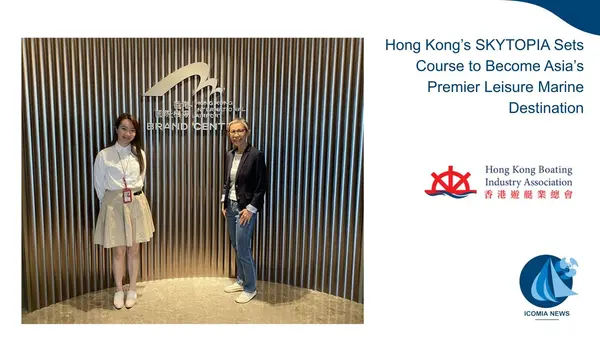
Hong Kong airport developer AAHK has issued an expression of interest for SKYTOPIA Yacht Bay investors and operators, distinct from marina promotion milestones.
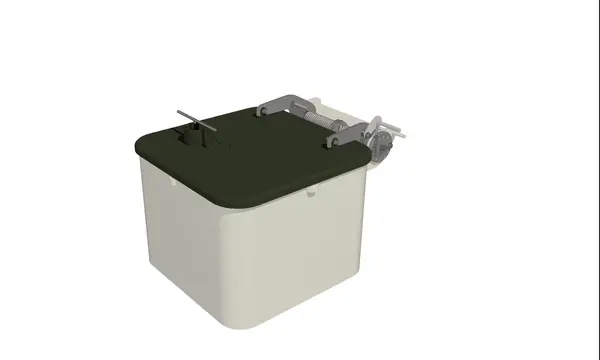
Oceanco adds established Dutch marine manufacturer Winel to its group, bringing custom yacht door and hatch engineering, tank vent valves and specialist suppliers.
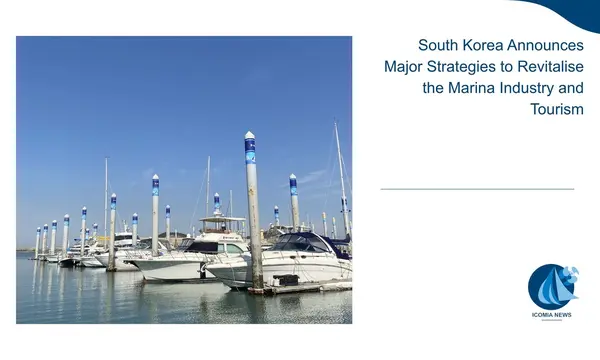
South Korea’s Ministry of Oceans and Fisheries outlines a marina revitalisation strategy focused on regional visitor demand and AI-enabled berth information.
Superyacht Guide
Continue into the wider Superyacht Guide.
Business opportunities · Superyacht Guide
Companies serving the superyacht market can discuss clearly identified advertising, sponsorship and business-profile opportunities. Commercial activity remains separate from independent editorial coverage.