Italian Sea Group Board Advances SRI Global €220m Proposal
By Superyacht Guide Newsroom · Edited by Superyacht Guide Newsroom
Italian Sea Group Board Advances SRI Global €220m Proposal — attributed SYG News batch04 20261125
The Italian Sea Group board approves the next steps for SRI Global’s €220m restructuring proposal, with a separate €275m escrow condition and court approval pending.
The Italian Sea Group has announced that its board of directors examined the €220 million proposal submitted by SRI Global Limited on 23 November 2026 and considered it suitable, at this stage, to allow the restructuring process to move forward. The announcement followed the conclusion of a competitive procedure on 16 November in which SRI's offer had been identified as the preferred proposal for the company's entire business. This latest step is an actual board decision, distinct from the earlier selection of a bidder, but it is not a completed sale or proof that every legal condition has been satisfied.
The report is especially significant for a company connected to large-yacht construction and refit through brands including Admiral, Tecnomar, Perini Navi and Picchiotti. The board's decision concerns the potential future operator and structure of the business, while the company's day-to-day projects, employees and suppliers have a direct interest in financial and operational continuity. An accurate account must separate the value of the acquisition offer, the financing conditions and the court process. Treating them as interchangeable would overstate what the board has actually resolved.
SRI Global's proposal is reported at €220 million for the entire business undertaking. That figure is the consideration described for the proposed acquisition, not an independently confirmed market valuation of the various yacht brands or their individual projects. The fact that a preferred proposal has been selected does not guarantee the price will be paid, that all conditions will be met or that ownership will be transferred on an announced date. Completion requires further steps and approvals.
The proposed structure involves an initial business lease followed by a subsequent sale of the relevant assets. Such arrangements can be used to establish a path for operations during a restructuring before the final transfer is completed. The exact allocation of liabilities, contractual responsibilities and risks would depend on the agreements themselves. The published statement does not provide sufficient detail to calculate the value of particular shipyard buildings, order books or intellectual property. It is therefore more precise to discuss the total proposed transaction than to invent component valuations.
The company's communication includes a financial requirement of at least €275 million to be deposited into escrow before the agreement can be signed. The report says €55 million would be released progressively in accordance with the relevant terms. This amount does not change the reported €220 million acquisition consideration. The difference between the purchase figure and the escrow requirement is material and can easily be misunderstood if both are presented simply as competing prices for the shipyard.
Escrow arrangements generally aim to ensure that funds are available subject to agreed conditions. However, the published account does not specify how every euro in the escrow arrangement will ultimately be applied, and readers should not infer an exact distribution to creditors, workforce or investment projects. The requirement is a condition attached to the proposed transaction. Its existence signals the importance of financial assurance during the restructuring but does not independently prove that the entire amount has already been deposited or released.
The board also defined the terms of a new application to the competent court, under the relevant provisions of Italy's crisis and insolvency framework. The purpose is to obtain authorisation for the proposed business lease and related arrangements for a later transfer. That remains an application step rather than an automatic judicial endorsement. No final authorisation should be assumed unless supported by an official court decision. The court process, company resolutions and any contractual signatures have different legal effects.
This distinction is essential for owners and suppliers dealing with a shipyard in a restructuring. A board can support a direction of travel, but legal conditions and contractual obligations still determine what becomes effective. The announcement identifies an expected pathway while acknowledging that additional requirements remain outstanding. Reporting on legal and financial developments is therefore most useful when each event is dated and described according to its actual status, rather than being compressed into an unqualified statement that a takeover has occurred.
The competitive process has attracted different proposals and legal questions. The published account notes an urgent application by Palumbo Group seeking a renewed comparison of offers, and the announced intention of T.I.S.G. Asia Investment Holding Limited to challenge its exclusion from the final stage. PressMare reports that documentary evidence of the latter application having actually been filed was not available at the time of its 23 November article. This difference between a stated intention and a confirmed filing must be preserved.
The board's conditions include the absence of precautionary court measures that would prevent or restrict execution of the proposed agreement. This recognises that existing or potential disputes could affect the timetable. The announcement does not provide grounds for declaring any competitor's legal position resolved, nor for alleging that a specific bid was improperly rejected. Subsequent developments, including Palumbo's separately reported decision to step back on 24 November, are distinct events and should be assessed against their own dated evidence.
The proposed transaction also requires completion of statutory consultation with trade unions. Such consultation is a significant element of continuity planning when a business relies on a large workforce of skilled engineers, fabricators, interior specialists, project managers and administrative staff. At a superyacht builder, the knowledge held by individual teams can be central to completing complex hulls and maintaining technical records over long construction cycles. Preserving that capability is an industrial issue as well as a matter for the people directly affected.
The reported conditions do not quantify future employment levels or guarantee that every role, contract and facility will remain unchanged. Those conclusions would depend on an authorised plan and subsequent implementation. Workers and suppliers need reliable information about who will be responsible for ongoing activities and how payment, warranty and delivery obligations are addressed. General expressions of support for continuity are not substitutes for documented agreements. The statement points to a process for resolving these matters rather than demonstrating that all questions have been answered.
The announcement also refers to approvals from relevant authorities, including those responsible for maritime state concessions. Shipyards depend on land and waterfront rights that may have separate public-law requirements from a company's private commercial contracts. A proposed change in operating entity cannot simply assume that every concession can transfer without review. The need for authority approval is therefore understandable in a large yacht-building business with waterfront assets.
The published report does not list all permits, conditions or decisions still required. Nor does it say that a particular yacht may no longer be constructed at the site. Each operational implication would require project-specific and official information. What can be said is that the transaction's effectiveness remains linked to permissions beyond the board's own decision. This reinforces why the €220 million headline should not be reported as an unconditional completed acquisition.
The company has indicated that the business lease could be signed during the first week of December 2026, subject to court authorisation and satisfaction of the relevant conditions. This is a conditional expectation, not a fixed contractual completion date. A schedule can change if financing, approvals or legal matters require more time. The report also notes that trading in shares of The Italian Sea Group on Euronext Milan had remained suspended since 3 November, a separate sign that the restructuring is an ongoing market-sensitive process.
A first-stage lease and eventual sale should not be confused. Even if the initial agreement is signed, the later transfer may remain conditional on obligations not yet fulfilled. Investors, yacht owners and suppliers should therefore follow formal communications rather than extrapolating an exact handover date. The company's planned timetable is useful as a statement of intent but must be updated if later evidence shows different events or requirements.
The Italian Sea Group's portfolio includes large vessels for which design changes, specialist procurement and build schedules can extend across years. An extended restructuring process can create questions about continuity, especially when clients have committed significant funds to particular projects. Yet no conclusion about an individual vessel's contractual status can be derived solely from this announcement. Owners should rely on current written information from the entities responsible for their projects and appropriate independent advisers.
The concrete new fact on 23 November is that the board has considered SRI Global's proposed acquisition and authorised the next procedural direction, with a €220 million consideration, a separate €275 million escrow condition and additional court, regulatory and labour requirements. The future of the company remains contingent. Reporting that sequence accurately helps the wider superyacht industry understand the progress made without presenting unresolved conditions as accomplished outcomes.
Primary source: PressMare report of The Italian Sea Group 23 November 2026 board statement.
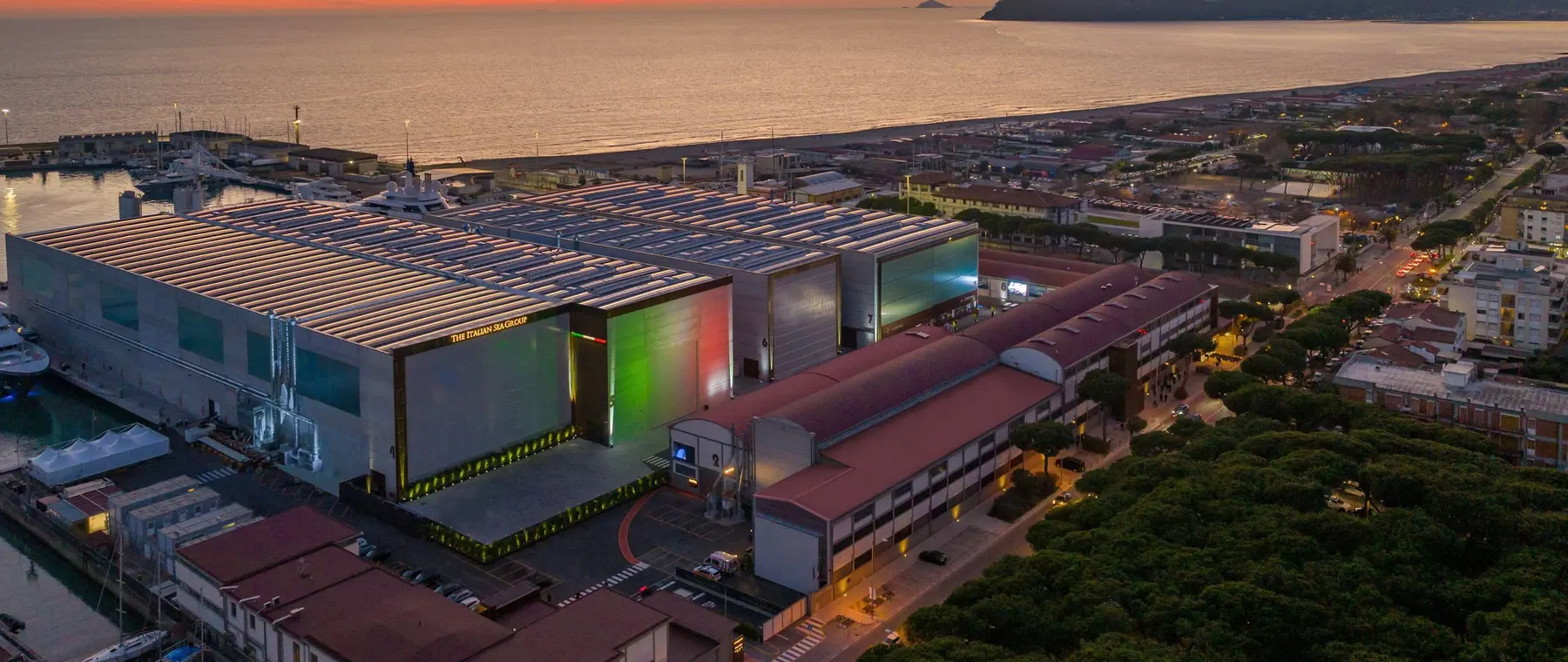
PressMare news photograph associated with The Italian Sea Group board decision dated 23 November 2026; © PressMare and original image rights holder. Official source.
Explore
Go deeper into the yachts, companies, events and destinations directly connected to this article.
Continue reading

Palumbo Group says it is stepping back from the TISG acquisition process after the group’s board decisions, while the status of its earlier urgent …

The Italian Sea Group confirms SRI Global Limited's €220 million offer was selected at the close of competitive bidding, with further approvals still required.

The Italian Sea Group's unaudited court filing shows a €58.7 million year-to-date loss at 30 September 2026, with cash down to €1.75 million and …

The Italian Sea Group's 30 October 2026 regulatory disclosure sets out €292.3 million in overdue consolidated liabilities at 30 September, €184.2 million in net …
Superyacht Guide
Continue into the wider Superyacht Guide.
Business opportunities · Superyacht Guide
Companies serving the superyacht market can discuss clearly identified advertising, sponsorship and business-profile opportunities. Commercial activity remains separate from independent editorial coverage.