Edmiston Q3 Data Shows Larger Yacht Sales Outpacing 30–40m Market
Edmiston's third-quarter 2026 superyacht market review reports 254 yachts sold in the first nine months, around 4% below the previous year. The firm finds …

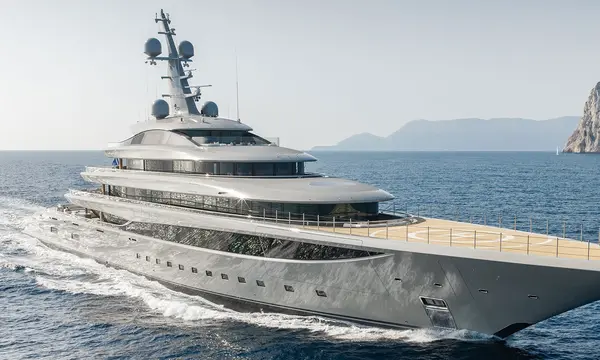
Superyachts at Port Hercule, Monaco (2026)
IYC estimates 675 worldwide yacht sales worth $7.3 billion in January–September 2026, as a separate Northrop & Johnson review shows resilient 24m-plus brokerage volume but weaker aggregate value.
Market analysis, 10 November 2026. This report distinguishes two brokerages’ separately constructed datasets; their totals must not be added or treated as directly interchangeable.
IYC’s autumn review of the 2026 yacht market puts worldwide sales in the first nine months at 675 yachts with a combined value of $7.3 billion. The brokerage reports a nine per cent decline in the number of transactions against the corresponding 2025 period and a 20 per cent reduction in new listings. Its reading is not that buyers have abandoned the market; rather, they are increasingly particular about the vessel, condition and price that will persuade them to proceed. The figures were published in an IYC report dated 28 October, and the commentary remains relevant as the industry enters the final weeks of the year.
For an owner considering a disposal or a first large-yacht acquisition, the essential difference is between an active market and an effortless market. A substantial total transaction value does not establish that every yacht will sell quickly or that any one asking price is achievable. Superyacht ownership presents multiple constraints beyond the advertised purchase number: maintenance history, delivery location, crew continuity, future yard periods and whether the configuration genuinely suits its next owner. The broker’s primary report provides market context, not a personalised valuation.
The 675 transactions and $7.3 billion cited by IYC are broad headline totals. A change in their relationship can result from a different mix of yacht sizes, prices and new versus previously owned vessels, even without a corresponding change in the price of any particular model. Conversely, a few very large sales can materially influence total value while moving the yacht count hardly at all. Readers should resist calculating a simple headline average and applying it to the yacht they own.
That interpretation is especially important when a broker reports enquiries or offers. Neither is identical to a completed sale, and an asking price is not the confirmed settlement value. Large yachts can spend long periods moving between initial marketing, serious inspection, survey and final agreement. IYC’s figures describe known market activity through September rather than a forecast of the full 2026 outcome. Further reports, late-year contracts and reporting revisions may change the eventual picture.
IYC reports that yachts between 24 and 30 metres accounted for 44 per cent of the sales it counted during January to September. The 30-to-40-metre segment added a further 32 per cent. Together these categories represent roughly three quarters of the transactions in its stated breakdown, underscoring how much of the superyacht brokerage market is driven by vessels smaller than the giant yachts that dominate international photographs and event headlines. The category boundaries matter, particularly where another database defines length differently.
The prevalence of these two sectors does not prove strong price growth or fast selling at the entry end. A large share of a smaller total can remain large even if the absolute number of transactions declines. Owners selling a 28-metre yacht should therefore identify genuinely comparable recent sales, specifications and asking prices before judging demand. Sellers of a 65-metre yacht face a different pool of potential purchasers, a more complex transaction and a smaller sample of directly relevant completed deals.
IYC says it continues to receive meaningful upper-market buyer enquiries, but suitable yachts that also meet purchasers’ price expectations are in shorter supply than that activity might suggest. The brokerage sees an important distinction between a motivated purchaser searching for a very specific vessel and a buyer willing to accept whatever is listed. Its review also places the average length of yachts sold at 34.8 metres, compared with 34.1 metres a year earlier, an increase of about two per cent in the series it cites.
A slightly higher average length says something about transaction mix, not necessarily broad appreciation. For very large-yacht purchasers, layout, pedigree, engineering, maintenance and the expected delivery timetable can matter as much as nominal size. Owners should ask their broker how many comparable boats genuinely exist at a proposed budget and what conditions make each comparable. A shortage of suitable inventory creates an opportunity only for a vessel positioned and documented well enough to satisfy due diligence.
Northrop & Johnson’s separately published Q3 market review counts 472 sales of pre-owned yachts measuring at least 24 metres through September, against 477 a year earlier. It puts the aggregate value of those brokerage transactions at $5.20 billion, down about 4.7 per cent from $5.46 billion. These are not competing claims about one precisely identical universe. Northrop & Johnson specifies pre-owned yachts of 24 metres and above, while IYC provides its own broader headline of 675 worldwide yacht sales. Their populations, classifications and collection methods should not be assumed identical.
That is why adding the figures together would be wrong, as would declaring an error simply because one source counts fewer yachts. The better comparison is directional: both market commentaries describe active buyers alongside constraints and an uneven distribution of transactions. Independent datasets can help identify a pattern, but they do not eliminate differences in recording dates, sale disclosure or which deals are counted. Buyers, lenders and owners representatives should keep the source and scope attached to any chart they circulate.
IYC reports that the number of new sales listings fell 20 per cent across its monitored market. Northrop & Johnson, meanwhile, records 1,400 new central agency listings of pre-owned yachts of at least 24 metres in the nine-month period, a 5.5 per cent increase from 1,327. At first sight those numbers point in opposite directions. They should be treated as distinct measures with potentially different datasets and definitions, not forced into a single headline. A central agency appointment is one kind of listing event, and the denominator for an all-market series may be different.
In practice, an owner selecting a broker needs local and segment-specific evidence. How many competing 35-metre vessels entered the relevant market in the last quarter? How long have they remained available? What fraction changed their prices? Those questions are more informative for an individual vessel than a broad market count. Brokers should be able to explain where their comparison comes from and identify when a sale or listing is still subject to verification.
Northrop & Johnson identifies the 40-to-50-metre bracket as unusually resilient in its pre-owned market review. It records 63 reported sales in that category during the first nine months of 2026, up from 49 in the corresponding period of 2025, an increase of approximately 29 per cent. Smaller brackets were softer, and sales in several larger categories were also below the previous year. The result is important precisely because it demonstrates that a single global transaction figure conceals markedly different outcomes by length.
The 40-to-50-metre result must still be handled carefully. Sixty-three recorded sales are a valuable observation but not enough to guarantee pricing power for every yacht in the bracket. Build year, interior arrangements, classification, location and substantial planned maintenance can alter its competitive position. The segment’s strength may justify a more detailed comparable-sales review; it does not remove the need for technical survey or an evidence-based asking price.
In the Northrop & Johnson series, pre-owned yachts aged five to nine years generated 103 sales, followed by vessels up to four years old with 94. The two cohorts together accounted for approximately 42 per cent of the reported pre-owned market. The same review says yachts aged 25 to 29 years experienced particularly pronounced average asking-price reductions. These data show a relationship between age categories and trading conditions, but they do not say that older yachts cannot be attractive or that a newer yacht is necessarily sound.
A buyer should consider documented refits, machinery hours, coatings, electrical and navigation systems, flag compliance and the work likely to fall due in the next few seasons. An older yacht that has been comprehensively maintained can compare favourably with a younger vessel carrying deferred costs. Equally, an expensive recent refit may not be fully recovered in a sale price. Technical information helps bridge the gap between a listing’s presentation and the cost of ownership after the transaction closes.
Northrop & Johnson’s report records 216 reported new-build sales of yachts measuring at least 24 metres through September, against 266 in the comparable period a year earlier. The report explicitly warns that new-construction data are revised as previously undisclosed contracts come to light. Its 50-to-60-metre bracket increased from 12 reported sales to 16, while several other size brackets declined. Such uneven movement means that quoting one percentage for the entire new-build sector may obscure the position of a particular shipyard or yacht size.
A new-build sale can carry different timing, financing and technical issues from a brokerage transaction. Contract signing, construction milestones, launch and delivery may span multiple reporting periods; calling them all sales in the same sense can create confusion. Buyers considering a speculative hull should ask exactly which structural and design decisions remain open, which payments have become due and whether the delivery date is supported by a credible schedule. The reported market contraction is context for that decision, not proof that all builders are reducing their pipelines equally.
IYC notes that the September Cannes and Monaco yacht events generated strong engagement, but it has not yet identified an immediate equivalent rise in completed transactions. That lag is unsurprising in transactions that can require detailed inspections, financial arrangements and extensive negotiation. Northrop & Johnson reports that new listings and asking-price reductions were prominent around the autumn show period, while cautioning against claiming that the timing itself proves a causal relationship.
An owner should judge a show campaign by the quality of qualified follow-up as well as attendance. Viewings, confidentiality checks, requests for technical documents and the conversion of interest to negotiations are more meaningful than casual footfall. Likewise, a seller who cuts an asking price after a show has not necessarily done so because the exhibition failed. Individual circumstances, competing inventory and a change in expectations may be more important. Both published reviews invite careful interpretation rather than a simplistic story about a single event driving the market.
IYC reports that Europe represented 58 per cent of total sales in its January-to-September sample, an increase of five percentage points over the previous year. Italy accounted for 30 per cent of transactions by closing location, with the United States on 26 per cent. A closing location should not automatically be read as the owner’s nationality, the yacht’s flag or its preferred cruising region. Professional services, tax considerations, delivery position and the structure of a deal may all influence where it completes.
This distinction matters for regional business planning and analysis of superyacht service demand. Sales in an Italian closing jurisdiction do not establish that a vessel will spend the following season in an Italian marina. A yacht may move immediately into maintenance or reposition across an ocean. Shipyards, marinas and service providers should read brokerage data together with reliable operational and fleet information before drawing conclusions about future local capacity.
The two primary reports present a market in which transactions continue at substantial value, while different size bands and activities respond unevenly. For sellers, a defensible asking price, consistent maintenance documents and realistic availability can help turn an enquiry into an actionable offer. For buyers, the sensible priorities remain a clear requirements brief, independent technical review, an understanding of near-term expenditure and enough flexibility to recognise a genuinely suitable opportunity. Neither source provides grounds to declare a guaranteed year-end recovery or an inevitable decline.
Superyacht Guide’s reading is deliberately narrower than a market forecast: the data support selectivity and divergent sector trends as of the end of September 2026. New-build reporting can change, and several weeks of fourth-quarter deal activity remain outside the published series. Any future headline about a record year, a collapse or an across-the-board rebound should therefore be tested against completed sales, comparable definitions and subsequent primary data. For an individual yacht, evidence about that vessel remains more decisive than a global average.
Primary sources: Iyc Primary 2026 Market Review; Northrop And Johnson Primary Q3 Report.
Mike is Michi / CC BY-SA 4.0 / archival illustrative photograph
Continue reading
Edmiston's third-quarter 2026 superyacht market review reports 254 yachts sold in the first nine months, around 4% below the previous year. The firm finds …
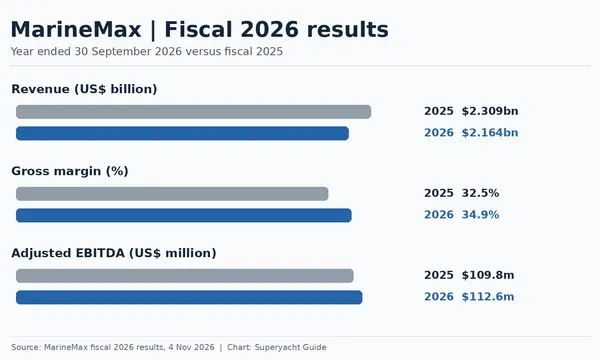
MarineMax reports a fiscal 2026 loss of $8.2 million despite improved gross margins, against lower boat sales and a pending Safe Harbor takeover.
IYC’s nine-month 2026 market review reports 675 yacht sales worth $7.3bn and fewer new listings, while separate BoatPRO statistics show a different picture for …
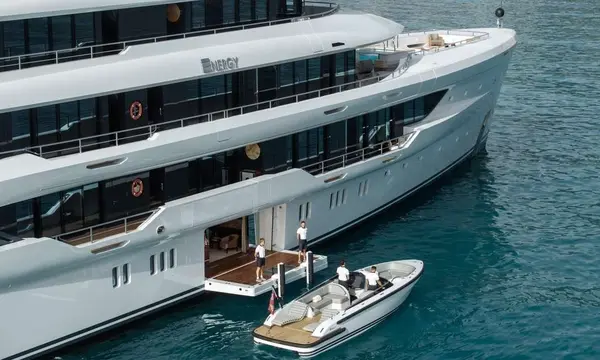
Burgess spotlights four recently delivered Dutch-built yachts above 70m—ENERGY, BOARDWALK V, SYNTHESIS and VANISH—in its October sales overview.
Superyacht Guide
Continue into the wider Superyacht Guide.
Business opportunities · Superyacht Guide
Companies serving the superyacht market can discuss clearly identified advertising, sponsorship and business-profile opportunities. Commercial activity remains separate from independent editorial coverage.