61m Leapher HORIZON II Heads to UK After Dutch Outfitting
By Stephen Yardley · Edited by Stephen Yardley
Leapher's first explorer superyacht, HORIZON II, reportedly departed Vlissingen for the Isle of Wight on 5 November, following launch and outfitting in the Netherlands.
The inaugural explorer yacht from Dutch builder Leapher Shipbuilding has taken another step towards her owner. On 5 November 2026, industry publication SuperYacht Times reported that the vessel known as Horizon II had left Vlissingen and was heading towards the Isle of Wight in the United Kingdom. The report describes the movement as part of the yacht's delivery process and cites vessel-tracking information. It is a significant development for the Tolkamer-based builder, whose first superyacht began as a keel-laying project in 2023.
The report should be read with an important distinction in mind. A yacht travelling to a delivery location is not necessarily evidence of every contractual handover, registration or owner acceptance detail. Leapher has not supplied a fresh public delivery statement in the primary sources consulted for this article. Accordingly, the directly reported event is the departure from Vlissingen, with the movement towards Britain described by the specialist publication. The title Horizon II is used in that report, while the builder's original material refers to the project simply as Horizon.
Leapher introduced Horizon in May 2023 as its first 60.5-metre expedition yacht. At its Tolkamer location, the company marked the beginning of construction with the traditional lowering of steel sections into the building area and a lucky-coin ceremony. Those steps mattered to more than one future yacht: they were the public beginning of the new brand's construction programme. The company's own account names Yiannis Andriotis as the figure behind the enterprise and describes the ambition to build long-distance explorer vessels.
The first public design particulars were those of a substantial, steel-hulled expedition yacht, not a speculative concept without a building programme. Leapher's launch announcement and the subsequent shipyard timeline provide a traceable sequence of construction milestones. That traceability is particularly valuable for a relatively new yachtbuilding name entering a field where buyers are asked to place considerable trust in engineering capacity, project management and after-sales support. It does not prove that every original specification remained unchanged during the build.
Shipyard De Hoop, the Tolkamer facility involved in the project, recorded the launch of Horizon on 20 February 2026. Its account describes a ceremony with guests and identifies the design as NAVIX 60, developed by Cor D. Rover, with engineering by O7 Designers. De Hoop also credits Passer SIDC with building the hull. The official shipyard record provides independent confirmation that the long-running project reached the water, rather than relying solely on images or renderings circulated at its announcement.
A launch is a major event but is not synonymous with final delivery. A newly floated yacht may still require completion of upper-deck structures, commissioning, installation of specialist equipment and sea trials. The sequence documented for Horizon illustrates that distinction. It is therefore appropriate to mark the February ceremony as the launch, the March move as a transfer for completion and the November movement as a subsequent development. Compressing the three milestones into a single date would obscure the work involved.
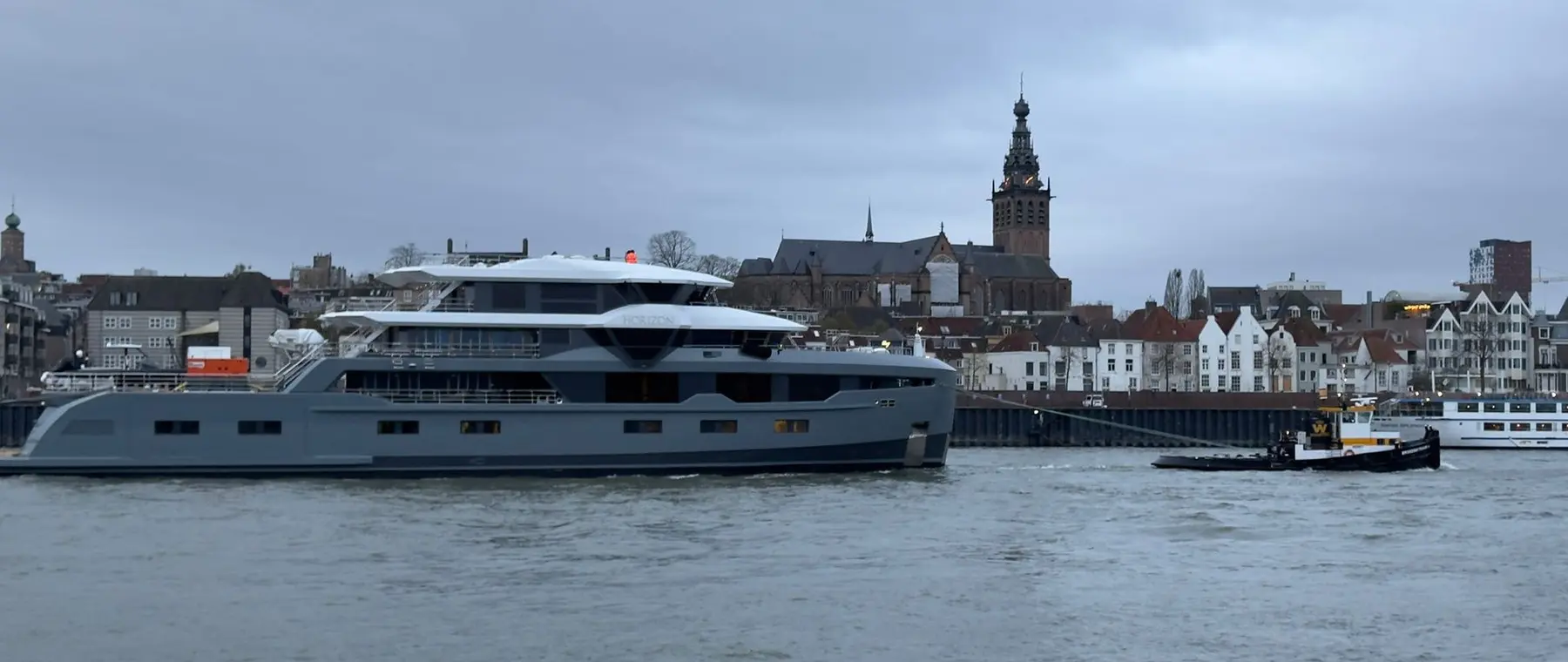
De Hoop published a second operational update dated 13 March 2026, reporting that Horizon had departed its yard. The shipyard said a pontoon carried the final upper level of superstructure and the antennas, with the assembly due to be completed at Damen facilities in Vlissingen after the yacht cleared the bridges along the route. It also said final finishing and sea trials would take place at Vlissingen. This public record establishes why the vessel later appeared at a different Dutch maritime location.
The March account is also a reminder that large yacht construction can involve multiple specialist sites. The available records identify hull fabrication, launch, movement and final outfitting work, each with its own practical requirements. Transport restrictions on inland waterways help explain why some upper structures may travel separately before completion. No precise final installation date is given in the De Hoop statement, and this article does not infer one from the November sailing. The published sequence nevertheless shows a clear progression towards the operational stage.
Horizon brought together a group of businesses with defined roles. Leapher was the yachtbuilding brand; Passer SIDC produced the hull according to De Hoop's launch account; O7 Designers handled naval architecture and engineering; Cor D. Rover worked on the exterior and interior design; and later outfitting took place at Damen's Vlissingen facilities. Specialist reporting also credits Van Oossanen Naval Architects with hull optimisation and computational-fluid-dynamics work. These functions should not be conflated with ownership of the final vessel.
For an explorer yacht, integrating such contributions is a major exercise in coordinating performance, layout, equipment and construction tolerances. A sharp exterior line cannot be assessed separately from deck circulation, structural requirements or long-range operational needs. The identified companies help readers understand the chain of work, but not the private terms of their individual contracts. Neither the technical documentation nor the delivery report publishes a complete account of cost allocation or the identities of every subcontractor involved.
Leapher's official NAVIX60 specification sheet sets out the intended characteristics of its explorer platform. It lists a steel displacement hull with Ice Class 1C, a moulded beam of 12.8 metres, gross tonnage of 1,753 and a design range of 9,000 nautical miles at a ten-knot cruising speed. Its published maximum speed is twelve knots, while a separate entry gives 5,800 nautical miles of range at maximum speed. These figures describe the shipyard's published design specification, not independently measured results from the final yacht.
That distinction is particularly important for long-distance cruising claims. Range depends on fuel use, speed, loading, conditions and operating policy, and a specification is not the same as a logged transoceanic passage. Ice classification likewise refers to a defined technical standard rather than unlimited polar capability. The published documents are valuable because they make the vessel's design ambition concrete. Any final operating performance should ultimately be confirmed through class records, trials or the ship's own verified operational data.
The same specification document identifies a hybrid-power machinery arrangement and an estimated full-electric range of fifteen nautical miles. The builder's earlier news release also described an ambition for forty days of endurance in zero-discharge areas. These are notable design targets for a yacht conceived around extended voyages and areas with strict operating requirements. They indicate that Leapher was thinking about autonomy, redundancy and environmental constraints from the project's earliest phases.
Neither figure should be presented as proof of actual emissions performance or a guarantee of forty days without logistical support in every cruising scenario. Electric-range figures can depend on operational load and other assumptions, while zero-discharge endurance involves more than propulsion alone. Waste storage, freshwater, hotel systems and crew procedures all matter. The project brief creates a framework for understanding the design; the real-world test comes after commissioning and sustained service. The public November movement report does not include those trial measurements.
Leapher's technical brochure describes accommodation for up to fourteen guests, with twelve sleeping across seven cabins, and a crew complement of up to seventeen within ten cabins. The builder's earlier 2023 announcement referred to sixteen crew, illustrating why figures published at different development stages require careful attribution. They should not be combined into an invented final manifest. Both documents show that the yacht was conceived to support a sizeable group over long distances while providing the staffing associated with sophisticated private operations.
Exploration-oriented yachts need more than a long advertised range. Crew circulation, technical redundancy, storage, maintenance access and the ability to handle prolonged voyages shape how such a vessel is used. The project specifications provide evidence of that ambition, but they do not confirm the eventual owner's cruising programme, specific polar destinations or whether the yacht will be offered for charter. Those details have not been established by the primary sources reviewed here and should not be assumed merely from the term explorer.
Leapher describes itself as a boutique Dutch shipbuilding company rooted in a historic maritime location at Tolkamer. Its first project thus carries particular significance as a working example of the brand's ambitions. A departure towards the United Kingdom after years of construction and outfitting is an operational milestone far more concrete than a new design presentation. The project began publicly in 2023, was launched in February 2026, moved to Vlissingen in March and has now reportedly begun its delivery passage.
Future clients considering a relatively new brand will want evidence of finished quality, service support, reliability and the ability to deliver complex explorer projects. This first vessel can eventually provide such evidence, although it is too early to draw conclusions about fleet-wide performance or repeat orders from one departure report. The story is notable because it brings Leapher's plans into contact with a real, identifiable yacht. It does not establish contract prices, final operating costs or the existence of further sales that the builder has not announced.
Three classes of evidence support the timeline. Leapher's own 2023 announcement documents the keel and original project specifications. Shipyard De Hoop's official February and March 2026 updates confirm launch and transfer for final work. SuperYacht Times supplies the newly reported 5 November departure from Vlissingen towards the Isle of Wight, citing tracking information. The image accompanying this article comes from De Hoop's March yard update and is clearly an archival construction-period photograph, not an image claimed to show the November voyage.
The distinction between official construction records and third-party movement reporting is essential for accuracy. No public statement reviewed here provides the yacht's purchase price, verified final consumption figures, confirmed present owner or a completed delivery certificate. Those details should remain open until authoritative evidence becomes available. For now, Horizon II's reported passage represents the latest step in a well-documented Dutch build, one whose next public updates may establish the final handover and first operating programme.
Explore
Go deeper into the yachts, companies, events and destinations directly connected to this article.
Continue reading

Cantiere delle Marche secured two 2026 ISS Design & Leadership Awards, with the 44.3m Nasiba and 30.8m Haze² recognised in different motor-yacht size categories.

Abeking & Rasmussen's Lina Heinze received the 2026 ISS Artisan Award in Fort Lauderdale, recognising the practical shipyard craftsmanship that underpins complex superyacht projects.
Sunseeker has unveiled the 45M semi-displacement yacht concept, combining approximately 440GT, an aft ocean lounge and adaptable upper-deck guest spaces.
The ninth Baglietto T52, identified as hull 10261, has been launched in La Spezia, adding another 52m example to the Italian builder’s displacement range.
Superyacht Guide
Continue into the wider Superyacht Guide.
Business opportunities · Superyacht Guide
Companies serving the superyacht market can discuss clearly identified advertising, sponsorship and business-profile opportunities. Commercial activity remains separate from independent editorial coverage.