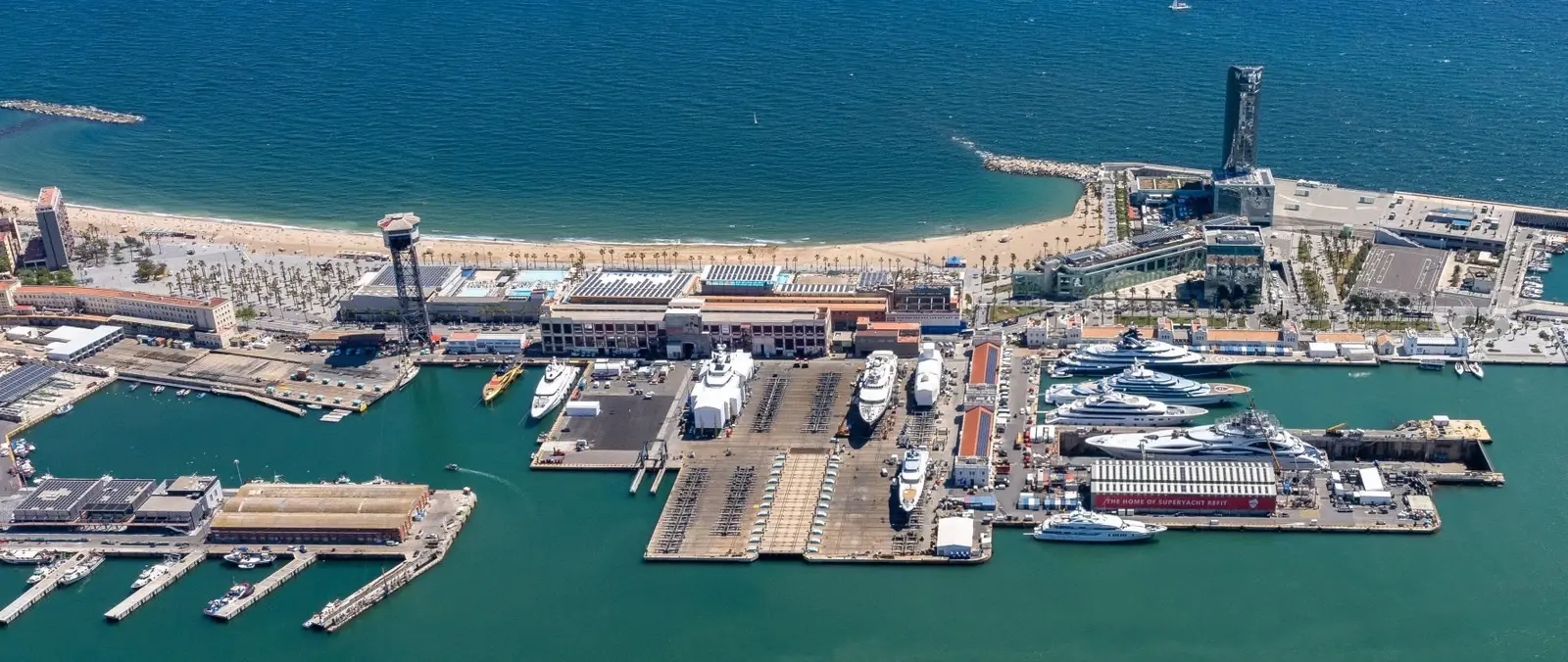
Image: MB92 Barcelona
A small group of Mediterranean refit yards can physically accommodate superyachts at or above 100 metres, but their capabilities differ sharply. We compare verified dry docks, shiplifts, hardstanding and technical berths across Spain, France, Italy, Malta and the Adriatic.
For a 40- or 50-metre yacht, the Mediterranean offers a long list of refit options. At 100 metres and above, that list contracts quickly because a yard needs far more than skilled trades: it needs the physical dimensions, lifting capacity, quay depth, shore power, access and project-control infrastructure to accept a yacht whose displacement and systems can resemble those of a small commercial ship.
Official facility data shows that several Mediterranean yards have crossed that threshold, although not in the same way. Some can dry-dock or haul yachts above 100 metres, others provide hardstanding or covered work areas around that length, and some offer technical berths suitable for major afloat programmes. Those distinctions matter when owners, captains and managers are planning a class survey, paint programme, machinery overhaul, interior reconstruction or multi-season conversion.
A published maximum length is only the first filter. A 105-metre yacht may be too heavy for a shiplift rated for another vessel of similar length, too wide for a graving dock, too deep for a particular berth or unsuitable for a covered structure because of air-draft limits. The practical question is therefore not simply whether a yard advertises “100 metres”, but which part of the facility can accept the yacht and what work can be carried out there.
For this comparison, Superyacht Guide has separated dry-dock, shiplift and hardstanding capability from wet-berth or afloat capability. The figures below are taken from current official shipyard facility pages and should be treated as infrastructure limits rather than automatic confirmation that every yacht within those dimensions can be accepted for every type of project.
| Shipyard / facility | Location | Verified large-yacht capability | Primary 100m+ mode |
|---|---|---|---|
| MB92 Barcelona | Barcelona, Spain | 220m Panamax dry dock; 4,800t shiplift for yachts up to 115m LOA | Dry dock and hardstanding |
| MB92 La Ciotat | La Ciotat, France | 200m × 60m dry dock; 4,300t shiplift with hardstanding for yachts up to 115m | Dry dock and hardstanding |
| Amico & Co | Genoa, Italy | 102m covered graving dock; access to a 170m dry dock on request; technical berthing to 110m | Dry dock and technical berth |
| Lusben Livorno | Livorno, Italy | 180m floating dock; dedicated giga-yacht area with dry berths up to 115m LOA | Floating dock and dry berth |
| Palumbo SY Refit Malta | Malta | 160m dry dock and 140m covered dry dock | Dry dock |
| Palumbo SY Refit Marseille | Marseille, France | Dry docks up to 125m; berthing for yachts up to 200m | Dry dock and afloat |
| Palumbo SY Refit Messina | Messina, Italy | Dry dock up to 268m | Dry dock |
| Palumbo SY Refit Rijeka | Rijeka, Croatia | Floating dry docks up to 260m and extensive technical berthing | Floating dry dock |
| Palumbo SY Refit Ancona | Ancona, Italy | Covered paint sheds up to 120m and berths for yachts up to 110m | Covered / afloat work |
| STP Shipyard Palma | Palma de Mallorca, Spain | Technical berths for vessels up to 120m; travel-lift capacity up to 1,000t | Afloat 100m+ work |
MB92 operates two of the clearest purpose-built 100m+ refit platforms in the western Mediterranean. In Barcelona, the group lists a 220-metre-long, 36-metre-wide Panamax dry dock and a 4,800-tonne shiplift able to place yachts up to 115 metres on hardstanding, creating options for both very large docked projects and multiple lifted yachts within the same technical complex.
La Ciotat adds a different combination. Its Grande Forme dry dock measures 200 by 60 metres, with the yard stating that the dock has extension potential to 300 metres, while the 4,300-tonne shiplift can serve six hardstanding positions for yachts up to 115 metres. For a 100m+ project, that combination is important because it gives project teams alternatives between a conventional large dry dock and a modern lifting platform rather than relying on a single berth or dock configuration.
Amico & Co in Genoa combines dedicated superyacht infrastructure with access to larger port dry docks. Its own covered graving dock accommodates yachts up to 102 metres, while the yard also lists use of dry dock No. 1 on request with total capacity of 170 metres. The technical marina includes berthing up to 110 metres, allowing some large projects to remain afloat when the work scope does not require docking.
Lusben’s Livorno facility approaches the problem through a large floating dock and a dedicated giga-yacht area. The official specification lists a 180-metre floating dock with 18,000-tonne capacity and a dry-berth area for yachts up to 115 metres, placing Livorno firmly in the group of Mediterranean facilities that can support projects beyond the conventional 70- or 80-metre refit market.
Palumbo Superyachts Refit is unusual because its 100m+ capability is distributed across several yards rather than concentrated at one site. The group lists a 160-metre standard dry dock and 140-metre covered dry dock in Malta, dry docks up to 125 metres in Marseille, a 268-metre dry dock in Messina and floating dry docks up to 260 metres in Rijeka. Marseille and Naples also list berthing for yachts up to 200 metres, giving the network substantial afloat capability alongside its docking infrastructure.
Ancona broadens that network with covered paint sheds up to 120 metres and berthing up to 110 metres. Naples is more nuanced for this comparison because its largest floating dry dock is listed for vessels up to 100 metres rather than above that threshold, although its 200-metre berthing capacity means larger yachts can still be accepted for suitable afloat work. The lesson is that a network-wide headline can conceal important site-by-site differences in what can actually be done to a particular yacht.
STP Shipyard Palma belongs in the discussion for a different reason. Its official facility data lists 53 technical berths for craft up to 120 metres, while its largest travel lift is rated at 1,000 tonnes. That does not mean a 120-metre yacht can be hauled by the travel lift, and the distinction should be explicit: Palma’s 100m+ strength is primarily technical berthing and access to the island’s large refit ecosystem rather than a published 100m+ haul-out system.
For some programmes that is entirely sufficient because significant engineering, interior, AV, rigging, hotel-system and maintenance work can be completed afloat. For others, particularly hull, propulsion, class or paint work requiring complete access below the waterline, a captain will need to compare Palma with facilities offering a dry dock or shiplift sized for the yacht’s actual displacement, beam and draught.
A 200-metre dry dock sounds more capable than a 115-metre shiplift, but project suitability depends on far more than headline length. Beam, displacement, docking-block arrangement, draught, air draught, crane reach, shore-power demand, environmental controls, paint containment, subcontractor access and the availability of a suitable project slot can all become limiting factors before length does.
The type of work also changes the choice. A full repaint may favour a controlled covered environment, a propulsion or class programme may make dry access essential, and a major interior or hotel-services refit may be achievable alongside with less disruption and lower docking cost. Owners and managers should therefore use published dimensions as a screening tool and then send the yard a complete yacht specification and scope before treating capacity as confirmed.
The Mediterranean now has a credible network of yards able to support the 100m+ fleet, but that network is much smaller than the infrastructure available to conventional superyachts. MB92 Barcelona and La Ciotat offer some of the clearest purpose-built lifting and dry-dock options, while Amico & Co, Lusben and the Palumbo network add important capacity across Italy, France, Malta and the Adriatic. STP Palma strengthens the afloat side of the market for yachts that do not require 100m+ haul-out capability.
As more yachts cross the 100-metre threshold, the strategic value of these facilities will increase because refit capacity cannot be created as quickly as another marina berth or service office. For the largest yachts, choosing a refit base is therefore an infrastructure decision first and a location decision second: the yard has to be able to accept the yacht physically before its labour pool, cruising position or owner experience can matter.
Explore
Go deeper into the yachts, companies, events and destinations directly connected to this article.
Continue reading
MB92 says connected data and condition monitoring could move superyacht maintenance from seasonal yard periods toward more continuous lifecycle management.
Major refit yards are adding capacity, drawing private capital and capturing repeat work from an expanding fleet, turning maintenance and modernisation into a strategic …

Pendennis has highlighted winter 2025/26 refit capacity at its Falmouth shipyard.
Videoworks has issued technical details of its completed digital refit aboard the 60m CRN charter yacht ELENI, covering multi-zone audio, a 115-inch upper-deck screen …
Superyacht Guide
Continue into the wider Superyacht Guide.
Business opportunities · Superyacht Guide
Companies serving the superyacht market can discuss clearly identified advertising, sponsorship and business-profile opportunities. Commercial activity remains separate from independent editorial coverage.