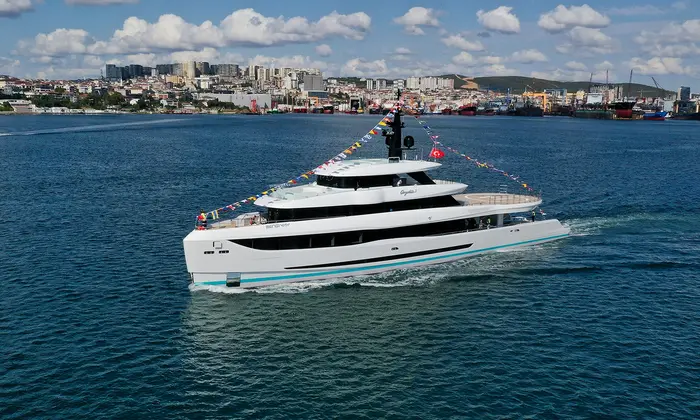
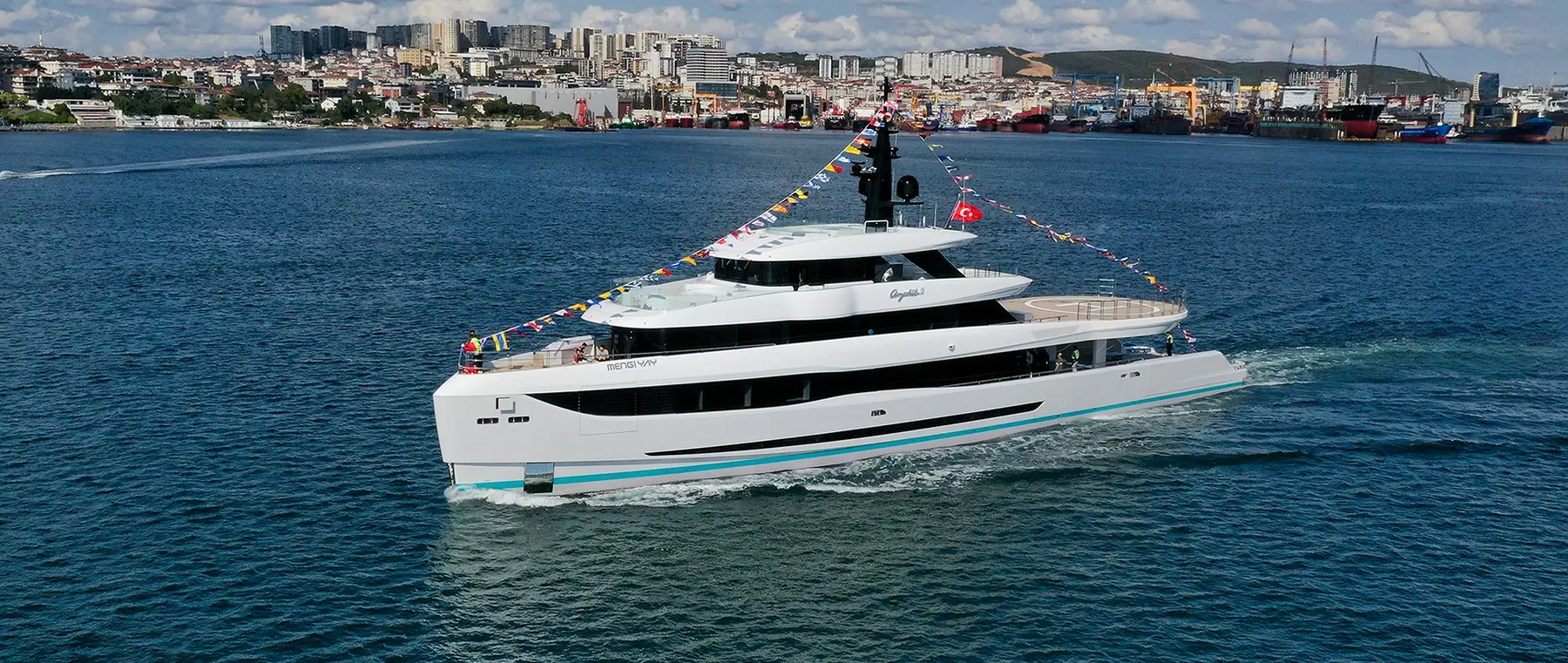
© Mengi Yay Yachts / Reviva Refit original company newsletter, source email ID 314 dated 2026-07-14. Original URL and sha256 recorded. Official press image of named vessel.
Mengi Yay launched AMPHIB II NB116 in July 2026. Examine the 52.4m explorer, its design specifications, planned trials and relationship to GRAY WOLF.
Mengi Yay announced the successful launch of AMPHIB II, builder hull NB116, on 13 July 2026 at its Tuzla shipyard near Istanbul. The manufacturer issued a detailed press release the following day describing an explorer motor yacht of more than 52 metres, developed with exterior design by VYD Studio and naval architecture by Van Oossanen Naval Architects. AMPHIB II belongs to Mengi Yay's growing large-yacht programme but is a different physical hull from the earlier 2026 launch GRAY WOLF NB113. The company described further outfitting, commissioning and trials as remaining work, so the launch should not be rewritten as a confirmed final delivery.
The most important fact is the hull number. AMPHIB II is NB116. GRAY WOLF is NB113. Both are associated with the broader Virtus XP explorer development, and future sales material may refer to a model size rather than either public name. These labels are useful for marketing, but they can cause confusion when older press releases are processed into a fleet database.
The official July email connects the named yacht to the NB116 construction number. That relationship supports a single individual fleet record. It also prevents an unrelated sales announcement mentioning a Virtus XP53 hull from being mistaken for an entirely new launch if the physical builder number already matches AMPHIB II.
The launch took place in Tuzla, where Mengi Yay has expanded its production capacity and developed a programme of increasingly large custom superyachts. The builder's direct announcement presents the event as a significant stage of construction. It indicates that the hull has reached the water, but it does not supply the vessel's final operating dossier or certification documents.
Large-yacht launch events are important because they move a project from a largely land-based environment into one in which systems operate in a real marine setting. Buoyancy, machinery cooling, seawater systems and the behaviour of the boat become more immediate engineering concerns. The transition is an achievement, but the programme does not end there.
The shipyard describes AMPHIB II as exceeding 52 metres overall and lists 52.40 metres on its fleet site. A yacht in this size class can offer substantial exterior lounges and the storage necessary for extended operations. The source additionally describes the yacht as remaining below 500 GT, which is significant because enclosed volume is subject to different calculations than physical length.
Gross tonnage is not the ship's weight. A vessel can be more than 50 metres long yet remain below 500 GT depending on its enclosed spaces and design. Any comparison with another yacht should therefore state both measures accurately and avoid interpreting one as the other.
VYD Studio contributed the exterior and interior vision. An explorer's styling has to accommodate large deck spaces, practical working routes and the impression of a vessel built for travel. Guests may want attractive, sheltered areas for relaxation while the yacht is anchored, yet deck equipment must remain accessible when tenders are handled or preparations are made for a passage.
An integrated design brief can make those functions work together. The visual language may be modern, but the practical question remains how the ship behaves during prolonged use. Easy circulation, useful storage and manageable exposure to the elements become particularly important on longer voyages.
Van Oossanen Naval Architects was responsible for the naval architecture, according to the original press material. Its work shapes the underwater form, stability calculations and the intended relationship between displacement, efficiency and propulsion. The builder also refers to compliance with classification and regulatory frameworks for an unrestricted cruising programme.
A designer's planned performance values cannot be treated as independently verified trials data before testing is complete. A careful news article preserves the original figures but identifies their status as published builder specifications.
AMPHIB II uses a steel hull and an aluminium superstructure. This arrangement is frequently chosen for substantial displacement motor yachts because it allows a robust hull structure while managing the mass of the upper decks. It is well suited to a design in which comfort and endurance are central objectives.
The construction introduces its own engineering responsibilities. Protection of metal surfaces, isolation of dissimilar materials and inspection of high-load joints remain important during the yacht's operating life. A long-range vessel must be maintainable as well as attractive, especially when cruising far from its builder.
The original Mengi Yay release identifies a maximum design speed around 15 knots and a typical cruising speed of approximately 12 knots. Those values help explain the type of motor yacht AMPHIB II is intended to be. The project balances the desire to cover substantial distances with the comfort and economy expected by its owner.
Speed alone does not determine whether a yacht is a successful explorer. The range achievable at a given speed depends on loading, engine efficiency, sea conditions and the amount of power used by hotel services. Trial measurements should eventually provide a better picture than early builder estimates.
The shipyard describes fuel tankage of roughly 65,000 litres and a freshwater capacity near 15,000 litres. The numbers are relevant because they show the intended scale of the cruising programme. Long voyages place demands on supplies, mechanical reliability and the ability to maintain water and sanitary systems for extended periods.
The presence of large tanks does not guarantee a specific range under every operating condition. Captains plan reserve margins and may reduce speed or change route depending on weather. The useful data emerges from integrating tankage with consumption, equipment reliability and operating procedures.
The original press statement refers to Ice Class 1C and a broader combination of classification objectives. This is unusual and interesting for a yacht whose exterior styling is suited to pleasant Mediterranean anchorages. It suggests that the owner wants the vessel to be considered for demanding conditions beyond conventional seasonal cruising.
An ice-class designation requires engineering and operational discipline. It does not mean that every route through ice is safe or that the captain can disregard current conditions. The classification itself should be confirmed in the completed ship's certificates before it is presented as an unrestricted guarantee of capability.
Mengi Yay also mentions a helicopter landing area among the planned certifications. The feature can support access to remote destinations, but it is not simply a decorative circle painted on a deck. Structural, safety and operational matters have to be addressed, including firefighting arrangements, restricted approach paths and the professional expertise of the people involved.
A landing-area certification is a specific technical matter. The launch release reported the intended compliance framework, and the status should remain qualified until documentation from commissioning is available. No helicopter operation on AMPHIB II was established by the email.
Following launch, the builder outlined further outfitting, systems integration, harbour trials and sea trials. The sequence is significant because it demonstrates how much work can remain after a vessel first floats. Mechanical systems have to be examined under realistic conditions, and the crew must have confidence in the controls and emergency arrangements.
Even an exceptionally well-managed construction project can require changes during commissioning. Every large yacht incorporates equipment from multiple manufacturers and specialist subcontractors. Ensuring that those systems work as a single ship is one of the last major tasks before a client can begin normal use.
GRAY WOLF had entered the water on 5 April 2026 as the first Virtus XP explorer, making AMPHIB II a distinct later event. The two launches demonstrate the yard's ability to advance more than one large project through different stages of production in the same year. They do not establish identical interior layouts or a shared owner.
A production family helps explain design continuity but cannot replace individual vessel history. It is therefore important to keep the builder numbers and dates separate, even where the published photographs show similar proportions.
Later brokerage communications concerning Virtus XP yachts may describe agency arrangements, sale availability or a proposed delivery. Those are separate commercial events, and some may concern a yacht already announced under its builder number. A model-based headline alone is not evidence of another physical vessel.
Superyacht Guide already carried a later article about a Virtus XP53/03 sales arrangement. The July launch story serves a different purpose: it records the moment AMPHIB II entered the water, the people responsible for its design and the intended technical capabilities. A duplicate launch report would add little value.
The hero image was taken directly from Mengi Yay's original 14 July 2026 email about AMPHIB II. The image was checked at the original company distribution URL and registered with its byte-level digest and the identifying source email ID. It is not an artist's impression of a future hull or a photograph of GRAY WOLF.
The original email also referred to a collection of high-resolution launch photographs. The fact that a press release offers more media does not mean the newsroom should automatically copy every image without reviewing its identity and rights. The chosen photograph remains traceable to a specific source.
AMPHIB II's 13 July 2026 launch is a concrete, dated achievement. The builder described an ambitious explorer with steel and aluminium construction, long-range design goals, possible ice-class operation and a helicopter landing facility. Those features create a distinctive technical proposition, while much of the operational proof would emerge during commissioning.
The official record should not turn a construction milestone into an imagined transatlantic passage or confirmed client delivery. The completed launch is important on its own, especially when identified precisely as NB116 and kept separate from the first Virtus XP yacht. Future updates can be attached to this same fleet identity as verified evidence becomes available.
Original source verification: Mengi Yay Yachts original direct press email 314, dated 14 July 2026, describing the 13 July launch of NB116. AMPHIB II official Mengi Yay yacht profile and Mengi Yay official fleet. Photograph © Mengi Yay, retrieved from the original company-distributed July 2026 launch email; SHA-256 and hull identity retained.
Mengi Yay Yachts original direct official shipyard photograph
Explore
Go deeper into the yachts, companies, events and destinations directly connected to this article.
Continue reading
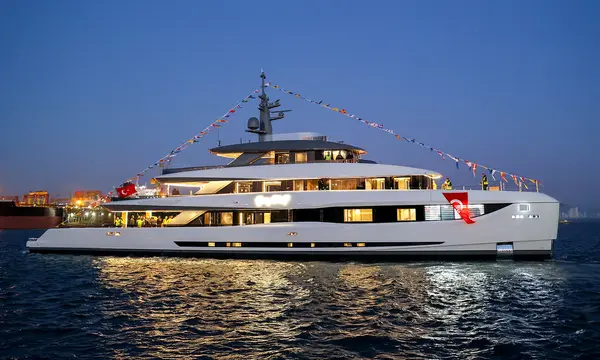
Mengi Yay launched 52.5m GRAY WOLF NB113, the first Virtus XP explorer, on 5 April 2026. Read about VYD Studio, Van Oossanen and the …
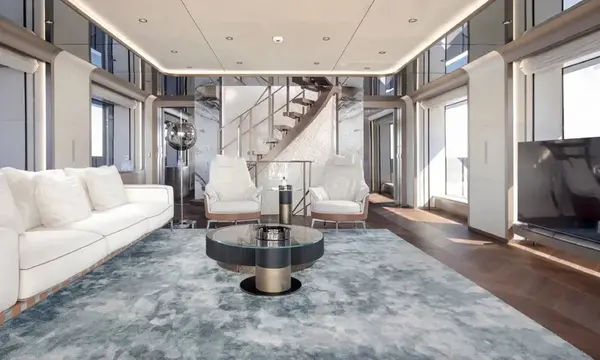
VYD Studio releases interior images of Mengi Yay’s 52.6m GRAY WOLF explorer, showing its guest spaces, main saloon and contemporary material scheme.
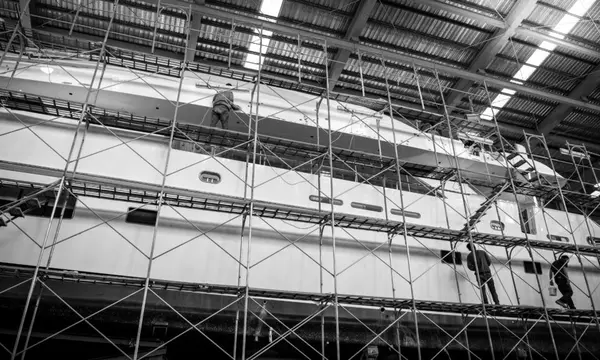
Turkish superyacht builder Mengi Yay has joined the international Superyacht Builders Association, with custom projects underway between 45 and over 60m.
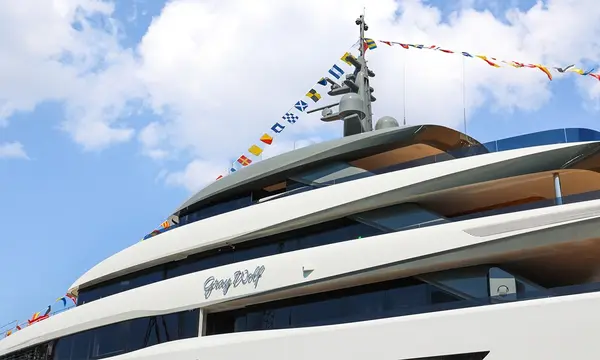
Monaco Yacht Show lists the 52.4m Mengi Yay explorer GRAY WOLF at berth E09 ahead of its international public debut after an April launch.
Superyacht Guide
Continue into the wider Superyacht Guide.
Business opportunities · Superyacht Guide
Companies serving the superyacht market can discuss clearly identified advertising, sponsorship and business-profile opportunities. Commercial activity remains separate from independent editorial coverage.