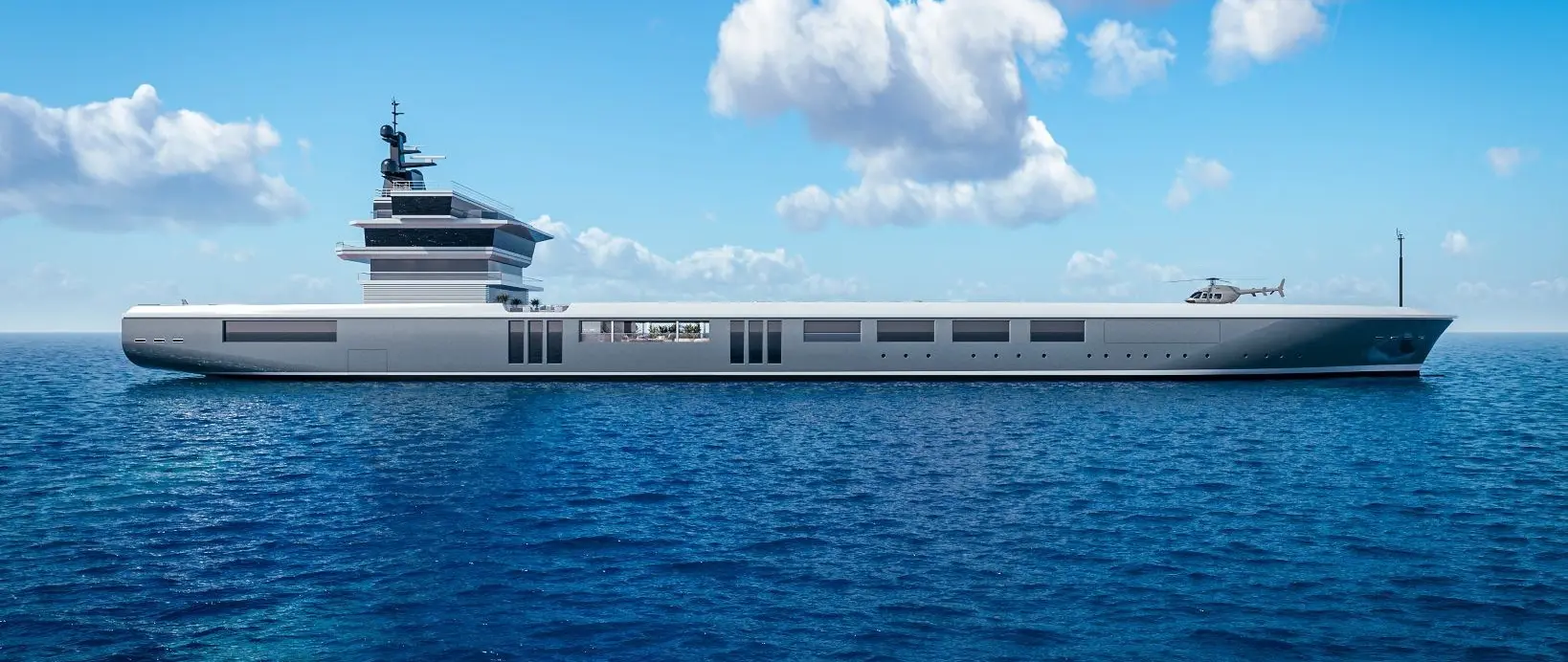
150m Project Anthos original Oceanco and Mario Biferali Yacht Design official concept rendering 2026
Oceanco, Mario Biferali Yacht Design and Lateral outline Anthos, a 150m container-ship conversion concept with a 10,630GT proposed layout.
A project developed by Mario Biferali Yacht Design with Oceanco and Lateral Naval Architects explores how a commercial container-ship platform could be redesigned as a 150-metre luxury superyacht. The concept, called Anthos, was described in detail by SuperYacht24 on 23 October 2026 as part of the Nacht initiative. Its proposed enclosed volume is approximately 10,630 gross tonnes, substantially larger than many purpose-built superyachts. The important qualification is that this is a design and conversion proposal; the public material does not establish that a specific ship has been purchased or that physical conversion work has begun.
The idea is to retain useful aspects of an existing commercial vessel while changing the arrangement and function of its spaces. That approach differs from beginning with a blank-sheet superyacht design, and it poses a distinctive set of engineering questions. A merchant ship has been built around cargo handling and safe maritime transport, while a private yacht must provide accommodation, hospitality spaces and different operating arrangements. Converting the two requires far more than applying luxury finishes to an existing hull.
The Anthos design is associated with Nacht, a term used by Mario Biferali to describe a bridge between naval architecture and yachting. The underlying thinking draws upon the idea of adapting an existing structure to a new purpose rather than replacing it completely. In architecture, that can mean retaining major elements of a building while changing its use. Applied to a vessel, however, the design must still satisfy stability, structural, machinery, safety and operational requirements appropriate to its future role.
A commercial ship's dimensions can offer unusual internal volume, but they may also constrain where windows, new decks, major openings and passenger spaces can be installed. The design team has to work with the platform's original geometry while considering whether it is economically sensible to preserve it. A large project might offer a striking new use for an existing hull, but reuse is not automatically cheaper or environmentally preferable. The outcome depends on the condition of the starting vessel and the scope of its transformation.
The project is described as a collaboration between Mario Biferali Yacht Design, the Dutch builder Oceanco and Lateral Naval Architects. Each organisation has a different role within the concept. The design studio develops the yacht's architectural vision; naval architects assess the technical implications; and Oceanco brings experience in large-yacht construction, refurbishment and life-cycle support. The announcement does not identify an owner, contract value or completed build programme for Anthos.
Oceanco's life-cycle activities provide context for its interest in projects that repurpose or modernise ships. Maintaining and updating a yacht over decades can require substantial technical investment; moving from a commercial to a private operating role is an even more ambitious challenge. Collaboration at the concept stage does not prove that a conversion will be commissioned or approved. Before any work could proceed, the team would need a suitable donor ship, verified documentation, a technical programme and a willing client with a clear understanding of cost and risk.
Anthos is conceived around an extensive main deck divided by a central architectural tower. The arrangement separates different activity areas without relying on the familiar sequence of enclosed guest lounges found on many motor yachts. The proposed bow includes helicopter facilities, sports spaces shielded from wind and an elevated swimming pool. Aft, the design envisages social areas and a large terrace with a canopy arrangement that can offer shade.
These are conceptual features, not completed facilities available for inspection. A working helicopter arrangement would have to be assessed for structural loading, operations and safety, while an elevated pool affects weight distribution and the engineering of water systems. The more unusual the use of space, the more important it becomes to examine the technical assumptions behind the visualisation. Renderings help illustrate the concept, but they do not determine how the vessel would perform once its final structure, machinery and equipment were defined.
Published particulars for the concept include a full-beam principal saloon of approximately 335 square metres. Its proposed floor-to-ceiling windows would make the large interior feel connected to the sea, a feature that is harder to achieve within the existing geometry of many commercial ships. Designing significant openings in a conversion requires naval-architecture work because the original hull and superstructure were engineered for a different purpose. The visual opportunity must be balanced against structure, fire safety and watertight integrity.
Large glazed surfaces also influence daily operation. Temperature control, cleaning access, shading and the resistance of equipment to movement can affect the comfort of occupants. A yacht designed for extended passages needs systems which remain reliable far from specialist contractors. A render showing broad views does not provide proof that every relevant engineering question has been resolved. The saloon is best understood as a statement of design ambition, requiring detailed technical validation before a real ship could be constructed.
Anthos includes an owner-focused arrangement reported at around 284 square metres spread over three decks, together with private lounges, offices, a multimedia room and approximately 135 square metres of terraces. The intended use extends beyond conventional holiday cruising. The proposed offices and multimedia areas could support an owner who spends longer periods aboard or wishes to use the yacht for meetings, remote work or private projects. These amenities must be assessed as one design package rather than independent selling points.
A multilevel owner's arrangement can create privacy but also requires carefully designed circulation. Service access, crew movement, lift facilities and emergency routes have to work together. An office may also require specialist communications, power resilience and acoustic separation that are not captured in the square-metre figure. The published concept describes the intended allocation of space, not verified as-built accommodation. Buyers should distinguish those dimensions from the certified plans of a completed vessel.
The design includes two proposed duplex super-VIP suites, further VIP accommodation and other guest cabins. Its crew arrangement has been described as 27 cabins for 54 people, plus the captain's cabin on the bridge. The scale of the proposed complement reflects the demands of a vessel with numerous hospitality, leisure and specialist spaces. Yet a published cabin count cannot establish the legally approved minimum crew or passenger capacity for a vessel that has not been built.
A yacht of this size requires operational planning well beyond the guest rooms. Provisions, laundry, refrigeration, workshop space, medical support, waste handling and crew access all compete for room in the hull. An existing commercial platform may provide useful volume, but converting its internal subdivision is a complicated exercise. Crew accommodation must be considered from the outset rather than being fitted into whatever space remains after owner areas are drawn. The reported figures provide scale, not evidence of a completed operations plan.
Anthos's proposed facilities include a full-width gym, a double-height sports hall, wellness rooms, a sauna, hammam and treatment areas. Some spaces are conceived with the flexibility to support scientific research, remote working or charitable activities. That multifunctional intent gives the design a character beyond a traditional floating residence. It also means that the vessel's technical systems and staffing might need to support quite different uses during different voyages.
The practical challenges are substantial. A sports space used by guests may have different safety and equipment needs from a laboratory or technical workshop. Research equipment can create requirements for electrical supplies, storage and specialised crew procedures. A future owner would have to define which activities are actually intended before the conversion could be specified in detail. The design concept suggests possibilities, but it does not prove that the ship will be outfitted for a particular scientific programme or receive authorisation to conduct one.
Another distinctive feature is the proposed Sea Garden, described as a sheltered outdoor space open to the sky with views of the water on both sides of the vessel. The concept includes vertical greenery and openings connecting interior and exterior zones. Such a space might provide a quieter retreat than a completely exposed upper deck while maintaining a connection to the surrounding sea. It is one of the architectural ideas that differentiate Anthos from a conventional commercial-ship conversion.
Planting and open-air structures also generate maintenance requirements. Drainage, irrigation, corrosion, wind exposure and access for repair must all be addressed. A space that appears serene in a rendering may be more challenging to operate in a strong sea breeze or during a long passage. On a real yacht, furniture and landscaping would need to remain secure and appropriate for marine conditions. The concept offers an interesting design direction, but detailed engineering would determine whether it could be operated reliably.
The project material discusses Oceanco's Energy Transition Platform, developed with Lateral Naval Architects and industrial partners including ABB and MTU. The principle is to create an adaptable technical architecture which may allow future changes to energy sources and equipment with less disturbance to the vessel's underlying structure. The intention addresses a challenge faced by long-lived large yachts: technologies and regulatory expectations can change significantly during the life of the ship.
It would be misleading to claim that Anthos is already operating on an alternative fuel or that the concept has established a measurable emissions reduction. The proposal describes an architecture intended to support future changes, not a performance trial on a completed vessel. Environmental benefits from using an existing hull also require proper comparison of the materials, energy and work involved in conversion. Reuse can avoid some new construction, but the total impact depends on the starting ship and the final engineering solution.
The source-backed development is the public presentation of Anthos as a 150-metre, approximately 10,630GT commercial-to-yacht conversion concept developed by Mario Biferali Yacht Design with Oceanco and Lateral Naval Architects. The proposal includes substantial owner and guest areas, an extensive crew arrangement, a Sea Garden and the possibility of an adaptable energy architecture. Those features have been described publicly as design proposals and should not be mistaken for completed yacht installations.
No independently verified conversion contract, donor-vessel purchase, launch or delivery date appears in the material reviewed. The project is noteworthy because it explores an unconventional route to large-yacht construction while taking adaptive reuse seriously as a design question. Whether it becomes a built vessel will depend on commercial interest, technical feasibility, regulatory review and the condition of a specific vessel. For the superyacht industry, the important present-day story is the concept and its implications, not a conversion claimed to be under way without evidence.
Primary source: SuperYacht24, 23 October 2026 interview and description of the Oceanco/Mario Biferali Anthos design concept.
Further information: Oceanco official life-cycle support, rebuild and conversion capabilities.
Concept rendering: Mario Biferali Yacht Design / Oceanco, as supplied for the original October 2026 Project Anthos report. This is a proposal, not a photograph of a converted vessel. Official source.
Explore
Go deeper into the yachts, companies, events and destinations directly connected to this article.
Continue reading
Oceanco has presented Lily as part of its Beyond Custom design coverage.

Oceanco's Amsterdam programme links yacht-interior material intelligence, environmental adoption, World Boating Day 2027 and positive ocean impact.
The arrival of 125-metre sailing yacht Koru in Cairns is expected to contribute close to A$1.95 million to the local economy. The visit illustrates …
Oceanco will present 111-metre LEVIATHAN and 92.9-metre DRAAK together at the 2026 Monaco Yacht Show, placing a recent new build alongside an extensively rebuilt …
Superyacht Guide
Continue into the wider Superyacht Guide.
Business opportunities · Superyacht Guide
Companies serving the superyacht market can discuss clearly identified advertising, sponsorship and business-profile opportunities. Commercial activity remains separate from independent editorial coverage.
