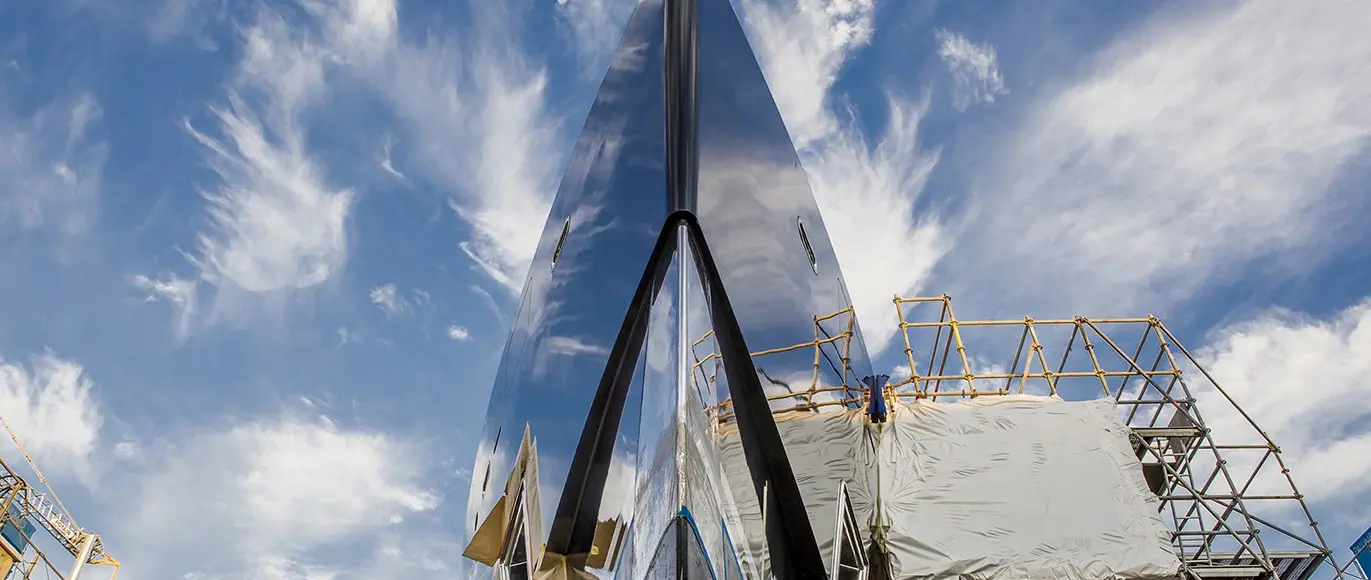
Palumbo Superyachts Refit official promotional shipyard photograph

News

Palumbo Upfit Brings Seven-Yard Refit Network to Metstrade 2026

Nov. 12, 2026 Refit

Palumbo Superyachts Refit official promotional shipyard photograph

Palumbo Upfit will present its seven-yard Mediterranean maintenance and refit network at Metstrade 2026, with its Amsterdam exhibitor listing confirming stand 07.350R.

Industry news, 12 November 2026. Metstrade's official exhibitor catalogue confirms Palumbo Upfit for 17–19 November in Amsterdam; this preview distinguishes confirmed company and show information from owner-side editorial analysis.

A refit network prepares for an Amsterdam industry meeting Palumbo Upfit appears on the official Metstrade 2026 exhibitor list with stand number 07.350R. The Amsterdam exhibition is scheduled for 17–19 November at RAI Amsterdam, bringing marine equipment suppliers, service providers and other industry professionals together. The significant detail for superyacht operators is not simply another name on a stand plan. Palumbo is presenting its maintenance and repair proposition as a geographically distributed Mediterranean network at a time when refit programmes demand increasingly careful planning across technical disciplines and cruising seasons. The show listing describes the business as a provider of full-cycle yacht assistance, with technical and design enhancements alongside routine maintenance. That is the company's commercial description, not a promise that every job or vessel will fit every location. Owners considering work should treat the exhibition as an opportunity to clarify capabilities and available dates, rather than infer a confirmed booking, yard slot or newly signed project from a listing.

Seven locations offer options, not interchangeable facilities Metstrade's exhibitor catalogue names Marseille, Malta, Naples, Ancona, Savona, Messina and Rijeka as the seven locations in the Palumbo Upfit network. It also identifies Monaco as the headquarters. The distribution is significant because superyacht cruising patterns are not uniform. Some vessels remain in the western Mediterranean, others are more naturally based in the central basin, and some move east during a season. A network extending across these areas may help a management team compare routing and support options. However, geographical coverage should not be mistaken for identical equipment, dock capacity, covered space or specialist workforce at every site. An owner contemplating a major structural alteration should ask the company to identify the particular yard proposed, the physical limits of its facilities and the named engineering team responsible. A project delivered within a group remains a project at an actual location, subject to that location's capabilities, access restrictions and timetable.

The exhibitor listing matters more than the September name change The Palumbo Upfit identity was introduced earlier in 2026 as part of the group's repositioning of refit and lifecycle services. That history has already been reported and is not a new rebranding announcement today. The new development is the brand's appearance in the official November Metstrade programme under its current name and a specifically listed stand. It creates a practical point of contact for brokers, captains and managers who will attend Amsterdam before winter maintenance windows tighten. Meetings should distinguish corporate positioning from evidence: which projects were completed, which activities are undertaken in-house, which are subcontracted and which location performed the work? Published marketing language often emphasises continuity, innovation and a broad service range. Those messages are useful introductions but need to be translated into schedules, drawings, named responsible parties and commercial terms before anyone commits a vessel to the yard.

A superyacht refit begins long before the first contractor boards For a large yacht, the yard period is the visible centre of a process that begins with condition surveys, technical documentation, the owner's priorities and a review of regulatory obligations. Paint, interiors, machinery, deck equipment, electrical systems and hotel services can all compete for access to the same spaces. If the specification is incomplete, the programme may acquire expensive variations as soon as fittings are opened or equipment is removed. A seven-yard network can offer possible choices for where to undertake the work, but it cannot remove the need for a coherent engineering scope. Captains and management companies should prepare equipment inventories, defect histories and known constraints before requesting quotations. They should also identify decisions requiring flag-state, class or insurer input. The main question is not whether a yard is generally described as experienced; it is whether the proposed scope is technically achievable on the particular vessel within the window that the owner can tolerate.

Location affects logistics as much as travel convenience The Mediterranean location of a facility influences far more than its position relative to a summer itinerary. Moving a superyacht to a yard can involve repositioning fuel, crew travel, guest equipment, freight deliveries, temporary berthing and arrangements for specialist subcontractors. Import and customs treatment may differ depending on ownership, flag, goods movements and the circumstances of the work, and should be assessed by qualified advisers rather than inferred from the country alone. Owners should also consider where long-lead components can be delivered and stored, whether heavy lifting is available, and how emergency work is handled during the project. A yard network may offer flexibility across ports, yet transferring a partially completed project between facilities can introduce its own risks. A sensible decision compares the whole voyage and project cost, including disruption to the cruising calendar, rather than concentrating solely on an apparently attractive headline quotation.

Repair, refurbishment and conversion require different evidence The official exhibitor description covers both maintenance and technical or design improvements. Those categories have distinct technical implications. A repair aims to restore a system or structure to an acceptable condition. Refurbishment might improve finishes or replace ageing equipment without substantially changing the yacht's function. A conversion can alter layout, displacement, stability, access or operational purpose. On a vessel above 24 metres, even a design decision that appears minor may have consequences for emergency escape, electrical demand, fire protection or safe operation. The appropriate documentation depends on the yacht and the change. Captains should request clarity about engineering responsibility, approval drawings, test procedures and the final configuration records. For an extensive project, an independent owner's representative can help ensure that decisions taken by several specialist trades remain consistent with the original brief and that every change has a defensible technical rationale.

Why the winter timetable deserves attention in November Metstrade takes place in mid-November, just as many Mediterranean-based owners and managers are thinking about winter work and the next summer season. For some yachts, the schedule may already be fixed; others may still be assessing an unexpected defect or a shorter upgrade programme. The timing makes an exhibition conversation commercially relevant, but it cannot establish that a particular berth, shed or subcontractor has capacity. Even an available slot is only one part of a credible plan. Owners need to understand the intended start date, dependencies, critical-path tasks, weather-sensitive activities, acceptance tests and contingency for discoveries once equipment is opened. A proposed completion date should be linked to a detailed programme and clearly defined responsibilities. If the vessel has charter commitments, those should be disclosed early so that potential conflicts are understood before deposits or procurement obligations become irreversible.

Procurement and specialist trades shape the final result Superyacht refit outcomes depend on the supply chain as much as the reputation of the principal yard. Stabiliser components, control systems, generators, custom glass, refrigeration machinery, electronics and bespoke furniture may have very different manufacturing and delivery times. Some replacement parts need approval from original equipment makers or class representatives; others can be sourced through established distributors. A project team should seek a procurement schedule showing what is already ordered, what remains provisional and which items could delay commissioning. It is equally important to document who owns materials paid for in advance and what happens if an alternative product is proposed. Meeting a multi-yard operator at Metstrade offers an opportunity to ask about group purchasing and supplier relationships, but buyers should seek project-specific evidence rather than assume a network automatically guarantees better pricing or quicker delivery.

Quality assurance must extend beyond handover photographs A successful refit cannot be assessed entirely from freshly painted surfaces and a renovated saloon. Systems may need harbour and sea trials, endurance testing, electrical inspections, class surveys, safety checks and crew familiarisation. The owner should receive an intelligible record of completed work, replaced components, outstanding defects, updated drawings and warranties. Crew members who maintain the vessel after redelivery need direct access to accurate information about hidden changes. A documented snagging process is preferable to a vague understanding that minor issues can be handled later. Warranty terms should specify the legal entity responsible, applicable location, exclusions and practical route for obtaining service when the yacht has left the original yard. A network spanning several countries may be an advantage for aftercare, but that potential benefit should be tested against actual contractual responsibilities and service arrangements.

What to ask Palumbo Upfit during Metstrade 2026 For owners and their advisers visiting stand 07.350R, the most valuable discussions will concern the boundaries of the offer. Which of the seven yards is appropriate for a particular length, beam and draft? Is a drydock or suitable lifting arrangement available? Can the company show recent comparable projects with permission from their owners? How are subcontractors managed, and who signs off structural or systems alterations? What evidence supports the proposed timeframe, and how will changes be approved and priced? These questions make the official listing actionable without exaggerating its significance. The event starts on 17 November and has not yet taken place at the time of this report. Superyacht Guide will distinguish any future contract or project announcement from the company's pre-show statements. For now, the confirmed news is a network-wide refit presentation at a named Amsterdam stand, and the practical opportunity is for operators to assess whether its capabilities match their yachts.

Primary source: Metstrade 2026 official exhibitor catalogue: Palumbo Upfit.

Photo licence and source

Palumbo Superyachts Refit / official company promotional photograph. Archive shipyard refit image; not a photograph of Metstrade 2026.

Continue reading

All news

Superyacht Guide

Explore the superyacht world

Continue into the wider Superyacht Guide.

Business opportunities · Superyacht Guide

Reach the superyacht industry audience

Companies serving the superyacht market can discuss clearly identified advertising, sponsorship and business-profile opportunities. Commercial activity remains separate from independent editorial coverage.