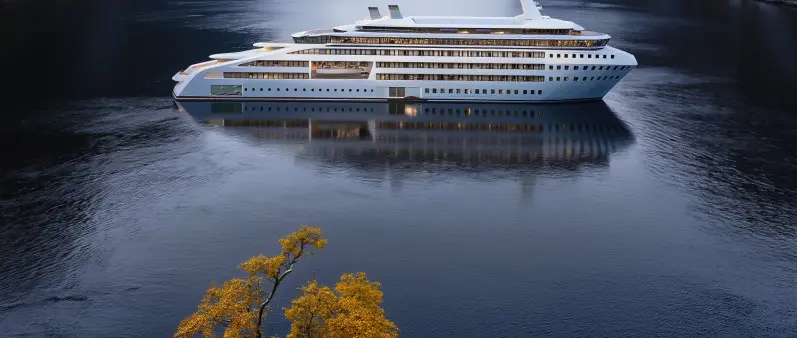
Pastrovich Reopens 88m Offshore Supply Ship Conversion for 30–36 Guests
By Stephen Yardley · Edited by Stephen Yardley
Pastrovich Studio presents an engineering-led 88m offshore-supply-vessel conversion for 30–36 guests, with modular construction and alternative expedition layouts.
Pastrovich Studio has opened up a series of technical studies showing how an 88-metre North Sea platform supply vessel could be transformed into an expedition yacht for 30 or 36 guests. The project has a long history: in 2015 a Norwegian shipowner asked designer Stefano Pastrovich to consider new uses for two technically sound but commercially idle offshore vessels. The studio published a detailed renewed presentation on 28 September 2026 as expedition cruising attracts a wider audience.
The crucial qualification is that the conversion studies have not yet been built. They describe an engineering and hospitality proposal based on a real vessel class, not a completed yacht or a confirmed order for immediate delivery. Pastrovich argues that the underlying commercial logic remains relevant: a robust offshore ship already possesses machinery, range and seakeeping characteristics that would be expensive to reproduce from a blank sheet.
The primary 88-metre configuration provides fifteen suites for thirty guests. A second variation offers eighteen suites for thirty-six guests under an approach informed by the Passenger Yacht Code. This difference is operationally important. A large yacht carrying more than twelve passengers can be subject to different certification, lifesaving, crew and operational requirements from a private yacht designed around the familiar twelve-guest limit.
The studio also studied expansion of the platform to approximately 100 metres, allowing a larger boutique expedition-charter vessel for sixty-four guests or an expedition cruise ship with up to 116 passengers. Those alternatives cannot be treated as interchangeable. They imply different regulatory frameworks, guest circulation requirements, safety systems and commercial operating models. An owner needs to choose the intended business case before judging a proposed interior arrangement.
Many North Sea platform supply vessels are designed with machinery and working accommodation toward the forward part of the hull, leaving a substantial aft working deck. Pastrovich's study uses that arrangement as an advantage: new guest accommodation can be developed as a separate superstructure assembly while the existing ship undergoes preparation. The reference platform offers roughly one thousand square metres of open deck space aft.
The concept is not simply to cover a utilitarian ship in luxury cladding. Engineers would need to assess the foundation structure, additional topweight, fire boundaries, stability, passenger circulation and the integration of the new accommodation with existing machinery. A prefabricated modular approach may save time, but the practicality of lifting and connecting a superstructure depends on its weight and the condition of the individual hull. Those elements require detailed engineering before construction.
The representative vessel described by Pastrovich is based on the Brage Supplier platform, built in 2011 and approximately 86.6 metres long with a beam of nineteen metres. Its published specification includes four Wärtsilä main engines, Rolls-Royce azimuth propulsion and DP2 dynamic-positioning capability. The design intent is to retain core marine systems while giving the vessel a fundamentally different role.
DP2 provides redundancy in position-keeping systems, but it does not make a vessel immune to every failure or guarantee permission to operate in any sensitive waterway. Likewise, a supply-ship hull may be strong and suitable for challenging sea states without meeting every polar operational requirement. Ice-class status, machinery cold-weather capability, survival equipment and local environmental rules must be assessed against the intended route, rather than inferred from the vessel's offshore origins.
The study suggests that parallel preparation of the original hull and construction of the new guest superstructure could permit a conversion period of approximately fourteen to twenty months from yard entry. This is a design-stage estimate and not a binding commitment applicable to every supply vessel. Corrosion history, structural survey results, equipment obsolescence and class changes can materially affect the cost and schedule.
For a potential investor the comparison is with a custom new build that may require substantially longer planning and delivery. Acquiring a suitable existing ship can reduce some exposure to hull and machinery procurement, but it also brings uncertainty about hidden defects and future maintenance. A realistic financial case must include acquisition, class conversion, passenger-safety compliance, design development, shipyard work and a substantial contingency.
Pastrovich's layouts attempt to place key social areas where motion can be less pronounced, organise guest suites into convenient vertical groupings and create appropriate separation from working service spaces. Panoramic lounges, efficient embarkation zones and tender deployment arrangements are central to the proposed expedition experience. The study was informed by observations of existing expedition operators and the logistical demands of guided shore excursions.
Such decisions shape the guest experience more than the amount of polished stone in a saloon. When people are boarding tenders repeatedly in remote locations, circulation, safety briefings, drying facilities and secure equipment storage become everyday necessities. A dining room that is attractive at anchor may be unsuitable in heavy weather if access or motion has not been considered. This is why expedition hospitality has to begin with operational analysis.
Pastrovich Studio is a Monaco-based design practice with experience in exploratory yacht concepts and challenging conversions. Stefano Pastrovich is known for developing ideas that connect unusual vessel platforms with highly tailored guest experiences. In the larger 116-passenger study, Meccano Engineering contributed naval-architecture expertise, while a related hundred-metre new-build concept developed with Wärtsilä explored hybrid propulsion strategies.
Those collaborations matter because an ambitious conversion can cross the boundaries between yacht design, commercial shipbuilding and passenger-vessel regulation. An architect can establish a compelling guest concept, but experienced marine engineers are needed to validate stability, subdivision and systems integration. Equipment suppliers must also provide reliable components and documentation. The proposal's future depends on that combined technical work, not on styling alone.
The published proposal offers a provocative response to growing interest in remote and shared expedition travel. A family with several generations or a specialist operator could theoretically use the same basic platform in different ways, provided the chosen configuration meets the applicable rules. The attraction is access to an engineered ship with an existing working history and a substantial deck capable of carrying new accommodation.
The most important unanswered questions remain financial and regulatory. No construction contract, completed conversion or accepted passenger certification has been announced for these configurations. A buyer would need independent surveys and a full conversion feasibility study before making a decision. Pastrovich's renewed publication is news because it brings a detailed, long-developed concept back to market consideration; its eventual value will be established only if an actual vessel is converted successfully.
Explore
Go deeper into the yachts, companies, events and destinations directly connected to this article.
Continue reading

Acquera Group outlines how its 25-country yacht agency network, Wilsonhalligan recruitment operation and digital tools are being integrated around crew needs.
NAVIGO and ISYL ITS Academy will run a Yacht Chef Master Programme in Viareggio on 1–4 December, covering provisioning, guest service and operational galley …
Royal Huisman has detailed the lightweight construction and engineering methods behind 47-metre performance cruiser Nilaya.
Royal Huisman has published new detail on the 65m AQUARIUS, explaining how returning owners and crew used six years of experience to shape Project …
Superyacht Guide
Continue into the wider Superyacht Guide.
Business opportunities · Superyacht Guide
Companies serving the superyacht market can discuss clearly identified advertising, sponsorship and business-profile opportunities. Commercial activity remains separate from independent editorial coverage.