Sanctions Compliance for Yacht Brokers, Managers and Shipyards
Yacht brokers, managers and shipyards face sanctions risk through ownership structures, payments and services, making effective due diligence essential.
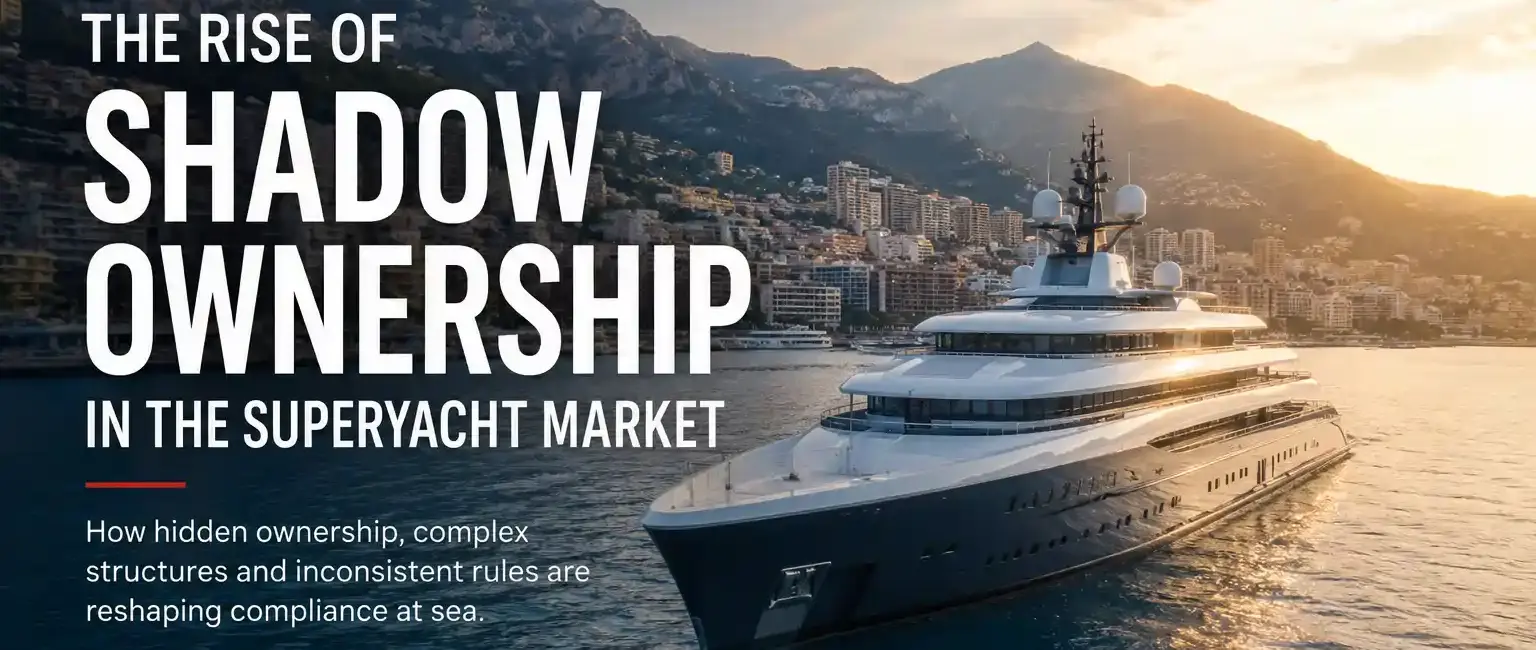
Corporate structures are a routine part of superyacht ownership, but the compliance risk changes when they obscure the person who ultimately owns or controls the asset. Sanctions cases and diverging beneficial-ownership rules are making that distinction increasingly important.
Superyachts have long been owned through companies, special-purpose vehicles and other legal structures rather than in the personal name of the individual who ultimately controls the asset. Those arrangements can serve legitimate purposes, including financing, liability separation, estate planning, tax administration, charter operations and management. The issue now attracting greater attention is not structured ownership itself, but the point at which the legal owner visible on paper no longer makes the ultimate beneficial owner readily identifiable.
“Shadow ownership” is useful editorial shorthand for that gap, but it is not a formal legal term. It describes situations in which the natural person who ultimately owns or controls a yacht is obscured by one or more intermediary entities, nominees, trusts or contractual arrangements. There is no reliable public dataset proving that the proportion of secretly owned superyachts is rising, so the defensible change is the growing prominence of beneficial-ownership opacity as a compliance, enforcement and transaction issue rather than a quantified increase in hidden ownership across the fleet.
A superyacht is a mobile, high-value asset that may be registered in one jurisdiction, owned by an entity formed in another, managed from a third and financed, insured, crewed or commercially operated through additional jurisdictions. That cross-border structure means the registered owner may be a perfectly legitimate company created specifically to hold the vessel. A corporate owner therefore tells only part of the story: the more important compliance question is who ultimately controls that company, provides the funds and exercises the economic rights associated with the yacht.
The distinction is central to the Financial Action Task Force’s Recommendation 24 guidance, which calls for authorities to have access to adequate, accurate and up-to-date information on the true owners of companies. FATF’s Recommendation 25 guidance extends the transparency focus to express trusts and similar legal arrangements. FATF also makes an important distinction that matters in the yacht market: companies and trusts perform legitimate functions, but layered structures can be misused when they prevent investigators or regulated counterparties from identifying the person exercising ultimate ownership or control.
Recent sanctions-enforcement cases show why beneficial ownership has become a practical yacht-market issue. In a U.S. civil forfeiture complaint concerning the 106.1-metre Amadea, the Department of Justice alleged that beneficial ownership was transferred through a series of shell companies in a manner designed to conceal Suleiman Kerimov’s ownership of the yacht. The allegations remain claims made in a government court filing, not a general finding that the use of holding companies in yacht ownership is improper.
A separate U.S. criminal case concerning the 77.7-metre Tango makes the same distinction even more clearly. According to the Department of Justice account of the indictment, a complicated shell-company structure was allegedly designed to hide Viktor Vekselberg’s ownership and involvement with the vessel after sanctions had been imposed. Again, the significance for the wider market is not that corporate yacht ownership is suspicious by default, but that enforcement authorities increasingly look beyond the registered entity when they believe the structure masks the person exercising real control.
The European Union’s new anti-money-laundering regulation gives the yacht sector an unusually explicit place within beneficial-ownership law. Article 67 of Regulation (EU) 2024/1624 requires certain legal entities created outside the Union, and certain foreign legal arrangements, to submit beneficial-ownership information to a Member State central register when they acquire specified high-value goods in the circumstances set out by the regulation. The list includes watercraft for non-commercial purposes priced at least €7.5 million, and the regulation generally applies from 10 July 2027.
That provision should not be confused with a universal European yacht-ownership register: it applies to defined transactions and foreign entities or arrangements within the scope of Article 67. Even so, it is significant because high-value watercraft are expressly identified as an asset class for which beneficial-ownership disclosure can be required. The UK’s Register of Overseas Entities offers a parallel example from another asset class, requiring qualifying overseas entities dealing with UK land or property to identify registrable beneficial owners; it is property-focused, not a yacht register, but it illustrates the wider policy direction toward looking through overseas holding structures.
The regulatory picture is not moving uniformly toward more disclosure. On 11 August 2026, the U.S. Financial Crimes Enforcement Network issued a final rule that permanently removed Corporate Transparency Act beneficial-ownership reporting requirements for U.S. companies and U.S. persons. Certain foreign entities that remain reporting companies must still report beneficial-ownership information for foreign individuals, but the change creates a clear divergence between the U.S. domestic-entity regime and transparency initiatives developing elsewhere.
For the superyacht industry, that divergence does not eliminate the need to understand who sits behind a vessel-owning company. Banks, insurers, brokers, managers, shipyards and other counterparties may still have their own sanctions, anti-money-laundering, know-your-customer or risk-management obligations depending on the jurisdiction and transaction. A corporate registry may therefore be only the starting point for due diligence, particularly where payments, financing, refit work, brokerage or management services involve multiple jurisdictions or sanctioned-person screening.
The commercial effect is a sharper distinction between legitimate privacy and ownership opacity. An owner can have valid reasons for keeping personal details out of general public view while still providing banks, lawyers, regulators and other entitled counterparties with verifiable beneficial-ownership information. Problems arise when the ownership chain is so fragmented, circular or nominee-driven that the person with ultimate economic control cannot be established with confidence.
That is the real “rise” of shadow ownership in the superyacht market: not proven growth in the number of hidden owners, but a growing collision between traditional private asset-holding structures and regulatory systems designed to identify the human beings behind them. As beneficial-ownership rules evolve unevenly across jurisdictions, the market is likely to place more value on structures that can preserve lawful privacy while still producing a clear, defensible ownership trail when a regulator, bank or commercial counterparty has the right to ask for it.
Continue reading
Yacht brokers, managers and shipyards face sanctions risk through ownership structures, payments and services, making effective due diligence essential.

After Russia’s invasion of Ukraine, superyachts linked to sanctioned Russian elites became unusually visible test cases for asset freezes, ownership investigations and international enforcement.

Seizing a sanctioned superyacht is only the beginning. The yacht may remain immobilised for years while ownership is disputed, maintenance bills continue, crew arrangements …
How yacht ownership structures use companies, trusts, flag states, managers and compliance systems to handle privacy, liability, tax and operational risk.
Superyacht Guide
Continue into the wider Superyacht Guide.
Business opportunities · Superyacht Guide
Companies serving the superyacht market can discuss clearly identified advertising, sponsorship and business-profile opportunities. Commercial activity remains separate from independent editorial coverage.