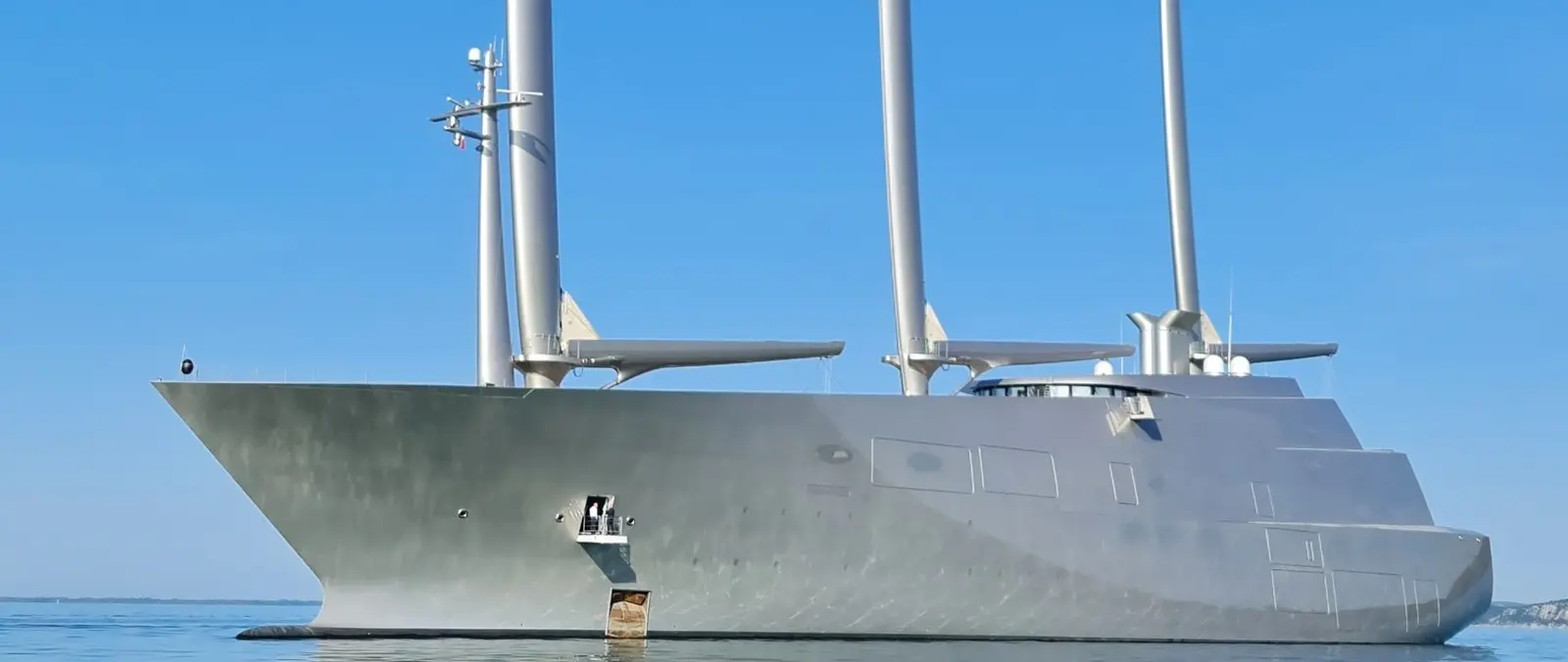
The 142.8m sailing yacht A may move from Trieste to Ancona for six months before further maintenance, with potential shore-power and preservation implications.
The 142.8-metre sailing superyacht A is the subject of a proposed transfer from Trieste to Ancona, where reports indicate it may spend approximately six months before more substantial maintenance work at another Adriatic location. Industry reporting dated 12 November says the move would change how the vessel receives electrical power while it remains subject to an Italian administrative freeze. This is a story about the engineering and management of a very large stationary vessel, as well as a high-profile example of the costs associated with prolonged restrictions. The move was reported as expected rather than independently confirmed completed, and the financial estimates cited in coverage should be treated as reported figures, not audited expenses.
What has been reported about the itinerary
SuperYacht24 reported on 12 November that sailing yacht A was expected to leave the Gulf of Trieste for Ancona before the end of that month, potentially earlier. It described a stay of around six months at the port before further work elsewhere on the Adriatic. An expected arrival date is not proof that the yacht has already reached the destination, so current position and port status should be verified separately before anyone treats the transfer as completed. In a case of this prominence, a difference between a plan and an actual movement is important. Public reporting may evolve as arrangements with ports, contractors and public authorities are finalised.
A yacht of unusual engineering scale
Delivered by the German builder Nobiskrug in 2017, sailing yacht A combines a distinctive Philippe Starck design with engineering contributions associated with Dykstra Naval Architects and the yard. Its length of approximately 142.8 metres and reported beam close to 24.9 metres give some indication of the infrastructure needed to accommodate it. The vessel has a published gross tonnage of roughly 12,558 GT, a measure of enclosed volume rather than weight. A yacht of this size cannot simply be treated like a conventional marina visitor. Suitable draught, mooring arrangements, access control and shore-power capability can determine where it can remain for an extended period.
The long period in Trieste
The vessel has been subject to an Italian administrative freeze since March 2022, according to the industry account. The legal and administrative status is material to any movement or maintenance arrangements, and public reports should not be reduced to a general claim that it is free to sail. Restrictions can affect the ability to appoint contractors, approve expenditure or arrange access, but those matters depend on the competent authorities. Maintenance obligations do not disappear merely because a yacht is not operating commercially or privately. The hull, machinery and interior environment still require regular attention to prevent deterioration while the vessel remains stationary.
Why a stationary superyacht remains expensive
A large yacht at anchor continues to consume resources. Electrical generation may support air conditioning, humidity control, pumps, monitoring equipment and basic accommodation services for the people maintaining it. Machinery must be inspected and exercised appropriately, while emergency systems remain operational. Prolonged inactivity can cause its own problems through corrosion, stagnant water or the deterioration of seals and equipment. Industry reports suggest that expenses associated with sailing yacht A's extended stay have become substantial. Any precise total should be attributed to the relevant published estimate rather than presented as a confirmed financial statement. A proper cost assessment would distinguish fuel, personnel, maintenance, port services and other expenditure.
Reported maintenance costs
The November account cited earlier media estimates that spending linked to storage and upkeep had exceeded €40 million, with a reported daily figure around €24,600. These figures are not independently verified here and should not be used as a precise basis for calculating a liability or the cost of an individual service. They nevertheless illustrate why authorities responsible for a restricted asset may seek more efficient operating arrangements. Even a modest saving per day can become significant over many months. The challenge is to reduce waste without compromising the condition, safety or value of an unusually complex vessel.
Shore power as the key practical change
One proposed advantage of Ancona is access to a berth and shore-based electricity. If the yacht can be supplied with suitably rated, reliable shore power, some onboard generator use may be reduced. That could lower fuel consumption, noise, local exhaust emissions and maintenance demand on generators, although the actual savings depend on the power arrangement and total hotel loads. A vessel of this size may require substantial electrical capacity and carefully controlled transfer procedures. It would be misleading to claim that connection to shore automatically makes the stay emission-free or eliminates all onboard machinery operation. Environmental and cost benefits need to be measured against real power demand.
The difference between anchoring and berthing
Remaining at anchor can involve different operating requirements from a secure alongside berth. A yacht must maintain its position, manage weather exposure and support transfer arrangements for personnel and supplies. Shore access may be less convenient, and a large yacht’s electrical needs can be difficult to meet without direct infrastructure. Alongside, properly designed fendering and mooring arrangements can facilitate maintenance, deliveries and access by specialist contractors. But a berth is not without risk: lines, gangways, power connections and nearby port activity require careful management. Any proposed move must consider both the benefits and the constraints of the particular quay.
What the Ancona berth would involve
SuperYacht24 identified Quay 1 of Molo San Francesco as the expected location, with temporary security restrictions around the berth and its water approaches. That information concerns a planned arrangement, not an invitation for members of the public to approach the yacht. It is normal for a restricted high-value vessel to require controlled access, especially if authorities are managing its legal status. Port operators would also need to coordinate deliveries, maintenance traffic and nearby commercial activity. Photographers and spectators should respect exclusion areas rather than attempt to reach an unapproved vantage point by small boat. Safety and security rules apply independently of the yacht's public profile.
The crew and caretaker requirement
Reports indicated that a complement of around thirty people would remain aboard for maintenance and management during the next phase. That number should be understood as a reported planning figure, not a verified permanent crew roster. The presence of personnel on a stationary superyacht is not unusual when complex machinery and interior systems require ongoing supervision. Roles may include engineering, deck maintenance, security and housekeeping. The precise staffing level depends on operational requirements and the instructions of the responsible managers or authorities. Crew welfare, rest, safety training and access to necessary supplies remain important even when the vessel is not undertaking normal voyages.
Preparing for further maintenance
The proposed Ancona stay has been described as an interim stage before a more substantial technical programme in 2027. Large yachts commonly need periodic inspections and work on machinery, hull coatings, propulsion or rigging to maintain their condition and relevant certifications. The actual scope for sailing yacht A has not been independently established in this report. A statement that major maintenance is planned does not necessarily mean a specific dry dock or contractor has been appointed. Surveyors and managers would need to define the work, identify suitable facilities and coordinate approvals before it begins. The size and unusual configuration of the yacht make early planning especially valuable.
Classification and inspection considerations
Industry coverage linked the anticipated maintenance to possible class-related inspection requirements. Classification is a technical framework for assessing whether a vessel continues to meet applicable standards, and its detailed obligations depend on the vessel's status, class society and survey cycle. A restricted yacht does not automatically lose its physical inspection needs, even if it rarely moves. Maintaining records of preservation work and inspections can be important to protect future options. It would be inappropriate to declare that the yacht has passed or failed a particular class requirement without a primary record from the responsible organisation. Public reporting should separate anticipated survey work from completed certification decisions.
What this says about preservation budgets
An asset as complex as a very large yacht cannot safely be placed into a state of complete inactivity and left for years without cost. Preserving machinery and finishes requires planning that balances immediate energy use against the potential damage from insufficient environmental control. Different systems may benefit from reduced operation, while others require regular testing or exercise. A professional lay-up programme sets priorities, monitoring intervals and escalation procedures. The sailing yacht A case is unusual because of its legal context and scale, but the underlying preservation questions are familiar to refit managers handling any large yacht that will remain stationary for an extended period.
Lessons for owners and insurers
Private owners considering a long-term lay-up should define responsibilities for supervision, emergency response, insurance and equipment preservation before choosing a berth. Shore-power arrangements, humidity control and security are all relevant to the cost of a stationary vessel. Insurers may also have conditions relating to crewing, location and maintenance. The administrative circumstances around sailing yacht A should not be generalised to ordinary private ownership, but they highlight how a change in operating status can alter the financial and technical profile of a yacht. Owners should ask for a detailed lay-up budget that makes assumptions explicit rather than treating non-use as a negligible-cost option.
A sensitive and evolving case
The yacht's ownership and restrictions have attracted substantial public attention, making careful attribution essential. The reported estimates and prospective movement are drawn from published industry coverage, not from direct access to government accounts or the yacht's management records. No assertion about the personal motives or legal guilt of individuals follows from a maintenance story. The relevant questions for marine professionals are where the vessel can be safely accommodated, which technical work is required and how ongoing preservation can be managed responsibly. Those issues can be examined without drawing conclusions beyond the available evidence.
The next confirmed milestone
The practical significance of the planned move will become clearer when the yacht’s actual arrival, berth arrangements and any subsequent maintenance contracts are formally confirmed. Until then, the proposal remains an important but still developing account of how Italian authorities and marine contractors may manage a very large, restricted asset. For the superyacht industry, the lesson is that preservation, electrical infrastructure and classification planning matter as much during extended inactivity as during an active cruising season. A berth with appropriate services can change the cost and condition of a vessel, but the scale of the benefit must be demonstrated rather than assumed.
Primary source: SuperYacht24 — planned Ancona transfer of sailing yacht A, 12 November 2026.
Photograph: SuperYacht24 original 12 November 2026 sailing yacht A reporting — true photograph of the identified yacht, credited to the reporting source. Official source.