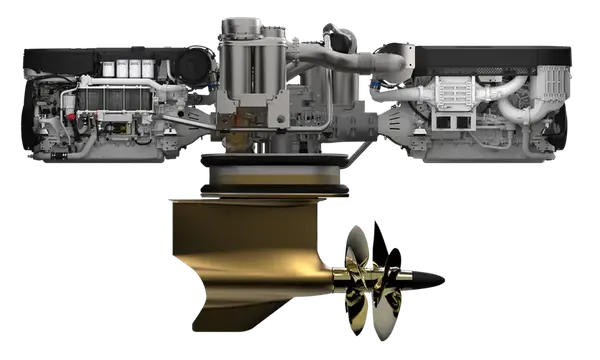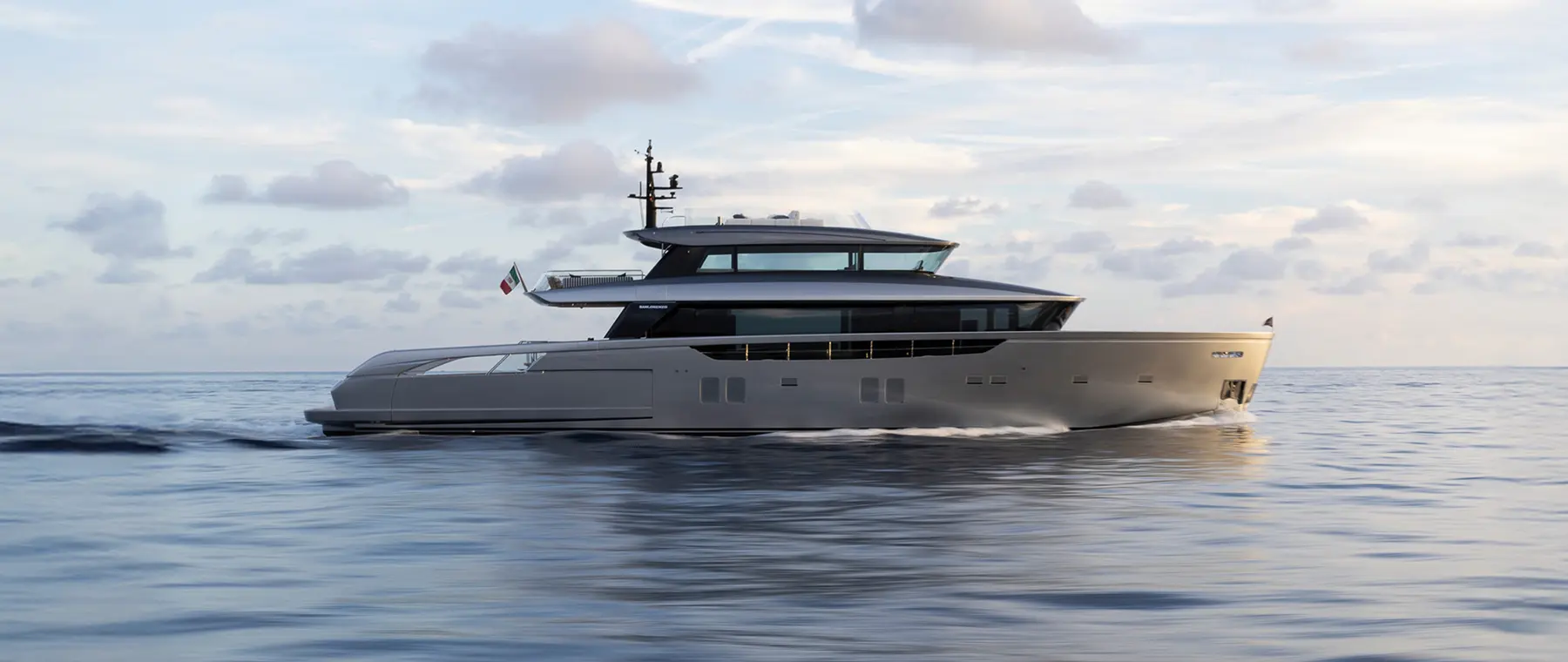
The 36.58m Sanlorenzo SX120 is demonstrating Volvo Penta’s IPS Professional Platform with four D13-IPS 2700 units and a 24-knot maximum speed.
Sanlorenzo’s 36.58-metre SX120 is providing a current superyacht installation for Volvo Penta’s IPS Professional Platform. Volvo Penta is using the yacht as a case study for how the next-generation IPS architecture behaves at a size well above the traditional production-motor-yacht market.
Sanlorenzo specifies four Volvo Penta D13-IPS 2700 units for the SX120 and quotes a maximum speed of 24 knots. The installation combines the compact machinery arrangement associated with IPS with a yacht carrying an eight-metre beam and accommodation for 10 guests.
One of the platform’s defining features is Eco Mode, which can start and stop individual engines according to the power required at a given moment. Volvo Penta says the aim is to reduce unnecessary engine hours and improve load management without compromising manoeuvrability or control.
The system also retains individually steerable drives and joystick control, allowing the propulsion package to contribute directly to low-speed handling. For captains, that makes the installation relevant not only to fuel use but also to docking, close-quarters operation and the consistency of control across different engine combinations.
Volvo Penta positions the IPS Professional package far aft and says the arrangement can release more onboard volume than a conventional shaft installation. On the SX120, that packaging supports a large stern-focused lifestyle area rather than requiring the machinery arrangement to dominate the lower aft part of the yacht.
Sanlorenzo gives the SX120 a 70-square-metre beach area with a retractable pool, reinforcing the connection between machinery packaging and owner space. The design therefore provides a practical example of how propulsion architecture can influence general arrangement rather than remaining an isolated engineering choice.
Volvo Penta says IPS Professional is aimed at vessels from roughly 25 to 55 metres and combines dual-power-input capability, integrated controls and forward-facing counter-rotating propellers. The company quotes improvements in range, acceleration and noise compared with a traditional inboard shaft installation, although actual results depend on vessel design and operating profile.
The SX120 gives those claims a production-superyacht reference rather than a laboratory or commercial-vessel example alone. It also extends Sanlorenzo’s use of IPS into a flagship model where propulsion efficiency, interior volume and beach-club space are all being developed as parts of the same platform.
Explore
Go deeper into the yachts, companies, events and destinations directly connected to this article.
Continue reading

Volvo Penta is showcasing the D13-IPS1350H at Cannes, combining its most powerful IPS engine with an integrated hybrid propulsion architecture.
Compass Tenders has built an 8.7m limousine tender for ANGELIQUE, pairing a drive-in stern-dock arrangement with seating for 12 guests and a 32-knot top …
Vitters is presenting preliminary performance data from 68.9m SY ZERO in Monaco as the all-electric sailing yacht advances its renewable-energy programme.
Superyacht Guide
Continue into the wider Superyacht Guide.