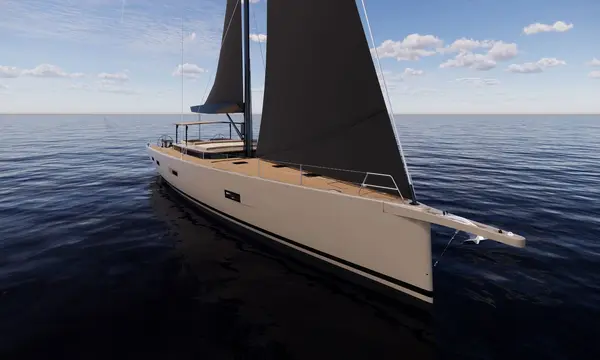
24m YYachts FITZROVIA Joins IYC Charter Fleet as First Hybrid Y8
IYC has added the 24m YYachts FITZROVIA to its global charter fleet. Delivered in 2026, she is the first hybrid-powered Y8 and combines sailing …
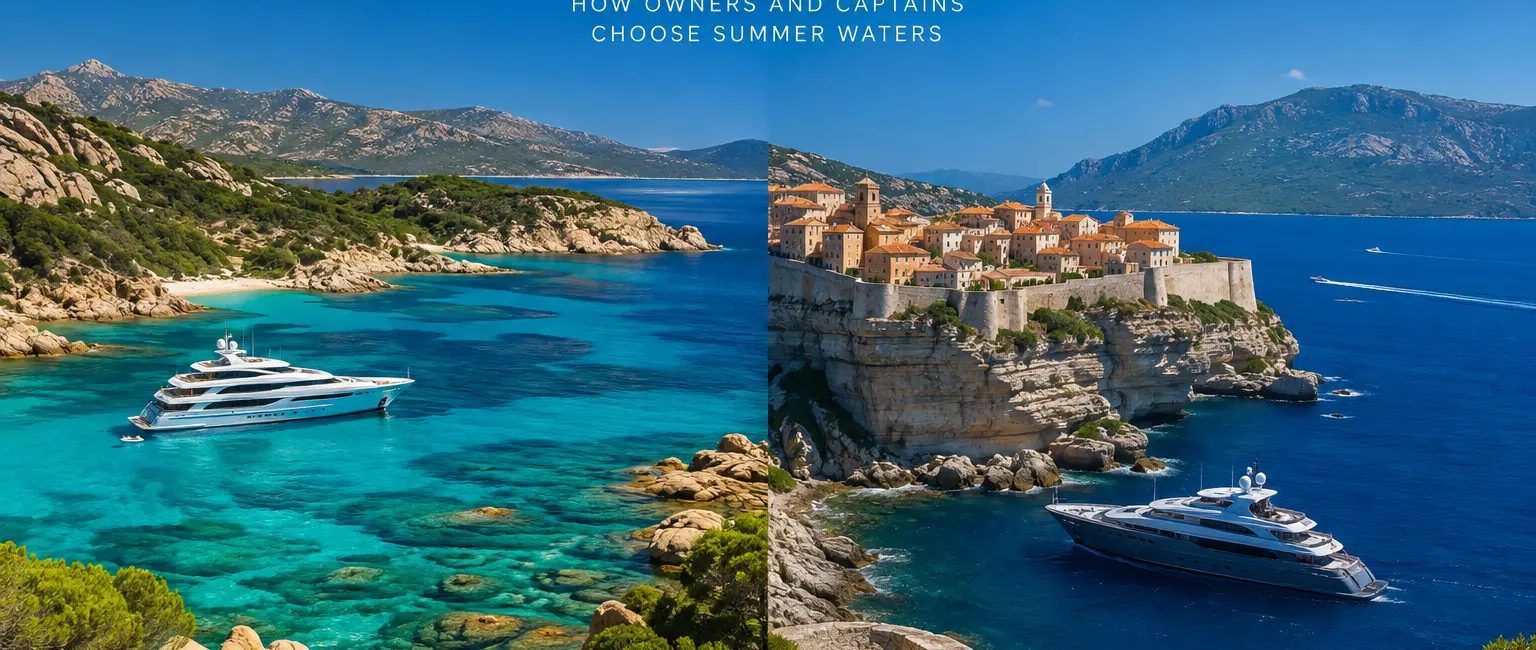
Sardinia and Corsica are separated by a narrow stretch of Mediterranean water, yet they offer markedly different superyacht experiences. Owners may choose according to atmosphere and lifestyle, while captains must reconcile that vision with weather, anchoring restrictions, berthing, logistics and the capabilities of the yacht.
From the aft deck of a superyacht cruising through the Strait of Bonifacio, Sardinia and Corsica can seem like two parts of the same summer playground. The granite islands of La Maddalena lie close to Corsica’s pale southern cliffs, and a route linking the Costa Smeralda with Bonifacio appears straightforward when first drawn on the chart. For the owner planning a Mediterranean holiday, both promise clear water, dramatic anchorages and memorable days spent between the yacht and the shore.
The experience changes considerably once the yacht arrives. Northern Sardinia has developed one of the Mediterranean’s most concentrated luxury circuits, combining established marinas, internationally known resorts, restaurants, shopping and private aviation within a relatively small cruising area. Corsica has capable ports and yacht services of its own, but much of its attraction lies in a less orchestrated coastline where old harbour towns, mountains and protected natural areas remain more prominent than the machinery of luxury tourism.
This is why owners and captains can look at the same two islands and reach different conclusions. The owner may be choosing between social energy and a sense of escape, while the captain is considering berth dimensions, tender journeys, environmental rules, provisioning, guest movements and the possibility that a change in the weather will overturn the planned route. Neither island is automatically the better choice because each delivers a different version of the superyacht summer.
For owners who want their yacht to operate at the centre of the Mediterranean summer scene, northeastern Sardinia remains exceptionally persuasive. Porto Cervo and the wider Costa Smeralda provide a recognisable social setting in which the yacht becomes part of a larger programme involving hotels, restaurants, shops, villas, beach venues and other yachts. Guests can arrive for a short stay and experience several distinct settings without spending much of their limited time underway.
Porto Cervo Marina illustrates the scale of the supporting infrastructure. The marina lists 700 berths, including 100 positions intended for megayachts, and states that it can accommodate yachts up to 120 metres with a maximum draught of eight metres. On-site facilities include yacht services, high-speed fuel pumps, a shipyard, customs and immigration, waste handling, security, provisioning and laundry, giving captains access to a broad range of operational support in one protected location.
That concentration gives a captain valuable flexibility. A delayed flight, a late guest arrival or an owner’s sudden wish to dine ashore does not necessarily require the entire itinerary to be reconstructed. The yacht can remain within reach of the same transport and service network while moving between Porto Cervo, nearby coastal anchorages and the islands of La Maddalena.
The La Maddalena Archipelago adds a contrasting natural dimension to the Sardinian programme. SardegnaTurismo, the region’s official tourism platform, describes La Maddalena as the largest of around 60 islands and islets forming the archipelago northeast of Sardinia. The close succession of islands, channels, beaches and granite formations allows a yacht to create considerable visual variety without undertaking the longer coastal passages that may be required elsewhere.
For an owner spending three or four days aboard, this density is a considerable advantage. A morning can begin in a quiet anchorage, continue with watersports and lunch on board, and end with an evening ashore without requiring the yacht to travel a significant distance. Friends staying in nearby villas or aboard other yachts can also join the programme relatively easily, reinforcing Sardinia’s reputation as a social cruising ground rather than merely a collection of attractive bays.
The disadvantage is that the same qualities attract intense demand during the height of the season. Famous anchorages may be busy with yachts, tenders and excursion vessels, while the most desirable marina positions and restaurant reservations become highly sought after. An owner expecting the Costa Smeralda to provide complete isolation may therefore discover that its strongest appeal is not solitude but access, convenience and participation in a highly active summer circuit.
Corsica presents a different relationship between the yacht and the destination. Bonifacio offers the island’s most dramatic arrival, with the harbour approached beneath limestone cliffs and the historic town rising above the water. The setting is sufficiently distinctive that entering the harbour can become one of the defining moments of the cruise rather than simply the practical conclusion of a passage.
The official Port of Bonifacio describes the harbour as receiving more than 10,000 visiting boats each year. Demand becomes particularly intense during August, when reservations between 1 and 25 August are limited to one night for boats under 18 metres and two nights for larger vessels. The restriction demonstrates both the harbour’s popularity and the importance of confirming availability before the owner’s programme is built around an overnight berth.
From Bonifacio, the yacht can remain in southern Corsica or begin a more extensive coastal journey. Porto-Vecchio and the southeastern beaches can support a shorter programme, while yachts with more time may continue towards Propriano, Ajaccio, the Gulf of Porto, Calvi and Saint-Florent. Each part of the island changes the character of the cruise, introducing different landscapes, harbour towns and relationships between the coast and Corsica’s mountainous interior.
The appeal for many owners lies in this sense of progression. Corsica is less easily compressed into a rapid sequence of internationally recognised venues, and the yacht often remains the principal source of accommodation, dining, entertainment and service. A day may be built around a secluded swimming stop, a tender visit to an old town and a dinner prepared on board rather than an appointment at a famous shore establishment.
This does not mean that Corsica lacks professional support. The island’s official tourism platform lists yacht services based in Bonifacio and covering southern Corsica, including Porto-Vecchio, with additional contacts in Ajaccio and Calvi. The existence of services in several principal ports gives captains a workable network, although it is less geographically concentrated than the one surrounding the Costa Smeralda.
Corsica consequently rewards owners who are prepared to give the cruise more time and allow the yacht greater independence. A longer programme gives the captain room to wait for suitable conditions, remain in a particularly successful anchorage or change the order of the route without creating the impression that an essential destination has been lost. Owners who prefer to travel through a landscape rather than move repeatedly between luxury venues may find this less structured rhythm more satisfying.
The same qualities can become limitations when expectations are different. A demanding last-minute provisioning request, an urgent technical requirement or a complicated series of guest transfers may involve more coordination than it would in northeastern Sardinia. The captain and crew must therefore prepare carefully, ensuring that fuel, stores, transport, waste arrangements and technical contacts are organised before the yacht moves into the less concentrated parts of the itinerary.
Owners usually begin with the desired atmosphere rather than the operating plan. One may want to be close to friends, restaurants and the visible social life of the season, while another may regard the yacht as a means of escaping precisely that environment. Some owners enjoy arriving stern-to in a celebrated marina where the yacht becomes part of the waterfront scene, whereas others prefer the privacy of remaining offshore and visiting the land only by tender.
Sardinia generally makes the first style of ownership easier to deliver. Its compact cruising area allows an owner to combine social activity, short passages, marina evenings and anchorage days without sacrificing a large part of the holiday to movement. Corsica often suits the second style, particularly when the owner is comfortable allowing the yacht and its crew to provide most of the experience without relying upon a continuous succession of shore-side venues.
The captain must translate those preferences into a programme that works for the particular yacht. A vessel that depends heavily on marina access, regular vehicle movements or frequent changes of guests may be better suited to Sardinia’s concentrated infrastructure. A yacht with substantial storage, capable tenders, good stabilisation and an owner comfortable remaining at anchor may be able to make fuller use of Corsica’s more dispersed coastline.
Size alone does not determine the answer. Draught, manoeuvrability, windage, anchoring equipment, tender design and the comfort of the yacht underway may be more important than length. A large yacht with excellent tenders and strong operational independence may cope very well with a remote programme, while a smaller yacht with limited storage or an owner who dislikes tender transfers may require more frequent marina access.
Guest comfort also changes the captain’s judgement. A passage that is entirely safe may still be inappropriate when guests are expecting a relaxed lunch, an afternoon swim or an immediate transfer ashore. Similarly, an anchorage suitable for the mothership may involve a wet or uncomfortable tender journey, particularly when guests are dressed for an evening ashore or travelling with young children.
The Strait of Bonifacio makes this distinction especially important. Its position between the two islands means that a programme linking Sardinia and Corsica must retain sufficient flexibility to respond to wind and sea conditions. A captain may delay the crossing, reverse the order of the itinerary or remain on one side of the strait even when the yacht could technically complete the passage, because the owner’s experience depends upon comfort as well as navigational safety.
A successful itinerary therefore contains alternatives from the beginning. Sardinian anchorages can be retained as fallbacks when a crossing becomes undesirable, while a Corsican route can be shortened or reorganised rather than forcing the yacht to continue along an exposed coast. This flexibility should not be interpreted as uncertainty, because it is the means by which the captain protects both the yacht and the quality of the owner’s holiday.
Environmental regulation has become one of the decisive operational differences between an attractive itinerary on paper and one that a yacht can lawfully follow. Both Sardinia and Corsica include sensitive protected waters where captains must consider permits, vessel-length thresholds, designated moorings and the location of Posidonia seagrass before committing to an anchorage.
Within the La Maddalena Archipelago National Park, official authorisation is required for activities that include sailing, mooring or anchoring within 300 metres of the coast. The park calculates its fee according to the length of the recreational vessel and warns that entering without prior authorisation can result in fines and an additional surcharge. The requirement changes the way a superyacht approaches the archipelago because the captain cannot select a bay solely for its scenery, depth and apparent shelter.
The yacht must also be permitted to enter and operate within the protected area, while the bridge team must confirm the current rules applying to navigation, anchoring, mooring and proximity to the coast. Previous-season knowledge is not sufficient when procedures, boundaries or local orders may have changed, so the itinerary must be checked against current official information before arrival.
Corsica applies similarly important controls to large-yacht anchoring, particularly where anchors and chains could damage Posidonia meadows. Bonifacio Marina’s Sant’Amanza mooring area was established within the Bouches de Bonifacio Nature Reserve following regulations governing the anchoring of yachts over 24 metres. The marina states that these protections have since been extended around Corsica.
The organised Sant’Amanza area includes moorings for vessels of different sizes, with three positions for yachts up to 60 metres and one for a yacht up to 75 metres. The seasonal service operates from 1 June until 30 September, allowing large yachts to use protected waters without placing their anchors and chains on sensitive seabed. Availability, reservations and the dimensional limits of each mooring therefore need to be addressed before the owner is promised a particular location.
These restrictions do not make either island unsuitable for superyachts, but they require greater discipline than the traditional practice of choosing an empty bay and dropping anchor. Captains must work from current official charts, local notices, park permissions and harbour information, while owners need to understand that an apparently empty position may still be unavailable or environmentally unsuitable.
Responsible ownership accepts that access to exceptional waters may involve permits, designated moorings and occasionally being told that the preferred anchorage cannot be used. Pressure to anchor closer to a beach or disregard a protected seabed places the captain in an impossible position and threatens the environment that made the destination desirable in the first place.
The comparison between Sardinia and Corsica does not have to produce a single winner. For many yachts, the most satisfying programme uses each island for a different purpose, combining Sardinia’s concentrated luxury and logistical convenience with Corsica’s stronger sense of movement and discovery.
A yacht might begin in Porto Cervo, allowing guests to arrive and settle aboard within a well-supported environment. The first days could include the Costa Smeralda and La Maddalena before the captain selects a suitable window to cross towards Bonifacio. Once in Corsica, the itinerary could concentrate on the southern coast rather than trying to cover the entire island within a single week.
The reverse programme can be equally effective. Beginning in Corsica gives the cruise an immediate feeling of exploration, after which the yacht can finish in Sardinia with easier access to restaurants, social engagements and departure arrangements. This order may also suit owners who want the final days to feel less dependent upon long passages and changing weather.
The principal danger is trying to include too much. A seven-day itinerary linking Porto Cervo, Bonifacio, Ajaccio, Calvi and a return to Sardinia may look impressive on paper but could leave guests feeling that the yacht is constantly arriving or departing. Longer distances also reduce the captain’s freedom to wait for better conditions because every delay threatens the next destination.
A stronger itinerary chooses a defined part of each island and leaves room for the programme to evolve. The owner receives contrast without sacrificing comfort, while the captain retains enough alternatives to adapt to weather, port availability and the realities of operating a large yacht in protected summer waters.
Sardinia will usually appeal most strongly to an owner seeking a polished, social and highly connected holiday in which the yacht moves easily between recognised destinations. Corsica may be more rewarding for an owner who wants the vessel to create separation, explore a varied coastline and remain at the centre of the experience rather than functioning as a base for activity ashore.
Captains are less likely to describe either island in absolute terms. Their choice will depend upon the yacht, the guests, the forecast, the regulations and the time available, because the most famous destination is not necessarily the one that will produce the best week aboard. The successful decision is the one that allows the owner’s preferred version of summer to be delivered safely, comfortably and without forcing the yacht into a programme that the coast or conditions cannot support.
Continue reading
IYC has added the 24m YYachts FITZROVIA to its global charter fleet. Delivered in 2026, she is the first hybrid-powered Y8 and combines sailing …
What Is Life Like Working on a Superyacht? Hours, Cabins, Tips and Time Off Working on a superyacht can combine good pay, travel and …
Yacht Chef Salary 2026: Pay, Tips and Charter Earnings Yacht-chef pay depends on yacht size, private or charter use, professional background, qualifications, rotation and …
Superyacht Crew Tips: How Much Can Crew Earn on Charter? Charter-yacht crew often receive discretionary guest tips, but tips are not guaranteed salary and …
Superyacht Guide
Continue into the wider Superyacht Guide.