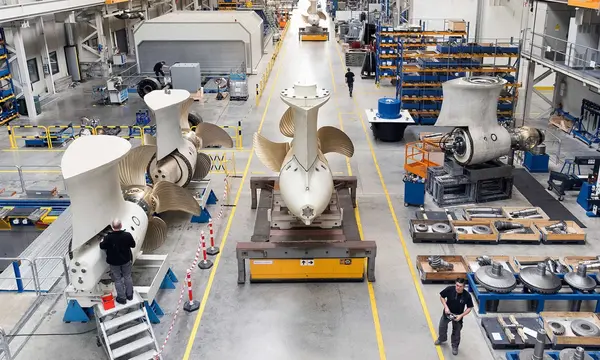
Schottel Says 20 Superyachts Have Ordered EcoPeller Main Propulsion
Schottel reports 20 superyachts on order with its forward-facing EcoPeller azimuth propulsion system, highlighting efficiency, manoeuvrability and reduced onboard noise.

Sharp prepares to demonstrate its MEO/LEO tracking satellite user terminals at CEATEC 2026, with marine vessels among the planned mobile use cases.
Japanese electronics company Sharp has confirmed that its forthcoming CEATEC 2026 display will include MEO and LEO satellite communications user terminals intended to maintain connectivity on moving platforms. Its official 30 September announcement identifies marine vessels among the possible applications, alongside road vehicles, construction and agricultural machinery and drones. CEATEC runs from 13 to 16 October at Makuhari Messe in Chiba, Japan.
The announcement is relevant to superyacht operators seeking additional communications choices beyond a single low-Earth-orbit network, but it does not describe a commercially installed yacht terminal or an operational service agreement for an owner's vessel. Sharp is presenting technology developed around accurate satellite tracking and reduced equipment size, rather than an independently verified maritime deployment.
Unlike a fixed shore-based receiver, an antenna aboard a yacht must cope with changes in vessel heading, roll, pitch and local obstructions while following satellites crossing the sky. Sharp says its proprietary beam-control technology is intended to maintain communication with non-geostationary medium- and low-Earth-orbit satellites as the platform moves. The manufacturer is applying compact and lightweight engineering approaches developed through its smartphone products.
A product's ability to track a satellite does not automatically establish the throughput, latency, switching capability or weather resilience that its customers will experience. Those measurements also depend on the selected satellite constellation, approved service, antenna configuration, installation position, available power and network management. Technical managers will require the correct test evidence and certification before considering a bridge or mast installation.
Sharp has previously demonstrated multi-orbit concepts and in 2024 announced cooperation with established marine-electronics specialist Furuno to study shipboard antenna performance. The 2026 CEATEC plans continue that work by showing user terminals suited to moving platforms, alongside other emergency communications technologies. Sharp's wider strategy includes collaborations involving satellite operators and non-terrestrial-network standards.
For yacht connectivity, optionality may become increasingly valuable as operators combine terrestrial cellular systems with LEO and MEO coverage along different cruising routes. Yet no single prototype should be treated as a ready replacement for existing VSAT, LEO or cellular systems without verifying network acceptance, regional coverage, type approval and after-sales support.
A yacht captain or integrator assessing future satellite terminals needs to consider safe antenna placement, blocked sectors, mast vibration, lightning bonding, electromagnetic compatibility, cable routing and the chosen network's subscription terms. Service redundancy may also require separate power supplies or multiple physically distributed antennas rather than relying on one terminal, regardless of its technical capabilities.
Crew and guest communications have different priorities. Navigation data, operational voice services and safety-related systems should be configured with appropriate resilience and access control, while entertainment and general internet traffic can use separate capacity policies. A new terminal might fit into that architecture, but the CEATEC announcement contains no evidence that such marine integrations have been formally released.
Sharp will exhibit seven technology themes under its Social Resilience programme, including an instant local 5G network, long-duration zinc-air energy storage and water-supply leak detection. The satellite terminals form part of that broader exhibition, reflecting the company's emphasis on maintaining communications and services where conventional infrastructure is limited or disrupted.
For the superyacht sector, this is an early-stage technology development worth watching rather than a firm procurement announcement. The original photograph accompanying this report is Sharp's official CEATEC 2026 booth illustration, clearly distinguishable from a photograph of a prototype antenna installed on a yacht. Future specifications and availability must be established directly with the manufacturer.
Continue reading
Schottel reports 20 superyachts on order with its forward-facing EcoPeller azimuth propulsion system, highlighting efficiency, manoeuvrability and reduced onboard noise.
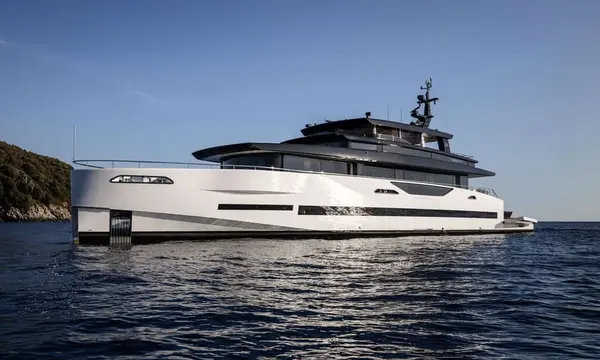
GX Superyachts has presented the 42-metre GX42 with a parallel hybrid drivetrain, substantial battery storage and solar generation integrated into one energy-management architecture.
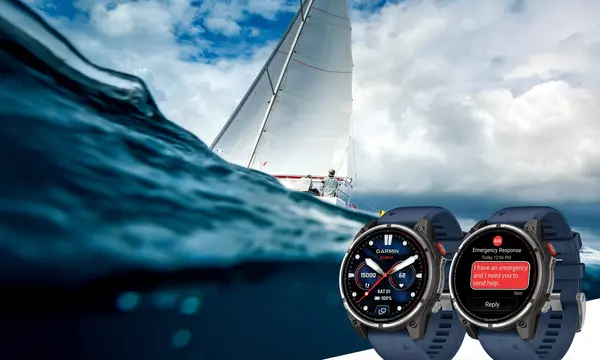
Garmin’s quatix 8 Pro combines inReach satellite and LTE connectivity, marine controls, SOS support and up to 15 days of smartwatch battery life.
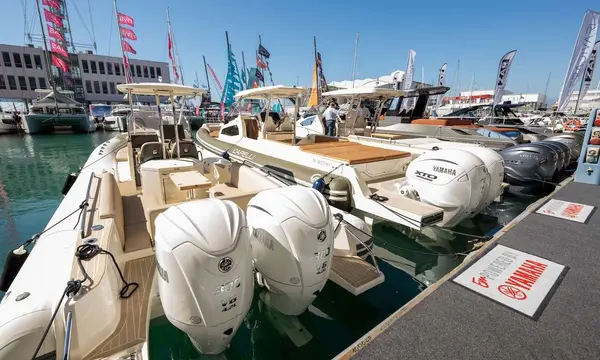
Yamaha Marine is using Genoa to present its high-power V8 and V6 outboards, integrated control systems and on-water Torqeedo electric propulsion trials.
Superyacht Guide
Continue into the wider Superyacht Guide.
Business opportunities · Superyacht Guide
Companies serving the superyacht market can discuss clearly identified advertising, sponsorship and business-profile opportunities. Commercial activity remains separate from independent editorial coverage.