Source: https://sunreef-yachts.com/en/news/100-sunreef-power-eco-double-happiness-an-electric-supercat/ | Copyright Sunreef Yachts | official PR editorial photograph | SHA256 4416fbff2aa3bfce2572031d0a210bfcbe807da81c1605777e3ce1f56cfad363
Discover the 28.63m Sunreef 100 Power Eco DOUBLE HAPPINESS: four 180kW motors, 990kWh batteries, solar energy and an expansive Ocean Lounge, revealed in 2025.
DOUBLE HAPPINESS is one of the clearest examples of Sunreef Yachts applying an electric propulsion system to a large luxury power catamaran. The builder's November 2025 presentation described the yacht as its first electric 100 Sunreef Power Eco, combining four electric motors, a substantial battery bank, solar generation and range-extending equipment. The yacht is a built 2025 vessel, not the same ship as the separate Sunreef 80 that has also carried the name Double Happiness. That distinction is critical when matching photographs, dimensions and powertrain details from a crowded builder newsletter.
The Sunreef 100 Power design is approximately 28.63 metres long and 13.5 metres wide, giving it a very different distribution of internal space from a conventional monohull of similar length. DOUBLE HAPPINESS uses that breadth to create a social layout that flows across the full width of the main deck. Its wide exterior platforms and stepped aft terraces are central elements of the design, not simply decoration placed around the propulsion equipment.
In the original source, Sunreef published the yacht's details on 27 November 2025. The same announcement appeared in the company's newsletter shortly afterward and remains a reliable record of the launch-era equipment and interior design. However, historical newsletter phrasing should not be used to claim that an owner has a particular charter week available today, or that the yacht is at a specified location in November 2026.
The builder lists four electric propulsion units rated at 180 kW each, giving 720 kW of installed motor capacity. Sunreef also describes a 990 kWh battery system. These are substantial figures for a yacht whose primary attraction is its combination of comfortable cruising and quiet operation. They provide useful context for the engineering approach but are not, by themselves, a statement of maximum range or average energy use in a specific sea state.
A large battery bank creates opportunities for reducing noise and exhaust from onboard generation during some operating periods. Its benefits vary with charging capacity, speed, hotel loads, temperature and the condition of the battery. Electric propulsion is not an exemption from the laws of energy balance: a yacht must still obtain its electricity through charging, generation, solar input or other sources. For a credible technical assessment, the origin and use of that energy must be considered alongside the installed motor ratings.
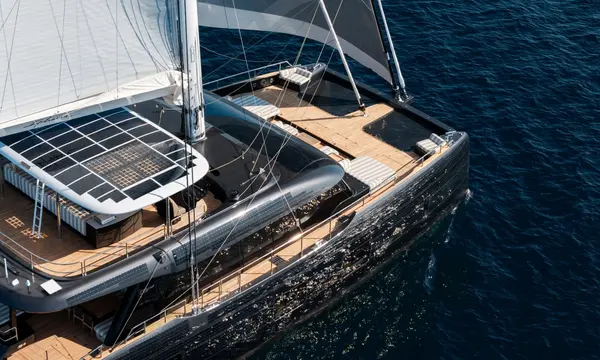
Sunreef says DOUBLE HAPPINESS carries solar panels incorporated into the bimini roof. The idea is to use otherwise exposed exterior surfaces for electrical generation without making the equipment a dominant visual feature. Even a well-designed solar installation cannot be expected to power sustained high-speed cruising on a large yacht by itself. The value of the contribution depends on weather, surface area, orientation, shadows and the loads that require support.
In practical terms, solar generation may be most useful for offsetting some onboard electrical consumption during periods when the yacht is stationary or moving slowly. Air conditioning, refrigeration, lighting and domestic services can represent significant continuous demand. The combination of onboard storage, solar input and controlled energy use offers greater flexibility than any single element would provide on its own.
The manufacturer's information describes two range extenders. These are part of the vessel's broader energy system and help address the gap between the energy available from batteries and solar panels and the requirements of a long passage. In a hybrid-style electrical architecture, the generator or range-extender components may allow the yacht to maintain power or recharge when shore supply and sunlight are insufficient.
The presence of such equipment is the reason the phrase 'zero emissions' requires care. The vessel can have quiet, locally emission-free operating modes, but the complete environmental impact depends on the energy sources used. The sensible claim is that DOUBLE HAPPINESS offers a range of electric operating possibilities supported by additional energy-producing systems. No independent full-cycle emissions estimate or audited consumption data is supplied in the original 2025 release.
For the guest experience, the most immediate result of the catamaran platform is space. Sunreef describes a main saloon with large windows and wide glass doors opening toward the aft cockpit. When the doors are open, the interior and exterior living areas can function as a connected environment rather than as two small spaces separated by a threshold. That is particularly valuable when hosting meals or gathering guests in a sheltered location with views over the stern.
The interior arrangement includes a dining table for ten and lounge seating intended for informal conversation. These facilities are specific elements of the builder's published layout, not assumptions about every 100 Power. The large beam can provide generous circulation, but careful furniture placement remains necessary so that the space works for guests and crew rather than becoming a large room without clear zones.
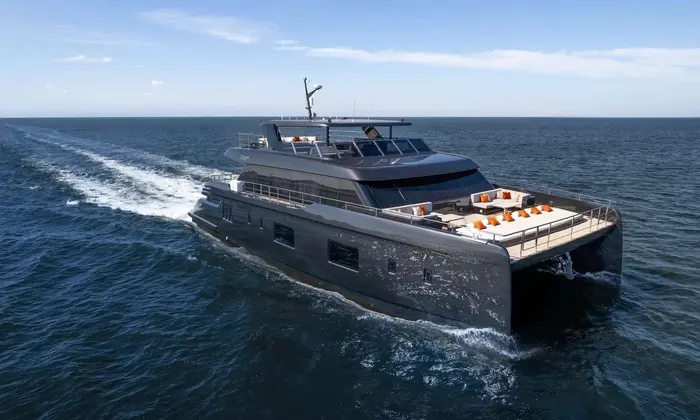
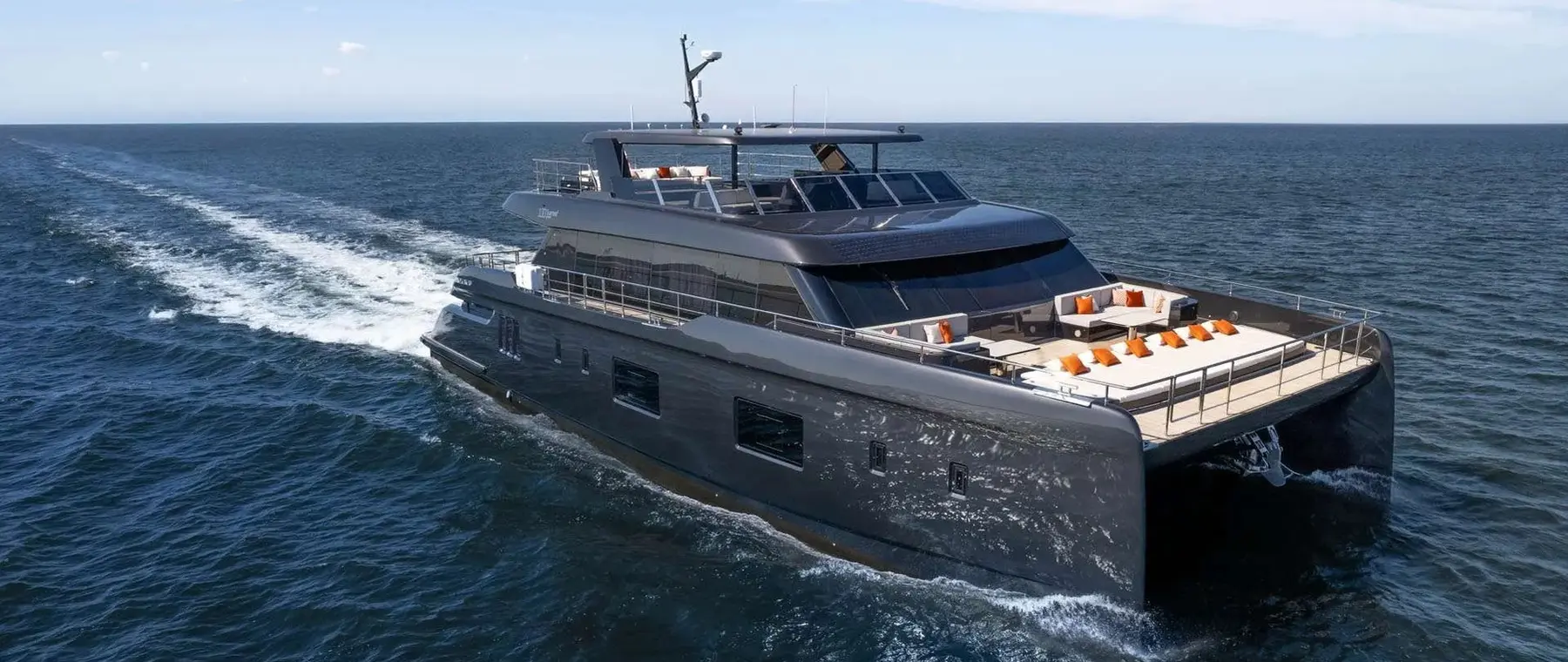
The yacht's stern is one of its defining features. Two large fold-down platforms increase the area available around the water, while steps and terraces connect it to the higher main deck. This arrangement provides space for swimming, boarding small boats and enjoying the sea close to the hulls. The builder calls this connected arrangement an Ocean Lounge, reflecting the growing preference for a beach-club experience on yachts of many different sizes.
The yacht also has a garage intended for two large jet skis and other water toys. Equipment capacity is important for the way a vessel is used, but it creates practical demands around storage, safe lifting and launch conditions. A garage is not evidence that every advertised craft is permanently aboard. Each owner's actual inventory may change, and only photographs or current operator information could establish what the vessel carries at a particular time.
A beam of 13.5 metres is one of the characteristics that gives a 28.63-metre catamaran an unusually large living footprint. It also affects practical operations. Berthing a wide vessel requires suitable spaces and careful manoeuvring, while the crew must plan for the geometry of the twin hulls when working close to docks. Tenders, platforms and the aft garage need room for safe use, particularly in tidal or windy conditions.
These operational considerations are easy to overlook in a yacht feature dominated by attractive photography. Yet they are part of what determines whether the design suits an owner's preferred cruising destinations. The same wide platform that creates an impressive saloon and beach club may require a different marina search strategy from a much narrower monohull. The best design serves the owner when underway and in port.
Sunreef emphasizes the near-silent character of DOUBLE HAPPINESS under electric power. Quiet operation can make a material difference to guests, particularly during early departures, slow passages and time spent close to scenic coastlines. Reduced vibration from propulsion machinery can also improve the experience in cabins and shared spaces. The ultimate acoustic result depends on the complete installation, including propellers, auxiliary systems and the condition in which the yacht is operating.
A responsible article should not take 'silent' literally as the absence of any sound. Water movement, air-conditioning units, wind, ventilation and deck activity continue to create noise. The builder's public claim establishes the intended advantage of the propulsion design; only vessel-specific measurements could quantify the improvement relative to a particular diesel yacht.
Sunreef's launched-fleet archive contains another yacht called Double Happiness in the Sunreef 80 sailing range. That vessel is a separate hull and belongs to a different size and propulsion category. Its photographs, guest arrangement and technical specifications should not be merged with those of the 2025 100 Power Eco. A yacht name alone is not a secure identifier in a fleet where both builders and owners sometimes reuse names.
The present record therefore uses the full model identity, builder and build year together: 100 Sunreef Power Eco DOUBLE HAPPINESS, a 28.63-metre electric motor catamaran launched in 2025. This is why a detailed original press email is so useful in the CRM. It allows an editor to connect a unique announcement and its photograph to the correct physical yacht, rather than guessing from a short name in a newsletter.
The photograph chosen for the article comes from the builder's original November 2025 media page. It shows the completed yacht rather than a generic concept render. The image has been downloaded from the Sunreef-owned site and registered with its original address, dimensions and checksum. That provenance matters because a photograph of the wrong Double Happiness could make an otherwise correct discussion of propulsion or dimensions misleading.
The image credit remains Sunreef Yachts. The editorial analysis is original and distinct from the builder's release; it explains the operational implications of the confirmed equipment and layout without inventing current performance figures. The source email and the public fleet page retain the same yacht identity and links.
DOUBLE HAPPINESS shows how battery storage, electric propulsion and supplementary generation can be integrated into an already expansive motor-catamaran platform. Its design makes strong use of the multihull's beam, especially through the connected main deck and water-facing aft area. The technical story is not simply that the yacht has electric motors. It is about the relationship between electrical capacity, cruising expectations and the way a modern owner wishes to live aboard.
A vessel of this type will still require careful energy management and conventional maritime operating discipline. But it demonstrates that electric systems have moved beyond a small experimental demonstrator and into a large, individually furnished superyacht. That achievement is worth recording with the appropriate detail and with the source date clearly stated: Sunreef presented DOUBLE HAPPINESS in November 2025, not as a new launch in November 2026.
Original sources and editorial note: Sunreef Yachts original newsletter SYMS email 1918 (27 November 2025); official DOUBLE HAPPINESS electric supercat feature and official launched vessel profile. Hero photograph © Sunreef Yachts. Distinct from the separately launched **Sunreef 80 Double Happiness**.
Explore
Go deeper into the yachts, companies, events and destinations directly connected to this article.
Continue reading
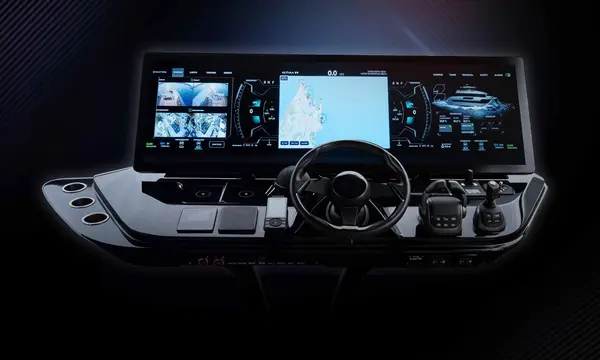
Sunreef Yachts has introduced WETRA, connecting navigation, energy, guest comfort and technical monitoring in an integrated yacht-management environment for owners and crews.
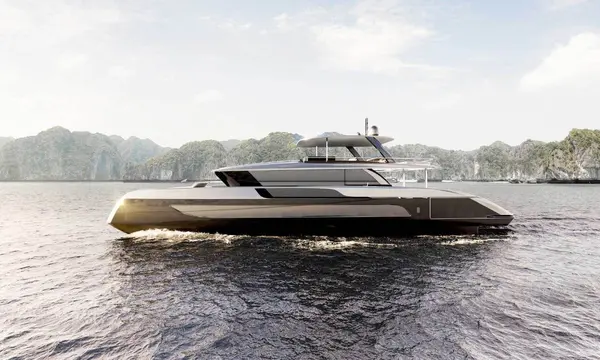
Paramount Yachts has announced its first US sale of a Sunreef ULTIMA 88 to a Florida family. The in-build 26.8-metre power catamaran is scheduled …

Sunreef Yachts has announced an ULTIMA 88 order for Lionel Messi, with the yacht under construction in the UAE and intended for the MIM …
The first Sunreef 100 Eco, Ipharra, will combine private family cruising with student educational voyages focused on the sea and environment.
Superyacht Guide
Continue into the wider Superyacht Guide.
Business opportunities · Superyacht Guide
Companies serving the superyacht market can discuss clearly identified advertising, sponsorship and business-profile opportunities. Commercial activity remains separate from independent editorial coverage.