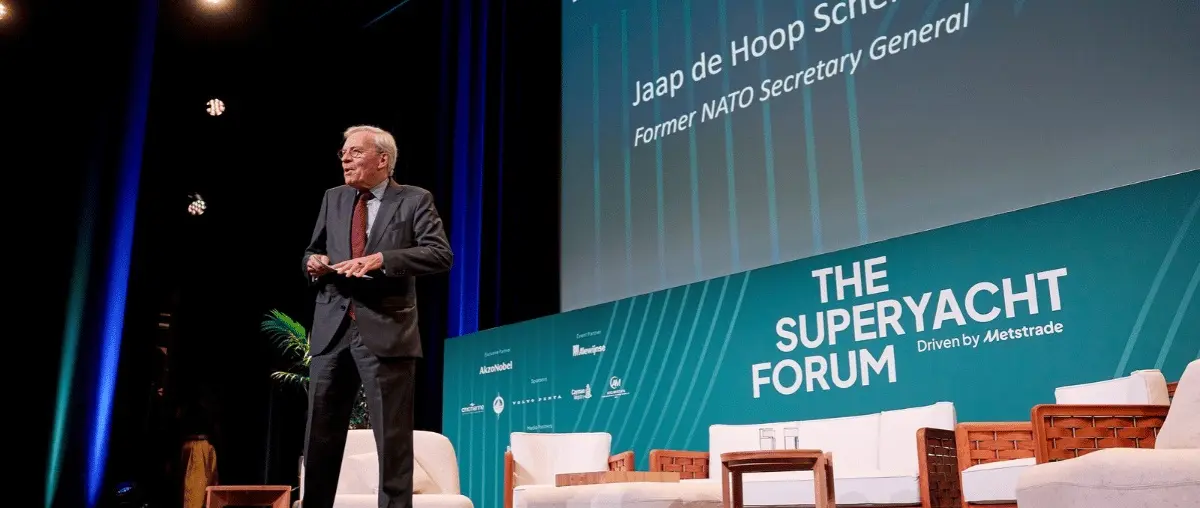
Opening keynote Superyacht Forum 2026 official organiser press image
Jaap de Hoop Scheffer's opening address at the 2026 Superyacht Forum calls for stronger geopolitical awareness, supplier resilience and industry cooperation.
The Superyacht Forum opened at RAI Amsterdam on 16 November 2026 with an address by Jaap de Hoop Scheffer, former NATO Secretary General and Dutch Minister of State. The organiser's account of the meeting says he encouraged industry leaders to incorporate international political developments into ordinary corporate decision-making and consider their exposure to individual suppliers and markets. The keynote was not a forecast of a particular maritime security incident or an announcement of new regulation. Its significance instead lies in the argument that the commercial environment of a highly international industry cannot be separated from changes in the relationships between the countries where it designs, constructs, services and operates yachts. The opening of the two-day conference placed these concerns alongside technical development, crew experience and the organisation of future industry work. For the leadership of a shipyard, brokerage or yacht management company, the practical question is how broader international developments should inform decisions that cannot easily be reversed once a project is underway.
A new-build yacht can incorporate equipment procured from a number of countries and manufacturers. Some installations use machinery specified early in design, around which structural arrangements, electrical supplies, cooling and control relationships are subsequently developed. It may therefore become difficult to replace a particular piece of equipment once construction has reached an advanced stage, even if another manufacturer can provide a component serving a similar purpose. Dependencies can also persist after delivery through the availability of replacement parts and specialist technical support. The keynote's emphasis on avoiding excessive reliance on individual suppliers has a clear application to this process. A project team can benefit from understanding which components have practical alternatives and which are dependent on a narrowly defined supply chain. Identifying those differences early provides opportunities to consider technical flexibility before changes become prohibitively difficult or disruptive. This is an editorial implication of the address rather than a statement that the Forum has adopted a specific procurement standard.
The identity of the company contracted to supply equipment does not always reveal the geography of its entire production process. A manufacturer may rely on components produced elsewhere, or on a particular subcontractor responsible for an important manufacturing stage. This can make the assessment of potential disruption difficult if a shipyard considers only its direct commercial relationships. Information about the production and support of unusually important equipment may therefore be useful when reviewing the risks associated with a specification. However, it would be impractical to demand an exhaustive description of every minor component for every installation aboard a yacht. A proportionate approach can concentrate on systems whose failure or extended delivery delay would have significant consequences for construction or operation. The relevant consequences can differ according to the stage of a build. An assembly required before a hull section can be closed presents a different scheduling risk from furniture that can be installed later without disrupting the surrounding construction programme.
Supplier diversification need not mean selecting equipment from as many manufacturers as possible. Installing several unrelated equipment families may introduce additional complexity in training, spares and maintenance. Conversely, a highly integrated specification can create dependence on continued support from one source. The management challenge is to determine where the advantages of integration outweigh the consequences of reduced commercial flexibility. Project teams can consider the extent to which standard interfaces, documentation and alternative technical arrangements may make future replacements more practicable. Any change must nevertheless satisfy the relevant engineering and certification requirements. A potential alternative is not automatically suitable for an installed system merely because it has a broadly equivalent nominal specification. The key is to understand the practical choices available before committing to an installation. The Forum's opening discussion brings that commercial and technical relationship into a wider conversation about the stability of international supply networks.
According to the organiser, De Hoop Scheffer also stressed the value of building relationships with the people who influence the rules governing commerce before circumstances make those relationships urgently necessary. That observation has a practical dimension for an industry in which vessels themselves regularly cross national boundaries. An operator may need assistance from regulators, classification organisations, local agents and other specialists whose responsibilities differ. Developing legitimate professional channels of communication can make it easier to understand emerging requirements and obtain appropriate advice. Such relationships must not be confused with an ability to circumvent requirements or secure preferential treatment in individual regulatory decisions. In preparation for a new project or itinerary, it is useful to identify the organisations responsible for the relevant approvals and determine the information they require. Establishing those channels as part of ordinary operations can reduce dependence on hurried enquiries at the point when a vessel or project is already facing a difficult situation.
The opening speaker identified Canada, Brazil and Indonesia as examples of countries whose international influence may increase. For the yachting industry, that observation is relevant beyond the potential sale of new vessels. Different locations may offer manufacturing capabilities, specialist service providers, sources of professional expertise and opportunities for the development of cruising itineraries. The commercial significance of each country cannot, however, be inferred directly from its broader international position. A shipyard considering a new supplier must establish the company's actual capabilities and quality arrangements. A yacht owner contemplating more extensive voyages should investigate the marine infrastructure and operational conditions in the intended destinations. The Forum account does not announce particular investments or new facilities in any of the countries named. Its implication is that companies should avoid treating their historical geographical concentration as an unalterable feature of their future operations. Assessing new possibilities requires detailed local information rather than a general expectation that political developments will necessarily produce a specific commercial result.
A particularly relevant element of this year's programme is the participation of 100 captains and senior crew through the Crew Voices initiative, according to the conference manager. Their presence gives the discussions an opportunity to incorporate experience of equipment and services after the construction phase has ended. The people operating a yacht may encounter difficulties that were not apparent when the original specification was agreed. Information about the availability of replacement components, clarity of documentation and practical access for maintenance can inform later projects. A formal method of communicating those observations to the parties responsible for design and procurement may be valuable to more than the individual yacht. A useful discussion should distinguish between an isolated failure and a problem that is repeatedly experienced in different installations. Such distinctions require sufficiently detailed information to establish the circumstances in which a difficulty occurred. The participation of operating personnel can help identify issues that merit further investigation without assuming that every observation applies universally.
The organiser describes a programme encompassing more than 30 hours of sessions developed with the Superyacht Industry Advisory Council and collaboration involving the Superyacht Alliance and its member organisations. The conference's themes address people, projects, progress and process. In the opening release, representatives of the conference and Alliance emphasised implementation and continuity beyond the November meeting. This is important because some of the problems under discussion cannot be resolved through agreement at a single conference. Changes to technical specifications, operational procedures or training arrangements can require contributions from organisations whose responsibilities overlap but whose commercial interests are not identical. A continuing working group can provide a setting in which options are examined after the event, although its effectiveness depends on the scope of its responsibilities and the resources made available. The opening statements set an ambition for subsequent work; they do not establish that the proposed initiatives have already delivered measurable improvements.
The keynote's practical significance for superyacht businesses is the invitation to consider international developments as part of recurring management discussions rather than only when a crisis has arisen. An individual company might translate this into reviews of significant contractual dependencies, support arrangements and the resilience of its delivery plans. Owners and management companies may similarly examine the availability of critical equipment support during proposed cruising itineraries. The appropriate measures will vary according to the business and the yacht involved. The November opening release does not establish uniform actions for every company or report a binding decision by participants. Nevertheless, it identifies a subject that connects commercial decisions taken ashore with the practical operation of vessels worldwide. Whether the conference produces lasting progress will depend on what industry organisations do with the discussions. The opening address provides an opportunity to examine those connections when the sector is already considering how its technical and operational arrangements should evolve.
Primary source: The Superyacht Forum official opening press release, 16 November 2026.
Photography: The Superyacht Forum / RAI Amsterdam, official opening-keynote publicity photograph. Official source.
Photography: The Superyacht Forum / RAI Amsterdam, official opening-keynote publicity photograph.
Explore
Go deeper into the yachts, companies, events and destinations directly connected to this article.
Continue reading
A METSTRADE interview with former Indian Navy engineer Darsitha Babu examines the transfer of engineering, project leadership and compliance skills to yachting.

SeaKeepers has published attendance and fleet participation figures for its completed Fort Lauderdale Founders gala, recognising conservation leaders and yacht crews who support marine …
STELLAMAR's 35-metre RJ 115 design shows how expedition-grade engineering and Italian interior architecture can share one coherent owner-focused superyacht.
Fraser has published its October 23 Fort Lauderdale Forum programme for yacht captains, with sessions on crew welfare, regulation, insurance and safety.
Superyacht Guide
Continue into the wider Superyacht Guide.
Business opportunities · Superyacht Guide
Companies serving the superyacht market can discuss clearly identified advertising, sponsorship and business-profile opportunities. Commercial activity remains separate from independent editorial coverage.
