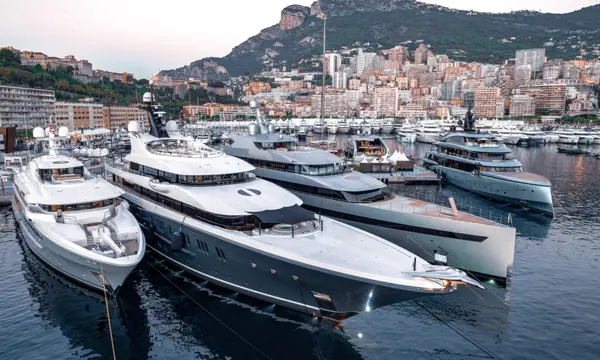
Yacht Club de Monaco Outlines Yachting Economy and September Industry Events
Yacht Club de Monaco reiterates a 411-company, 1,400-plus onshore-job industry footprint and details September events and the SEA Index marina network.
July brought a concentrated run of launches, deliveries, project milestones and new-build sales as European shipyards prepared their latest yachts for Cannes and Monaco.
July is often treated as a quieter point in the superyacht calendar. Owners and charter guests are already moving through the Mediterranean, shipyard teams are working around summer schedules, and much of the commercial attention is beginning to turn towards the major September yacht shows. The official announcements issued during July 2026, however, describe an industry that remained active across construction, delivery, sales, technology and long-term order-book planning.
Across Italy and the Netherlands, shipyards launched new flagships, delivered explorer yachts, laid the keels of future projects and secured sales extending into 2028 and 2029. Builders also began identifying the yachts that will define the Cannes Yachting Festival and Monaco Yacht Show, while the refit sector turned its attention towards data, artificial intelligence and the increasingly connected operational life of the fleet. Taken together, these movements show an industry still producing at pace, but also changing the way it sells, designs and supports large yachts.
Azimut opened one of the month’s most important chapters with the launch of the first Grande 44M on 9 July. The new flagship arrived with seven units already sold and uses a four-deck arrangement that moves the wheelhouse to the uppermost level, freeing the deck below to become a private owner’s deck with views both forward and aft. The project combines a Dual Mode hull, Hull Vane foil technology, extensive carbon-fibre construction, integrated solar panels and a mild-hybrid system designed to support periods at anchor with the generators shut down. The yacht entered final outfitting ahead of her scheduled world debut at the 2026 Cannes Yachting Festival.
Sanlorenzo followed on 10 July with the launch of SHE, a Heritage model developed around a contemporary reinterpretation of the classic 1960s navetta. Exterior design is by Zuccon International Project and the interiors are by Piero Lissoni, with the project placing longevity, proportion and restrained styling ahead of short-lived visual novelty. Sanlorenzo reported that the first five units had already been sold before the model’s official debut, providing another example of buyers committing to a new design before its first major public appearance.
Ferretti Group added two further launches during the month. The first Pershing GTX90 was launched at Fano on 1 July, with the official announcement following on 9 July. The 27.97-metre model expands Pershing’s GTX family into the 90-to-100-foot segment, combining a sportbridge arrangement, four guest cabins, large exterior spaces and a double garage. Twin MAN V12X engines, each producing 2,200hp, are coupled to Castoldi waterjets.
On 20 July, Ferretti Group announced the launch of the first Riva 96’ Argo Super at La Spezia. The 28.79-metre yacht evolves the existing Argo platform through redesigned aft and beach areas, revised guest accommodation and a closer relationship between the saloon and exterior spaces. The first unit is powered by two 2,000hp MTU engines and incorporates stabilisation, collision-prevention and manoeuvring systems. Like the Grande 44M and SHE, the new Riva is scheduled to make its public debut at Cannes in September.
Cantiere delle Marche completed another stage in the development of its Deep Blue range with the delivery of the Deep Blue 115 Octopus on 20 July. The explorer had been launched in April and represents a more compact development of the design philosophy established by the larger Acala. Horacio Bozzo was responsible for the exterior design and naval architecture, while Giorgio M. Cassetta developed the interiors. The steel-and-aluminium platform was created for genuine long-distance operation rather than explorer-inspired styling alone.
Damen Yachting marked a larger delivery on 9 July when the Amels 80 Project Zurich departed Vlissingen. The 80-metre yacht was developed through the Amels Limited Editions approach, combining a proven technical platform with a highly personalised and art-led interior. Damen reported that the yacht was completed on time and on budget. Following departure, Project Zurich was expected to travel towards the United Kingdom before continuing to the Baltic Sea and Norwegian fjords for her first cruising season.
The delivery illustrates the distinction between a limited-editions yacht and a conventional production vessel. The engineering platform and construction sequence may be established, but the owner retains considerable influence over interiors, materials, artwork and onboard identity. That balance between delivery certainty and personalisation would also be reflected in the Amels sales announced later in the month.
Heesen recorded two very different construction milestones during July. On 22 July, the Dutch yard launched the 57-metre Project Setteesettanta, also known as YN 20857. The full-custom aluminium yacht was commissioned by returning owners and combines an approximately 920GT interior with a shallow 2.3-metre draught. Omega Architects designed the exterior and Cristiano Gatto Design developed the interior.
Project Setteesettanta is the first yacht in the Heesen fleet to carry her bridge on the fourth deck, allowing the level below to become a private owner’s deck with a large forward terrace. The yacht is powered by two MTU 16V2000M72 engines and is expected to reach 18 knots, while her four-deck arrangement includes accommodation for 12 guests. Following the launch, she remained in Oss for systems commissioning ahead of North Sea trials and delivery scheduled for the end of December 2026.
On 30 July, Heesen announced that the keel had been laid earlier in the month for Project Kansei, a 56-metre steel yacht intended to mark the shipyard’s 50th anniversary. A coin dating from the yard’s 1978 founding year was placed into the keel during the ceremony at Talsma, Heesen’s steel-hull fabrication partner. The project is based on an evolved steel platform and is expected to offer approximately 760GT of internal volume, accommodation for 12 guests and a transatlantic range of 4,500 nautical miles at 12 knots.
Project Kansei is scheduled for launch in October 2028, followed by delivery during the first quarter of 2029. The yacht remains available to a buyer, meaning an owner entering at this stage would retain significant scope to influence the interior. The two Heesen announcements illustrate the length of the modern construction pipeline: while one yacht enters the water and approaches delivery, another begins a programme that will continue for more than two years.
Damen Yachting announced two important sales during July, both involving yachts intended for long-term cruising but aimed at different owner profiles. On 10 July, the yard confirmed the sale of another Amels 80 for delivery in spring 2029. The buyer is entering yacht ownership for the first time and was represented by Boatsters Black and Bjorn International Brokerage.
The transaction demonstrates the attraction of a proven large-yacht platform for a first-time owner. An established technical basis and defined delivery programme can reduce some of the uncertainty associated with a completely bespoke 80-metre project, while still leaving room for substantial personalisation. It also shows that owners remain prepared to commit to delivery schedules extending almost three years into the future.
Five days later, Damen announced the sale of an Xplorer 60 scheduled for delivery in 2028. The owner was represented by TWW Yachts and intends to use the vessel for cruising beyond conventional destinations, combining private exploration with the ability to support scientific research in remote regions. The sale follows the 2025 delivery of the first Xplorer 60, After You, and strengthens a fleet that already includes the 62-metre Anawa, 77-metre La Datcha and 58-metre Pink Shadow.
The Amels and Xplorer transactions point to two connected market trends. Owners continue to accept delivery dates extending into 2028 and 2029, while explorer capability is increasingly treated as a genuine operational requirement rather than a visual theme. Azimut’s seven Grande 44M sales and Sanlorenzo’s five pre-launch SHE sales reinforce the same conclusion across smaller size categories: shipyards are securing multiple buyers before the first yacht completes its public debut.
July’s movements were not limited to steel, aluminium and new-build contracts. On 16 July, Azimut published a detailed presentation of the 26-metre Seadeck 9, concentrating on its open architecture and relationship with the water. The aft arrangement uses a sequence of terraces leading towards a plunge pool and the sea, while its efficient planing hull, extensive carbon-fibre construction and triple Volvo Penta IPS installation are intended to reduce annual fuel consumption and emissions compared with a conventional yacht of similar size.
The Seadeck 9 also incorporates a battery-supported hotel mode intended to allow key onboard services to operate with the generators shut down. The concept reflects a wider change in yacht design: guest spaces are increasingly organised around direct contact with the sea, while energy-management systems are being integrated into the original platform rather than added later as isolated equipment.
On the same day, MB92 published its fifth major industry report, examining how artificial intelligence, connected systems and data could reshape yacht refit and operation. The report draws on the group’s operational experience, specialist interviews and a survey of more than 70 captains, crew members, owner representatives, managers, designers, yards and service providers. Its central argument is not that artificial intelligence will replace technical expertise, but that reliable data, interoperability, cybersecurity and workforce skills are required before digital tools can produce meaningful operational value.
This is directly relevant to the yachts launched during July. Hybrid systems, batteries, stabilisation equipment, navigation technology, connected hotel services and increasingly complex automation will eventually become refit and lifecycle-management responsibilities. The more technically sophisticated the new yacht, the more important its data architecture becomes after delivery and once the original warranty period ends.
Feadship added a people-focused development on 13 July when it announced the arrival of Robert Drontmann and Xavier Soubeyran. Although leadership and organisational appointments are less visible than a launch, they form part of the same industrial picture. Shipyards must strengthen their commercial, technical and strategic structures while managing increasingly complex projects, longer order books and the growing operational expectations placed on yachts after delivery.
By the second half of July, much of the industry’s attention was already turning towards September. The Monaco Yacht Show published its first official 2026 superyacht list on 17 July, with organisers expecting the fleet to reach approximately 120 yachts by opening day. The 35th edition is scheduled to run from 23 to 26 September at Port Hercule.
The initial list included 43 yachts delivered during 2026 and ranged from the 23.98-metre Arcadia A80 to the 102-metre Lürssen Nixie. That concentration of recent deliveries gives owners and advisers an opportunity to compare current shipyard output while many leading builders are quoting new-build delivery positions extending into 2028 or later.
Baglietto then confirmed on 22 July that its first FAST50 and first T60 would make their world premieres at Monaco. The 49.9-metre FAST50 marks the yard’s return to high-performance aluminium construction, with four engines and a stated top speed of around 30 knots. The 60-metre T60 takes a different approach, using large volumes, extensive glazing and continuity between interior and exterior spaces.
Both yachts have exterior design by Francesco Paszkowski Design, with interiors by the same studio in collaboration with Margherita Casprini and naval architecture by Pierluigi Ausonio. Cannes will provide the first public stage for the Grande 44M, SHE and Riva 96’ Argo Super, while Monaco will bring larger custom and semi-custom yachts into direct competition for owner, broker and media attention. The launches and deliveries announced in July were therefore not isolated yard milestones; they also marked the beginning of the autumn commercial campaign.
July 2026 did not produce a single event capable of defining the whole superyacht market. Its significance lies in the combination of movements. New models reached the water with several units already sold, large-yacht contracts extended delivery schedules into 2028 and 2029, and explorer yachts continued to attract owners with remote-cruising ambitions.
Shipyards promoted hybrid systems, efficient hull forms, batteries and quieter operation, while the refit sector warned that digitalisation will depend on better data, cybersecurity and skills. The month also demonstrated that the boundary between custom and production construction continues to blur. Azimut, Sanlorenzo, Riva, Pershing, Amels and Damen Xplorer offer different combinations of platform engineering, delivery certainty and owner personalisation.
For buyers, the decision is increasingly not simply whether to commission a custom or series yacht. It is how much engineering certainty, design freedom, delivery speed and operational complexity they are prepared to balance. By the end of July, the yachts covered in the month’s announcements were already moving towards their next stage: sea trials, delivery, first cruises, scientific programmes or public debut.
Cannes and Monaco will reveal how the market responds to them. The official announcements of July show that the builders are arriving with substantial new material and with order books suggesting that owners remain prepared to commit several years before taking delivery.
Continue reading
Yacht Club de Monaco reiterates a 411-company, 1,400-plus onshore-job industry footprint and details September events and the SEA Index marina network.
Burgess describes clients seeking private, personalised yacht charters built around wildlife, culture, family activities and specialist experiences.

Northrop & Johnson reports 6,036 worldwide charter starts in January–July 2026, up 30.5%, with more guests booking closer to departure.
D-Marin says June and July bookings for yachts over 50 metres rose 33% year-on-year, while bookings for 30–50m yachts increased by 10%.
Superyacht Guide
Continue into the wider Superyacht Guide.