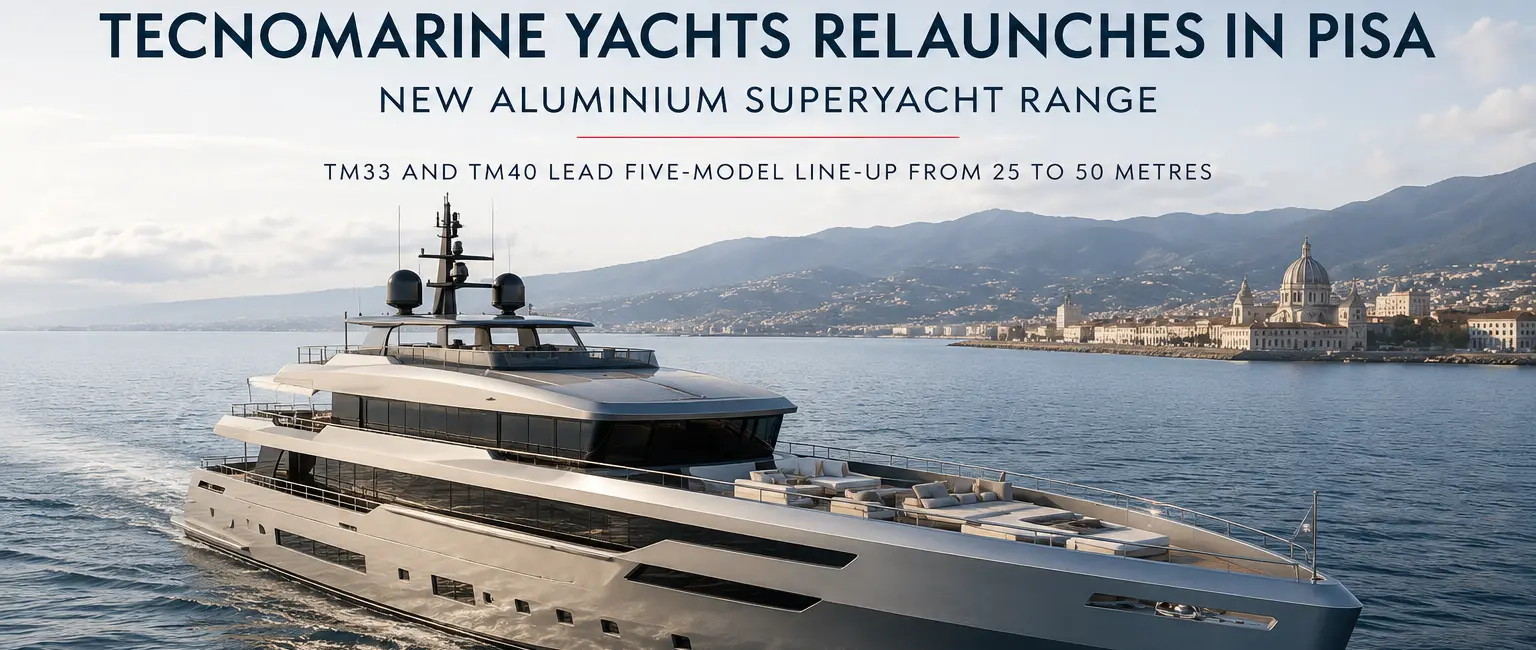
Tecnomarine Yachts returns under new ownership with a Pisa production facility and a proposed range of five custom aluminium yachts between 25 and 50 metres.
Tecnomarine Yachts is returning to the market under new ownership, reviving one of Italy's established yacht-building names with a new industrial base in the Pisa Navicelli district and a proposed range of custom aluminium yachts between 25 and 50 metres.
The relaunch is being led by entrepreneur Massimiliano Zilioli, who acquired the Tecnomarine brand and is directing its return to production. The initial programme centres on the 33-metre TM33 and 40-metre TM40, both developed with Michele Dragoni's Dragoni Designlab and due to be presented to the international market at the 2026 Monaco Yacht Show.
Tecnomarine's new facility includes approximately 3,500 square metres of covered construction space and a further 3,000 square metres of outdoor production areas. The shipyard says the site will support a fully custom production model rather than conventional series manufacturing, with each yacht developed around the requirements of its owner.
The announcement represents more than the launch of two new models. It is an attempt to restore an historic Italian brand while repositioning it within the modern market for medium-sized aluminium superyachts.
Tecnomarine was founded in Viareggio in 1972 by Moreno Maestrelli and members of the Picchiotti yacht-building family, with technical collaboration from designer Paolo Caliari.
The yard went on to build more than 300 boats, producing models that became closely associated with the brand, including the C-42, the Cobra range and the 36-metre T-118. Its history places Tecnomarine within a generation of Italian builders that helped establish the country's reputation for combining performance, styling and specialist craftsmanship.
The revived company is not simply reopening the earlier operation in its original form. It is introducing new ownership, a new production organisation and a clearly defined emphasis on aluminium yachts.
That distinction is important. Heritage may provide recognition, but it does not by itself establish a competitive modern shipyard. The success of the relaunch will depend upon whether Tecnomarine can turn its history into a credible contemporary product, supported by engineering, production capacity, supplier relationships and confirmed orders.
Zilioli has described the project as an industrial challenge built upon both the shipyard's heritage and the strengths of Italian yacht construction. He has said the intention is not merely to place the Tecnomarine name back on the water, but to position it among leading aluminium yacht builders through safety, efficiency and disciplined design.
The decision to establish production in Pisa's Navicelli district gives the relaunch a practical industrial foundation.
The Navicelli Canal connects Pisa with the port of Livorno and has developed into an important centre for yacht construction, engineering, outfitting and specialist marine services. Several builders and suppliers operate within the wider Tuscan cluster, giving a new yard access to experienced labour, subcontractors and logistics.
Tecnomarine's facility has been arranged around the construction of fully custom aluminium yachts rather than high-volume production. The covered space should allow hull, superstructure and outfitting work to proceed in a controlled environment, while the outdoor areas provide room for logistics, components and production support.
For a restarted shipyard, location within an existing cluster can reduce some of the difficulties of rebuilding an industrial organisation. Specialist welders, engineers, painters, outfitters, systems companies and project managers may already work within the surrounding area.
However, belonging to a strong yacht-building district also raises expectations. Tecnomarine will compete for skilled employees, subcontractors and owner attention against established Tuscan yards with active order books and proven delivery records.
The Pisa operation must therefore demonstrate not only that it can design attractive yachts, but that it can control weight, welding quality, systems integration, schedules and costs throughout construction.
The revived yard has chosen aluminium as the common construction material across its proposed range.
Tecnomarine says aluminium was selected for its strength, structural flexibility and suitability for highly customised yachts. It can support both displacement and semi-displacement platforms, allowing the shipyard to develop yachts with different performance, range and layout requirements while retaining a shared material strategy.
Aluminium construction can also offer a favourable relationship between strength and weight. A lighter vessel may require less installed power for a given performance target, although the final efficiency of any yacht depends upon its hull form, machinery, displacement and operating profile.
The material is particularly useful when a project requires extensive owner-driven modification. Aluminium structures can accommodate complex deck arrangements, large openings, beach clubs, terraces and unconventional superstructure geometry, provided the engineering is developed correctly.
It nevertheless requires specialist expertise. Aluminium yacht construction demands controlled welding procedures, careful management of distortion, appropriate isolation between dissimilar metals and close attention to structural detail.
The decision to focus on aluminium therefore gives Tecnomarine a distinct market position, but it also creates a clear technical standard against which the yard will be judged.
Tecnomarine's announced portfolio consists of five models: the TM33, TM40, TM41, TM45 and TM90.
Despite the presence of five names, the immediate relaunch is concentrated on the TM33 and TM40. These are the projects being used to introduce the new design direction, production strategy and brand identity.
The use of the numbers does not appear to describe a simple progression from one closely related platform. Instead, the range is intended to cover different yacht types and owner requirements within the wider 25-to-50-metre segment.
That market is highly competitive. Buyers can choose from semi-custom production lines, fully custom yachts and proven platforms offered by established European and Turkish yards.
Tecnomarine's challenge will be to explain why an owner should choose a newly revived brand rather than a builder with a recent delivery history. The answer is likely to depend on the degree of customisation available, pricing, construction quality and the ability of the design team to provide something distinctive without introducing unacceptable technical risk.
The TM33 and TM40 therefore carry more responsibility than ordinary new models. They must establish both the visual identity of the range and confidence in the industrial organisation behind it.
The 33-metre TM33 is presented as an aluminium fast cruiser with a sporty, aerodynamic profile and substantial outdoor living areas.
Dragoni Designlab has sought to balance taut exterior lines with an internal arrangement intended to maximise usable volume and comfort. The concept is not simply a performance yacht with accommodation inserted inside it; it is intended to retain a strong visual character while providing the spaces expected aboard a contemporary 33-metre yacht.
At this length, the balance between style, performance and volume is particularly sensitive. Owners often expect large cabins, expansive glazing, generous crew areas, tender storage and multiple exterior lounges, yet every addition affects weight, stability and machinery requirements.
A successful fast cruiser must also remain practical in operation. Deck circulation, protection from wind, noise control, access to machinery and the placement of service areas can determine whether a yacht is genuinely comfortable rather than merely attractive in renderings.
The TM33's aluminium construction may provide useful flexibility as the project moves from concept to owner specification. It should allow changes to internal arrangements and exterior features more readily than a fixed composite mould, although significant changes will still require engineering review.
The model appears intended for owners who want the presence and accommodation of a small superyacht while retaining a more dynamic profile and performance-oriented identity.
The 40-metre TM40 takes a different approach.
It is described as an aluminium displacement yacht intended to demonstrate the flexibility of the material for longer-range cruising. The design places particular emphasis on visual continuity between interior and exterior spaces.
Large areas of mirrored glazing are intended to open views from the accommodation, while the aft deck is conceived as a terrace overlooking the sea. The arrangement reflects a wider movement in contemporary yacht design towards lower, more open sterns and a stronger connection between guest spaces and the water.
At 40 metres, the yacht enters a category in which owners may expect extended cruising capability, substantial storage and greater independence from shore.
A displacement platform can provide more internal volume and efficient operation at moderate speeds, but its success depends upon careful control of hull resistance, weight distribution and machinery selection.
The TM40 will also need to reconcile its large glazed areas and open aft arrangement with structural strength, privacy, heat management and safe operation in different weather conditions.
Its importance to the relaunch lies in the way it expands the brand beyond the sporty associations of the TM33. Together, the two concepts suggest that Tecnomarine intends to offer several yacht personalities under one aluminium-construction strategy.
Tecnomarine describes the new production model as fully custom, yet it is also presenting a named range of five models.
These positions are not necessarily contradictory. A shipyard may use a model as the starting point for length, hull form and general design while allowing extensive changes to interior layout, exterior spaces, equipment and styling details.
The practical question is how much of each yacht will remain standardised.
Greater standardisation can reduce engineering time, purchasing uncertainty and construction risk. It may also support more reliable pricing and delivery estimates.
Greater customisation offers the owner more freedom, but each major change can affect structure, stability, weight, classification and production sequencing.
For a restarted shipyard, a controlled custom platform may be the most manageable approach. The yard can preserve owner choice while avoiding the cost and technical exposure associated with redesigning every yacht from the keel upwards.
The first contracts will reveal where Tecnomarine positions itself between those two extremes.
The company plans to present the complete range and details of its industrial organisation at the Monaco Yacht Show in September 2026.
That event will place the revived Tecnomarine directly before brokers, designers, owner representatives, project managers and potential clients. It will also expose the proposals to comparison with many of the world's most established custom-yacht builders.
The presentation must do more than display attractive renderings. Prospective buyers and their advisers will want to understand build slots, engineering partners, classification strategy, warranty arrangements, financial structure and how far each design can be customised.
They may also ask whether construction has begun on either of the two principal models and whether the yard has secured firm contracts.
A relaunch announcement establishes ambition. A signed order establishes commercial confidence, while a completed yacht establishes industrial credibility.
Monaco will therefore be an important moment, but it will be the beginning rather than the conclusion of the relaunch.
The return of historic yacht names has become a recurring feature of the marine industry.
A recognised brand can provide immediate visibility and emotional value, particularly when it is associated with distinctive earlier models. It can also help a new owner communicate continuity with Italian design and craftsmanship.
However, revived brands face a particular challenge. Their heritage belongs to an earlier organisation, while owners purchasing today must rely upon the current management, workforce and supply chain.
Tecnomarine must therefore distinguish between the history it inherits and the performance it must now prove.
Its focus on aluminium, the Pisa production base and the involvement of Dragoni Designlab give the new business a coherent starting position. The TM33 and TM40 also address two different owner profiles, broadening the brand's potential appeal.
The next steps will be decisive: confirming orders, beginning construction, demonstrating technical progress and delivering the first yacht to the expected standard.
If those stages are completed successfully, Tecnomarine's history may become a useful foundation for a new operation rather than simply a name from Italy's yacht-building past.
The principal source for this article is the Tecnomarine Yachts relaunch announcement distributed through PressMare on 27 July 2026. The announcement confirms the new ownership under Massimiliano Zilioli, the production facility at Pisa Navicelli, the five-model aluminium range and the development of the TM33 and TM40 with Dragoni Designlab.
The production and model information was also checked against reporting by Marine Industry News. The article does not claim that either the TM33 or TM40 is already under construction unless confirmed by the shipyard.
Explore
Go deeper into the yachts, companies, events and destinations directly connected to this article.
Continue reading
Sunseeker confirms its long-term ownership and appoints Scott Millar as CEO, establishing permanent leadership for the British yacht builder's five-year transformation.

Privacy is essential in superyacht ownership, but overly broad NDAs and opaque corporate structures can increase compliance costs, obstruct transactions and turn legitimate discretion …
Is a Superyacht an Investment? Depreciation, Income and Resale A superyacht should usually be treated as a lifestyle asset rather than a conventional investment: …
Can Charter Income Cover Superyacht Running Costs? Charter income can offset a meaningful share of superyacht operating costs, but it rarely makes ownership cost-free …
Superyacht Guide
Continue into the wider Superyacht Guide.