
TISG Board Backs SRI Global's €220m Proposal as Court Decision Awaits
By Superyacht Guide Newsroom · Edited by Superyacht Guide Newsroom
TISG Board Backs SRI Global's €220m Proposal as Court Decision Awaits — licensed SYG News 26Nov batch04
The Italian Sea Group board backs SRI Global’s €220m proposal amid competing bids and a planned court application; no acquisition has closed, for yacht.
The restructuring process at The Italian Sea Group has reached another important stage after its board supported a proposal from SRI Global Limited and outlined the conditions under which the shipbuilding business could move toward a sale. Marine Industry News reported on 25 November that the board backed the €220 million bid on 23 November and would seek permission from the Florence court to lease the business to SRI ahead of any eventual transfer. A competing bidder is contesting its exclusion, while Palumbo Group has reportedly withdrawn an earlier legal objection. For superyacht owners, employees and suppliers, the essential distinction is that these developments concern the process for a potential transaction, not a completed acquisition.
According to the report, SRI's €220 million offer forms the basis of the restructuring plan The Italian Sea Group filed in early November. The board subsequently decided to pursue an interim business lease as a means of maintaining operations while the proposed transaction moves through the required legal procedures. The plan remains subject to court authorisation and other conditions.
A board preference should not be treated as a final judicial decision. Creditors, regulators and other interested parties may have rights that affect the process. The eventual outcome and timetable can differ from the proposal under discussion. Customers with contracts at the yard should therefore rely on formally issued communications and their own professional advisers rather than assume that a commercial agreement has already changed the identity of their counterparty.
The reported structure involves leasing the business to the prospective buyer before a sale is completed. In a restructuring context, such arrangements may be intended to preserve production activity, retain skilled employees and protect the value of work in progress. A large shipyard depends on coordinated teams and specialist suppliers, and lengthy uncertainty can complicate ongoing projects.
The potential benefits do not remove legal or commercial risks. The responsibilities of a lessee, the treatment of existing contracts and the status of advance payments depend on the exact terms and applicable law. The public report does not provide enough information to determine the consequences for every yacht under construction. Owners and managers should request specific written clarification rather than infer that all obligations transfer automatically.
Marine Industry News says TISG plans to ask the Florence court for the necessary authorisation under Article 46 of the Italian insolvency framework. The company is reported to see the first week of December as a possible date for an interim lease, but only if the required conditions are satisfied. This is a forecast of a potential step, not a confirmed start date.
The court's decision will be material because it can affect whether and how the proposal proceeds. Proceedings may require additional evidence or hearings, and other parties may object. Responsible reporting should avoid presenting the proposal as inevitable or declaring the transaction complete simply because the board has identified a preferred bidder.
One condition described in the 25 November article is an escrow deposit of at least €275 million by SRI, with €55 million reportedly planned for release in instalments. These figures are components of the proposed structure and should not be confused with the €220 million headline acquisition offer. They serve different purposes, and the public report does not establish that all funds have already been transferred.
Readers should not add these sums together and call the result a new purchase price. Nor should they assume that escrow funds are automatically available for ordinary shipyard spending. Any release would be governed by the relevant agreement and approvals. Owners and suppliers seeking assurance about payments should request evidence specific to their contracts from authorised representatives.
A further development is the reported withdrawal of a legal challenge by Palumbo Group on 24 November. Marine Industry News says Palumbo had initially sought to prevent the board from accepting SRI's offer before its objections could be considered. Withdrawal of that application removes one reported obstacle in the process, but it does not amount to a judicial endorsement of SRI's bid.
The report also describes differences between the proposals and timing of submissions. Such matters can become commercially sensitive when several prospective buyers are involved. Editorial coverage should distinguish the positions attributed to parties from findings established by a court. A withdrawn objection does not settle every possible dispute over the restructuring.
The article identifies T.I.S.G. Asia Investment Holding Limited, a Hong Kong-based bidder, as having announced a €250 million offer and objected to its exclusion from the process. Its chief executive, Traugott Kaminski, is reported to be considering legal action or seeking the proposal's admission. These are the bidder's stated positions as relayed by the source, not a determination that the auction was unlawful.
The presence of a higher nominal figure does not by itself establish which proposal is superior. Conditions, scope, financing, treatment of employees and timing can be material, and any assessment may depend on legal requirements. A responsible news report should avoid declaring a winner based solely on the highest number while formal decisions remain outstanding.
The Italian Sea Group is associated with renowned yacht brands including Admiral, Tecnomar, Perini Navi and Picchiotti, as well as refit and specialist manufacturing activities. This makes the restructuring relevant far beyond a single industrial facility. Owners considering new projects may want to understand the implications for design teams, production capacity and support for vessels already in operation.
Brand names can survive a corporate change, but their future use and management depend on transaction terms. The report mentions an intention by SRI to retain major brands, yet no final ownership transfer is confirmed. Clients should not confuse a prospective management plan with a legal guarantee of future product support or delivery.
The group is based around facilities at Marina di Carrara, a significant location in Italy's yacht construction sector. Industrial waterfront sites are valuable because they combine access to skilled personnel, equipment and transport infrastructure. Reproducing those capabilities elsewhere is not simply a matter of acquiring land. Retaining an operational yard may therefore be important to any bidder's industrial strategy.
The value of existing facilities must be balanced against obligations to employees, customers, creditors and local authorities. A proposed sale may require consent for maritime concessions or other permissions connected with the use of port land. Those requirements can influence the timeline even after commercial terms have been negotiated.
The 25 November report notes that regulatory approvals are required, including consent concerning state maritime concessions. This detail matters because shipyard operations often depend on rights to use specialised waterfront sites. An investor may be able to buy commercial assets without automatically receiving unrestricted permission to operate every location.
The relevant public authorities will need to consider the applicable agreements and law. The existence of a preferred buyer does not predetermine those decisions. Owners evaluating the future availability of building berths and service facilities should therefore treat operational continuity as an objective of the proposed restructuring, not a settled fact.
The report identifies consultation with trade unions as another part of the process. Shipbuilding is labour intensive, and the skills of engineers, welders, outfitters and project managers are essential to delivering complex vessels. A restructuring that fails to retain critical expertise could have consequences even if a financial transaction is agreed.
Employment figures mentioned in media reports need particular care. The article refers to possible plans involving hundreds of directly employed staff and additional supply-chain jobs but says the company has not confirmed those projections. No precise retention or redundancy outcome should be presented as decided until authoritative details are available.
Marine Industry News names Vincenzo Poerio, a former Tankoa Yachts executive, in reporting about SRI's potential plans for the business. It also discusses the expected role of current TISG leadership if the transaction proceeds. These details illustrate the range of decisions that may accompany a corporate restructuring, but they do not prove that a new management team has formally taken office.
A proposed chief executive may have industry experience and a stated strategy, yet implementation requires the relevant appointment and transaction approvals. Employees and owners should look for confirmed communications from the company rather than treat reports about a future leadership structure as an enacted change.
The most immediate concerns for customers may relate to work schedules, technical responsibility and the handling of payments. A yacht in construction or refit can be affected by interruptions to specialist supply chains, availability of skilled staff and uncertainty around contractual obligations. Owners should maintain accurate records of approved specifications, milestones, variation orders and payments.
Any decisions about changing suppliers or moving a vessel are complex and can carry contractual and technical consequences. They should be evaluated with appropriately qualified advisers. General news of restructuring does not establish that every project will be delayed, but it justifies close attention to official information and clearly documented communications.
The Italian superyacht industry relies on extensive networks of specialist manufacturers, subcontractors and service companies. A large yard's financial or ownership changes can influence the orders and payment expectations of those businesses. Some suppliers may also support yachts from several competing builders, meaning that the effects of uncertainty can extend beyond the company immediately involved.
A stable recovery would need to address the confidence of both customers and suppliers. Maintaining procurement continuity and clear contractual arrangements can help protect ongoing projects. The media report identifies the proposed mechanism for restructuring but does not verify a complete recovery plan for every supplier.
The €220 million figure relates to a proposal to acquire a business. It is not the price of a specific superyacht, the combined value of yachts currently under construction or the market value of all company assets without adjustment. These categories are different and should not be substituted for one another in market intelligence. An owner's vessel value depends on its own design, condition, delivery status and market circumstances.
Likewise, the proposed escrow arrangements should not be converted into a claim about the financial health of the business before a court decision. Headline transaction figures can attract attention, but the supporting obligations and conditions are essential to understanding what they mean.
The next reported milestone is a court decision concerning the proposed lease arrangement, with the first week of December identified as a possible period for signing if approval and funding conditions are met. The schedule is inherently conditional. Competing positions and regulatory requirements may affect subsequent steps.
It would be inappropriate to report a completed sale or give an unconditional delivery date for a restructuring whose details remain in process. Owners, crew and industry suppliers should continue monitoring formal filings and the company's authorised announcements. A news article can explain the stage reached without anticipating the court's decision.
The verified development is the sequence reported through 25 November: TISG's board backed the SRI Global proposal, the company plans to seek permission for an interim lease, Palumbo's objection was reportedly withdrawn and a separate bidder has challenged the handling of its offer. The proposed €220 million transaction still faces material legal and regulatory conditions.
For the superyacht industry, this is important because the outcome could affect several established yacht-building brands and the skilled workforce supporting them. The responsible interpretation is one of significant movement toward a proposed restructuring, accompanied by continued uncertainty. The difference between a preferred bid and a completed acquisition remains fundamental.
Primary source: Marine Industry News original industry reporting 25 November 2026 on TISG board proposal, SRI Global bid and Palumbo objection.
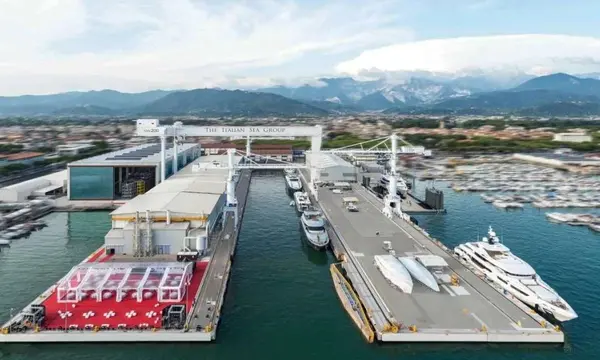
Licensed archival view of Marina di Carrara port where TISG operates, not evidence of a concluded corporate transaction. Photo: Gregorovius; CC BY-SA 3.0 via Wikimedia Commons. Official source.
Explore
Go deeper into the yachts, companies, events and destinations directly connected to this article.
Continue reading

The Italian Sea Group board approves the next steps for SRI Global’s €220m restructuring proposal, with a separate €275m escrow condition and court approval …
Palumbo Group says it is stepping back from the TISG acquisition process after the group’s board decisions, while the status of its earlier urgent …

The Italian Sea Group confirms SRI Global Limited's €220 million offer was selected at the close of competitive bidding, with further approvals still required.

The Italian Sea Group's unaudited court filing shows a €58.7 million year-to-date loss at 30 September 2026, with cash down to €1.75 million and …
Superyacht Guide
Continue into the wider Superyacht Guide.
Business opportunities · Superyacht Guide
Companies serving the superyacht market can discuss clearly identified advertising, sponsorship and business-profile opportunities. Commercial activity remains separate from independent editorial coverage.

