Company
As-El Metal Turizm Insaat Sanayi Ve Dis Tic.Ltd. Sti.
Explore the company profile and related Superyacht Guide coverage.
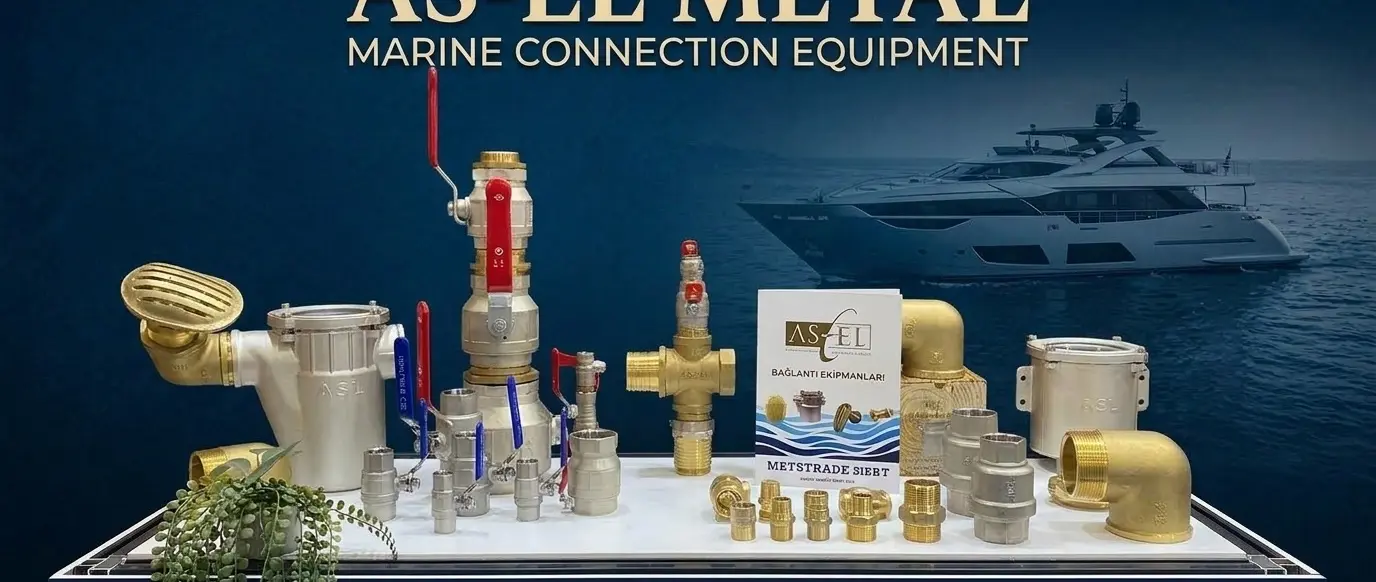
AS-EL Metal official exhibitor media asset METSTRADE 2026
Turkish manufacturer AS-EL Metal highlights brass and bronze seawater strainers, hull connections and marine pipework fittings in its 2026 exhibitor announcement.
Istanbul-based AS-EL Metal has used its 17 November 2026 exhibitor announcement at METSTRADE to highlight its production of seawater strainers in brass and bronze, together with hull and pipework connections for marine installations. The company traces its manufacturing origins to 1983 and identifies yacht builders and commercial shipyards among its customers. Its own catalogue extends beyond marine equipment to encompass a broader selection of metal fittings and valves. The exhibition announcement is a presentation of its manufacturing portfolio, rather than a declaration of a newly developed strainer or a confirmed contract with a particular superyacht builder. For large-yacht engineering and purchasing teams, it offers a reason to examine the procurement of relatively small components that can nevertheless have significant consequences for the reliability of a larger fluid-handling installation. AS-EL's announcement does not specify which models carry approvals for particular classes of vessel, making project-specific verification an essential part of any potential purchase.
The manufacturer's English-language company profile identifies Karaköy in Istanbul as the location where it began producing brass fittings. Its published contact information places the company in the İkitelli industrial area of Başakşehir, Istanbul. The current catalogue groups equipment into several product families, including marine plumbing, valves, brass compression and threaded fittings, and pump connections. This combination illustrates the relationship between general metalworking capability and the more specialised demands of marine equipment. Producing a fitting to a particular geometry is only one aspect of meeting a shipyard's requirements. The material specification, manufacturing method, permitted operating conditions and quality documentation may also determine whether the component can be used in an individual installation. A supplier with experience across several product families can potentially support purchasing teams with a range of components, but the scope of that capability does not establish that every catalogue product meets the same technical requirements. The particular demands of the intended marine service must remain the basis of its selection.
On a substantial yacht, seawater may be used in heat exchange arrangements serving propulsion, generating machinery or other systems. A strainer associated with an intake installation can help prevent material entrained in the water from reaching downstream components. The consequences of restricted flow may vary considerably according to the system served, its configuration and the circumstances in which a difficulty occurs. The choice of filtration equipment therefore involves more than simply identifying a connection that matches the nominal diameter of an adjoining pipe. The designer must understand the flow requirements, allowable losses and relevant installation conditions specified for the system. AS-EL's catalogue identifies seawater strainer products and replacement mesh components, while the November statement emphasises brass and bronze construction. It does not publish flow curves, pressure limits or approved applications for the items in its announcement. Those particulars would be required before an engineer could assess whether an individual unit was appropriate for a particular large-yacht system.
The use of copper-based alloys is widespread in marine hardware, but the general terms brass and bronze encompass materials with different compositions and properties. Selecting a component for exposure to seawater requires knowledge of the actual alloy and the conditions of service, rather than relying on its surface appearance or a broad commercial description. Some copper alloys may be susceptible to particular corrosion mechanisms under unsuitable conditions. The relationship between a fitting and adjacent materials can also influence corrosion behaviour. In a yacht, connections may form part of a larger assembly containing several different metals, coatings and protective arrangements. The engineering team should establish the specific material requirements for the complete installation, including the compatibility of its constituents. AS-EL's official exhibitor statement describes its products as resistant to corrosion in marine environments but does not identify the alloy designation or demonstrate that any individual item is suitable for unrestricted exposure under all circumstances. Detailed documentation is necessary to establish that distinction.
Marine hardware includes components associated with openings through a hull as well as fittings used entirely within a vessel's pipework. The company's product catalogue identifies brass through-hull outlets, scoop strainers and other marine plumbing items, while also listing check valves, threaded adaptors and union fittings. These products serve different functions and must not be treated as equivalent simply because they are manufactured from related materials. A penetration of the hull can have safety implications that differ from the connection of an internal service pipe. Requirements may depend on the particular location, vessel construction and applicable rules. The loads arising from the connected pipework also deserve consideration; a fitting is only one part of the installation that must accommodate them. The presence of a product within a marine catalogue does not itself establish suitability for a superyacht's seawater inlet or another critical penetration. For large-yacht procurement, the supplier's model-specific documentation and the requirements established by the vessel's designers and relevant approving bodies are more important than catalogue terminology alone.
The manufacturer's catalogue includes replacement strainer mesh and glass covers as well as complete assemblies. The distinction between a replaceable part and a complete fitting is particularly relevant to engineers responsible for equipment after the original construction phase. A service operation may require access to a component and its connections, while the surrounding installation may need to remain undisturbed. The designers of a new yacht can consider those needs when coordinating the location of pipework with machinery, structural elements and interior fittings. Engineers managing an existing yacht may have the more difficult task of selecting a suitable replacement within an established layout. Means of access, required clearances and the availability of compatible parts can influence the practicality of a product choice over the vessel's operating life. A purchasing team should establish whether replacement components will remain obtainable and whether the supplier can identify the correct version of an assembly from its documentation. The public catalogue does not establish the guaranteed future availability of particular spare parts.
For a superyacht construction or refit project, a technically appropriate order should identify more than a product name and a quantity. Depending on the nature of the installation, documentation may need to establish the relevant material, dimensions, permissible operating conditions and any certification required by the project. Where traceability is important, the relationship between technical records and the actual items delivered should be clear. These considerations can affect apparently modest purchasing decisions, especially where components form part of a critical seawater system. AS-EL describes its capability to supply international shipyards and its official website also refers to manufacturing customised products in substantial quantities. The present announcement does not provide delivery data, individual yard references, manufacturer test results or a list of model-specific approvals. Technical buyers considering the company's offering can discuss those details directly rather than infer them from its manufacturing history. A replacement component should be assessed against the applicable specification rather than selected solely because its external geometry resembles the part being replaced.
The company emphasises international supply and logistics in its November announcement. For a yacht that may operate far from its construction yard, procurement decisions can influence whether the operating team is able to obtain compatible components during a voyage or a later refit. A consistent register of installed equipment enables engineers to identify the specification before requesting a replacement. Where manufacturers supply several visually similar versions, the distinguishing model and technical details may become especially useful. A shipyard can also consider whether standardising appropriate fitting types across installations could simplify the spares inventory without compromising the engineering requirements of individual systems. The balance is project-specific: standardisation should not override the need for suitable materials and performance in a particular service. The manufacturer has not announced a new distribution centre or named a new international partner at Amsterdam. Its statement instead presents existing production and export capability to the professional exhibition audience.
The confirmed November development is the publication of AS-EL Metal's manufacturer profile and marine hardware offering during METSTRADE. The company is highlighting established metalworking capabilities and the supply of strainers, connections and other equipment rather than declaring a new product certification or a specific large-yacht contract. Its range illustrates why designers and purchasing teams should approach individual fittings as elements of engineered systems, with their suitability determined by the actual intended service. The company's official catalogue can provide an initial basis for enquiries about available products, while the detailed specifications and approvals must be confirmed before equipment is selected. This distinction is particularly important on a superyacht, where the operational consequences of the failure of a relatively inexpensive fitting may be significant. For owners, captains, engineers and yard representatives reviewing their supply arrangements, the exhibition provides an opportunity to establish contacts and examine the evidence supporting a potential supplier relationship.
Primary source: AS-EL Metal official METSTRADE exhibitor announcement, 17 November 2026.
Further information: AS-EL Metal official English product catalogue and company information.
Image: AS-EL Metal, publicity material supplied with its official METSTRADE exhibitor announcement. Official source.
Image: AS-EL Metal, publicity material supplied with its official METSTRADE exhibitor announcement.
Explore
Go deeper into the yachts, companies, events and destinations directly connected to this article.
Company
Explore the company profile and related Superyacht Guide coverage.
Continue reading

Ambright introduces a custom six-millimetre lighting composite with integrated conductors and LEDs, enabling illuminated shelves, pendants and ceiling elements.
Tecma debuts its compact electronic bidet with instantaneous water heating, adjustable flow and declared drinking-water protection certification at METSTRADE.
Posidonia and ARGUS demonstrate integrated stockless anchor monitoring, transmitting orientation and movement measurements through the anchor chain to the bridge.
International's new biocide-free fouling control coating uses surface renewal technology, with initial launch in eleven European markets and reported trial data.
Superyacht Guide
Continue into the wider Superyacht Guide.
Business opportunities · Superyacht Guide
Companies serving the superyacht market can discuss clearly identified advertising, sponsorship and business-profile opportunities. Commercial activity remains separate from independent editorial coverage.