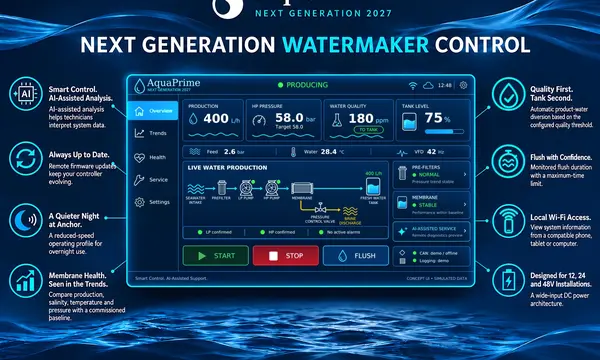
AquaPrime Previews Next Generation 2027 Watermaker Controls
AquaPrime will preview its new watermaker control platform at METSTRADE, with touchscreen monitoring and diagnostic features under development for yacht crews.

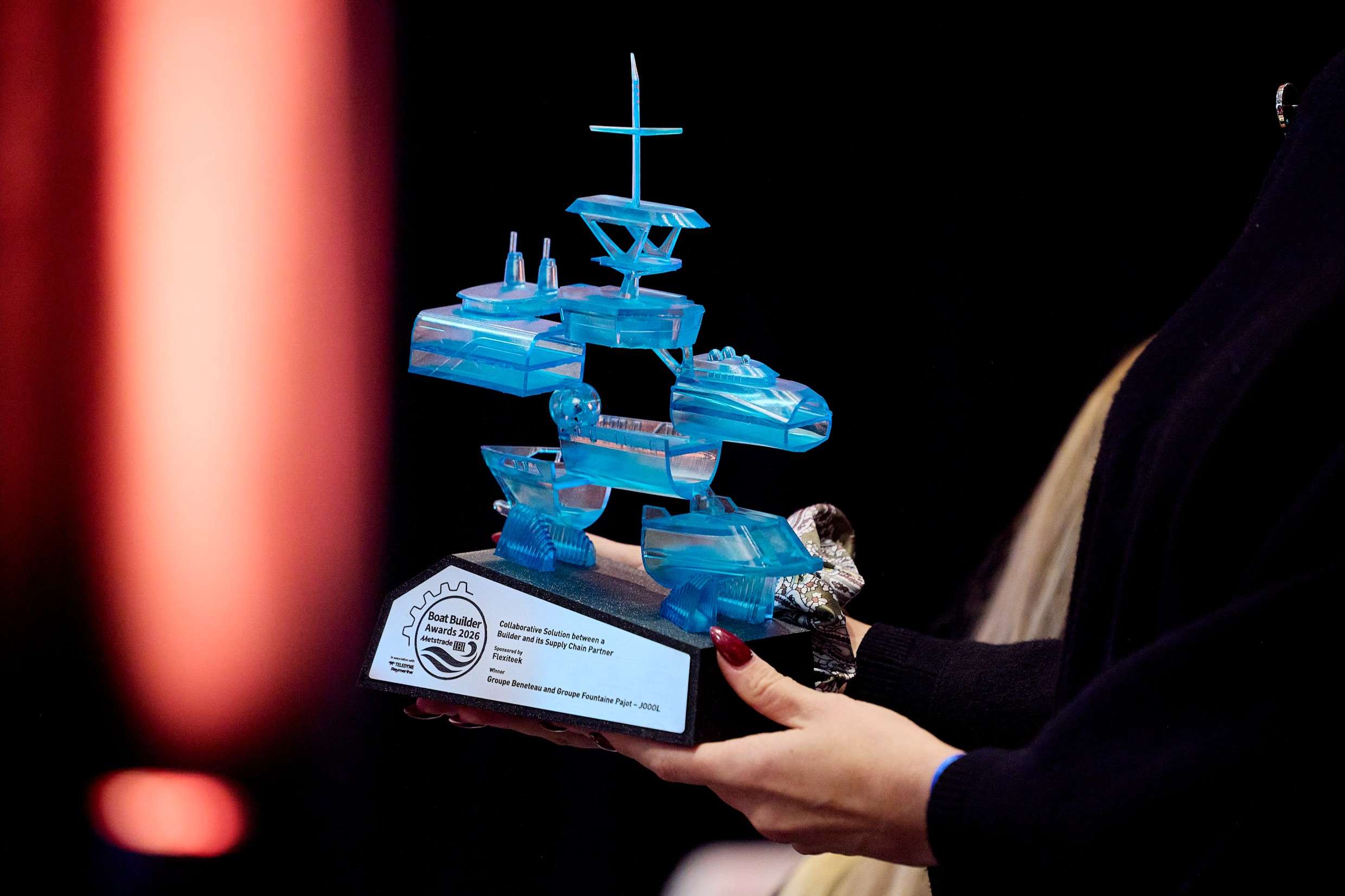
METSTRADE 2026 Boat Builder Awards trophy — organiser press release image
Benetti's 67m DAGGER receives the Boat Builder Awards sustainability honour for its integrated hybrid installation and supporting performance evidence.
Benetti's 67-metre motor yacht DAGGER has won the Sustainability Project of the Year category at the 2026 Boat Builder Awards. The award was presented on Wednesday 18 November in Amsterdam during METSTRADE, according to a statement issued by Benetti the following day. The jury's attention to measured performance, rather than the mere presence of novel equipment, is particularly relevant to owners commissioning hybrid superyachts.
DAGGER belongs to the B.Now 67M family and was constructed at Benetti's Livorno facility, with exterior design by RWD and interiors by Sinot Yacht Architecture & Design. Her hybrid machinery installation was already of interest when the yacht appeared in the industry earlier this year. The new development is the recognition of that installation by the awards jury, which specifically referred to the test evidence submitted and the selection of sodium-metal chloride batteries. The distinction matters: the award concerns an integrated project and its demonstrated technical proposition, not a new yacht launch or a new announcement of the battery installation.
The award organisers, IBI and METSTRADE, held the ceremony in association with Raymarine. The category addresses a central challenge in the development of contemporary yachts: how to distinguish a demonstrable improvement in environmental performance from an attractive technical concept.
According to Benetti's November statement, the judges appreciated that the technologies deployed on DAGGER are capable of operating now and that the entry included test results supporting the submission. The release does not reproduce the complete test report or specify the measurement uncertainty, loading conditions and comparison methodology. Those details remain important when anyone intends to apply the reported performance to another vessel.
For a prospective owner, the value of this recognition is as a reason to examine the engineering and the available evidence in greater detail. An award cannot substitute for reviewing the specification, operational history and independent survey of a particular installation. It does indicate that the project has been considered in a competitive industry setting by people assessing the stated environmental benefits.
The builder describes an installation comprising two propulsion engines, three generating sets, two reversible shaft machines and a 360-kilowatt-hour sodium-metal chloride battery system. The configuration permits different combinations of machinery according to what the yacht is doing.
That approach represents a more extensive design exercise than fitting batteries in parallel with an otherwise unchanged electrical system. Propulsion and domestic loads may compete for available electrical capacity, and the appropriate arrangement must also account for redundancy, the operating characteristics of the machinery and the conditions in which different components can be brought into service.
A shaft machine capable of operating as a generator or motor can provide the opportunity to exchange power between the mechanical drivetrain and the electrical installation. The extent of that capability depends on the actual ratings and control strategy. Neither the number of machines nor the total nominal battery capacity alone establishes all the vessel's performance characteristics.
The award offers an occasion for the wider industry to consider how an integrated design can support actual operating requirements, rather than view hybridisation solely as a choice of propulsion technology.
Benetti describes three cruising modes in its announcement. Electric cruising at seven knots is intended to deliver a quiet experience. The builder also identifies an Extended Range mode at twelve knots and an Eco Transfer mode at ten knots using a single propulsion engine with battery assistance.
These figures provide useful indications of the design intent, but each mode has an operating envelope. Electric cruising distance cannot be calculated simply from nominal battery capacity without knowing the usable energy, reserve requirements, propulsion demand and concurrent electrical consumption. The yacht's loading and environmental conditions will also affect the result.
Similarly, changing the number of engines operating at a particular moment is not inherently an efficiency improvement in all circumstances. The control system must match the demand to the practical operating conditions of the machinery. A captain selecting a mode has to consider the intended passage, manoeuvring requirements and the reserve of power required for anticipated changes.
The builder reports a fuel-consumption benefit of up to fifteen percent in the Extended Range configuration compared with a conventional system at the stated cruising speed. This is a specifically bounded supplier claim, not a measured average reduction for the entire yacht's annual operation. The underlying comparison needs to be understood before extending that percentage to other boats or voyages.
The selection of sodium-metal chloride batteries is an important part of the jury's reported reasoning. Benetti characterises the system as using a non-flammable electrolyte and identifies the absence of a dedicated battery room as an advantage of the particular installation. The manufacturer's description and the jury comments should be interpreted in the context of the design and approvals of DAGGER itself.
All energy storage equipment requires appropriate engineering, monitoring and maintenance. Different battery chemistries have different operating temperatures, failure characteristics, packaging requirements and integration constraints. A choice made for one vessel is not an automatic recommendation for every other application, even where the overall objectives are similar.
A technical comparison should consider usable energy and power, replacement arrangements, cooling or other thermal-management requirements, the expected pattern of use, system protection and the ability to isolate equipment if necessary. The installation also needs to be considered with the complete electrical and machinery system.
The award is significant because the battery chemistry formed part of a fully integrated design assessment, rather than being presented simply as an alternative product. Prospective purchasers should obtain the detailed equipment information and applicable approval documentation rather than interpret promotional descriptions as a guarantee of freedom from all electrical or fire hazards.
The builder says the installed battery system can support the yacht's hotel services for up to two hours with generating machinery shut down. During that period, the yacht can avoid local generator exhaust emissions and reduce the associated mechanical noise and vibration.
This feature is particularly relevant to guests on a large yacht. A vessel may spend much of its operating time stationary, while still running ventilation, refrigeration, lighting, domestic equipment and other essential services. Reducing dependence on running machinery at selected times can improve the experience at anchor without requiring the yacht to be moving under electric propulsion.
Actual endurance will depend on the electrical load and operating reserves. Weather, the number of occupied spaces and the yacht's service programme can influence consumption. A manager should establish realistic operating scenarios rather than treat two hours as an unconditional minimum duration.
The benefits of a quieter vessel may extend beyond the most visible guest spaces. The arrangement of machinery, the transmission of vibration through structural connections and the characteristics of auxiliary equipment can all affect conditions below decks. Measuring the results under defined conditions would allow the owner to establish whether the intended comfort improvements have been achieved.
Benetti also identifies generator heat recovery for onboard use and an exhaust arrangement routing gases above the superstructure. These systems illustrate why the performance of a complete yacht cannot be assessed from its battery specification alone.
Recovering useful heat from machinery can reduce the need to supply equivalent heat through other equipment, provided that the recovered energy corresponds to an actual demand. The value of the recovery arrangement depends on the yacht's operating profile and the extent to which that demand occurs when heat is available.
The integration of exhaust routing must similarly consider the intended machinery operation, the physical layout and the yacht's applicable engineering requirements. The location and design of exhaust outlets can influence noise, emissions exposure and the arrangement of guest areas.
The significance for owners commissioning new yachts is to establish performance objectives across the entire technical platform. A seemingly independent decision about domestic services may have consequences for propulsion efficiency, machinery operation or the equipment needed to support those services.
One of the difficulties facing owners comparing hybrid proposals is that shipyards may emphasise different measures of performance. A system optimised for silent evenings at anchor is not necessarily the system offering the greatest benefit during prolonged passages. A yacht used intensively on charter may have a different annual pattern from a privately operated vessel that spends long periods in a marina.
A useful owner specification should describe the proposed cruising speeds, time at anchor, shore-power arrangements, expected guest load and seasonal operating conditions. Designers can then model different machinery configurations against those scenarios. After delivery, the technical team can monitor actual operating data and compare it with the assumptions made during design.
The environmental assessment should also distinguish operating emissions from the impacts of producing, maintaining and eventually replacing equipment. A reported reduction in fuel consumption during one operating mode is valuable information, but it is only one part of a complete lifecycle assessment.
Benetti places its work on DAGGER within its longstanding Green Route research programme, which encompasses ways of improving the operation of large yachts. The November award recognises the application of several technologies together in a particular vessel, and especially the evidence presented to the jury.
The next challenge for owners and builders considering comparable arrangements is to establish repeatable evidence of their own operating results. Acceptance trials, consistent machinery records and a sound understanding of actual energy demand can help distinguish achievable savings from theoretical ones. The work does not end when the vessel leaves the shipyard.
DAGGER's award is therefore a significant development for the hybrid superyacht market. It highlights not just a particular energy-storage chemistry or a cruising mode, but the importance of substantiating the benefits of a complete installation. The relevant details for another project will remain those established for its own vessel, owner programme and technical specification.
Primary source: Benetti official statement distributed via PressMare, 19 November 2026.
Further information: METSTRADE official awards announcement, 19 November 2026.
METSTRADE official press photograph distributed via PressMare, 19 November 2026. Illustrative Boat Builder Awards trophy photograph, not a confirmed image of DAGGER’s individual award. Official source.
Continue reading
AquaPrime will preview its new watermaker control platform at METSTRADE, with touchscreen monitoring and diagnostic features under development for yacht crews.

Vulkan Italia will present its 200kW H1000 parallel-hybrid module for marine diesel engines rated 500–1,500kW during METSTRADE's Next Gen showcase.
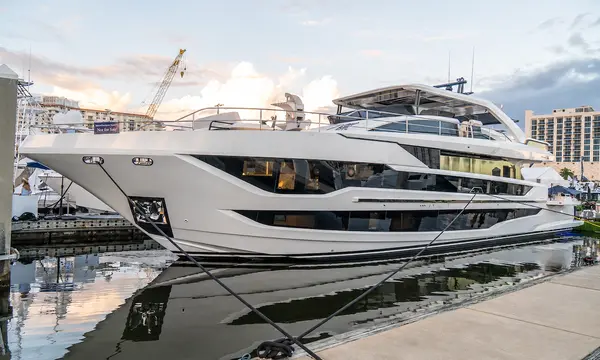
Pearl Yachts’ 30m Pearl 100 Hybrid makes its world debut at Fort Lauderdale with twin-shaft hybrid propulsion, five cabins and two full-beam suites.

Northrop & Johnson has profiled StarEDGE's approach to superyacht communications, including multi-orbit satellite links, mobile networks and a dashboard for yacht managers.
Superyacht Guide
Continue into the wider Superyacht Guide.
Business opportunities · Superyacht Guide
Companies serving the superyacht market can discuss clearly identified advertising, sponsorship and business-profile opportunities. Commercial activity remains separate from independent editorial coverage.