Company
AquaPrime Yachting San. ve Tic. Ltd. Sti.
Explore the company profile and related Superyacht Guide coverage.
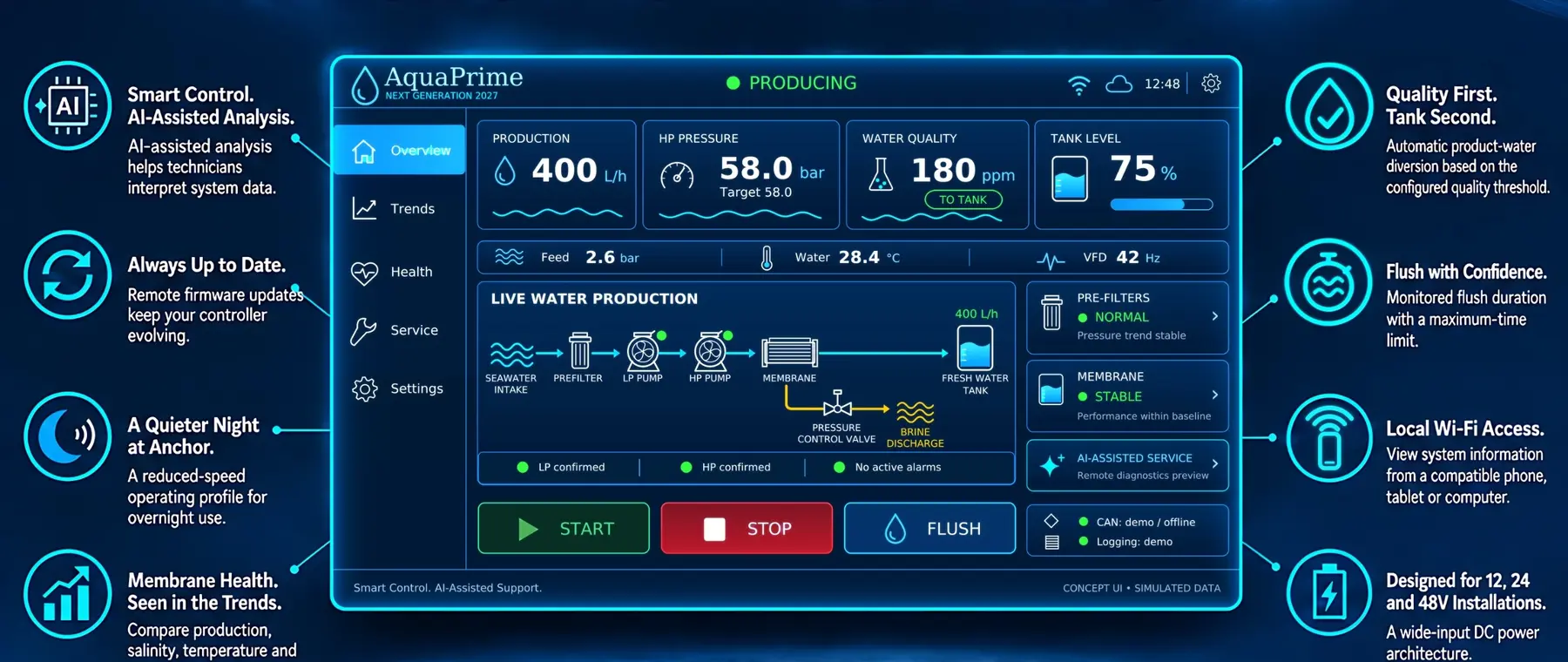
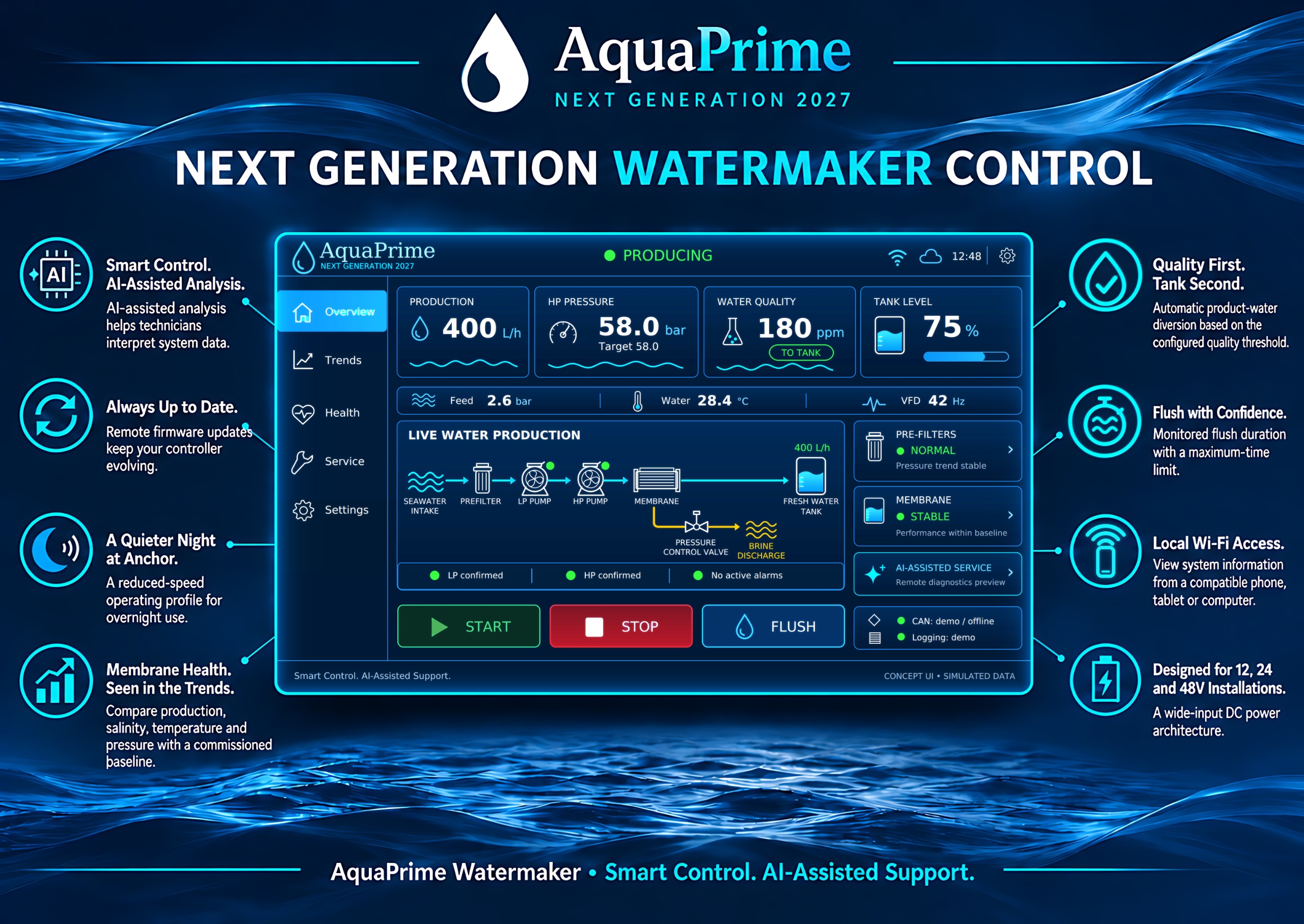
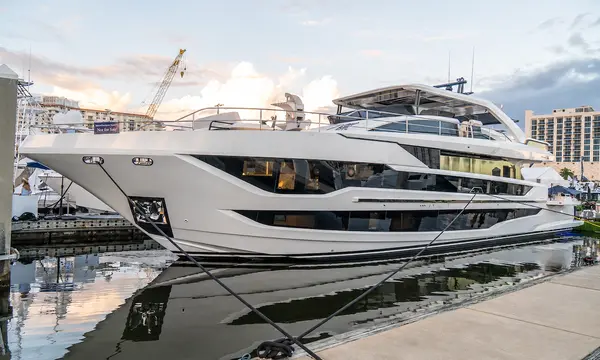
AquaPrime Next Generation 2027 — official exhibitor product image
AquaPrime will preview its new watermaker control platform at METSTRADE, with touchscreen monitoring and diagnostic features under development for yacht crews.
AquaPrime Watermakers is preparing to demonstrate its Next Generation 2027 control platform at METSTRADE in Amsterdam, bringing the production and monitoring of freshwater into a common touchscreen environment. The Bodrum-based manufacturer announced the preview on 9 November 2026 ahead of the exhibition, which runs from 17 to 19 November. The demonstration will represent a water production scenario of 400 litres per hour. For superyacht engineers, the important development is not simply the screen itself but the proposed combination of operational information and developing diagnostic capabilities. The announcement describes remote diagnostics and artificial intelligence-assisted service support as work in development, not as functions already proven aboard a named yacht.
According to AquaPrime, the touchscreen brings production rate, operating pressures, water quality and tank level into one interface. During its demonstration, visitors will be able to start, stop and flush the equipment and observe the movement of water through the system. Showing the relationship between these functions could make the operating sequence easier to understand than a series of disconnected instrument readings. The quality of the presentation will matter particularly when a relief engineer must take over an installation with which they have limited familiarity.
A unified display is not a replacement for the underlying instruments, protective functions or operating documentation. The engineering team should be able to distinguish an abnormal process condition from a failed instrument or unavailable display. Consistent units, clear alarm priorities and an intelligible description of the operating state are practical considerations. A well-designed system should help the person standing in front of it understand what the machine is doing, not just whether a numerical reading falls inside a nominal range. These are important questions for the demonstration rather than claims of verified performance that can already be attributed to the new platform.
Four hundred litres per hour represents the scenario chosen by the manufacturer for the exhibition. If that rate were maintained for twelve hours, the theoretical production would be 4,800 litres, before deductions for flushing, interruptions and changes in operating conditions. It is useful as an illustration, not a guaranteed production figure for any particular yacht. Seawater temperature, feedwater quality, operating conditions and machinery condition can all affect an actual installation. Buyers should establish the specified conditions and limitations that govern any proposed capacity rating.
Freshwater demand on a superyacht varies considerably with guest and crew occupancy, laundry, cleaning schedules and galley operation. A yacht may have access to reliable shore supplies at some points in its itinerary but require much greater independence during an extended passage. The engineering department can develop a credible demand profile from actual consumption records, together with the amount of water held in reserve. Capacity and redundancy should be considered separately. A single headline production figure does not establish how the vessel will operate during maintenance or machinery downtime. Comparing the demonstration with real consumption figures is a more effective starting point for procurement discussions than extrapolating directly from an exhibition display.
AquaPrime says that it is developing the ability to track filter and membrane performance over time. Its announcement identifies increases in pressure drop across a filter and declines in membrane production as examples of observations that could help the crew and service team. Gradual changes may be difficult to recognise when maintenance records are incomplete or people rotate through the engineering department. A visible trend can indicate that an operating condition deserves investigation before the system's performance becomes inadequate.
A value recorded without its context is of limited use. Instrument calibration, feedwater conditions and the operating configuration can influence the readings. Commissioning records should establish appropriate reference conditions so subsequent measurements can be compared meaningfully. The crew also need to be able to correlate a change with maintenance work, such as a filter replacement, and distinguish an apparent deterioration from a measurement fault. The announcement does not specify the final form of the historical record or its data export capabilities. These would be pertinent subjects for discussion with the supplier when reviewing the platform.
The controller presents key measurements associated with production and the status of the storage tank. These give the operator information about the process, but the yacht's complete freshwater management arrangements extend beyond the desalination machinery. Treatment, storage, distribution, maintenance and water quality testing must be addressed within the applicable vessel procedures. The presence of a water quality indication on a display does not establish that all relevant water safety requirements have been satisfied.
An important issue is the transition between starting the watermaker and permitting its output to enter the vessel's tank. The crew should understand what information determines that decision and what happens if a measurement is unexpected. During an interface demonstration, an engineering representative can ask which protections remain in operation when the display is unavailable, how alarms are handled and the circumstances in which a manual intervention may be required. The answers depend on the equipment and installation proposed. It would be premature to claim the new control platform resolves those issues without detailed documentation and commissioning evidence.
Remote diagnosis could be especially helpful to yachts that cruise far from their normal maintenance base. Access to a record of operating conditions might help a shore-based specialist formulate better questions and identify the most useful parts to bring before travelling to the vessel. AquaPrime describes this as an objective of the platform's ongoing development. The announcement does not identify an independently demonstrated reduction in service times or a completed remote support deployment.
Before adopting remote service functionality, a yacht's technical managers should establish what information will leave the vessel, who is authorised to access it and how such access is managed. Connectivity should not become a prerequisite for ordinary equipment operation at sea. The engineers aboard must retain clear responsibility for the machinery and access to appropriate instructions when assistance is unavailable. Any proposed artificial intelligence-assisted guidance deserves evaluation against the manufacturer's documented procedures, with a qualified engineer retaining responsibility for decisions. The benefits of remote information sharing therefore need to be assessed alongside the yacht's cybersecurity and operational resilience arrangements.
A new control platform may attract interest during a machinery renewal programme as well as during the design of a new yacht. A refit can involve components with many years of service remaining. An owner representative will need to establish whether the proposed controller can work with existing instruments and actuators, whether replacement components are necessary and what the supplier will warrant. Compatibility cannot be inferred from the announcement.
A survey of the existing installation should identify the relevant pipework, electrical interfaces, panel locations, maintenance access and relationship with other shipboard systems. If a controller is introduced into an existing plant, the design must account for the actual equipment aboard rather than assuming that drawings still accurately represent the installation. A clearly agreed commissioning process can help define which operating sequences and protective functions need to be demonstrated before handover. Those preparations also help the yard assess the effect on the refit programme and avoid discovering unresolved integration questions immediately before the vessel's departure.
Watermakers may remain on yachts through several changes of engineering personnel and management. The value of the installation will consequently depend on documentation, spares, training and support as well as the features visible at the show. A new control system introduces additional questions about replacement displays, software versions and the availability of historical information following component replacement. A purchasing decision can consider those issues at the same time as the initial specification.
AquaPrime identifies builders, installers, distributors and service partners among the people it intends to engage at METSTRADE. These participants have distinct responsibilities and may provide different elements of the equipment and installation contract. An owner representative should understand how responsibility for the completed system is allocated and which party will provide service in the yacht's intended operating regions. Documented part numbers, operating manuals and commissioning records can be more important to an engineer years later than the appearance of an interface at a trade exhibition. The opportunity is to make the supporting information as usable as the operating display.
The Next Generation 2027 announcement reflects a wider interest in making the operating condition of shipboard machinery visible to the people responsible for maintaining it. The proposed platform offers an opportunity to examine how several measurements can be brought into an intelligible operational context. Its value will ultimately depend on the behaviour of the installed system, the quality of the measurements and the usefulness of its proposed performance history. METSTRADE provides a setting in which yacht engineers can discuss those matters directly with the manufacturer.
For superyacht operators, the most attractive outcome would be a system that supports consistent operation by different crew members while preserving dependable local control. That outcome cannot yet be claimed on the basis of a preview. It is a sensible benchmark against which the future product can be assessed, particularly when the remote support and analytical functions have completed development. AquaPrime's demonstration supplies a concrete basis for those discussions, without requiring the industry to assume that proposed capabilities have already reached their final form.
Primary source: AquaPrime official METSTRADE announcement, 9 November 2026.
AquaPrime Next Generation 2027 — official exhibitor product image. Official source.
AquaPrime Next Generation 2027 — official exhibitor product image.
Explore
Go deeper into the yachts, companies, events and destinations directly connected to this article.
Company
Explore the company profile and related Superyacht Guide coverage.
Continue reading
ARES Yachts' 50.55m SPITFIRE project combines a lightweight composite hull, hybrid electric drive and a radically flexible guest layout as the Antalya yard develops …
Kite Dynamics is developing four-line kite propulsion following at-sea trials in 2025 and 2026, with yacht applications remaining at the prototype and engineering stage.

Vulkan Italia will present its 200kW H1000 parallel-hybrid module for marine diesel engines rated 500–1,500kW during METSTRADE's Next Gen showcase.
Pearl Yachts’ 30m Pearl 100 Hybrid makes its world debut at Fort Lauderdale with twin-shaft hybrid propulsion, five cabins and two full-beam suites.
Superyacht Guide
Continue into the wider Superyacht Guide.
Business opportunities · Superyacht Guide
Companies serving the superyacht market can discuss clearly identified advertising, sponsorship and business-profile opportunities. Commercial activity remains separate from independent editorial coverage.