
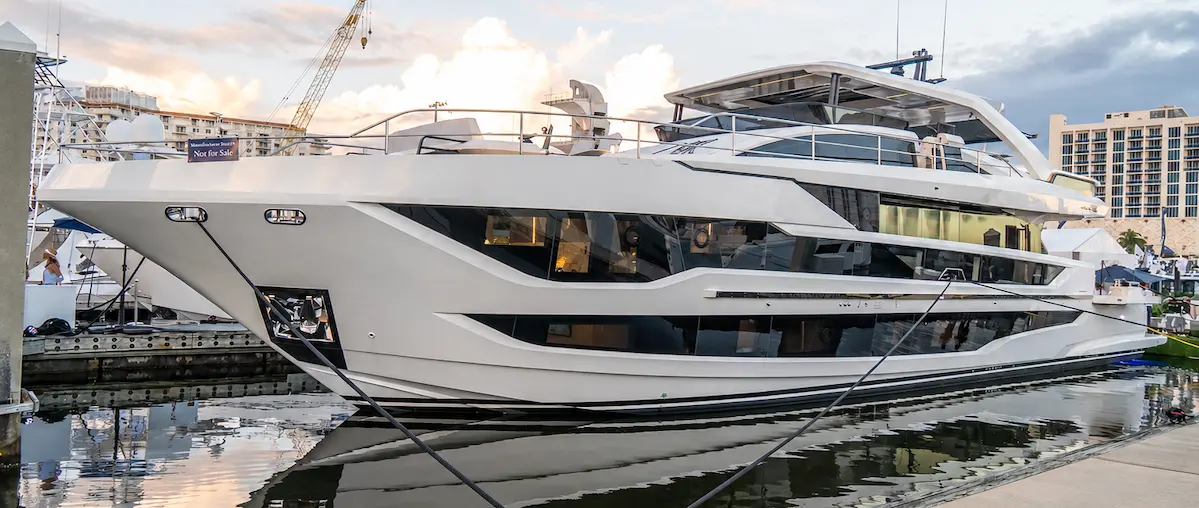
Pearl Yachts official image of its 30m Pearl 100 Hybrid flagship, from the builder's 2026 Fort Lauderdale announcement.
Pearl Yachts’ 30m Pearl 100 Hybrid makes its world debut at Fort Lauderdale with twin-shaft hybrid propulsion, five cabins and two full-beam suites.
Pearl Yachts used the 2026 Fort Lauderdale International Boat Show to introduce the Pearl 100 Hybrid, a new 30-metre flagship with the first hybrid propulsion installation in the British builder’s range. The company’s early-November announcement describes a world premiere and notes that the model was named a finalist in the show’s Best of Show Awards. The distinction matters: finalist recognition is not the same as winning the award, and the launch itself is the substantive development for owners assessing technology in this size bracket.
The Pearl 100 Hybrid extends a range that had already moved into the over-24-metre market with the Pearl 82. This is not simply a new finish package for an established boat. Pearl describes a raised-pilothouse yacht with five en-suite guest cabins, a redesigned owner experience and a power system intended to offer different modes of operation. For Superyacht Guide readers, those choices raise practical questions about engine-room integration, hotel loads, guest comfort and the service support needed as a builder introduces a new propulsion architecture.
The manufacturer’s show material identifies an e-Motion hybrid system that connects two MAN V12 diesel engines, each rated at 2,000 horsepower, with two radial-flux permanent-magnet electric motors through a twin-shaft installation. The published arrangement is intended to support different operating modes, including periods of electric propulsion and the ability to supply hotel loads from an associated power pack. It is more specific than the general word hybrid, which can describe very different arrangements on different vessels.
Those technical details should be kept separate from performance claims that have not been independently tested. A hotel-load mode designed to avoid running a conventional generator does not mean the yacht requires no energy, nor does silent electric operation imply unlimited endurance. Battery capacity, charging strategy, electrical demand, propulsion speed and installed safety systems determine what can be achieved in practice. Pearl’s release sets out the concept and equipment architecture; it does not supply a verified sea-trial table sufficient to calculate a universal fuel-saving percentage.
Owners should therefore ask for the actual commissioning and sea-trial results, battery and power-management documentation and a clear explanation of what happens when changing modes. Crew training is part of that conversation. A system that links diesel machinery, electric motors and hotel loads potentially introduces additional controls and maintenance requirements. The owner benefit may be quieter operation and more flexible energy management, but reliable service depends on transparent operating procedures and proper local technical support.
The Pearl 100 Hybrid’s accommodation plan is unusually significant to the design story. The company describes five en-suite guest cabins including a main-deck owner’s suite with a private foredeck terrace and a second full-beam suite amidships on the lower deck. It also specifies a forward double and two twin cabins. The result offers different ways of accommodating family groups and mixed parties, with two cabins capable of serving as principal accommodation under different arrangements.
The main-deck owner’s position changes how the yacht allocates valuable interior space. It offers a separation from the lower accommodation area and a private connection forward, while the second large suite gives a further group of guests an option that goes beyond a conventional smaller cabin. Those advantages have to be judged against circulation, crew access and the intended use of the vessel. Prospective buyers should examine the actual general arrangement and not assume that a photogenic private terrace automatically provides complete privacy in every marina or anchorage.
Pearl’s publication also indicates separate accommodation for four or five crew, depending on specification. That is not an insignificant detail on a yacht intended for extended guest use. The ease with which crew can provision, prepare meals, serve guests and maintain machinery affects the lived experience as much as the number of guest cabins. An owner comparing yachts in the 30-metre segment should ask where service routes cross guest areas and how the crew’s working spaces function during a full house.
Dixon Yacht Design is responsible for the exterior styling and naval architecture, while Kelly Hoppen Interiors provides the interior design. Pearl’s announcement introduces a Monochrome scheme using contrasting tonal materials and a disciplined palette. Buyers can also select from other established Kelly Hoppen schemes described by the builder, including Indulgence, Luxury and Modern. These are design options rather than evidence that every interior shown in marketing imagery appears in the specific yacht introduced in Florida.
Outside, fold-out wings at the aft cockpit aim to increase the connection to the water, while a route from the extended flybridge toward the foredeck supports movement between the yacht’s social areas. Such features have become increasingly important in the owner’s experience, but their practical value depends on the deployment arrangements, local conditions and the ease of using them with guests aboard. A fold-down terrace that requires careful positioning and crew supervision is a different proposition from a fixed deck surface.
The raised pilothouse is part of the layout strategy rather than a merely stylistic label. It allows the helm to be placed so that the main deck can be organised around guest accommodation and entertaining, but sight lines, wheelhouse access and separation from guest activity still deserve inspection. A careful sea trial and walk-through can reveal issues that a first impression at a boat show will not.
The organiser had already listed the Pearl 100 Hybrid among its 2026 world-debut yachts ahead of the 28 October–1 November event. Pearl’s own coverage then described the world premiere and Best of Show finalist recognition. Together these sources confirm the timing and the public introduction, while stopping short of establishing independent measurements for speed, range, acoustic performance or fuel use. Those are later evaluation questions, not facts to infer from a debut announcement.
Pearl also presented the 25-metre Pearl 82 in its Fort Lauderdale programme. That comparison matters because the smaller model already brings five en-suite cabins and a forward owner-focused arrangement into a relatively compact platform. The Pearl 100 Hybrid adds scale, its particular two-suite layout and a new propulsion architecture. The decision between them is not automatically resolved by the larger yacht’s length: berthing options, crewing, capital budget, maintenance capacity and preferred cruising pattern can all change which vessel is suitable.
The Best of Show finalist status should similarly be read in its narrow sense. Selection for a shortlist acknowledges that the organisers or judging process considered the yacht noteworthy, but it is not a substitute for class documentation, signed technical specifications or the owner’s own assessment. Pearl’s release is commercial communication, and Superyacht Guide is reporting the company’s claims with the source identified so that readers can distinguish a manufacturer’s announcement from independent testing.
The first is energy: in which operating modes can the yacht move under electric power, what hotel loads can the power pack support, how are reserves protected and how is the system charged? The second is handling: how does the particular hull behave at low speed, at anchor and in close quarters with the hybrid installation? The third is ownership support: which components are serviced by Pearl’s network, which by equipment manufacturers, and what training and spare-parts arrangements are offered to the captain and engineer?
Accommodation deserves equally rigorous attention. Buyers should confirm the precise five-cabin layout, the two full-beam suites, crew complement and the amount of usable private deck area in their chosen specification. A model can be highly persuasive in press photographs without answering the everyday questions of storage, galley workflow, accessibility or noise while machinery is running. For an owner intending to spend weeks aboard, those considerations will remain long after the excitement of a world premiere.
The builder has not, in the primary material examined for this report, published independently verified fuel-consumption, emissions or operating-cost figures covering all modes of the new system. Claims that hybrid technology is automatically cheaper or greener in every use case would therefore go beyond the available evidence. The most responsible conclusion is that Pearl has moved an identifiable hybrid installation into a 30-metre yacht, and the real-world results will need to be assessed as more detailed operational data emerges.
The Pearl 100 Hybrid is a significant addition to the available choices at the smaller end of the superyacht market, particularly for owners interested in energy management and a substantial accommodation plan without moving into the much larger-vessel category. It has clear design responsibilities, a defined hybrid architecture and an identifiable launch at a major US show. Those facts stand on their own, without invented savings figures or assumptions about the final performance of every future build.
The next useful information will be detailed technical data, operational demonstrations and individual delivery specifications. Until those are published, owners and brokers should treat the announcement as a well-documented market introduction rather than a finished independent assessment. The Fort Lauderdale International Boat Show event guide provides the show context, and the source links below preserve the distinction between manufacturer information and organiser confirmation.
Original sources: Pearl Yachts, world premiere and finalist announcement; Pearl Yachts 2026 official model overview; and Fort Lauderdale show organiser’s debut-vessels release. The hero illustration is supplied by Pearl Yachts from the builder’s official press page.
Explore
Go deeper into the yachts, companies, events and destinations directly connected to this article.
Continue reading
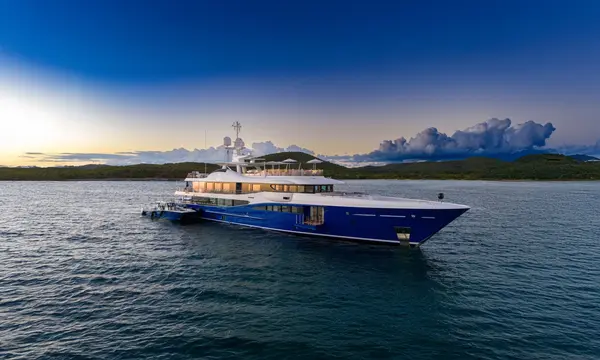
Burgess has announced the sale listing of NOMAD, the 55-metre Amels delivered in 2019, with an asking price of €36,450,000. Its 26 October announcement …
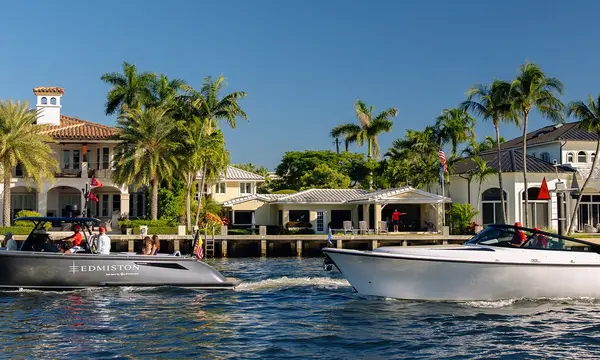
Edmiston has confirmed five superyachts from 28.5m to 59.9m for Fort Lauderdale's 2026 boat show, including IDOL, DOMANI, RULE NO.1, KNICKERBOCKER and BLONDIE.
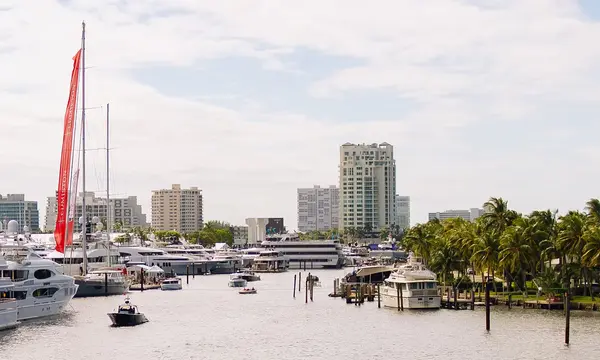
Edmiston has published its 2026 Fort Lauderdale International Boat Show guide ahead of the 28 October–1 November event, highlighting the show’s importance to the …
Northrop & Johnson will bring seven yachts for sale to FLIBS 2026, led by the 44.5m Trinity SUMMERDANCE. The brokerage will also operate a …
Superyacht Guide
Continue into the wider Superyacht Guide.
Business opportunities · Superyacht Guide
Companies serving the superyacht market can discuss clearly identified advertising, sponsorship and business-profile opportunities. Commercial activity remains separate from independent editorial coverage.