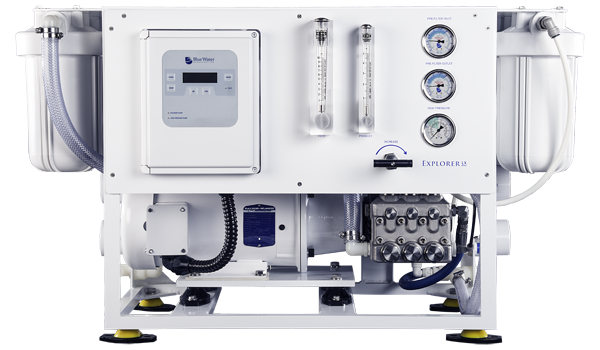

Blue Water Explorer LX Watermakers Bring 12,870-Litre Daily Capacity Into Yacht Planning
By Superyacht Guide Newsroom · Edited by Superyacht Guide Newsroom
Blue Water Explorer LX Watermakers Bring 12,870-Litre Daily Capacity Into Yacht Planning — first-party photo SYG News 24 Nov 2026 batch08
The Explorer LX from Blue Water Desalination offers a semi-automatic reverse-osmosis option for larger yachts, with published output up to 12,870 litres daily.
Fresh water is one of the less visible limits on a superyacht's independence. Guests expect showers, laundry, clean decks and reliable galley service, while the engineering team must balance storage, desalination output and the restrictions of the cruising location. Blue Water Desalination's Explorer LX is listed in the METSTRADE 2026 superyacht catalogue as a family of semi-automatic watermakers with published production capacities from approximately 7,950 to 12,870 litres per day. The maker describes conventional control switches, a manual high-pressure valve, an electronic diversion of product water and an LCD display of salinity and status. Those specifications provide a starting point for technical review, not proof that every unit will produce the headline daily volume in every sea or climate. For yacht owners, the issue is how to turn rated capacity into a dependable and maintainable water-supply plan.
A daily production figure is useful when comparing equipment, but it needs to be connected to the yacht's real demand and operating schedule. A charter yacht with many guests and frequent laundry may require very different watermaking capacity from an explorer carrying a smaller party on long voyages. Production can vary with feedwater temperature, salinity, system condition and the time the unit is allowed to run. A published maximum should not be adopted as the normal daily yield without checking the maker's test conditions. Engineers should estimate consumption by activity and season, establish minimum storage reserve and consider how the yacht will cope when watermaking is temporarily unavailable.
The first-party catalogue places Explorer LX within a semi-automatic range for larger yachts and commercial applications. It gives an output band of 2,100 to 3,400 US gallons per day, corresponding to approximately 7,950–12,870 litres per day. The description refers to traditional controls and a manually operated high-pressure valve rather than a completely unattended process. An electronic controller is said to divert produced water into the storage tank, while an LCD reports salinity and operating status. The information does not establish specific pump efficiency, exact membrane count or operating pressure for every model. Those details belong in the current technical data sheet and should be checked against the proposed unit.
Watermakers need a way to prevent unsuitable product water from entering the yacht's freshwater tanks, especially during start-up or after a condition that changes salinity. Blue Water says the Explorer LX uses an electronic controller to manage product-water diversion. This is useful in principle because it can support a defined acceptance threshold, but the exact threshold and failure response must be confirmed with the manufacturer. Crew should know when water is rejected, when tank filling is permitted and how to test any sensor on which that decision depends. An indication on a display is not sufficient if maintenance procedures do not include independent checks of water quality and correct routing.
The presence of manual high-pressure adjustment may appeal to engineers who prefer direct control and clear visibility of process conditions. It also places responsibility on an operator to follow the correct start, adjustment and shutdown sequence. A vessel with rotating crews should have a concise operating procedure that is consistent with the manufacturer manual. Technicians should understand the function of each valve and what pressure or flow readings indicate a problem. The yacht's management team needs to decide who is authorised to use the equipment and how its operation is recorded. An apparently simple control arrangement can still be hazardous if untrained staff improvise adjustments during a busy passage.
A yacht may take seawater from an open, relatively clean location on one voyage and find itself near a marina or sediment-laden coastal area on the next. Watermaker performance can be affected by suspended particles, biological growth, hydrocarbons and other contaminants. Pretreatment and intake location are therefore central to any desalination installation. The catalogue's output range does not remove the need to follow the manufacturer's feedwater conditions and cleaning procedures. Owners should establish when running the equipment is appropriate and when it is better to rely on stored water or a verified shore supply. Membranes and filters are service items, not components that can be expected to tolerate every operating environment.
On a large yacht, freshwater tanks act as an operational reserve when the watermaker is stopped for maintenance or when sea conditions and local rules make production unsuitable. Sizing that reserve is a risk-management exercise, not simply a question of whether it can hold a day's average consumption. Engineers should consider unexpectedly high demand, a failed pump, a blocked intake or a prolonged period when water quality prevents production. The yacht should have a sensible way to monitor tank contents and manage consumption during a fault. A high-capacity watermaker can reduce dependence on shore water in normal use, but it should not encourage an owner to eliminate all practical storage contingency.
Reverse-osmosis water production requires energy to pressurise feedwater and move it through the treatment system. The installed electrical load may influence which generator or shore-power arrangement is used during watermaking. Pumps can also create heat, vibration and noise in the machinery space, which must be considered in an accommodation-focused vessel. The public Explorer LX listing does not provide detailed consumption curves, so it is not possible to calculate electricity cost per litre from the catalogue alone. The engineering team should request power demand at representative operating conditions and review whether production can be scheduled to coincide with efficient generator loading or periods of suitable shore supply.
A desalination plant separates freshwater from a more concentrated reject stream that must be discharged appropriately. The route and location of that discharge need to be considered in the yacht's plumbing design, alongside local operating rules and the possibility of contamination of nearby intakes. Engineers should also ensure that backpressure and pipe sizing meet manufacturer limits. During refits, existing through-hull fittings and pumps may not suit a materially larger unit. The chosen arrangement should be reviewed for leaks, accessibility and isolation. A watermaker advertised as a straightforward replacement still has to be integrated into a vessel whose freshwater and seawater systems were designed around specific loads.
Membranes, filters, seals and pumps require inspection and service over time. Rated water production may decline gradually as equipment becomes fouled or components wear. Regular trending of salinity, pressure, flow and product volume can help technical teams recognise that change before it causes an operational problem. The Explorer LX's LCD reporting of salinity and system status provides a starting point, but a complete maintenance programme should specify which values must be recorded, what deviations trigger action and who is authorised to clean or replace components. Crews should follow approved procedures for preservation during long periods without operation. Improper cleaning or storage can shorten the life of otherwise sound equipment.
Producing low-salinity water does not automatically establish that the full freshwater system is hygienic or that it meets every applicable potable-water requirement. Storage tanks, distribution pipes, treatment steps and sampling all contribute to water quality at the point of use. The yacht should follow its approved freshwater management plan and any relevant flag and port-health requirements. This is especially important where guests consume water supplied onboard or where showers and other services produce aerosols. A watermaker's salinity display serves an engineering purpose; it is not a comprehensive microbiological or chemical analysis. Operators should distinguish between production performance and the wider duty to provide safe water.
Before installing a larger machine, an owner should compare actual tank-level trends, watermaker run time and the causes of present shortages. Sometimes the difficulty is insufficient equipment output; in other cases it is a maintenance issue, a leaking service line or a concentration of water use during turnover. An accurate demand study can prevent overspecification and identify low-cost improvements. The physical refit must also consider weight, mounting, access, electrical protection, raw-water flow and spare-parts storage. The yard should confirm whether the selected model fits existing routes and whether replacement can occur without extensive modification to finished spaces. Those installation costs may be as consequential as the equipment price.
Blue Water Desalination's official METSTRADE 2026 entry identifies the Explorer LX as a semi-automatic watermaker range for larger yachts and commercial users. It publishes an output band up to 12,870 litres per day, describes traditional switches and a manual high-pressure valve, and refers to automatic product-water diversion plus salinity and status display. It does not identify a newly launched superyacht using the system or provide independent test results for every feedwater condition. Nor does its presence in the current exhibitor catalogue establish a launch in November 2026. The accurate editorial frame is a product assessment based on supplier documentation, with operating performance requiring vessel-specific verification.
A yacht's freedom to stay at anchor depends on more than the nominal output of a desalination unit. It depends on consistent water quality, storage, crew competence, maintenance resources and realistic assumptions about daily use. The Explorer LX offering gives owners a sizeable potential production range and an operating arrangement that remains directly understandable to engineers. Whether it is the right solution depends on the vessel's real consumption and technical profile. A successful procurement decision will therefore combine the manufacturer's specifications with a demand calculation, a documented operating procedure and a carefully commissioned installation. Freshwater independence is earned through those preparations, not by quoting the largest daily figure in a brochure.
Primary source: Blue Water Desalination official Explorer LX watermaker product entry, METSTRADE 2026.
Photo copyright Blue Water Desalination. Maker-supplied Explorer LX watermaker product photograph. Official source.
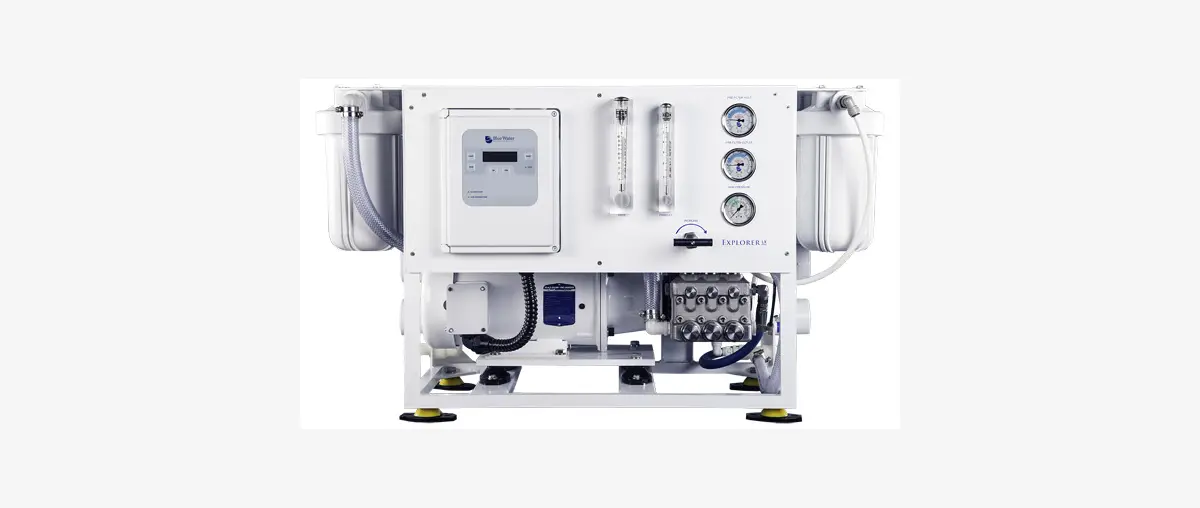
Photo copyright Blue Water Desalination. Maker-supplied Explorer LX watermaker product photograph.
Explore
Go deeper into the yachts, companies, events and destinations directly connected to this article.
Continue reading
IYC has added the 24m YYachts FITZROVIA to its global charter fleet. Delivered in 2026, she is the first hybrid-powered Y8 and combines sailing …
FGI's July 2026 project announcement confirms the launch of 53.5-metre Silvia in Marina di Carrara, with hybrid propulsion and owner-focused detailing.
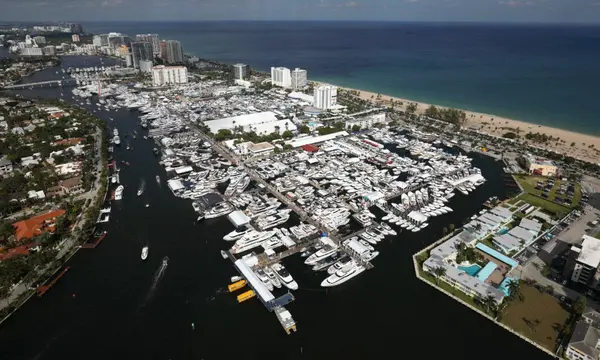
Blue Water Desalination has confirmed three locations at the Fort Lauderdale International Boat Show, taking place at Bahia Mar from 28 October to 1 …
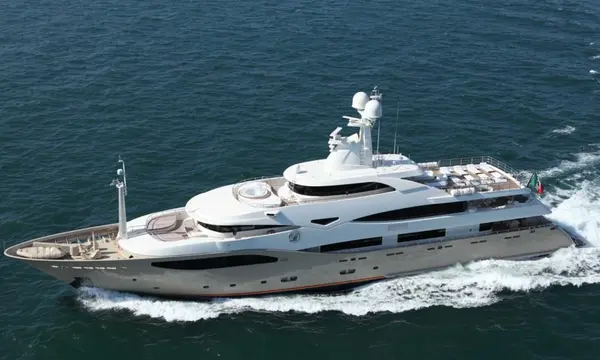
Videoworks has issued technical details of its completed digital refit aboard the 60m CRN charter yacht ELENI, covering multi-zone audio, a 115-inch upper-deck screen …
Superyacht Guide
Continue into the wider Superyacht Guide.
Business opportunities · Superyacht Guide
Companies serving the superyacht market can discuss clearly identified advertising, sponsorship and business-profile opportunities. Commercial activity remains separate from independent editorial coverage.