Swiss materials research institute Empa has developed a flame-retardant epoxy-based composite that can be broken down for the recovery of its reinforcement materials, and the research team is now discussing possible applications beyond aviation and rail. In an interview published by Superyacht Technology on 6 November 2026, lead researcher Sabyasachi Gaan confirmed that marine applications, including glass-reinforced and carbon-fibre components used on superyachts, merit further exploration. That is a meaningful new connection between laboratory materials science and yachtbuilding, but it is not an announcement that a shipyard has selected the resin for a new yacht or that a marine product has passed classification approval.
Empa research draws new attention from yacht construction
Swiss materials research institute Empa has developed a flame-retardant epoxy-based composite that can be broken down for the recovery of its reinforcement materials, and the research team is now discussing possible applications beyond aviation and rail. In an interview published by Superyacht Technology on 6 November 2026, lead researcher Sabyasachi Gaan confirmed that marine applications, including glass-reinforced and carbon-fibre components used on superyachts, merit further exploration. That is a meaningful new connection between laboratory materials science and yachtbuilding, but it is not an announcement that a shipyard has selected the resin for a new yacht or that a marine product has passed classification approval.
The underlying work was announced by Empa in September 2026 through a Swiss federal government release, and an associated scientific paper describes the chemistry and experimental results. The important distinction is between a demonstrated materials-recycling process and a material qualified for installation on a particular vessel. Superyacht builders will be interested in both flame behaviour and end-of-life recovery, yet must also assess fatigue, moisture exposure, workmanship, repairability and all the other requirements of a marine installation. The November interview signals potential, not the completion of that demanding qualification process.
Why conventional epoxy composites are difficult to recover
Glass-fibre reinforced plastic and carbon-fibre composites are familiar to yacht designers because they allow complex shapes and high stiffness without the same weight as many traditional structural solutions. Epoxy resin binds the reinforcement layers together as the laminate cures, creating a strong network that is difficult to take apart afterwards. That durability is useful throughout a yacht's service life, but becomes a problem when panels are damaged, replaced during a major refit or ultimately dismantled. Conventional thermoset epoxy cannot simply be remelted and reshaped in the way some thermoplastics can.
There is no single recovery problem applicable to every yacht. Large steel or aluminium vessels may still contain substantial composite components in masts, tenders, interiors and equipment housings, while other yachts rely much more extensively on composite hulls and superstructures. A material that improves recoverability in one application will not automatically solve the end-of-life problem for an entire vessel. Recycling also requires identification of the constituent materials, suitable collection and processing facilities, and an economic route for recovered fibre to be used again. These stages remain separate from the laboratory invention itself.
A phosphorus-containing molecule changes the chemistry
Empa explains that its researchers introduce a phosphorus-containing component during epoxy production, changing the behaviour of the cured network. The material is intended to retain useful mechanical performance and flame resistance while permitting later separation under controlled processing conditions. In the September release, the institute described both thermomechanical reprocessing and a method involving an appropriate solvent and heat to separate the reinforcement from the resin system. The exact conditions matter: a composite does not become casually dissolvable in seawater, nor does the work suggest that finished yacht panels can be recycled without specialist treatment.
The 2025 Chemical Engineering Journal paper provides technical context for the approach and includes work on carbon-fibre reinforced composites. Such research results give engineers useful starting points for questions about fibre recovery and the behaviour of recycled resin, but the composition of a tested sample should never be treated as the specification of a production yacht component. Resin formulation, fibre architecture, laminate thickness, bonding methods and manufacturing controls all affect an installation's behaviour. A shipyard considering the technology would need to establish which combination has actually been tested and whether those results transfer to its own construction methods.
Fire behaviour matters as much as recyclability
One attraction of the Empa programme is that the researchers did not pursue recyclability while ignoring flame performance. Passenger transport materials face demanding fire-protection requirements, and Empa's project was developed with aviation and railway applications in mind. The team reports that its modified epoxy composite maintains strong fire-resistant properties while offering a recovery route that conventional epoxy structures lack. That combination has obvious conceptual relevance to a yacht, where accommodation, crew spaces, machinery areas and escape routes create very different fire-risk environments within one vessel.
Nevertheless, satisfying a particular laboratory fire test or transport-sector requirement is not the same as proving compliance with a yacht's applicable flag, class and statutory standards. A complete marine installation may include core materials, adhesives, surface finishes, coatings and insulation whose performance has to be assessed together. Smoke production, toxicity, heat release and the integrity of escape arrangements are distinct questions. Naval architects and surveyors would therefore need the exact test certificates and proposed use case before accepting the material. The present research should be described as promising technology, not a certified fire-safety upgrade for superyachts.
Sandwich panels illustrate the potential and the constraints
Empa's September announcement highlights a composite sandwich structure consisting of reinforcing face sheets around a lightweight core. Such construction illustrates why dismantling could be valuable: high-cost reinforcement and core elements are otherwise locked together by cured adhesive and resin. The research describes recovery of component layers using the appropriate treatment, allowing material that would be lost through straightforward disposal to be considered for further use. On yachts, analogous sandwich structures can be found in certain deck, interior and superstructure applications, although materials and engineering details vary considerably among builders.
Recovering fibres in a laboratory is only one stage of industrial reuse. Any recovered carbon or glass reinforcement would need to be examined for damage, contamination and retained performance before a designer could assign it a structural role. A decorative panel, an equipment cover and a primary load-bearing structure present very different levels of risk if their properties are uncertain. Future yachtbuilding value may therefore emerge first in carefully bounded components or manufacturing offcuts, before anyone considers a broadly specified structural material. No yachtbuilding adoption sequence has been announced by Empa, and this is a practical editorial assessment rather than a forecast from the researchers.
What the new marine interview actually establishes
The November Superyacht Technology interview is important because it brings a researcher directly into a marine-sector discussion. Gaan identifies glass-reinforced plastic and carbon-fibre uses on yachts as possible areas for future work while making clear that the range of applications has not been fully explored. The interview provides a contemporary industry angle to the September research announcement, but it does not provide sea-trial data, a production contract or a formal marine qualification timetable. Nor has the laboratory published comparative lifecycle figures for a superyacht built with this resin instead of a conventional alternative.
This distinction protects readers from two common overstatements. First, the existence of a potentially recyclable resin does not establish that all composite yachts will become recyclable in practice. Second, a fire-resistant laboratory formulation does not justify assuming it is suitable for every exposed or concealed onboard location. For owners, naval architects and technical managers, the immediate story is about a potential future design choice and a set of research questions. It belongs in the industry-development discussion alongside established methods of controlling waste and extending useful service life, rather than in a catalogue of products ready to purchase.
Newbuild and refit teams face different decisions
A newbuild yard can potentially consider an alternative resin at a comparatively early design stage, before laminate schedules, joining details, production methods and quality procedures are frozen. Even then, adopting an unfamiliar system entails engineering verification, supplier assurance, worker training, sampling and approval by the parties responsible for the yacht's specification. Existing ships are different. During a refit, removing one panel does not make it sensible to substitute an unqualified material into a structure whose behaviour depends on the original design. Repairs also require compatible materials and documented methods, not simply a promising sustainability claim.
The refit sector could still benefit from better choices over time. For removable furniture components, non-critical fittings or certain replacement panels, the eventual availability of recoverable composites could help a team consider what happens when the next renovation is due. The key is to work from a verified specification and a realistic disposal route. A shipowner might quite reasonably prefer a durable repair that extends the service life of an existing assembly over replacing it with a new material that carries uncertain engineering risks. Sustainability decisions need to include service life, not only a headline about recycling.
The supply chain must make recovery practical
Even if a new resin performs well at sea, the commercial benefits of recoverability will depend on the processing chain. Shipyards, service companies and dismantling facilities would need reliable ways to identify the material, remove incompatible fittings and coatings, and send it to a facility able to apply the correct recovery process. Transport and processing themselves consume resources, so a claim of reduced environmental impact would require a credible assessment of the full cycle. Recovering high-value carbon fibre could support a commercial case, but market demand and the quality of the recovered material would determine whether that value is realised.
Empa worked with industrial partner Elantas, part of speciality-chemicals group ALTANA, in the development programme. That partnership indicates an effort to connect scientific chemistry with practical materials production. It does not establish a supply agreement with any yachtbuilder. For the superyacht industry, the questions to monitor now include larger-scale manufacturing trials, marine-specific durability testing, evidence of flame performance in actual assemblies, independent certification and an identified recycling pathway. These are more meaningful measures than the number of publicity announcements that mention a possible boating application.
A careful step toward materials with a second life
The sector has spent years examining how large yachts can reduce waste at construction and refit without compromising safety or reliability. Empa's research adds a potentially useful approach because it seeks to address two characteristics that matter to engineering teams: the ability of a composite to resist fire and the possibility of recovering its ingredients later. The November interview makes the connection to superyachts explicit, while the Swiss research announcement and scientific paper supply a firmer foundation for understanding what has been tested. Those sources support cautious interest, not claims of an imminent revolution in production hulls.
The next decisive news would be an actual marine development programme with named test partners, published performance data and a qualified application. Until that exists, yacht owners and builders should ask how any future material compares with established laminates across strength, safety, maintenance, repair and end-of-life treatment. A yacht must first function dependably throughout decades of service; better recycling at the end is an additional benefit if it can be substantiated. Empa's work is worth following precisely because it frames those questions for a class of materials that has previously been especially difficult to recover.
First-hand 6 November interview: researcher interview; Swiss federal government release of the Empa research: additional first-party or industry material. Report dated 9 November 2026. Announcements and operating plans may change; editorial interpretations are distinguished from confirmed facts.
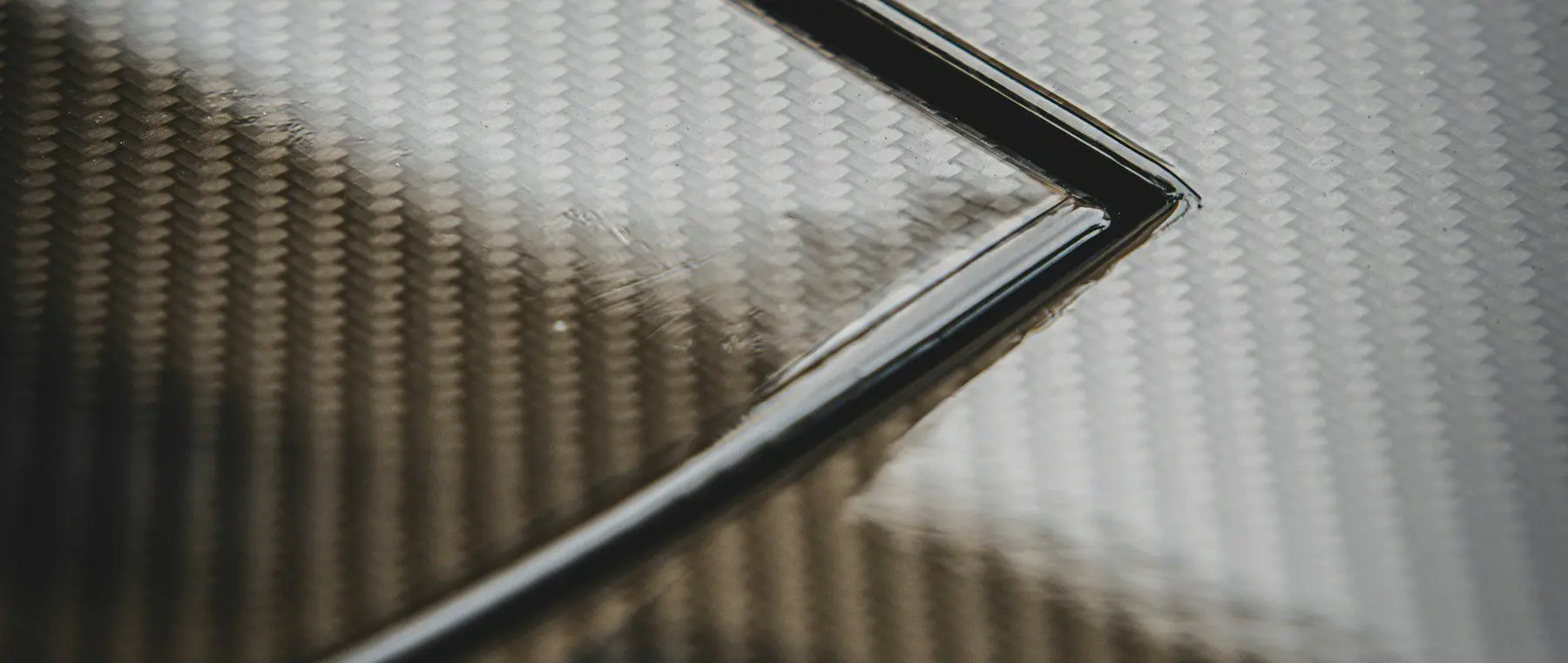
Editorial photograph: photographer and original image — Madeline Liu / Unsplash License; September 2025 close-up of woven carbon-fibre surface; illustrative material texture, not an Empa sample or a yacht component. Cropped and resized under the Unsplash License. Illustrative photograph only; it does not show the 2026 event or named product.