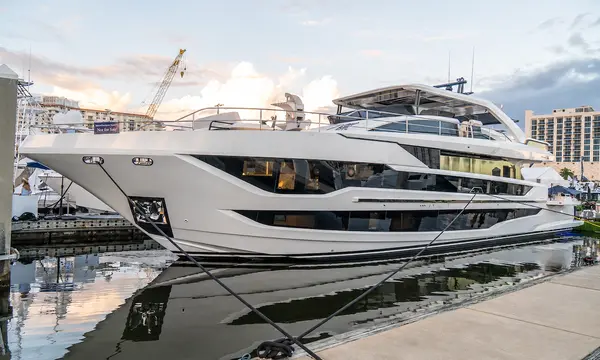
Pearl 100 Hybrid Makes 30m World Premiere at Fort Lauderdale 2026
Pearl Yachts’ 30m Pearl 100 Hybrid makes its world debut at Fort Lauderdale with twin-shaft hybrid propulsion, five cabins and two full-beam suites.

2026 Sustainable Maritime Transport Outlook presentation, official Eni press photograph
RINA, Eni and Fincantieri outline differing pathways for shipping emissions to 2050, highlighting practical consequences for large-yacht propulsion, refit and fuel decisions.
Eni, Fincantieri and classification and engineering group RINA have presented the second edition of their Sustainable Maritime Transport Outlook, setting out a less certain route towards maritime decarbonisation than the companies described a year earlier. Published in Rome on 11 November 2026 with technical support from Bain & Company Italy, the study compares fuel and technology options, infrastructure availability and projected ownership costs through 2050.
Although the companies’ analysis places significant weight on commercial shipping and the cruise industry, its implications are relevant to the superyacht sector. Builders and owners planning vessels with decades of service life face decisions about propulsion, generator systems, electrical capacity and possible future conversions at a time when fuel infrastructure and international regulatory measures remain in flux.
The report should not be mistaken for a superyacht-specific forecast. The underlying stakeholder engagement includes shipping-market participants with a different operating profile from a 50-metre private motor yacht or a 100-metre explorer. It nevertheless offers a structured way to consider the choices facing owners and designers, especially where current equipment needs to remain viable for long periods.
RINA’s official account describes a reference scenario called “Today as Future.” Under that scenario, Europe is projected to reduce maritime emissions intensity by approximately 80% by 2050 against 2020, compared with a reduction of around 40% at global level. Those are modeled scenario outcomes, not achievements already made and not commitments applying to every individual ship.
The report also considers a slower pathway, “Decarbonization by 2070,” under which Europe’s targets are delayed until 2070 and other countries follow later. The contrast between these pathways highlights how strongly future outcomes depend on coordinated decisions by governments, fuel suppliers, port operators, engine manufacturers and shipowners.
For a yacht owner commissioning a long-lived vessel, the significance is practical. A yacht delivered in the late 2020s could still be in active service well beyond 2050 after major technical refits. Equipment selected today may therefore influence not only near-term efficiency but also the feasibility and cost of later changes in fuels, storage and onboard distribution.
A scenario is not a prediction. It represents one internally consistent set of assumptions, and owners should avoid making large financial commitments on the belief that any one pathway is guaranteed.
The Outlook’s stakeholder interviews cover operators representing a substantial proportion of container and cruise markets, as well as technology suppliers and port organisations. The authors say the study includes shipowners and operators representing around 40% of the container market and 20% of the cruise market, together with propulsion suppliers accounting for more than 80% of the internal-combustion-engine market.
These are important perspectives for understanding investment momentum and the industrial supply chain. But the same evidence cannot be transferred mechanically to yachts. A large container ship operates predictable routes and consumes fuel at a scale that may justify dedicated bunkering arrangements. A superyacht frequently visits smaller or less predictable ports and may spend significant time at anchor or alongside with substantial hotel loads.
The yacht’s energy demands also vary with its design. Some owners prioritise transoceanic range, others silent overnight operation, shallow-water access or frequent use of tenders and onboard equipment. A diesel-electric configuration could offer different benefits on a vessel with variable hotel loads than it would on a high-speed yacht with a conventional propulsion arrangement.
Designers must therefore test each technology against the mission profile rather than assume that a fuel pathway identified for merchant ships is automatically optimal for private yachts.
The RINA statement argues that the industry is increasingly favouring technologies that are already commercially mature and more readily available. That conclusion is understandable in a market where an expensive newbuild cannot rely on infrastructure which has not yet been built.
Eni points to hydrotreated vegetable oil, or HVO, and other biofuel options as potentially useful ways to reduce environmental impacts while using much of the existing shipping infrastructure. It also discusses LNG and bio-LNG in a wider mix of transitional fuels. The emissions performance of any fuel, however, depends on feedstock, production processes, transport and combustion, not simply on its marketed label.
For yacht owners, compatibility must be assessed at the level of the individual engine, fuel system and warranty conditions. A fuel that can be stored in a conventional-looking tank is not necessarily approved for every engine or generator, and emissions savings claimed for a fuel may vary depending on how its full life cycle is calculated.
These are tasks for engine manufacturers, designers, classification professionals and the yacht’s technical team. A press release cannot substitute for the vessel-specific engineering assessments needed to approve a change.
Fincantieri describes an approach based on combining technologies and preserving flexibility. In commercial passenger shipping, LNG is presented as one important current alternative, with possible movement to bio-LNG and synthetic e-LNG over time. The group also identifies biofuels, dual-fuel engines, overall vessel efficiency and longer-term research into nuclear technology as parts of a broad development programme.
The point for yacht design is not that every future superyacht should carry LNG tanks or adopt a particular alternative fuel. Different fuels require different volumes, containment arrangements, ventilation, safety systems, class approvals and supply logistics. A technology that looks promising on a very large cruise ship may be impractical in the available volume of a comparatively compact private yacht.
What can be transferred is the principle of keeping options open. When feasible, designers can examine maintenance access, electrical distribution, spare capacity and the possibility of changing major equipment during future refits. Building in flexibility has costs and trade-offs of its own, including space and weight that might otherwise serve the owner’s accommodation or range requirements.
A sensible design study should quantify those trade-offs. It should also state plainly which conversion ideas are technically plausible and which remain aspirational.
The release points to slower progress in low-emission hydrogen projects and continued high costs for synthetic fuels made using green hydrogen. It notes that several maritime hydrogen initiatives have been paused, while alternative-fuel vessel orders continue to increase at a measured pace.
A yacht can be technically capable of using a fuel yet operationally constrained if that fuel is not reliably accessible in the destinations it visits. This is particularly relevant to cruising patterns that move between the Mediterranean, Caribbean, Indian Ocean and remote Pacific locations.
Captains and managers require more than a list of technically compatible fuels. They need evidence about delivery capacity, quality, storage, safety procedures, price, lead times and bunkering arrangements in actual ports. These details can change between one cruising season and the next.
For owners interested in novel propulsion, the availability of a conventional fallback may be important. The exact solution depends on the yacht’s architecture, flag, classification and commercial or private status; there is no universal template.
Refit yards are likely to encounter increasingly complex requests as owners seek quieter operation, improved hotel-load management and lower energy consumption without commissioning entirely new yachts.
A refit may combine more efficient generators, battery storage, power-management software, heat recovery, improved insulation or changed auxiliary systems. Each improvement needs to be examined within the vessel’s existing safety case and electrical design.
Battery capacity, in particular, should not be confused with a source of primary energy. Batteries store electricity that must be generated or supplied from somewhere. Their value depends on how they change generator operation, shore-power use, peak loads and the comfort of guests and crew. A battery installation can be useful without making a yacht emission-free.
The Outlook’s emphasis on mature technologies suggests a disciplined engineering approach: start with changes that have credible performance evidence and support arrangements, then build optionality for later advances. However, an owner should still commission an independent, vessel-specific feasibility and cost-benefit study.
The RINA announcement says uncertainty over regulation has increased and notes that global agreement at the International Maritime Organization has been postponed. It contrasts that uncertainty with the continued European regulatory direction under FuelEU Maritime.
Private and commercial yachts should not assume that every measure described in commercial-shipping discussions directly applies to them. Scope can depend on vessel type, tonnage, trading activity, flag and the particular rule. Legal obligations must be checked against the actual text in force and against any exemptions or thresholds.
Even where a requirement does not formally apply, owners may encounter commercial pressure from ports, marinas, insurers, charter clients and service providers. Those expectations can affect decisions about shore-power compatibility, energy monitoring, reporting and the choice of equipment.
Classification societies are important participants because they evaluate whether proposed arrangements satisfy applicable technical rules. Their involvement is not a guarantee that any emerging technology is approved for every use. Novel systems require careful review of their own risks and integration.
The study considers the evolution of total cost of ownership, an important departure from comparing propulsion options by initial equipment price alone. Fuel price, operating patterns, maintenance, access to infrastructure, training, insurance and the cost of later replacement can all change a technology’s economics.
For a superyacht, there may also be intangible benefits such as lower noise and vibration, improved guest comfort and the ability to operate more equipment without starting additional generators. Those benefits can be meaningful to an owner but difficult to represent in the same way as fuel savings.
A credible financial comparison should separate quantified savings from assumptions and owner preferences. It should also identify the date and geography of each fuel-price estimate, since a quoted cost in one port may be irrelevant to a yacht operating elsewhere.
Owners should be wary of simple percentage savings claims that ignore the yacht’s actual loading and cruising profile. A technology that saves energy in one operating mode may deliver a much smaller benefit in another.
At the Rome presentation, Eni, Fincantieri and RINA also agreed to continue the Observatory’s work over the next three years. The companies say the collaboration may expand to additional participants in the maritime value chain.
That continuation matters because fuel availability, technical maturity and regulation cannot be assessed accurately from a static snapshot. As new vessels enter service and operating data becomes available, the balance between different technologies may change.
For the superyacht industry, the most useful contribution from such work will be better evidence on real-world system performance and infrastructure readiness. Owners and designers would benefit from information detailed enough to distinguish vessel types and mission profiles rather than treating all marine transport as a single category.
The report’s broad message is one of pragmatism rather than inactivity. The industry can adopt proven improvements now while engineering future yachts with the flexibility to respond to technological and regulatory developments. That is a more defensible approach than making sweeping promises about any single fuel.
**Editorial interpretation:** The Outlook addresses global maritime transport. Its projections are not yacht-specific, and its scenario values should not be presented as predicted emissions reductions for private yachts.
Primary source: RINA / Eni / Fincantieri.
Photo: Eni / official 11 November 2026 Sustainable Maritime Transport Outlook media images. Official press photograph.
Photo: Eni / official 11 November 2026 Sustainable Maritime Transport Outlook media images.
Continue reading
Pearl Yachts’ 30m Pearl 100 Hybrid makes its world debut at Fort Lauderdale with twin-shaft hybrid propulsion, five cabins and two full-beam suites.

Northrop & Johnson has profiled StarEDGE's approach to superyacht communications, including multi-orbit satellite links, mobile networks and a dashboard for yacht managers.
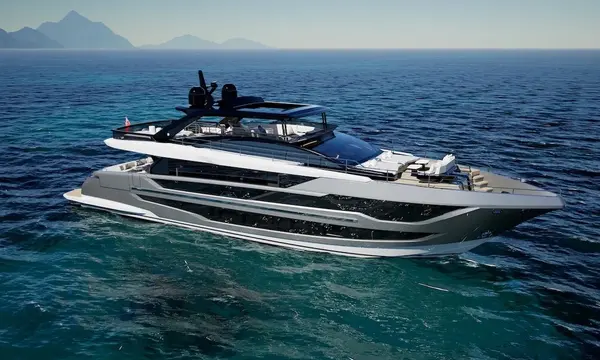
The first Pearl 100 Hybrid is scheduled for its world debut at Fort Lauderdale, introducing the company’s largest yacht and its first hybrid propulsion …

HikoTerra adds distributors and technical partners for the modular H⁴ Hybrid Power System, with configurations allowing up to 30kW of inversion and 96kWh of …
Superyacht Guide
Continue into the wider Superyacht Guide.
Business opportunities · Superyacht Guide
Companies serving the superyacht market can discuss clearly identified advertising, sponsorship and business-profile opportunities. Commercial activity remains separate from independent editorial coverage.