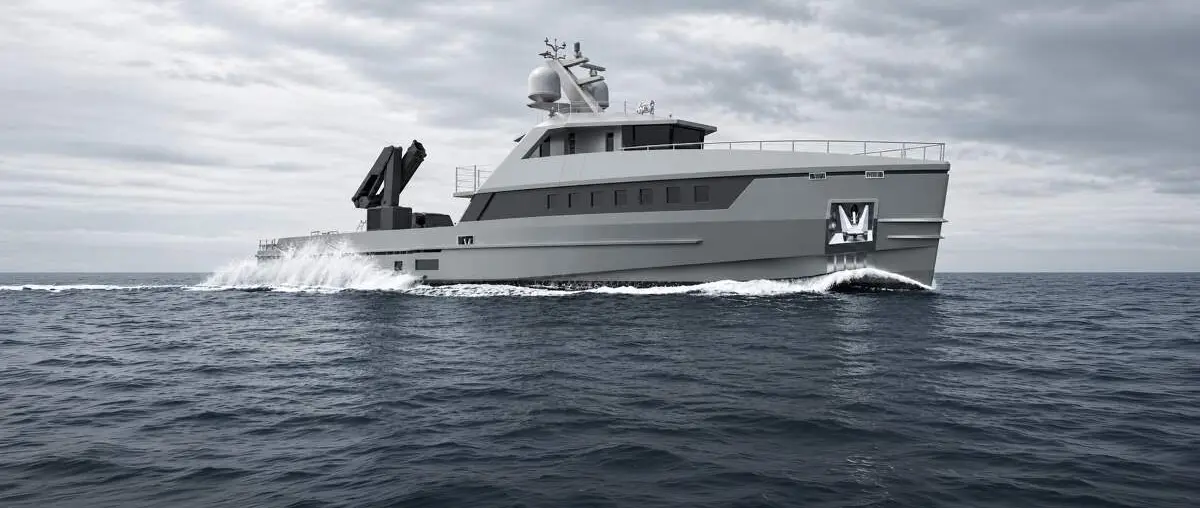
OMBRA 38 metre support yacht project official Fraser design rendering November 2026
Fraser adds the 38-metre OMBRA support yacht project to its sales fleet, with a steel hull, nine crew berths and tender capacity for craft up to eight metres.
Fraser announced on 18 November 2026 that OMBRA, a 38-metre support vessel from Cantieri Navali Termoli, had joined its sales fleet. The brokerage's accompanying vessel particulars identify an asking price of €15.9 million and a build year of 2029. The news is therefore the marketing of a prospective yacht project rather than the resale of a completed vessel. Fraser names Peter Redford and Eugenio Cannarsa as the contacts for the announcement.
The proposed yacht is intended to carry equipment and additional personnel that might otherwise occupy space aboard a principal superyacht. The brokerage describes its intended market as owners of yachts up to 499 gross tonnage, although that is a commercial positioning statement rather than a universal engineering limit for the operation of the two vessels together.
The announced specification identifies a steel displacement hull and a design by Piredda & Partners. The lead image published by Fraser is a rendering representing the future vessel, not evidence that construction or sea trials have been completed. The precise construction status and contractual delivery arrangements should be established with the representatives before any acquisition decision.
A support vessel can allow a group to distribute equipment and working spaces between two hulls. A principal yacht might otherwise have to accommodate a significant collection of tenders, diving equipment, spare parts and stores alongside the accommodation intended for guests. Transferring some of those functions to a separate vessel can change the way both yachts are used.
The arrangement also introduces costs. A second yacht requires its own fuel, crew, maintenance, insurance and management, as well as appropriate berthing or anchoring arrangements. The comparison is therefore not simply between the capital cost of a larger principal yacht and the advertised acquisition price of the support vessel.
For a prospective owner, the relevant assessment begins with identifying activities that cannot conveniently be accommodated within the existing yacht. Bringing equipment to an occasional destination may require a different solution from maintaining a dedicated expedition capability over an extended period. The proposed operational benefit must justify the additional vessel within the owner's actual cruising programme.
Fraser's OMBRA listing illustrates a particular approach to that requirement at a size below forty metres. The brochure's description of its market does not establish the suitability of every possible pairing with another yacht.
According to Fraser's published particulars, the proposed OMBRA measures 38 metres overall, with an 8.6-metre beam, a 2.5-metre draft and an indicated volume of 300 GT. These measurements describe a comparatively broad platform within the specified length. Gross tonnage is a measure derived from enclosed volume, rather than the vessel's displacement or the mass of equipment that it may carry.
The design is described as being arranged over three decks. The profile in the brokerage's illustration shows a substantial working area aft of the superstructure, consistent with a vessel dedicated to supporting other maritime activities. The practical usefulness of that space will depend on the approved deck arrangement, its structural loading limits and the clearances needed to operate equipment.
A prospective owner interested in carrying several craft should obtain detailed drawings showing how the intended items can be positioned and secured. A vessel capable of accommodating one specific tender is not necessarily able to carry every combination of tenders and equipment contemplated by an owner.
The commercial listing does not disclose the maximum combined payload or a complete list of approved deck-loading configurations. Those details should form part of the technical review of the proposed build.
Fraser identifies the capacity to carry tenders up to eight metres as an important feature of the project. A tender of that size can be a considerable item of equipment and may require a dedicated handling system. Its suitability cannot be judged by length alone. Beam, displacement, lifting points and the positions of protruding components also influence the arrangements required.
The work involved in transferring guests or equipment between the support yacht and its principal vessel deserves consideration independently of the initial lifting arrangements. The two yachts may have different freeboards and different motion characteristics. Where they operate separately, the availability of the tender and its crew must be coordinated with the intended programme.
An owner considering a particular craft should obtain the proposed handling equipment's specifications, the permissible operating conditions and the arrangements for securing the tender on passage. Those matters are not resolved by the illustration of a crane or by a statement of the maximum tender length.
The advantage of a dedicated working platform can be substantial where large tenders form an important part of the owner's activities. Its actual operation will remain dependent on the final technical design and the procedures established for each vessel.
The brokerage's particulars specify accommodation for two guests in one stateroom and nine crew. The stated crew arrangement comprises one single cabin and four double cabins, each provided with a bathroom. In addition to the wheelhouse and captain's cabin, the listed spaces include a crew mess, briefing room, laundry and dry and refrigerated stores.
This allocation of space reflects a different set of priorities from those of a yacht intended principally to provide extensive guest accommodation. A briefing room can support coordination of activities away from the principal yacht, while storage and laundry facilities may be particularly useful during an extended voyage.
The nine-crew figure describes the accommodation available, not a confirmed minimum safe manning requirement. The crew necessary for a particular operation will depend on certification, watchkeeping, maintenance and any specialist activities the vessel is expected to undertake.
If the owner expects the support yacht to provide services such as diving operations or the care of several tenders, the qualifications and organisation of the crew will need to reflect those functions. The published cabin arrangement is one component of that planning, not a complete operational staffing proposal.
The specification identifies two Baudouin engines rated at 1,500 horsepower each. Fraser's tabulated particulars give a cruising speed of twelve knots and maximum speed of fourteen knots. The narrative describes a range of up to 4,500 nautical miles, while the technical table separately lists a range of 4,800 nautical miles and a cruise range of 3,000 nautical miles.
These figures are not identical and the published material does not give enough information to reconcile the speeds, loading conditions, reserve allowances or testing assumptions used for each. They should remain separate until the builder supplies the relevant technical basis. As this is a future project, the advertised performance is not an independently verified sea-trial result for a completed yacht.
For an owner planning longer operations, the support yacht's fuel requirements and autonomy should be assessed alongside those of the principal yacht. A difference in speed or endurance may affect the planned movements of the two vessels, particularly where refuelling options are limited.
The listing also identifies two 90 kW Kohler generators and a 43 kW unit. The practical electrical capacity available to support equipment will depend on the design of the complete system and its anticipated load profile.
Fraser describes an optional certified helipad or hangar configuration. This is an option identified in the marketing material rather than confirmation that the base project includes a completed and approved aviation installation.
Aviation capability raises several distinct engineering and operating questions. The size and weight of an intended aircraft, the deck's structural capacity, the applicable certification requirements and the practical clearances need to be assessed for the intended operation. A hangar may also affect the available space for tenders or other equipment.
Owners interested in this configuration should establish what is included in the advertised price and whether the optional arrangement changes the specifications of the vessel. The broker has not provided a separate price for the option in the announcement, nor has it identified a particular aircraft or confirmed approval for its use.
The distinction is relevant to the value of the project because the support yacht's capacity is ultimately finite. A layout dedicated to one activity may leave less space available for another. The priorities of the complete cruising programme should inform the final specification.
The brokerage identifies RINA classification in its description. For a project marketed before its stated build year, the intended class, applicable notations and actual approval status need to be understood in the context of the construction agreement. The listing does not establish that an operational vessel is currently in class.
The €15.9 million figure is an asking price rather than a concluded transaction value. Prospective purchasers should establish the build specification included at that price, the contractual delivery date, payment security, change-order provisions and responsibility for acceptance testing. Tax treatment, registration and the operating implications of the chosen flag also require individual assessment.
The 18 November announcement gives the project a new brokerage context. It does not identify a completed sale, name a purchaser or confirm that hull construction has reached a particular milestone.
For the superyacht sector, OMBRA is an example of the continued commercial interest in vessels dedicated to the equipment and personnel supporting larger yachts. Its proposition rests on the eventual delivery of a practical working platform, not simply its appearance in the official rendering. The differences within the published performance figures and the optional nature of its aviation arrangements are among the points to establish with Fraser and the builder before proceeding.
Primary source: Fraser official brokerage announcement, 18 November 2026.
Further information: Fraser OMBRA project particulars, consulted 19 November 2026.
Fraser, official brokerage rendering of the proposed OMBRA support vessel. Design illustration, not a photograph of a completed yacht. Official source.
Explore
Go deeper into the yachts, companies, events and destinations directly connected to this article.
Continue reading
The best family charter yacht is the one whose layout, crew, safety, toys and itinerary fit the group. We explain what parents and multi-generational …

An IYC and SuperYacht Times panel at Monaco Yacht Show 2026 examined how crew rest, staffing, mental wellbeing and working culture affect the guest …

Fraser has been named the yacht-charter company winner in The Zoe Report's 2026 Readers' Choice Awards following a public reader vote.
Mediterranean and Caribbean charters offer different seasonal rhythms, costs and guest experiences. We compare weekly rates, APA, taxes, marinas, anchorages and itineraries.
Superyacht Guide
Continue into the wider Superyacht Guide.
Business opportunities · Superyacht Guide
Companies serving the superyacht market can discuss clearly identified advertising, sponsorship and business-profile opportunities. Commercial activity remains separate from independent editorial coverage.
