Company
Superyacht Builders Association (SYBAss)
Explore the company profile and related Superyacht Guide coverage.
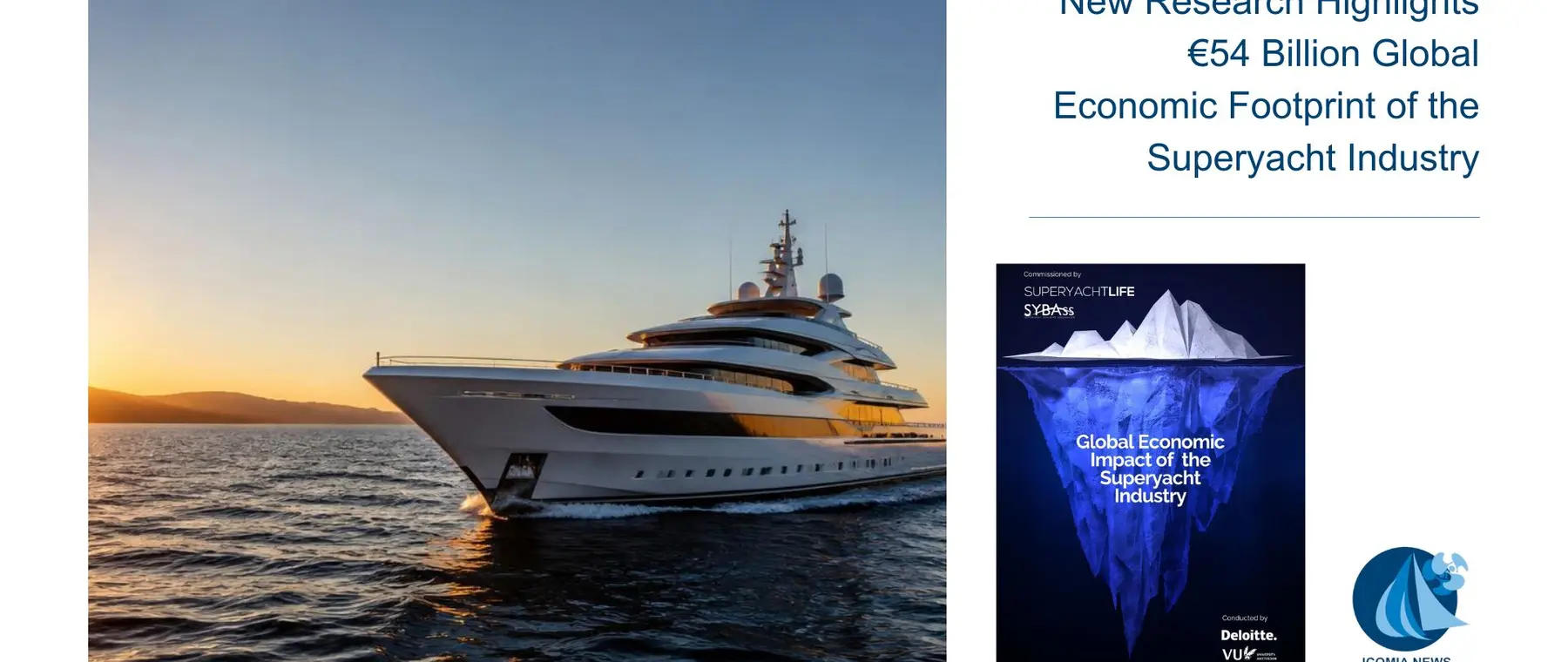
Research Puts Global Superyacht Economic Output at €54bn — verified official source image
A new industry study estimates that superyachts over 30 metres generated €54 billion in global economic output in 2022 across direct spending and wider supply chains.
New research commissioned by the Superyacht Builders Association and the Superyacht Life Foundation estimates that superyachts over 30 metres generated €54 billion in global economic output in 2022. The figure combines approximately €22 billion of direct expenditure with a further €32 billion of indirect activity created through supply chains and associated services.
The date matters because the report is being circulated in 2026 but its economic model uses the 2022 fiscal year as the underlying reference period. It should therefore be read as a quantified assessment of the industry’s economic footprint in that year rather than as a claim that current 2026 turnover is €54 billion.
The research covers new build, refit, fleet operations, charter, brokerage, tourism and destination spending rather than treating shipyard revenue as the whole industry. That wider scope reflects the fact that an active superyacht continues to generate expenditure long after delivery through crew, maintenance, fuel, insurance, management, marinas, technical support and local services.
ICOMIA’s summary says the analysis combines primary industry surveys, secondary market intelligence, company financial data, AIS movement information and expert interviews. Macroeconomic input-output modelling was carried out using FIGARO tables from Vrije Universiteit Amsterdam, with corporate financial data cross-checked and validated by Deloitte.
One of the report’s headline findings is an estimated total output multiplier of 2.4. In practical terms, the study calculates that every €1 million of direct superyacht turnover is associated with a further €1.4 million of economic output elsewhere in the economy, giving €2.4 million of total output.
That effect reflects purchases from specialist suppliers as well as spending that reaches sectors not normally labelled as part of the superyacht industry. Engineering, interiors, professional services, logistics, hospitality and destination businesses can all receive income linked to yacht construction or operation even when yachting is only one part of their wider commercial activity.
New construction can produce very large individual contracts, but the study also places weight on recurring expenditure from yachts already in service. Refit cycles, maintenance programmes and normal operations create work repeatedly across a yacht’s lifetime, spreading activity among yards, subcontractors, marinas and service providers in multiple countries.
That lifecycle perspective is particularly relevant to established superyacht hubs where the local economy is supported by visiting yachts as well as by resident builders. A region without a major construction yard can still capture substantial economic value through repair, seasonal berthing, provisioning, crew services and owner or guest spending.
The authors acknowledge that the private nature of the superyacht sector means some inputs are based on representative modelling rather than exhaustive global reporting. Ownership structures, private operating budgets and fragmented supplier data make it difficult to obtain a complete audited dataset for every yacht and every business involved.
Even with that limitation, the study provides a structured attempt to quantify activity that is often discussed only through yacht values or order-book numbers. The €54 billion figure is most useful when its scope and 2022 reference year are kept visible, allowing future studies to compare changes on a consistent basis rather than turning one modelled estimate into a current headline without context.
Explore
Go deeper into the yachts, companies, events and destinations directly connected to this article.
Company
Explore the company profile and related Superyacht Guide coverage.
Continue reading

The Superyacht Forum closes with a SYBAss economic study highlighting market growth, regional demand and constraints on large-yacht production capacity.
Deloitte's analysis of the €54bn superyacht economy breaks down construction, refit, operations and the high economic contribution from yachts above 60 metres.

Northrop & Johnson's October market update finds charter activity rising much faster than participating fleet size, while early 2027 reservations are fewer but longer.
Atalante records 18 sales, 36 new listings and 44 asking-price reductions in its October review of the 30-metre-plus segment, highlighting four vessels.
Superyacht Guide
Continue into the wider Superyacht Guide.
Business opportunities · Superyacht Guide
Companies serving the superyacht market can discuss clearly identified advertising, sponsorship and business-profile opportunities. Commercial activity remains separate from independent editorial coverage.