MCA Yacht Unlimited CoC Opens Route to 3,000GT+ Command
The MCA’s Yacht Unlimited CoC lets qualified deck officers progress to Chief Mate or Master on yachts above 3,000GT without leaving yachting for cargo-vessel …
Greece combines exceptional cruising with a substantial Athens maritime cluster, but weather, island logistics, berthing and regulation require careful planning.
Greece is one of the Mediterranean's most compelling places in which to operate a superyacht. It combines an immense cruising ground, clear water, historic ports, internationally recognised islands and a season that can extend far beyond the busiest weeks of July and August.
For owners and guests, the attraction is immediate. A yacht can leave the Athens coast and reach the sheltered Saronic Gulf without undertaking a long positioning passage. From there, it can move east into the Cyclades, north towards the Sporades, south through the Dodecanese or west through the Corinth Canal towards the Ionian Sea.
The country's geography provides almost limitless itinerary variation. Greece promotes sailing areas including the Cyclades, Dodecanese, Sporades, Ionian Islands and the Saronic and Argolic gulfs. Its territory contains thousands of islands and islets, although only a fraction are inhabited, creating a mixture of major destinations, small ports and remote anchorages.
Yet an attractive cruising ground is not automatically an ideal operating base.
A superyacht base must provide dependable berthing, engineering support, crew transport, customs and charter administration, provisioning, waste management, fuel, security and rapid access to specialist parts. It must also remain practical outside the summer season, when many island businesses reduce their operations and international air connections become less frequent.
Greece performs strongly in some of these areas and unevenly in others. Athens and Piraeus can support sophisticated yacht operations, while facilities elsewhere vary greatly. The result is a country that can function extremely well as a seasonal operational centre, but only when the yacht's programme, size and technical requirements are matched carefully to the chosen location.
For most large yachts, the natural Greek base is not a fashionable island but the Athens–Piraeus metropolitan area.
This is where the country's greatest concentration of marinas, yacht agents, engineers, chandlers, provisioning companies, surveyors, legal advisers and shipping expertise is found. It is also where access to international flights, hospitals, hotels, road transport and commercial ports is strongest.
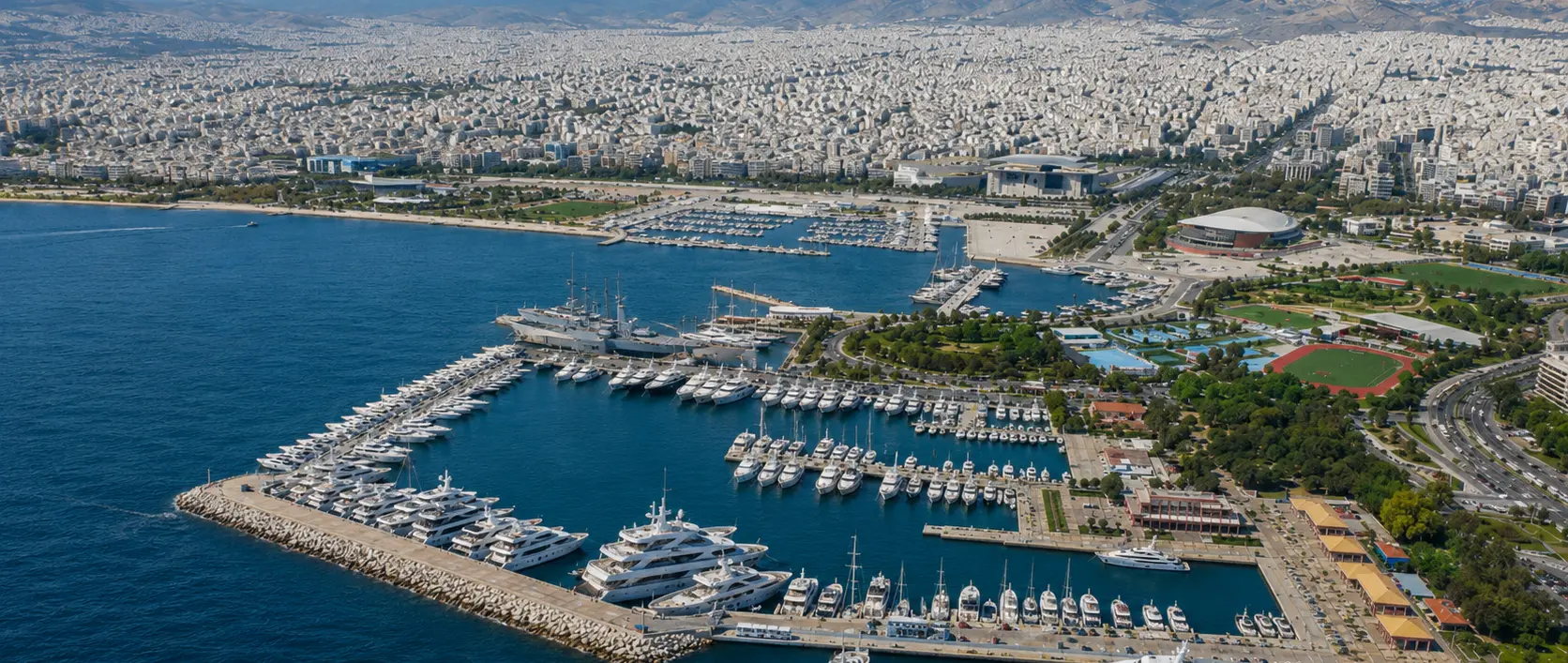
Superyacht Guide recognises this concentration through its Athens–Piraeus Superyacht Business Hub, which covers the wider Attica maritime cluster rather than treating each marina as an isolated destination.
The region offers several distinct berthing environments.
Flisvos Marina provides 310 berths, with more than half capable of accommodating yachts above 30 metres. Its location in Palaio Faliro places yachts close to central Athens while retaining the security, hospitality and shore-side services expected of a major superyacht marina.
Athens Marina at Neo Faliro is more explicitly configured for very large yachts. It has approximately 130 berths, including dedicated capacity for yachts between 50 and 130 metres, and can accommodate vessels up to 130 metres alongside.
Farther south, Astir Marina offers a more private and resort-oriented environment on the Vouliagmeni peninsula. Its redeveloped facilities include 59 berths for yachts up to 60 metres and one berth intended for a yacht above 130 metres.
These marinas serve different operational priorities. Flisvos offers proximity to Athens and a well-established superyacht community. Athens Marina provides capacity for some of the largest yachts visiting Greece. Astir emphasises privacy, luxury hospitality and access to the Athenian Riviera.
The advantage is not merely the number of berths. A captain can place the yacht within reach of the broader Greek shipping economy, including Piraeus-based suppliers accustomed to commercial vessels, ferries and large-scale marine engineering.
That wider maritime base gives Athens an advantage over isolated resort marinas. A superyacht may require a specialist pump, fabricated component, refrigeration technician or class-approved contractor at short notice. The ability to draw upon the commercial-shipping sector can be as important as the facilities provided directly by the marina.
Lavrion, on the south-eastern side of Attica, provides an alternative for yachts whose priorities are maintenance, storage and rapid access to the central Aegean.
Olympic Marine describes itself as a year-round marina with an integrated boatyard, repair capability, winterisation, storage, fuelling and waste-management services. Its position near Cape Sounion reduces the distance to islands such as Kea and Kythnos compared with starting from central Athens.
The location can be particularly useful for yachts that do not need to remain immediately beside Athens' hotels and nightlife. A vessel can complete technical work, load stores and depart directly into the Aegean without first navigating the busier waters around Piraeus.
Lavrion is also reasonably accessible from Athens International Airport. Olympic Marine presents the marina as approximately 30 minutes from the airport and around 45 minutes from central Athens, although actual road times can vary significantly with traffic and season.
The limitation is that Lavrion does not offer the same urban environment as Flisvos, Vouliagmeni or central Piraeus. Owners and guests may prefer to join the yacht elsewhere, while crew members requiring embassies, specialist medical services or extensive shopping may still need to travel into Athens.
It is therefore best understood as an operational and technical base rather than an automatic substitute for every function available in the capital.
The strongest argument for basing a yacht in Greece is that the yacht is already positioned inside one of the world's richest cruising regions.
The Saronic Gulf offers a relatively sheltered introduction to Greek waters, with destinations such as Aegina, Poros, Hydra and Spetses within practical reach of Athens. The area is immediately accessible from Athens' marinas and generally less exposed to the strongest Meltemi conditions than the central Cyclades.
This makes the Saronic Gulf useful for short owner visits, corporate use and turnaround periods. Guests can arrive through Athens, board the same day and begin cruising without a long transfer or overnight passage.
The Cyclades offer a more dramatic programme. Mykonos, Paros, Naxos, Milos, Sifnos, Serifos and the smaller surrounding islands provide the visual language most closely associated with Greek yachting: white villages, dry landscapes, deep-blue channels and open-water passages.
The Dodecanese offer longer itineraries extending towards Türkiye, while the Sporades provide greener landscapes and more sheltered northern cruising. The Ionian Islands offer a markedly different environment, with forested coastlines, lighter summer winds and easier passages between Corfu, Paxos, Lefkada, Ithaca, Kefalonia and Zakynthos.
This variety allows a yacht to remain within one country while changing the character of the itinerary completely.
A yacht based in the western Mediterranean often has to cover substantial distances to create the same degree of contrast. In Greece, a relatively short passage can move guests from an urban embarkation point to an archaeological site, a remote bay or an island with an internationally known nightlife scene.
Athens International Airport is one of Greece's major operational advantages.
It provides the most dependable year-round route for owners, charter guests, crew changes and urgent technical travel. The airport supports domestic and international connections, allowing crew or specialists to continue onwards to regional airports where necessary.
For yachts based around Attica, this creates a relatively straightforward chain: aircraft to airport, road transfer to marina and departure into the Saronic Gulf or Aegean.
Several islands also have commercial airports, including Mykonos, Santorini, Paros, Corfu, Rhodes, Kos, Skiathos, Kefalonia and Zakynthos. These can make owner embarkation and crew movement much easier during the summer.
However, regional connectivity is heavily seasonal. Routes that operate frequently in July may be reduced sharply or disappear during winter.
This is an important distinction between Greece as a cruising destination and Greece as a permanent operating base.
During the summer, many islands feel exceptionally well connected. During winter, the same yacht may become dependent on Athens, domestic flights and ferries. A marina that appears convenient during the season may be substantially less practical when direct international services stop.
Crew planning should therefore be based on the winter transport network, not only the summer timetable.
The Greek islands can support luxury hospitality at a very high level, but yacht logistics do not always match the quality of the hotels, restaurants and villas ashore.
Large islands and major charter destinations can provide fresh food, flowers, beverages, laundry, transport and routine technical assistance. Smaller islands may offer excellent local produce but limited specialist stock, inconsistent delivery schedules and no immediate replacement for a failed yacht-specific component.
A large yacht may therefore provision heavily in Athens before beginning an island programme. Agents can arrange additional supplies later, but freight may depend upon ferries, domestic flights or small local cargo services.
The national ferry network connects the islands with the mainland and with one another, with Piraeus and Rafina serving much of the Aegean and Patras, Kyllini and Igoumenitsa supporting western routes.
This network is extremely useful, but it was built primarily for passengers, vehicles and island commerce rather than urgent superyacht logistics.
A component may reach an island quickly in normal conditions, yet delays can arise from weather, sailing schedules, local holidays or the need to route the shipment through Athens. A yacht operating far into the Dodecanese or at a small Cycladic island cannot assume that every technical problem will be solved with the speed available in Antibes, Palma or Genoa.
Captains generally need to carry a more deliberate inventory of critical spares and consumables. The farther the itinerary moves from Attica, Corfu or another substantial centre, the more important onboard self-sufficiency becomes.
The Aegean's summer northerly winds are central to Greek yacht operations.
The Meltemi can provide relief from extreme heat and excellent conditions for sailing yachts, but it can also disrupt itineraries, expose anchorages and create uncomfortable passages for guests.
Its effects are not uniform. An anchorage that is calm in a southerly wind may become unsuitable when strong northerlies develop. Islands can have dramatically different conditions on their windward and leeward coasts, requiring captains to prepare alternative plans rather than follow a rigid itinerary.
The Saronic Gulf is generally less exposed than the central Cyclades, which partly explains its value for short programmes and first or final charter days.
Weather forecasting is therefore not a routine background service but a core part of itinerary design. The Hellenic National Meteorological Service issues national forecasts and gale warnings for Greek sea areas, and these should be monitored alongside professional yacht-routing services and local observations.
The practical consequence is that a seven-day Greek itinerary should not be designed as a fixed sequence of famous islands.
A yacht may need to remain in a sheltered area, reverse its route or abandon an exposed destination. Owners and charter guests who understand this usually receive a better experience than those who treat every advertised island as a guaranteed stop.
The Meltemi is not a reason to avoid Greece. It is a reason to operate with flexibility.
Greece's principal superyacht marinas provide serious infrastructure, but berth quality and availability vary sharply around the islands.
Some ports have deep water and substantial quays but limited electrical capacity, privacy or yacht-specific services. Others are picturesque but physically unsuitable for a large yacht. Even where the dimensions are adequate, commercial ferries, local excursion boats and fishing vessels may take priority.
A superyacht that can anchor safely and operate tenders has far greater freedom than one that requires a marina berth every night.
This creates a fundamental difference between Greek cruising and the Côte d'Azur model. In Greece, the yacht itself often remains the primary destination. Guests may go ashore by tender for dinner or sightseeing while the vessel stays at anchor.
For owners who prefer frequent alongside berthing, shore power and immediate road access, this can feel limiting. For those who value privacy, swimming and open anchorages, it can be one of Greece's greatest strengths.
Large-yacht berths should be reserved well in advance, particularly in Athens, Mykonos and other high-demand locations. Published marina capacity does not guarantee practical availability for a particular yacht, because berth allocation also depends on beam, draught, electrical requirements, manoeuvring space and the length of stay.
Seasonal demand can leave a captain with a nominally capable marina but no berth that matches the yacht's actual dimensions.
Greece has modernised significant parts of its yacht-charter administration through electronic systems.
The official e-CharterPermission platform allows qualifying foreign professional pleasure yachts to apply for specified-period charter permission. The system applies to non-Greek yachts recognised as professional under the law of their flag state, subject to conditions including vessel length and construction material.
Greece also operates an electronic charter-party platform for submitting and managing charter agreements, while its electronic vessel register covers Greek-flagged private yachts and professional recreational vessels operating under relevant Greek requirements.
These systems have made the process more structured, but they have not removed the need for specialist advice.
The legal position can differ according to flag, ownership, commercial status, embarkation point, disembarkation point, vessel length and whether the yacht is already registered within the Greek system.
A foreign yacht that is legally commercial elsewhere should not assume that it can embark charter guests in Greece without additional permissions and tax arrangements.
The correct approach is to involve a Greek yacht agent, lawyer and fiscal representative before marketing or signing a Greek charter. Permissions, charter documentation and tax treatment should be confirmed for the specific yacht rather than inferred from another vessel's experience.
The system is workable, but errors can affect the yacht's ability to charter, clear authorities or complete a planned itinerary.
Private pleasure yachts operating in Greek waters may be subject to the Greek recreational craft and day-ship fee, commonly administered through the eTEPAI system.
The Greek government provides an online service through which private-yacht owners can calculate the applicable fee and obtain an electronic payment code.
The existence of an online platform does not mean that the wider tax and customs position is simple.
A yacht's VAT status, flag, ownership structure, import position, commercial activity and time within EU waters can all affect its treatment. The consequences can be significant enough that an owner should not rely solely on marina advice or informal guidance.
For an operating base, the important point is not whether Greece has more rules than every competitor. It is whether the yacht has a reliable local structure for complying with them.
A well-managed yacht supported by an experienced Greek agent may operate smoothly for years. A yacht arriving without its documents, tax position and charter status properly organised can encounter avoidable delays.
Crew logistics are often easier around Athens than on the islands, but nationality and employment status still require attention.
European Union and Schengen rules affect how non-EU crew members enter, remain and travel. The correct documentation can depend upon the vessel's flag, the seafarer's nationality, the port of joining and whether the individual is entering as a seafarer or as an ordinary visitor.
Crew rotation through Athens is normally more practical than arranging changes at a small island airport or port. It provides more flights, immigration facilities, accommodation and transport alternatives if plans change.
However, this advantage can be lost if the yacht begins a remote itinerary immediately after the crew change. Lost baggage, delayed visas or medical issues may become harder to resolve once the yacht has moved several islands away.
Captains should also assess whether local crew accommodation, training, medical care and payroll support remain available outside the main season.
Greece has a substantial maritime workforce and a deep seafaring culture, but a superyacht may still need to source specialist crew, trainers and certification services internationally.
Athens, Piraeus and Lavrion can handle a wide range of yacht maintenance and repair.
The region has engineers, machine shops, electricians, fabricators, painters and suppliers connected to both yachting and commercial shipping. Olympic Marine's integrated boatyard is one example of the year-round repair capacity available within Attica.
Routine winter maintenance, mechanical work, haul-out for suitably sized vessels, interior repairs and many technical projects can therefore be completed in Greece.
The limitation concerns the largest and most complex refits.
A yacht requiring major structural alteration, complete repainting, extensive warranty work or a highly specialised manufacturer may find a deeper concentration of suitable infrastructure in established refit centres such as Marseille–La Ciotat, Barcelona, Palma, Genoa or Malta.
This does not make Greece unsuitable as a winter base. It means the technical programme should determine the location rather than the other way around.
A yacht may spend the cruising season in Greece, winter in Attica for routine maintenance and reposition elsewhere only when a major shipyard period is required.
That hybrid approach can capture the advantages of Greece without expecting its infrastructure to replicate every service available in the largest European refit clusters.
Athens is not the only credible Greek base.
Corfu offers a useful position for yachts operating between Greece, Albania, Montenegro, Croatia and southern Italy. It can also act as the entry point for an Ionian programme that avoids a long passage around the Peloponnese.
D-Marin Gouvia is located approximately six kilometres from Corfu town and seven kilometres from the international airport, giving it a practical relationship with local transport and hospitality.
The Ionian Sea is generally regarded as a more forgiving summer cruising ground than the central Aegean. Passages are shorter, islands are greener and the most severe Meltemi effects are absent.
For yachts whose owners prefer relaxed cruising and frequent guest changes, Corfu can be highly effective.
Its limitations are similar to those of other regional centres. The range of specialist suppliers is narrower than in Athens, year-round flights are less extensive, and very large refit projects may require repositioning.
Corfu is therefore a strong seasonal gateway and a possible long-term base for the right yacht, but not a complete substitute for the Athens–Piraeus maritime economy.
The freedom to anchor in beautiful bays is one of the central attractions of Greek cruising, but it must increasingly be balanced against environmental protection.
Greek waters include marine protected areas, sensitive wetlands, monk-seal habitat, sea-turtle nesting areas and extensive Posidonia oceanica seagrass meadows. National environmental bodies are developing ecological moorings and additional protection measures in parts of the Ionian and Aegean seas.
A recently approved protection framework for Gyaros includes zones intended to protect monk seals, seabirds and Posidonia meadows.
For captains, this means anchoring practice must be more precise than simply selecting a bay with adequate depth.
Local restrictions, seabed type, protected-zone boundaries and seasonal wildlife measures should be checked before arrival. Anchoring on seagrass can cause lasting damage and may expose the yacht to enforcement or reputational risk.
Modern charting, satellite imagery and local pilot information make responsible anchoring easier, but they do not eliminate the need for visual checks and communication with local authorities.
The expansion of environmental controls should not be treated as hostility towards yachts. It reflects the growing pressure on precisely the natural assets that bring yachts to Greece.
Greece can be an attractive winter location, particularly for yachts based in Attica, but winter operation is very different from the summer image.
Many island restaurants, hotels and service businesses close or operate on reduced schedules. Regional flights decline, weather becomes less predictable and remote ports may offer little technical support.
Athens remains fully functional, and major mainland suppliers continue to operate. A yacht wintering in Flisvos, Athens Marina, Vouliagmeni or Lavrion can retain access to a large city and maritime workforce.
The question is whether the yacht's winter programme benefits from remaining there.
A vessel requiring only routine care, security and occasional owner use may find Greece entirely suitable. A yacht undertaking an intensive refit, continuous charter marketing or frequent international crew rotation may find another Mediterranean centre more efficient.
Winter berthing should therefore be chosen after reviewing the maintenance list, crewing plan, insurance requirements and expected owner use.
The cheapest or most attractive berth may not be the lowest-cost operating decision once travel, freight and contractor mobilisation are included.
Greece works best for yachts that accept the character of the country rather than trying to impose a western Mediterranean operating model upon it.
The most successful programmes use Athens or another strong hub for provisioning, crew changes and technical work, then allow the yacht to become more self-sufficient as it moves through the islands.
Itineraries remain flexible around wind and berth availability. Critical spares are carried onboard. Local agents are appointed early. Charter and tax formalities are resolved before guests arrive. Environmental restrictions are treated as operational requirements rather than afterthoughts.
Under those conditions, Greece can be far more than a destination visited for two weeks in August.
It can provide a seasonal home, a charter platform, a winter berth and a strategic point between the eastern and central Mediterranean.
Its beauty is undeniable. Its logistics are increasingly capable. Its limitations are real but manageable.
The correct conclusion is not that Greece is either an ideal base or a difficult one. It is that Greece is an excellent base for a yacht whose programme has been designed around the country's geography, weather and infrastructure.
This article uses official Greek government services for recreational-vessel fees, yacht registration and electronic charter administration, including the eTEPAI recreational-vessel fee service, the e-CharterPermission platform and the electronic charter-party platform.
Marina capacity and service information was checked against official marina websites and the Greek Marinas Association, including Flisvos Marina, Athens Marina, Astir Marina, Olympic Marine and D-Marin Gouvia.
Geographical and cruising information was checked against Greece's official tourism platform. Weather information was checked against the Hellenic National Meteorological Service, while environmental considerations were checked against the Natural Environment and Climate Change Agency and the Greek Ministry of Environment and Energy.
Continue reading
The MCA’s Yacht Unlimited CoC lets qualified deck officers progress to Chief Mate or Master on yachts above 3,000GT without leaving yachting for cargo-vessel …
Junior Yacht Stewardess Salary 2026: Entry-Level Pay and Leave Junior yacht stewardess and steward pay in 2026 is currently benchmarked at about €3,000–€3,500 per …
Yacht Spa Manager Salary 2026: Pay, Rotation and Duties Spa managers with yachting experience on 80m+ yachts are currently benchmarked from about €4,500+ per …
Yacht Head of Housekeeping Salary 2026: Pay by Yacht Size Head of Housekeeping salaries in 2026 are benchmarked at about €4,500–€6,000 on 60–80m yachts, …
Superyacht Guide
Continue into the wider Superyacht Guide.