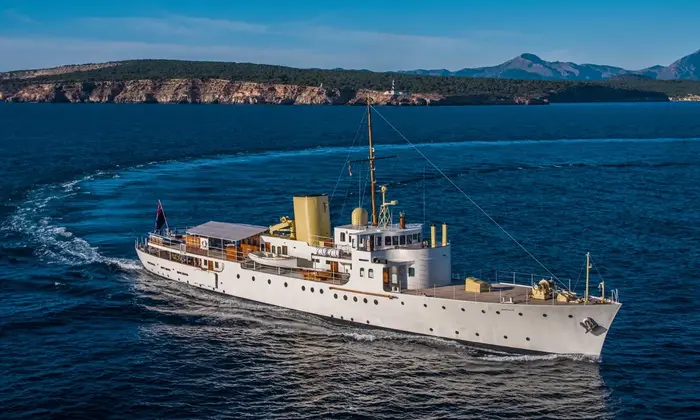
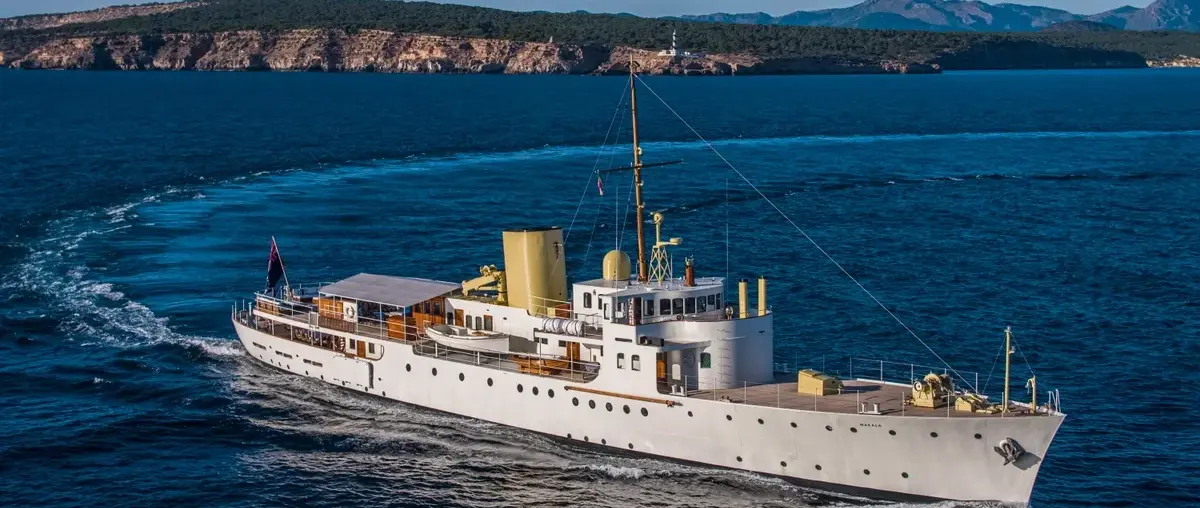
Built by Camper & Nicholsons in 1931, Marala later served the Royal Navy as the anti-submarine yacht Evadne. Her survival, original machinery and extensive Pendennis restoration make her one of the most compelling operational classics of the pre-war era.
Few large motor yachts from the early 1930s survive with the degree of physical and historical continuity found aboard Marala. Built by Camper & Nicholsons in 1931, she has passed through private ownership, wartime naval service and an extensive modern restoration while remaining recognisably connected to the yacht that left the British yard more than nine decades ago.
Pendennis records Marala at 58.83 metres overall, with an 8.08-metre beam and a 3.96-metre draft, and identifies Charles E. Nicholson as the designer of her original exterior. Her long sequence of names — including No. 388, Evadne, HMS Evadne, Zapala and Gaviota IV — provides an unusually visible record of the different lives that one yacht can accumulate.
What makes Marala especially important is that the survival is not merely cosmetic. Pendennis says her basic layout and original engines endured through much of her history, giving the restoration team something far rarer than a historic profile to reproduce: substantial physical continuity with the original vessel.
Marala emerged from Camper & Nicholsons during a period when substantial private motor yachts were becoming increasingly capable ocean-going vessels rather than enlarged coastal craft. Her proportions remain characteristic of that era, with a long, low hull, restrained superstructure and comparatively narrow beam producing a profile quite different from the high-volume motor yachts that dominate the modern market.
The yacht nevertheless changed repeatedly as owners adapted her to new expectations and new uses. Pendennis records alterations to both her superstructure and interior over the decades, while the most consequential transformation came when the yacht entered naval service during the Second World War.
Royal Navy records provide direct contemporary evidence of that wartime chapter rather than relying only on later yacht histories. The Admiralty War Diary for 16 March 1941 records an intention to augment South Irish Sea escorts by employing Troubadour and Evadne, demonstrating that the former private yacht had been drawn into the practical work of protecting wartime shipping.
Her role later extended beyond British home waters. On 19 December 1943 the Royal Navy War Diary identified her specifically as the anti-submarine yacht Evadne and recorded that she was being reallocated to the Commander-in-Chief Mediterranean, with Gibraltar designated as her base and passage requested via the Azores.
Those entries are important because they place the yacht within the operational record of the war rather than simply attaching a naval title to her biography. Marala therefore survives as a physical link between pre-war private yachting and the wartime practice of adapting civilian vessels to military requirements.
After the war the vessel returned to private life and subsequently carried the names Zapala and Gaviota IV before becoming Marala. Pendennis describes her as having had unusually few owners for a yacht of her age, a circumstance that helped preserve elements of her character, arrangement and machinery through periods when many comparable yachts were radically rebuilt or disappeared entirely.
When she came onto the market in 2016, Pendennis says it was the first time she had been offered for sale in more than half a century. Her new owner chose not to turn the yacht into a modern vessel concealed inside a historic silhouette, but instead commissioned a restoration intended to preserve the qualities that made the surviving yacht distinctive.
Marala arrived at Pendennis in Falmouth in August 2019 after earlier preparatory work in Malta. She entered the yard's inner dry dock for what became a two-and-a-half-year programme involving structural investigation, a Lloyd's special survey and the detailed coordination of engineering work with a completely reconsidered interior.
The structural programme proved extensive, with Pendennis reporting that more than 100 tonnes of steel were renewed, predominantly in the hull. At the same time, the decision was made to leave the hull unfaired so that the finished yacht would retain the visual character of her historic construction rather than acquiring the perfectly smooth surface expected of a new yacht.
The restoration also involved comprehensive renewal of domestic and electrical systems, pipework, ducting, cabling, lighting and associated hardware. Her auxiliary generators were rebuilt, the emergency generator was replaced by a battery-based system, and both hydraulic and original manual steering arrangements received extensive work.
Externally, some changes accumulated during the 1950s and 1960s were removed so that the yacht's profile could move closer to its 1930s form. Internally, Muza Lab worked from historical material and original design information, creating a new interior that references different periods in Marala's life without attempting to turn the yacht into a static museum reconstruction.
Preservation remained central to the project even while major systems were renewed. Pendennis retained as much original timber as practicable, preserved significant riveted construction and kept the rebuilt original engines, allowing modern engineering work to coexist with material that connects the yacht directly to her earlier life.
The major restoration was completed in 2022, after which Marala moved to Pendennis' Mediterranean facility in Vilanova. Pendennis subsequently records the project as the winner of the Rebuilt Yacht category at the 2023 World Superyacht Awards, recognition of a project whose challenge lay as much in deciding what not to replace as in the scale of the engineering work itself.
Marala's importance is not based on size records or a single famous owner. Her significance comes from continuity across radically different periods of maritime history: a 1930s private motor yacht became a wartime anti-submarine vessel, returned to private service and then survived long enough to undergo a preservation-led restoration using twenty-first-century engineering.
She is also a reminder that historic-yacht conservation does not necessarily mean permanent preservation alongside a quay. Marala remains an operational yacht, so the restoration had to reconcile heritage with the safety, reliability and comfort expected of a vessel that would continue going to sea.
That combination makes Marala a natural addition to Superyacht Guide's Historic Yachts archive. Her Fleet profile preserves the structured record of her builder, dimensions, aliases, designers and sources, while her history shows why those data points matter when viewed across almost a century of changing use.
Explore
Go deeper into the yachts, companies, events and destinations directly connected to this article.
Company
Explore the company profile and related Superyacht Guide coverage.
Continue reading
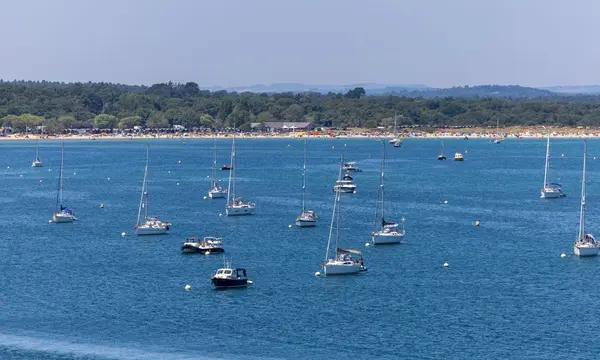
Five years of Studland Bay monitoring found average bare-seabed scars shrank 93.6% around trial eco-moorings, offering evidence for better yacht anchoring practices.
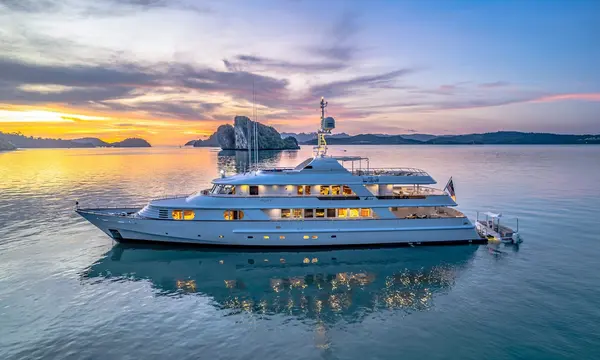
The 48.2m CRN-built AZUL V features in the October 12 premiere of Below Deck Season 13, filmed around Phuket, connecting a working charter yacht …
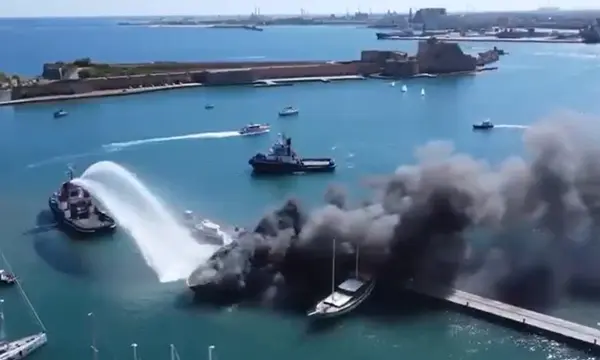
The 30m Sanlorenzo motor yacht JOHN was badly damaged by fire on 3 October at Marina di Brindisi; no injuries were reported among crew …
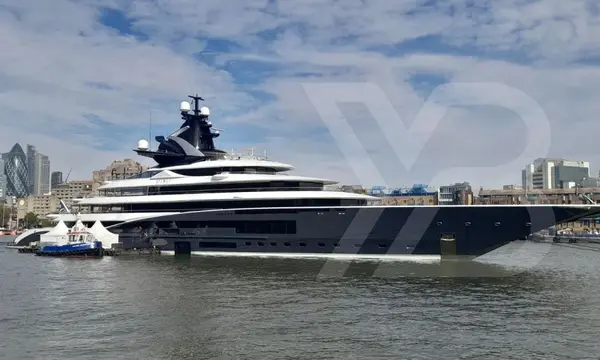
The 122-metre Lürssen superyacht Kismet has returned to central London, mooring near Tower Bridge for a third consecutive autumn visit.
Superyacht Guide
Continue into the wider Superyacht Guide.
Business opportunities · Superyacht Guide
Companies serving the superyacht market can discuss clearly identified advertising, sponsorship and business-profile opportunities. Commercial activity remains separate from independent editorial coverage.