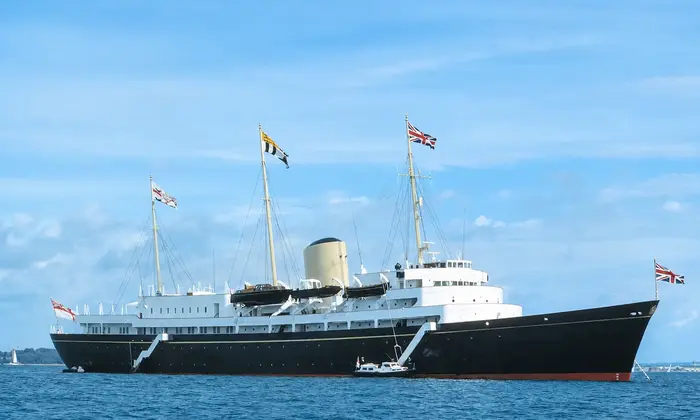
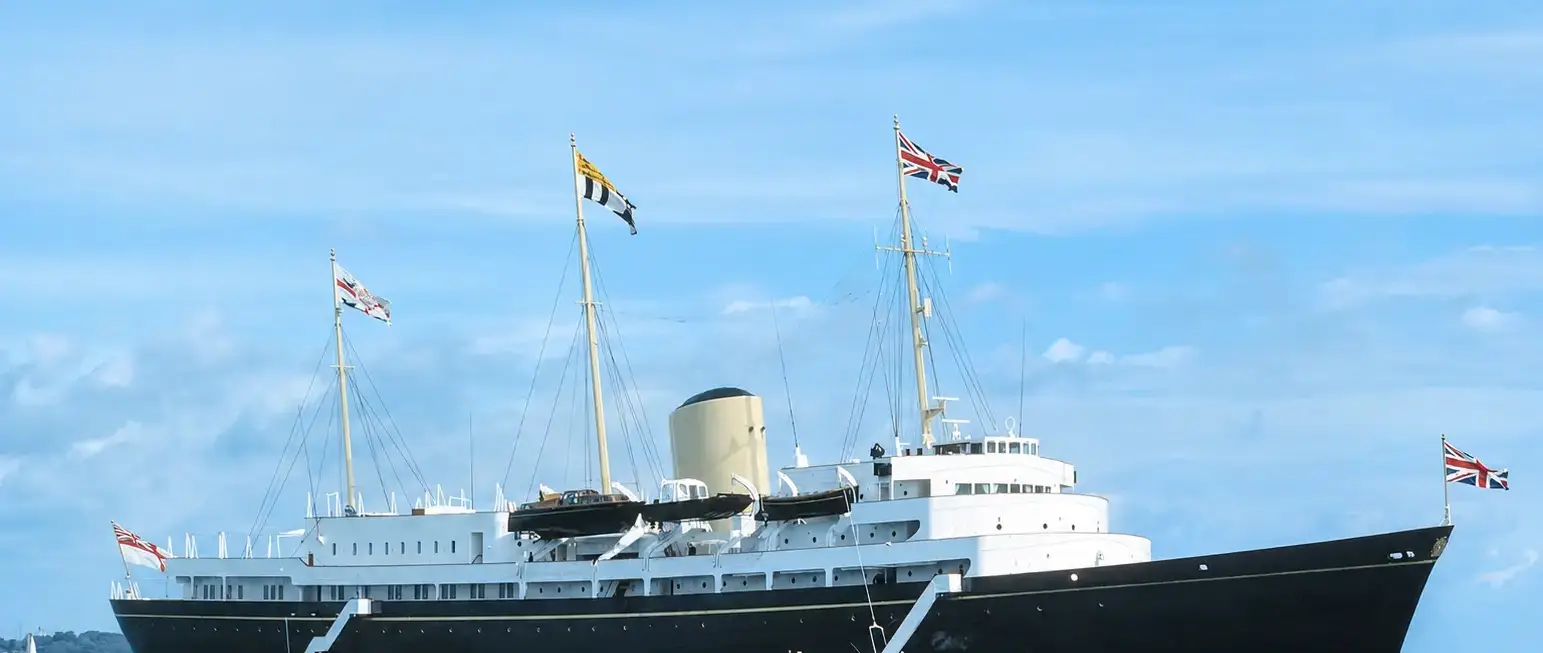
HMY Britannia carried Queen Elizabeth II and the Royal Family around the world for more than four decades, combining the roles of royal residence, naval vessel and diplomatic platform. Built for global service rather than spectacle, she sailed more than one million nautical miles and became one of the defining yachts of the twentieth century.
There are yachts remembered because they were the largest of their age, others because they were exceptionally beautiful, and a smaller group whose significance came from the lives and events that unfolded aboard them. Her Majesty’s Yacht Britannia belongs firmly in the last category, although at roughly 126 metres she was also a very substantial vessel by any standard.
For more than four decades, Britannia served Queen Elizabeth II, the Royal Family and the British state. She crossed oceans, hosted presidents and prime ministers, carried generations of the Royal Family on private holidays and honeymoons, promoted British industry overseas and, on one extraordinary occasion, became an evacuation ship during a civil war.
By the time she was decommissioned in 1997, Britannia had travelled 1,087,623 nautical miles. Royal Collection Trust records show that she had undertaken 696 foreign visits and another 272 visits in British waters, while the yacht's official history records calls at more than 600 ports in 135 countries.
Her significance to yacht history goes beyond royalty. Britannia was conceived as a true ocean-going residence capable of taking its occupants almost anywhere in the world, combining comfort, privacy, seaworthiness, communications, security and ceremonial capability in a way that anticipates many of the requirements now taken for granted aboard large modern superyachts.
The origins of Britannia stretched back before the Second World War. The Admiralty had considered replacing the ageing Victoria and Albert III in 1938, with plans for a new vessel capable of serving both as a Royal Yacht in peacetime and as a hospital ship during war, but the outbreak of hostilities caused the project to be abandoned.
The concept was revived in 1951. Britain wanted a new yacht with genuine ocean-going capability, able to operate in both tropical and Arctic conditions while also being capable of relatively rapid conversion into a wartime hospital ship.
King George VI approved the developing plans, but he died on 6 February 1952, just two days after John Brown & Company received the Admiralty order to build the vessel. The responsibility for the new Royal Yacht therefore passed to the young Queen Elizabeth II at the very beginning of her reign.
The keel was laid at John Brown & Company in Clydebank in June 1952. The yard was one of Britain's great twentieth-century shipbuilders and had already produced the liners Queen Mary and Queen Elizabeth, giving it considerable experience in constructing large prestige vessels intended for international service.
Britannia was launched on 16 April 1953. In keeping with the austerity of post-war Britain, Queen Elizabeth II christened her with Empire wine rather than Champagne before announcing the name that had until then been kept secret.
Building continued after the launch, followed by sea trials off western Scotland beginning in November 1953. Britannia was formally commissioned into the Royal Navy on 11 January 1954, and on 22 April entered Malta's Grand Harbour on her first overseas call.
Britannia's original technical paper reveals a vessel conceived far more seriously than the expression “royal yacht” might suggest. She measured 412 feet 3 inches overall, approximately 125.7 metres, with a beam of 55 feet, a load displacement of 4,715 tons and a gross tonnage recorded at the time as 5,769 tons.
Her machinery developed 12,000 shaft horsepower through two sets of geared steam turbines driving twin shafts. The design provided a continuous seagoing speed of 21 knots, while trials produced more than 22 knots despite difficult weather.
The engineering priorities would be immediately recognisable to a modern yacht designer. Noise and vibration were treated as major concerns because Britannia had to function as a residence as well as a ship, and the Admiralty undertook extensive modelling and propeller work to minimise vibration transmitted into the accommodation.
Even the choice of four-bladed propellers reflected the emphasis on comfort. The designers accepted a small theoretical loss of speed because calculations suggested the arrangement would reduce the risk of objectionable hull vibration, a trade-off between outright performance and onboard refinement that remains central to large-yacht engineering today.
She was also expected to be genuinely self-sufficient. Britannia carried substantial fresh-water capacity and was fitted with evaporators capable of producing around 120 tons of distilled water in a 20-hour day, while extra fuel capacity gave her an estimated endurance of approximately 3,560 miles at an economical 15 knots.
Those figures illustrate an important point about her design. Britannia was not simply a ceremonial vessel intended to move between nearby ports; she was constructed to undertake sustained ocean passages while continuing to function as a royal residence and centre of state business.
The exterior carried all the ceremony expected of a Royal Yacht, but the interior was intentionally restrained. Queen Elizabeth II and Prince Philip had final approval over the design of the Royal Apartments, and the post-war economic climate strongly influenced the result.
Sir Hugh Casson was brought in to advise after earlier interior proposals were considered too lavish. The resulting spaces were elegant but comparatively informal, closer in character to an English country house than to the more exuberant interiors associated with many modern large yachts.
Britannia's distinctive dark-blue hull was itself a personal choice. The colour was inspired by Bluebottle, the Dragon-class racing yacht given to Queen Elizabeth and Prince Philip as a wedding present, linking the great Royal Yacht visually with the family's much smaller sailing yacht.
The State Apartments nevertheless had to support diplomacy on a remarkable scale. Britannia became a venue in which monarchs, presidents, prime ministers and other international figures could be received while the ship was thousands of miles from Britain.
The State Dining Room was at the centre of that role. Among those entertained aboard during Britannia's career were figures including Winston Churchill, Margaret Thatcher, Nelson Mandela, Ronald Reagan, Bill Clinton and Boris Yeltsin, while gifts acquired on state visits gradually became part of the ship's decoration.
Yet Britannia was also intensely personal. Queen Elizabeth II regarded the vessel as a rare refuge from public life and described it as the place where she could truly relax, while family holidays aboard often took the yacht to the Western Isles of Scotland and other relatively private cruising grounds.
Four royal honeymoons were spent aboard, beginning with Princess Margaret and Antony Armstrong-Jones in 1960. The ship could therefore move almost seamlessly between state ceremonial duties and the role modern owners would recognise as a highly private family yacht.
Britannia's polished public appearance depended on an unusually large naval organisation. Her standard complement included 20 officers and around 220 Royal Yachtsmen, the sailors universally known aboard as the “Yotties”, with personnel specially selected for service on the vessel.
Their working culture was exceptionally demanding. Maintaining the yacht involved everything from daily care of the thick teak decks and polished metalwork to arranging flowers, operating the laundry and supporting state banquets, while the Royal gangway was even required to be presented within a specified maximum angle.
Many Yotties became deeply attached to the ship. A significant proportion served for long periods, and promotion could be slow because personnel sometimes preferred remaining aboard Britannia to accepting advancement that would require transfer to another Royal Navy vessel.
The contrast between the Royal Apartments and crew accommodation also makes Britannia particularly interesting when viewed through the lens of today's superyacht industry. The yacht delivered extraordinary standards of service at the guest end while remaining unmistakably a naval ship below decks.
More than 3,000 officers, ratings and Royal Marines bandsmen served aboard over the yacht's career. The Association of Royal Yachtsmen records 3,296 people connected with her service between January 1954 and December 1997.
The ship operated according to traditions rarely encountered on modern yachts. Official Britannia material records that shouting was prohibited and that orders could instead be conveyed by hand signals in order to preserve the tranquillity expected aboard the Royal Yacht.
One of Britannia's most remarkable characteristics was largely invisible during ordinary royal service. From the beginning she had been designed so that, in wartime, she could be converted into a hospital ship for approximately 200 patients.
This requirement influenced much of her engineering and internal arrangement. Stabilisation, air conditioning, unusually extensive laundry capacity and her relatively high speed were all considered valuable to the hospital role and were incorporated during construction because adding them after the outbreak of war would have been expensive and slow.
The transformation envisaged by the designers was extensive. Royal accommodation would become wards, parts of the drawing room could accommodate isolated infectious-disease patients, the Royal bedrooms were intended for additional hospital use, and a full operating theatre and specialist medical spaces were planned on the lower deck.
Britannia was never converted into that hospital configuration. The fact that it was engineered into the vessel from the beginning, however, explains why some apparently unusual elements of her layout and machinery existed and underlines how differently she had been conceived from a purely pleasure-driven yacht.
Her secondary humanitarian capability was nevertheless tested dramatically in January 1986. Civil war in South Yemen led Britannia to divert to Aden, where her status as a non-combatant Royal Navy vessel allowed her to participate in an evacuation without further escalating the conflict.
Britannia evacuated 1,068 men, women and children representing 55 nationalities before continuing toward New Zealand. Despite the diversion, the Royal Yacht arrived only one day behind schedule, an episode that demonstrated the practical capability concealed beneath her ceremonial role.
Britannia's value to Britain was not confined to transporting the sovereign. For decades she functioned as a mobile diplomatic venue capable of bringing a recognisably British royal environment directly into overseas ports.
That had important practical advantages. State dinners, receptions and meetings could take place aboard what was effectively a mobile royal residence, while the yacht could move between countries without recreating the entire apparatus of a royal household ashore.
The vessel also became closely associated with British trade promotion. So-called Sea Days brought business leaders and political figures aboard during overseas deployments, using the prestige and controlled environment of Britannia to showcase British industry.
The yacht's official historical record says the Overseas Trade Board estimated that commercial activity associated with Britannia generated £3 billion for the Exchequer between 1991 and 1995 alone. Whatever figure is placed on the wider effect, the programme demonstrates that Britannia was consciously employed as an economic as well as diplomatic asset.
This aspect makes her especially relevant to modern superyacht history. Today's largest yachts can also function as private offices, meeting spaces and platforms through which owners conduct business internationally, but Britannia institutionalised that role on behalf of a state decades before the modern megayacht became commonplace.
Britannia's real distinction was ultimately the intensity with which she was used. Her official service amounted to almost 44 years of repeated long-distance deployment rather than a ceremonial existence spent largely alongside.
National Historic Ships records 1,087,623 nautical miles over 43 years and 334 days. The official Britannia history describes that achievement as roughly equivalent to travelling around the world once for every year she was in service.
Her geographical reach was extraordinary. Britannia operated across the Caribbean, Americas, Africa, Pacific, Antarctic regions and many of the Commonwealth countries that played a central role in Queen Elizabeth II's reign.
She also became part of recurring royal traditions closer to home. Britannia attended Cowes Week from 1955 until 1996 in connection with Prince Philip's participation in the regatta, linking the enormous state yacht with Britain's much older culture of competitive and recreational yachting.
Royal Collection Trust's total of 968 official visits — 696 abroad and 272 in British waters — gives some indication of the workload involved. These were not simply voyages from one marina to another, but carefully orchestrated movements involving diplomacy, security, naval operation, formal entertaining and an extensive royal household.
By the 1990s Britannia was approaching the end of a long working life and faced the prospect of a costly major refit. On 23 June 1994, John Major's government announced that no further refit would be authorised and that the yacht would be withdrawn from service.
The question of whether Britain should build a replacement subsequently became politically contentious. Following the 1997 general election, the new Labour government confirmed that Britannia would not be replaced, bringing to an end the succession of British royal yachts that stretched back to the reign of Charles II in 1660.
Britannia made a farewell voyage around Britain beginning in October 1997. When she passed the former John Brown yard on the Clyde, she sounded her sirens in salute to the shipyard that had built her more than four decades earlier.
Her decommissioning ceremony took place at Portsmouth on 11 December 1997 in the presence of Queen Elizabeth II, Prince Philip and other members of the Royal Family. Britannia's clocks were stopped at 15:01, the moment the Queen was piped ashore from her yacht for the final time.
The ceremony became one of the most memorable public moments associated with the vessel. As the Royal Marines played Highland Cathedral, Queen Elizabeth II was visibly emotional at the retirement of a ship that had been both an instrument of her reign and a family home for almost its entire duration.
Britannia arrived in Leith, Edinburgh, on 5 May 1998 and opened to visitors on 19 October that year. She is now permanently preserved there by The Royal Yacht Britannia Trust and is included in Britain's National Historic Fleet.
Much of what visitors see remains authentic to the vessel's working career. Furniture, paintings, photographs and artefacts in the Royal Apartments are largely original and remain aboard through arrangements with the Royal Collection.
Preservation matters because Britannia documents a form of yachting that has effectively disappeared. She was simultaneously a Royal Navy vessel, sovereign residence, family yacht, international diplomatic platform, potential hospital ship and global transport system for one of the most travelled monarchies in history.
She also occupies an intriguing position in the development of the modern large yacht. Britannia was not called a superyacht in the contemporary sense and should not be retroactively reduced to that label, yet many of the design problems she solved are the same ones confronting today's largest private vessels: long-range autonomy, low noise and vibration, multiple guest and crew zones, communications, security, formal entertaining and the ability to operate as a self-contained residence far from home.
Modern yachts have surpassed Britannia in volume, technology and luxury, but relatively few have matched the range of duties expected of her. She had to be comfortable enough for private family life, imposing enough for a state banquet, robust enough for ocean passages and sufficiently adaptable to become a 200-bed hospital if Britain went to war.
That combination is why Royal Yacht Britannia deserves a central place in any history of important yachts. Her significance rests not merely in who owned her, but in what a large yacht could be made to do when design, naval discipline, diplomacy and private life were brought together within a single 126-metre ship.
Explore
Go deeper into the yachts, companies, events and destinations directly connected to this article.
Continue reading
Bilgin Yachts’ 80-metre Al Reem has won the Motor Yacht Over 60 Metres category at the 2026 Design et Al International Yacht & Aviation …
An owners association continues to preserve and operate wooden boats built by the Huisman yard between 1884 and 1943.

Royal Huisman has highlighted the 2026 winners of the Conny van Rietschoten Trophy, named after the Dutch offshore sailor behind the Flyer programme.
Royal Huisman is marking 50 years since Conny van Rietschoten commissioned the first Flyer, beginning a landmark chapter in offshore racing history.
Superyacht Guide
Continue into the wider Superyacht Guide.
Business opportunities · Superyacht Guide
Companies serving the superyacht market can discuss clearly identified advertising, sponsorship and business-profile opportunities. Commercial activity remains separate from independent editorial coverage.