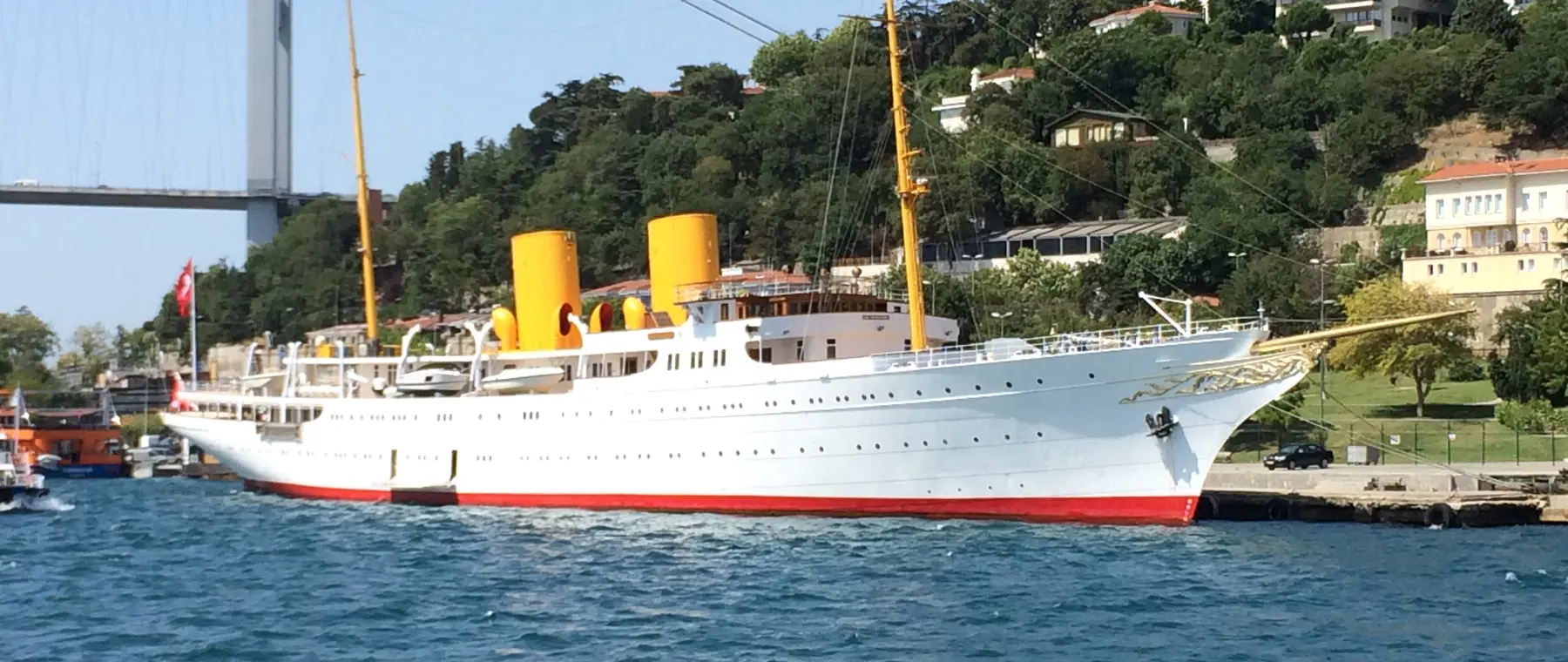
Built in Hamburg in 1931, Savarona became Mustafa Kemal Atatürk’s presidential yacht in 1938, later served as a naval training ship and returned to state service after a major restoration.
Savarona belongs to a small group of yachts whose importance extends far beyond design or size. Built in Hamburg in 1931 for American heiress Emily Roebling Cadwallader, the 136-metre vessel later became the presidential yacht of Mustafa Kemal Atatürk and ultimately a surviving state symbol of the Turkish Republic.
Her story spans private interwar luxury, presidential service, naval training, commercial restoration and a return to state ownership. Few yachts of her era have remained so closely connected to national history while also surviving as an operational vessel.
The Republic of Türkiye Ministry of Culture and Tourism records that Savarona was commissioned by Emily Roebling Cadwallader and built by Blohm & Voss in Hamburg in 1931. The same government account gives an overall length of 136 metres, a beam of 16 metres and a maximum speed of 18 knots, dimensions that made her exceptional among privately owned yachts of the period.
Cadwallader used Savarona in Atlantic, Mediterranean and South African waters, but high American import duties complicated bringing the German-built yacht into the United States. She was eventually offered for sale, creating the opportunity for the Turkish government to acquire the vessel in 1938 as a new presidential yacht.
Turkey bought Savarona as Atatürk's health was deteriorating and the older state yacht Ertuğrul was no longer considered suitable. The Ministry of Culture and Tourism records that the Turkish flag was raised aboard Savarona in Southampton in March 1938 before the yacht reached Istanbul two months later.
The timing gave the new presidential yacht a significance no designer or owner could have planned. Savarona became one of the principal places from which Atatürk continued to work during the final months of his life, turning a recently acquired luxury vessel into part of the documentary landscape of the early Turkish Republic.
Official Turkish sources record cabinet work, state visitors and voyages aboard Savarona during the summer of 1938. The Ministry of National Defence chronology records Atatürk travelling aboard Savarona from Istanbul to Erdek on 24 June before departing for Istanbul again that evening.
The Atatürk Research Center also records his meeting aboard Savarona with Romania's King Carol during the Sudeten crisis. The Ministry of Culture and Tourism notes that cabinet meetings were held on board before Atatürk left the yacht and later died at Dolmabahçe Palace on 10 November 1938.
Savarona's association with the Turkish state did not end with Atatürk. After the Second World War, the Turkish Navy used the yacht as a training ship, extending her role from presidential transport into the education and formation of generations of naval personnel.
By the late twentieth century, however, the future of the ageing vessel had become uncertain. The government history records that scrapping was considered in 1989 before businessman Kahraman Sadıkoğlu secured a 49-year lease and began a major refurbishment that returned Savarona to active cruising.
A new chapter began when Savarona was transferred to the Turkish Naval Forces Command under state status on 17 August 2023. According to the Republic of Türkiye Directorate of Communications, Istanbul Naval Shipyard then carried out a nine-month programme intended to preserve the yacht's historic character while modernising essential systems.
The work was far more than cosmetic: the government says 80 tonnes of asbestos were removed, while hull, machinery, navigation and electrical systems were repaired and internal deck plating, fuel tanks and water tanks were renewed. Furniture was restored with the stated aim of remaining faithful to the yacht's original character, and full-speed trials subsequently reached 17.2 knots.
The 2023 transfer and subsequent restoration changed Savarona's status once again, bringing a vessel that had spent decades under a long-term private lease back under the Turkish Naval Forces Command. The September 2024 government account describes the yacht after the nine-month programme as modernised while retaining her historic character, rather than being converted into an unrelated contemporary vessel.
That distinction matters for a ship so closely tied to Atatürk's final months. Preserving the furniture and historic identity while renewing machinery, navigation, electrical and structural systems allows Savarona to remain a functioning vessel without separating her operational future from the history that gives her national significance.
Historic yachts often survive by losing much of the purpose that originally defined them, becoming static museum pieces or heavily altered private vessels. Savarona is unusual because her history has repeatedly changed her purpose while the Turkish state has continued to treat the ship itself as an object of national memory.
From Emily Roebling Cadwallader's immense private yacht to Atatürk's presidential vessel, a naval training ship and a restored state vessel, Savarona has accumulated identities rather than replacing them. Her survival demonstrates why the most important historic yachts are not simply old ships: they are physical witnesses to the political, technological and social worlds through which they have passed.
Explore
Go deeper into the yachts, companies, events and destinations directly connected to this article.
Continue reading
Superyacht Summit Türkiye returns to The Peninsula Istanbul on 4–5 November 2026 with a developing programme spanning markets, yacht-project delivery, brokerage, design, destinations and …
Superyacht Summit Türkiye’s latest Industry Insight Series turns to two themes gaining importance across the sector: the legal structures behind yacht ownership and the …
Five years of Studland Bay monitoring found average bare-seabed scars shrank 93.6% around trial eco-moorings, offering evidence for better yacht anchoring practices.
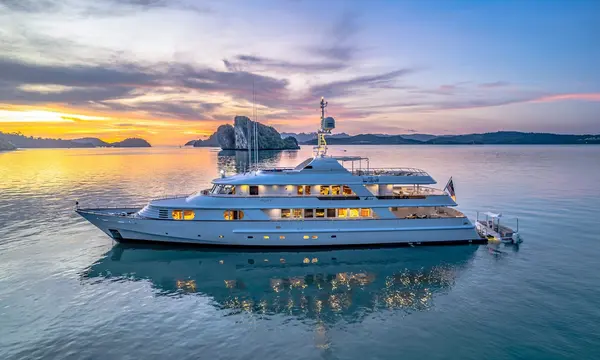
The 48.2m CRN-built AZUL V features in the October 12 premiere of Below Deck Season 13, filmed around Phuket, connecting a working charter yacht …
Superyacht Guide
Continue into the wider Superyacht Guide.
Business opportunities · Superyacht Guide
Companies serving the superyacht market can discuss clearly identified advertising, sponsorship and business-profile opportunities. Commercial activity remains separate from independent editorial coverage.