Published in March 2026, ISO/TS 23099 creates a common methodology for assessing the operational energy-related environmental performance of yachts 30 metres and longer.
A dedicated environmental benchmark for the large-yacht fleet
The International Organization for Standardization published ISO/TS 23099:2026 in March, creating a technical methodology specifically concerned with the environmental performance of yachts at least 30 metres in length. The specification addresses a long-standing difficulty for owners, yards and designers: how to compare the energy-related impact of vessels that differ substantially in size, propulsion, equipment and operating profile.
The specification was developed through ISO's large-yacht technical committee with input from industry work including the Water Revolution Foundation's Yacht Environmental Transparency Index, or YETI. Publication in March is a completed 2026 milestone, not an October announcement or a mandatory new classification certificate for every yacht. Its significance lies in establishing a common basis for analysis.
Why commercial shipping methods do not always fit
A superyacht can spend much of its time alongside or at anchor, maintaining hotel services rather than travelling at a constant commercial speed. Air conditioning, generators, lighting, pools and entertainment systems may impose significant energy demand even when the propulsion engines are not running. Methods designed around cargo transportation or miles travelled can therefore give a misleading picture of yacht operation.
ISO/TS 23099 defines a reference operational profile appropriate to professionally crewed large yachts capable of independent long-distance voyages. It enables comparable calculations without treating differences in how individual owners use their yachts as intrinsic characteristics of the design. The resulting figures are intended to support informed engineering comparisons.
What the method assesses
According to ISO's published abstract, the technical specification covers the environmental effects of operational energy consumption. This includes emissions associated with producing energy and with its use aboard, rather than only exhaust measured at the yacht. It combines the effects of the vessel's machinery and hotel systems within a coherent methodology.
Those boundaries matter. The specification does not claim to calculate the complete environmental footprint of every yacht. Manufacturing materials, maintenance processes and eventual disposal are outside its stated scope, as are variations arising solely from an individual owner's travel choices. A score should not be represented as proof that a vessel has no other environmental impacts.
How yachts with different equipment can be compared
The standard allows a vessel's performance to be assessed against a defined reference fleet. That requires engineering inputs appropriate to the systems aboard: propulsion characteristics, power generation, electrical loads and other relevant energy flows. The aim is not to impose one design solution but to provide a consistent way of understanding how different arrangements influence the result.
A large sailing yacht, for example, may have a different propulsion profile from a motor yacht of similar length, while the volume and onboard amenities can influence hotel demand. Meaningful comparisons need to reflect these distinctions rather than treating length alone as an adequate predictor of environmental performance.
Why design and refit teams should examine it
A common assessment method can help a naval architect study whether a proposed propulsion architecture, heat recovery system or reduction in hotel demand could improve the yacht's calculated impact. At the design stage, choices can still be changed before they become expensive structural and machinery commitments.
For an existing vessel, the same framework can support discussions about upgrades. A manager considering battery storage, more efficient cooling or generator changes can compare options using consistent assumptions rather than unrelated manufacturers' marketing figures. The final decision must still account for installation cost, weight, maintenance access and the actual operating plans of the yacht.
Understanding the YETI relationship
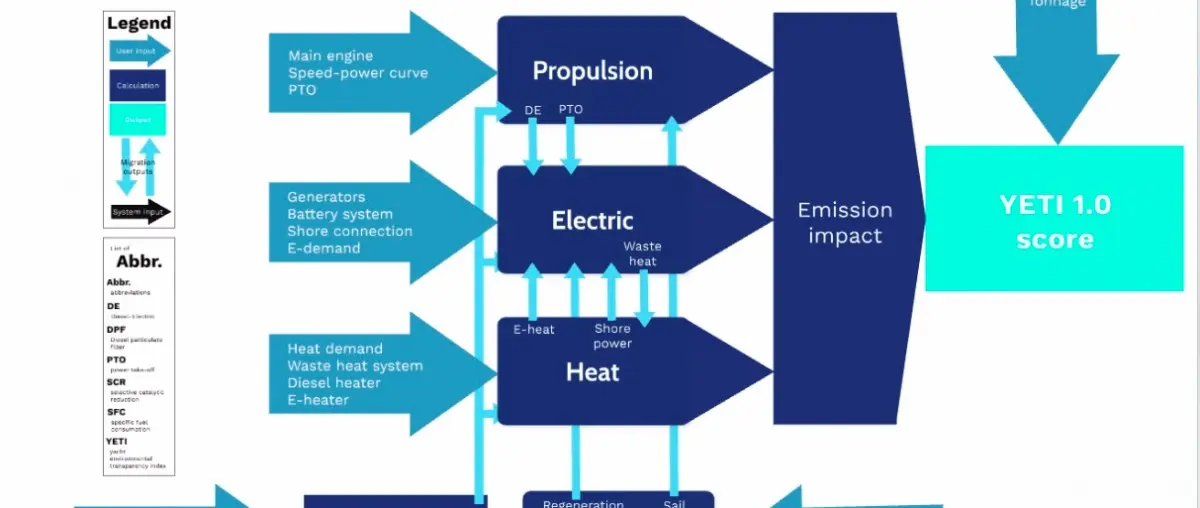
Water Revolution Foundation described the ISO project as building on several years of joint industry work around YETI. Its published account identifies a representative operational pattern of 10 per cent cruising, 34 per cent at anchor and 56 per cent in port, illustrating why the sector requires a different baseline from many forms of commercial transport.
The accompanying image is the Foundation's earlier YETI 1.0 methodology diagram, reproduced here as background to the approach that helped inform the international work. It should not be mistaken for a diagram of every calculation in the final 2026 ISO document, which is a separately published technical specification.
What the standard does not establish
The existence of an internationally recognised methodology is not evidence that every yacht has already been evaluated or that its data has been independently verified. Engineers must obtain suitable input values, document assumptions and perform the calculations correctly. Some yachts may require additional measurements before their performance can be assessed with confidence.
Nor does publication of a technical specification automatically impose a legal requirement on every privately operated yacht. Owners and builders should confirm any relevant flag-state, class or contractual obligations separately. Voluntary benchmarking can still provide value even where no specific regulatory assessment has been mandated.
A step toward evidence-based superyacht comparisons
With ISO/TS 23099 now published, the industry has a recognised reference for discussing the energy-related environmental performance of 30-metre-plus yachts. That could make the evidence behind design claims easier to examine and help distinguish genuine engineering progress from broad statements about sustainability.
The next challenge is practical adoption: obtaining reliable equipment data, using the same assumptions, and explaining the results clearly to owners and operators. For Superyacht Guide readers, the key development is that a common technical framework exists, while the accuracy and meaning of any particular yacht's result will continue to depend on the quality of the underlying assessment.