MarQuip's documented project with Dutch manufacturer Versteden shows why three large DN800 yacht exhaust water-lift separators must be fabricated in seven sections and bonded inside an 80m-plus vessel.
A major machinery component that cannot fit through the door
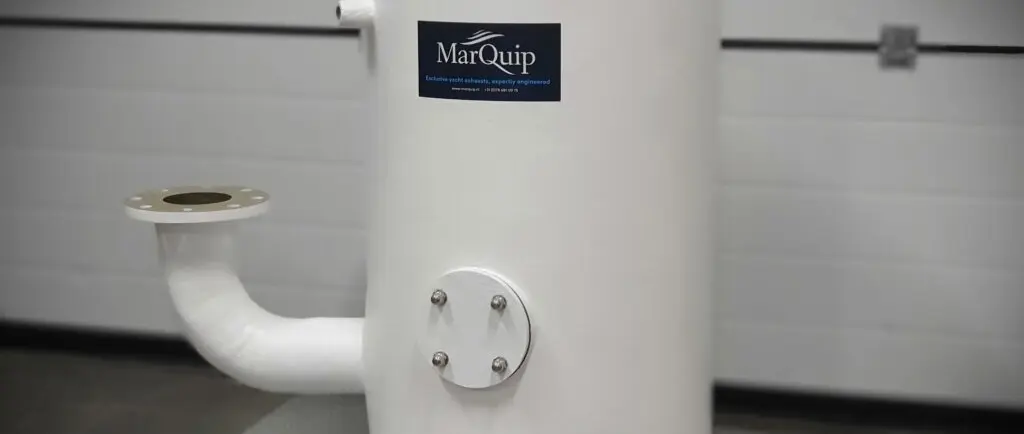
Superyacht exhaust specialist MarQuip has documented an engineering challenge involving three large DN800 water-lift separators for a yacht exceeding 80 metres. Working with Dutch composites supplier Versteden, the company selected an unusual installation approach: manufacturing each separator as seven separate sections that can pass through the vessel's restricted access routes before being bonded together in the engine room.
The example was described by MarQuip in October 2025 and remains a useful technical case study as the supplier returns to METSTRADE 2026. It is not a newly announced October 2026 build, and the client vessel was not named publicly in the company's account. The story illustrates how the dimensions of large-yacht machinery, access constraints and long-term service requirements can affect equipment design.
What the water-lift separator does
Wet exhaust systems use seawater to cool hot engine exhaust gases before discharge. Depending on the vessel's architecture, a separator can then divide water from the cooled gas stream so that the two can follow different outlet arrangements. MarQuip describes its components as part of an integrated exhaust system designed to manage gas movement, cooling, water separation and noise.
For a superyacht engineer, exhaust components are critical machinery rather than purely acoustic accessories. A poorly designed arrangement can introduce excessive back pressure, inadequate drainage or maintenance problems that affect the reliability of the engine and the safety of the machinery space. Equipment therefore needs to be selected against the actual engine characteristics and piping geometry.
Why the DN800 dimension matters
The DN800 designation identifies a large nominal diameter associated with the water-lift separators described in the project. Components of that scale can be difficult to transport inside a completed yacht, particularly around narrow passageways, access hatches, structural frames and fixed machinery. The shape of a large separator can make the installation challenge greater than its weight alone would suggest.
A yard may have sufficient room for the equipment once it reaches its final position but no practical route for delivering a completed assembly through the vessel. Moving a structure of that size may otherwise require opening surrounding bulkheads or removing expensive installed equipment, increasing cost and disrupting the yacht's build or refit programme.
Seven sections create a different installation strategy
MarQuip says its partner Versteden was manufacturing three separators in seven sections apiece, allowing the major parts to be transferred through constrained engine-room access and bonded together at their final location. The approach shifts some of the work from the manufacturer's workshop to the vessel, where joint preparation, alignment and controlled bonding become essential.
Such modular assembly requires detailed engineering. Joint design must account for the intended mechanical loads, temperature, vibration and exposure to cooling water and exhaust gases. The chosen bonding system should be applied under suitable conditions and inspected in accordance with the agreed fabrication procedure. A segmented design is not automatically simpler or stronger; it trades one access problem for a carefully managed on-site manufacturing operation.
Choosing the material for a wet exhaust installation
MarQuip's wet-exhaust product information promotes glass-fibre-reinforced composite material for a number of applications. It identifies corrosion resistance and the ability to manage temperature and noise among the benefits. The material is attractive where seawater and cooled exhaust gases create a harsh working environment, although exact resin and laminate specifications depend on the particular installation.
Engineering must still address the maximum temperatures, structural supports and movement transmitted from engines and hull. Material suitability cannot be inferred from a general claim that a composite is corrosion resistant. Builders and owners' representatives should require approved specifications, documented testing and a clear maintenance regime for equipment installed within critical machinery spaces.
Integrated exhaust engineering rather than an isolated purchase
MarQuip positions itself as a system integrator that works with main engine builders, emissions-technology suppliers and yards. Its engineering scope covers back-pressure calculations, exhaust cooling, noise attenuation, vibration control and the location of outlets. A water-lift separator is only one element in that chain, and its performance depends on what happens upstream and downstream.
For example, the geometry of bends and pipe runs can affect pressure loss, while the final discharge point influences the arrangement of water drains and silencers. Installing a technically impressive separator without considering the whole circuit could create new problems. The supplier's one-system approach is therefore relevant when shipyards select components from several specialist manufacturers.
Why engineering access should be decided early
On a new-build yacht, naval architects and machinery designers can preserve routes for large components before the hull and superstructure are completed. During a refit, access can be much more restrictive because decorative spaces, cabling and other machinery are already installed. The possibility of segmented equipment may reduce disruption if a suitable on-board assembly method can be approved.
The crew also needs to know how the component will eventually be inspected or replaced. A large assembly bonded in place should not obstruct access to other critical machinery, and the yard should document supports, drains, inspection points and any special procedures for future servicing. An installation that succeeds on delivery day but cannot be maintained economically may prove a poor long-term choice.
What the case study tells yacht owners and yards
MarQuip's documented example does not establish that the three separators have since been installed or successfully tested aboard the unnamed yacht; the manufacturer's original statement described production under way. Any subsequent milestones would require independent confirmation. What it does show is the value of designing equipment around the vessel's real installation constraints instead of treating the machinery space as an unrestricted factory floor.
As builders and managers prepare to meet MarQuip and other specialist suppliers at METSTRADE 2026, the underlying lesson remains relevant. Early discussion of access, system integration and serviceability can prevent costly late changes. Sophisticated superyacht engineering depends as much on planning how equipment enters and remains accessible aboard as it does on the performance of the finished component.