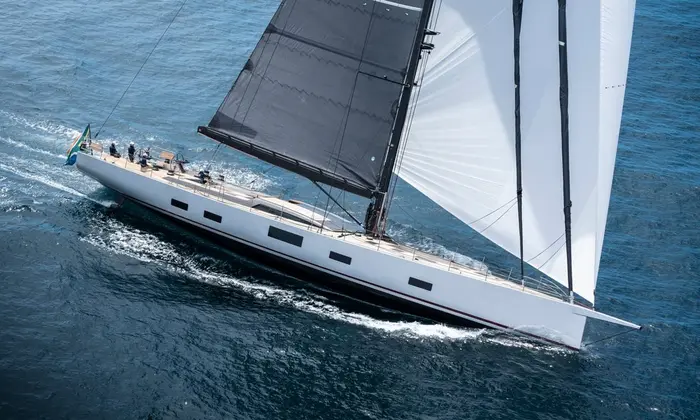
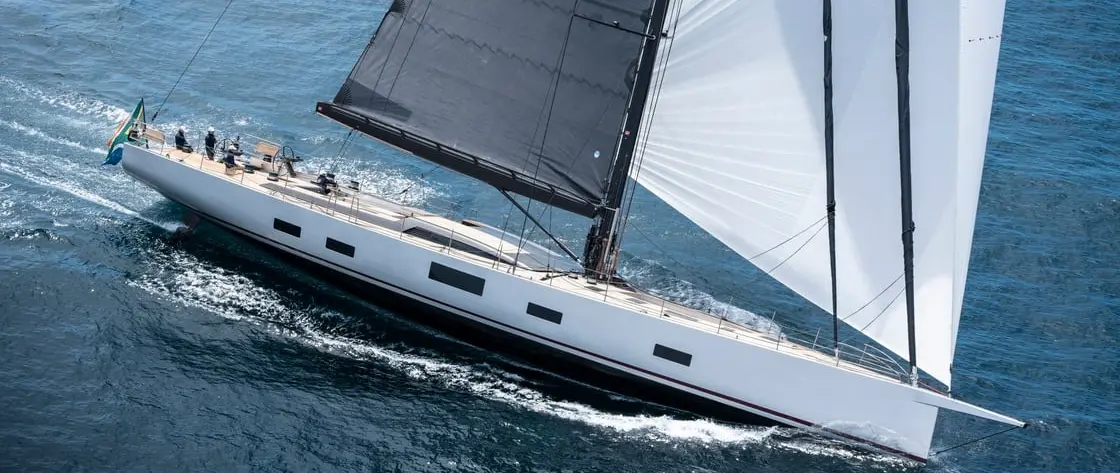
© Southern Wind Shipyard. Original 2026-03-12 press release email 641; builder-supplied editorial photo; sha256 e133ab19a6b9c12d558293521877ad
After a December 2025 launch and February 2026 delivery, Southern Wind SW108 KALANTIS left Cape Town for Palma. Her racing brief and technical design explained.
Southern Wind's March 2026 announcement gave the SW108 sailing yacht KALANTIS a new stage in her history: the completed yacht had departed Cape Town bound for her world premiere at the Palma International Boat Show. The delivery followed a December 2025 launch and a February 2026 handover, giving the crew a passage with which to begin understanding the ship beyond the yard's trials. KALANTIS is the third vessel in the SW108 Smart Custom series. She follows GELLICEAUX and KIBOKO 4, but her owner wanted a particular blend of serious racing capability and the comfort needed for long-distance travel.
The launch, delivery and public premiere should not be treated as interchangeable. KALANTIS entered the water in Cape Town in December 2025. The builder subsequently identified February 2026 as her delivery period, and its 12 March 2026 press release described her departure toward Palma. The public show presentation was scheduled for late April. Each event belongs to the same physical SW108#03 hull.
An email archive can easily make such a vessel appear to launch repeatedly if articles are created separately from every announcement without reconciling the dates. The company's corresponding CRM entries instead form a chronology. A ship launched in December can be described as newly delivered in February and publicly debuted in April without contradiction, provided every statement carries its proper date.
The Southern Wind SW108 model is described by the builder as having 32.77 metres of hull length and approximately 35.51 metres overall including the bowsprit. The maximum beam is around 7.51 metres. Those two length figures are both useful and should not be mixed casually. The long bow structure is important to the sail arrangement, while the hull measurement is often more meaningful when comparing accommodation, displacement and marina requirements.
KALANTIS has a lifting keel with a published working draft range of approximately 4.0 to 6.2 metres. Under sail, the deeper setting can contribute to performance and stability. In restricted water it may be possible to reduce draft, subject to the captain's operating procedures. This is a carefully engineered feature that requires maintenance and clear operational limits; it is not simply a switch that removes the normal constraints of navigating a large yacht.
The shipyard's original March press material says the owner wanted to pursue competitive racing while retaining the freedom to explore distant destinations. These goals can compete for design priority. Additional furniture, water and equipment increase displacement, while a racing-focused rig and underwater shape require a level of precision that may not suit an entirely relaxed cruising programme.
KALANTIS reflects a negotiated answer. Her configuration remains recognizably part of the SW108 family, but refinements to rigging, appendages and deck arrangement were evaluated against racing objectives. The owner did not need to choose between a purely stripped-out race boat and a heavy sailing residence; the project used a designed platform to seek a meaningful balance.
Farr Yacht Design worked on the sail plan and appendages, including choices related to the ORCsy measurement system. This matters because a rating environment can influence the relative value of sail area, stability and underwater configuration. Naval architects must design a yacht that performs well on the water, not merely one that looks favourable on a calculation sheet.
The original source describes a generous sail area and the benefit of good acceleration in lighter conditions, supported by high stability. The designers also considered the dimensions of a high-modulus carbon rig and EC6 carbon rigging. Such equipment can improve control of rig deformation, but it also demands careful handling and upkeep. No specific race speed can be inferred from those choices alone.
The twin-rudder arrangement is intended to help the yacht remain controllable as she heels, especially when sailing upwind or reaching. On a wide, powerful hull, a leeward rudder may continue to operate at a favourable angle while the other rudder becomes less immersed. The result can be improved helm response compared with a configuration in which one rudder is asked to work efficiently across a very wide range of heel.
The system is not self-managing. Rudder loads and the handling characteristics of the boat still depend on sail trim, sea state and speed. It can be particularly helpful to a crew that wants to race effectively without making the yacht difficult to handle on a family passage. Southern Wind's goal is to combine a responsive sailing experience with the predictability demanded by extended cruising.
Leaving the shipyard for the Mediterranean is a different exercise from completing a short harbour trial. Southern Wind has a history of using substantial passages to establish confidence in its yachts and their crews. Offshore sailing allows systems to be observed over long periods and in conditions that may differ from those encountered near the yard.
For KALANTIS, the Cape Town–Palma voyage also provided an opportunity to practise living aboard while preparing for public attention. A vessel's passage plan, actual route and crew watches are private operational matters unless published by the operator. The responsible conclusion is that the original March release recorded departure toward Palma; it does not furnish a position-by-position tracking history or independently verified voyage performance.
The SW108 platform's large central spaces allow the owner to combine different types of accommodation and social areas. The KALANTIS presentation refers to a modern interior created with Nauta Design, drawing natural light through the saloon and developing spaces that remain attractive during long periods aboard. The approach is deliberately different from a dedicated racing yacht that sacrifices much of its interior comfort to save weight.
A yacht at this scale requires useful spaces for crew as well as guests. Offshore sailing places demands on food preparation, watch systems, clothing storage and service access. A layout can succeed beautifully in a marina and still become awkward if work routes cross sleeping accommodation or the saloon lacks adequate secure stowage. The fact that these questions were considered alongside performance is central to the project's significance.
Southern Wind describes a dual-cockpit arrangement that separates some of the social and active sailing functions. Such division can let guests relax while the crew manages sheets and other equipment, particularly during longer passages. At anchor, the stern's Seaside Lounge concept adds a different kind of waterside experience, using the architecture of the transom to create a place closer to the water.
Operating such facilities requires appropriate conditions. A terrace open to the sea needs secure mechanisms, safe edges and sound judgement about swell. The design's recreational appeal should not obscure that a sailing yacht also carries a rig, substantial deck machinery and people whose work must remain unobstructed when the boat is underway.
The first SW108, GELLICEAUX, was delivered in 2023 and developed an impressive racing record. The second, KIBOKO 4, entered the water in 2024 and received her final delivery in 2025. They show how the SW108 concept can support different owners and programmes. KALANTIS is the third hull and has a different build sequence, interior identity and competition brief.
These differences belong in the fleet database. The original emails contain references to several hulls and award ceremonies, and a single model name might be attached to each. Keeping the hull numbers SW108#01, #02 and #03 with their appropriate public names prevents photographs, results and launch dates from being mixed.
By the time Southern Wind's 2026 Rendezvous and Trophy concluded, KALANTIS had made her first regatta appearance. The builder's final results announcement listed her third, behind SW96 LIBERTY and SW108 GELLICEAUX. That achievement can be recorded as part of her early competition history without claiming that she had become unbeatable or extrapolating a permanent ranking.
The outcome is particularly interesting because a new racing yacht requires a team to understand its sails, control settings and handling characteristics under pressure. Regatta results depend on wind and tactical decisions as well as design. An encouraging debut is evidence of a capable crew and promising yacht; the wider story will develop over many events.
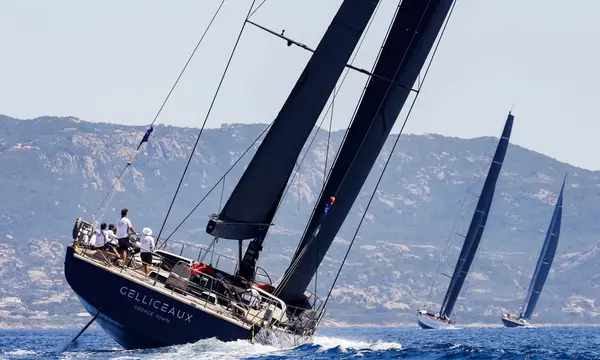
The hero photograph here was distributed by Southern Wind in the March 2026 KALANTIS correspondence. It depicts the actual sailing yacht, not a generic SW108 render or the earlier GELLICEAUX. The original image address and checksum are stored alongside the email identifier. That provenance helps keep her media record accurate as more photographs appear from races and show appearances.
KALANTIS now has an individual Superyacht Guide fleet entry. It records the 2025 launch, 2026 delivery, hull identity and official source image, with separate references for her public premiere and first race results. The builder's statements about engineering are presented as shipyard specifications, not as independent performance trials.
KALANTIS demonstrates the benefit of a flexible platform when a client has unusually strong ambitions for both racing and passage-making. The yard and its design partners could modify the configuration around those goals while retaining much of the development work behind the SW108 series. Her subsequent voyage to the Mediterranean and third-place finish in Porto Cervo give the design a practical context.
For the reader, the enduring story is more useful than a second retelling of the same launch. It follows the specific yacht from the end of construction toward her early use at sea, without confusing her with sisterships or guessing about the owner's private arrangements. The original March 2026 announcement deserves to remain available as the beginning of that verified operational chronology.
Original sources and photo provenance: Original Southern Wind email 641, dated 12 March 2026, along with follow-up final regatta email 2230, dated 1 June 2026. Official KALANTIS Cape Town–Palma shipyard release and builder's Palma show information. Hero photograph © Southern Wind Shipyard, retrieved from the original March press email, verified source image SHA-256.
Explore
Go deeper into the yachts, companies, events and destinations directly connected to this article.
Continue reading

Southern Wind reports Marco Alberti’s Lighthouse Legend recognition at the 2026 South African boatbuilding awards, honouring his long industry career.
The 32.87-metre Southern Wind sailing superyacht Kiboko 4 has earned the 2026 International Superyacht Society Best in Sail 24–40m award, recognising a yacht built …
Southern Wind reports seven yachts in the 20-boat Ibiza JoySail fleet, with Gelliceaux second, Kalantis third and Fortissimo making her regatta debut.
Southern Wind Rendezvous 2026 results from Porto Cervo: SW96 LIBERTY wins ahead of the SW108 sisterships GELLICEAUX and KALANTIS, with four days of racing.
Superyacht Guide
Continue into the wider Superyacht Guide.
Business opportunities · Superyacht Guide
Companies serving the superyacht market can discuss clearly identified advertising, sponsorship and business-profile opportunities. Commercial activity remains separate from independent editorial coverage.