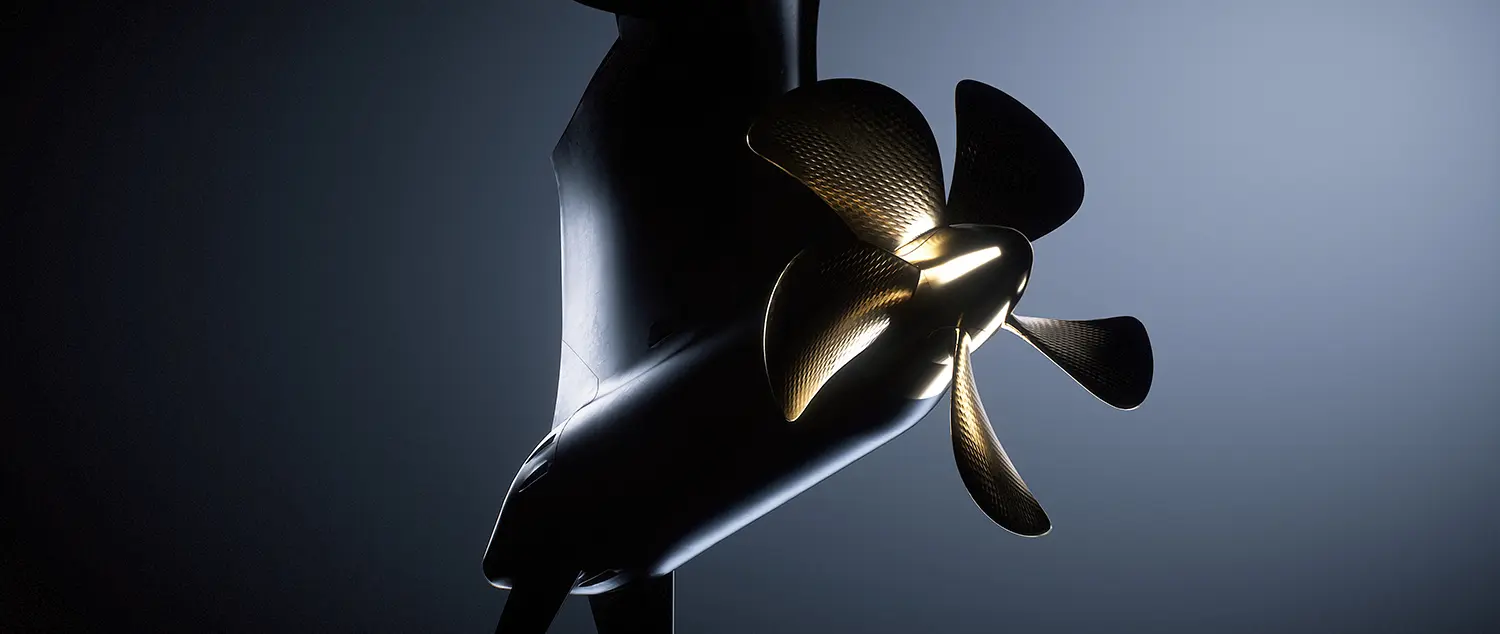
Kongsberg Expands Elegance Pod Propulsion Range to 22 MW
By Stephen Yardley · Edited by Stephen Yardley
Image: Kongsberg Maritime
Kongsberg Maritime is extending its Elegance Pod electric propulsion family with five larger sizes delivering up to 22 MW for high-power vessel applications.
Kongsberg Maritime is extending its Elegance Pod propulsion family with five larger sizes capable of delivering up to 22 MW. The expansion moves the permanent-magnet electric pod platform into a substantially higher power range and is aimed initially at the largest cruise vessels, while the underlying technology is also applicable to super and megayacht projects.
The new high-voltage units build on the existing Elegance platform, combining direct electric drive, hydrodynamic optimisation and low-noise operation. Kongsberg says the architecture is intended to support conventional, hybrid and fully electric vessel configurations, giving designers more flexibility as shipboard power systems evolve.
Elegance Pods place a permanent-magnet electric motor directly in the pod, removing the need for a conventional mechanical propulsion train between an inboard motor and propeller. Kongsberg offers low-voltage versions up to 7.5 MW and is now extending the high-voltage family to a maximum of 22 MW.
The system uses hydrodynamic work developed through Kongsberg's research facilities and includes its Twin-Tail technology. The manufacturer identifies propulsion efficiency, precise manoeuvrability, reduced onboard footprint and low noise as core advantages, all of which are significant design considerations on large yachts where machinery space and acoustic comfort carry a premium.
Although Kongsberg announced the expanded range in the context of large cruise vessels, its own application material specifically includes super and mega yachts. High-power electric pods can become particularly relevant as yacht projects adopt integrated electrical architectures in which generators, batteries and other energy sources feed a common distribution system rather than being tied directly to conventional shaft lines.
That approach can give naval architects greater freedom over machinery placement and redundancy, although the optimum solution depends heavily on hull form, speed profile and operating requirements. Podded propulsion also introduces its own engineering considerations, including underwater maintenance, structural integration, electrical conversion equipment and the need to manage efficiency across the yacht's real operating profile.
Kongsberg says the enlarged Elegance range is being developed for both present and future vessel architectures, including hybrid and fully electric propulsion. The high-voltage units are supplied with a diode front-end drive and transformer connected to an AC distribution system, while the lower-voltage range can integrate with DC or AC arrangements.
For superyachts, this flexibility matters because hybridisation is not a single configuration. Batteries may be used for peak shaving, spinning reserve, silent periods or propulsion assistance, while generator sets may remain the principal energy source on long passages. A propulsion platform that can sit within different electrical topologies gives designers more scope to optimise the complete energy system.
Low underwater radiated noise and reduced vibration are increasingly important alongside fuel consumption. Kongsberg says the pod design is intended to improve cavitation performance and onboard comfort, while condition monitoring and extended service intervals form part of the lifecycle proposition.
The expansion to 22 MW does not mean every large yacht will need such power, but it widens the available engineering envelope for the very largest projects. As superyacht propulsion moves toward integrated power generation, energy storage and electric drive, developments originating in cruise and commercial shipping are likely to have increasing influence on future yacht machinery specifications.
Explore
Go deeper into the yachts, companies, events and destinations directly connected to this article.
Continue reading
Scania is showcasing its 13-litre marine engine built on the Scania Super platform alongside hybrid systems and industrial battery technology.
Volvo Penta is showcasing the D13-IPS1350H at Cannes, combining its most powerful IPS engine with an integrated hybrid propulsion architecture.

Lloyd’s Register says nuclear propulsion for superyachts now warrants serious safety and regulatory work, while major technical and societal barriers remain.
SCHOTTEL’s new PropControl 4 platform combines propulsion controls, telemetry, cybersecurity and remote service for thrusters and controllable-pitch propellers.
Superyacht Guide
Continue into the wider Superyacht Guide.